
HSE-110 · Lesson 4 of 12 · 25 min
Bleeding and shock
Severe bleeding is one of the few injuries where a bystander's actions in the first few minutes decide whether a person lives or dies. An adult has roughly 5 litres of blood, and losing more than about a fifth of it quickly can be fatal. Bleeding from a large artery in the thigh or arm can cause that loss in a few minutes. Workplace injuries from saws, presses, glass, knives, power tools, vehicle crashes and falls onto sharp objects can all cause life-threatening bleeding. This lesson explains how to recognize severe bleeding, how direct pressure, wound packing and tourniquets work, and how to recognize and care for shock.
Bleeding control has become a public health priority in both Canada and the US. Programs such as Stop the Bleed, which began in the US after mass-casualty events, teach the public three actions: apply firm pressure, pack deep wounds and use a tourniquet for life-threatening limb bleeding. Many workplaces now include bleeding control kits with tourniquets and hemostatic dressings near AEDs, especially where hazard assessments identify a risk of serious lacerations or amputations.
Types of bleeding
Bleeding is often described by the type of blood vessel involved. Arterial bleeding comes from arteries carrying blood away from the heart under pressure; it is bright red and may spurt or pulse with the heartbeat. Venous bleeding comes from veins returning blood to the heart; it is darker red and flows steadily, and from a large vein it can be just as dangerous. Capillary bleeding comes from tiny vessels in grazes and minor cuts; it oozes and usually stops on its own. In practice, a first aider does not need to decide the type: what matters is whether bleeding is life-threatening.
Signs of life-threatening bleeding include blood that is spurting or flowing continuously, blood pooling on the ground, clothing or bandages soaked with blood, bleeding that does not stop with pressure, a partial or complete amputation, and a casualty who is becoming confused, pale or unresponsive. Internal bleeding, inside the chest, abdomen or pelvis or around a broken thigh bone, cannot be seen and cannot be controlled by a first aider; the signs are those of shock, described later in this lesson.
Protect yourself
Wear disposable gloves whenever you can, and eye protection if blood may splash. If gloves are not available, use a barrier such as a plastic bag or several layers of cloth, or have the casualty press on their own wound if they can. Do not let the lack of gloves delay care for life-threatening bleeding: the risk of infection from a single exposure to intact skin is very low. Wash your hands thoroughly afterwards and report any exposure of broken skin, eyes or mouth to blood, as Lesson 5 explains.
Direct pressure
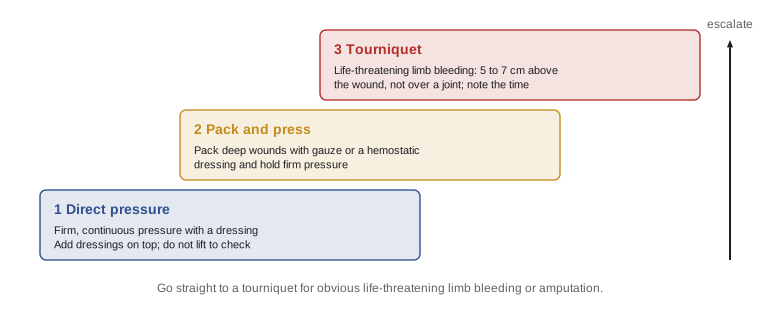
Direct pressure is the first and most effective way to control most external bleeding. Expose the wound so you can see where the blood is coming from, cutting away clothing if needed. Place a clean dressing or cloth directly on the wound and press firmly with the heel of your hand or both hands, using your body weight. Press hard and keep pressing without lifting to check: lifting the pad lets clots break away. If blood soaks through, do not remove the first dressing; add more on top and press harder, or re-position your pressure if it is not on the bleeding point. Once bleeding is controlled, secure the dressing with a firm bandage and check that the fingers or toes beyond the bandage stay warm and pink.
Raising the injured limb was once taught as a routine step, but current guidelines no longer recommend relying on elevation, because there is little evidence that it helps and it can distract from firm pressure or worsen other injuries. Indirect pressure at pressure points is no longer taught for the same reason.
Wound packing and hemostatic dressings
For a deep wound in a junctional area where a tourniquet cannot be used, such as the groin, armpit or neck, or for a deep wound in a limb while a tourniquet is being prepared, the wound can be packed. Packing means pushing gauze, ideally a hemostatic dressing impregnated with an agent that helps blood clot, firmly into the wound cavity until it is filled, then holding firm pressure on top for several minutes. It is uncomfortable for the casualty but effective. Certified first aid and bleeding control courses teach the technique on training models. Do not pack wounds of the chest or abdomen; cover them and apply pressure around them.
Tourniquets
A tourniquet is a band tightened around a limb to stop all blood flow beyond it. Once taught only as a last resort, tourniquets are now recommended by first aid guidelines for life-threatening bleeding from an arm or leg that cannot be controlled by direct pressure, or when direct pressure is not possible, for example with multiple casualties, an amputation or a casualty who is trapped. Military and civilian experience shows that a correctly applied commercial tourniquet saves lives and rarely causes lasting harm when it is removed in hospital within a few hours.
Commercial tourniquets with a windlass, a rod that is twisted to tighten the band, are more reliable than improvised ones. The general principles are: place the tourniquet high and tight on the limb, about 5 to 7 cm above the wound and not over a joint; tighten until the bleeding stops completely, which will be painful; lock the windlass; and record the time of application, often written on the tourniquet tag or on the casualty's forehead. If bleeding continues, a second tourniquet can be placed above the first. Never loosen or remove a tourniquet once applied; that is done in hospital. Improvised tourniquets made from a cravat or belt and a stick can work but often fail; narrow cords or wire should never be used.
Worked problem
Documenting tourniquet time
A worker's forearm is badly cut by a band saw. Direct pressure fails, and a co-worker applies a commercial tourniquet at 14:37. The ambulance arrives at 14:51, and the casualty reaches hospital at 15:24. How long has the tourniquet been on at handover to paramedics and at arrival in hospital, and why does this matter?
Show solution
- At handover: \(14{:}51 - 14{:}37 = 14\) minutes.
- At hospital: from 14:37 to 15:24 is \(23 + 24 = 47\) minutes.
- Record the time on the tourniquet tag and tell paramedics: "Tourniquet on at 14:37."
- The time matters because surgeons plan treatment knowing how long the limb has been without blood flow; a tourniquet left on for many hours increases the risk of damage to muscles and nerves.
Answer: The tourniquet has been on for 14 minutes at handover and 47 minutes on arrival in hospital. The application time, 14:37, must be recorded and reported.
Amputations and embedded objects
If a body part is amputated, control the bleeding first, using a tourniquet if needed. Then, if you can do so without delaying care, recover the part. Wrap it in a clean, moist gauze or cloth, place it in a sealed plastic bag and put the bag on ice or in cold water. Do not put the part directly on ice or in water, as that damages the tissue. Label the bag with the casualty's name and the time, and send it with the casualty. Surgeons can sometimes reattach fingers and limbs if the part is handled correctly.
If an object such as a nail, glass shard or piece of metal is embedded in a wound, do not remove it: it may be plugging a damaged vessel. Apply pressure around the object, build up padding on either side to stop it moving, and bandage around it. Remove an object only if it blocks the airway or prevents CPR.
Nosebleeds
Nosebleeds are common at work, especially in dry, cold weather or after a knock to the face. Have the person sit upright and lean forward, not back, so that blood does not run down the throat and cause vomiting. Ask them to pinch the soft part of the nose just below the bony bridge firmly for at least 10 to 15 minutes without letting go to check, and to breathe through the mouth. Seek medical help if bleeding continues beyond about 20 minutes, if it follows a significant blow to the head or if the person takes blood thinners.
Shock
In first aid, shock does not mean an emotional upset. It means a life-threatening condition in which the circulation fails to deliver enough oxygen-rich blood to the body's organs. The commonest cause after injury is blood loss, external or internal, but shock can also follow severe burns (loss of fluid), severe allergic reactions (anaphylaxis), serious infections, spinal cord injury and heart problems. The body tries to compensate by speeding up the heart and breathing and diverting blood from the skin to vital organs, which is why the early signs appear in the skin and pulse. When compensation fails, the person collapses.
| Early signs of shock | Later signs of shock |
|---|---|
| Anxiety, restlessness | Confusion, drowsiness, unresponsiveness |
| Pale, cool, clammy skin | Grey or bluish lips and fingertips |
| Rapid pulse | Rapid, weak pulse that may be hard to feel |
| Rapid breathing | Rapid, shallow or gasping breathing |
| Thirst, nausea | Vomiting |
First aid for shock focuses on the cause and on supporting the person until help arrives. Call 9-1-1. Control any external bleeding. Help the person lie down on their back, which helps blood reach the brain; if they are more comfortable sitting because of breathing difficulty, let them sit. Current guidelines say raising the legs is no longer routinely recommended, though a person who has fainted from a simple faint may feel better with legs raised if there is no injury. Keep the person warm with a blanket under and over them, because people in shock lose heat quickly. Do not give food or drink. Reassure them, keep them still and monitor breathing and level of response. If they become unresponsive and stop breathing normally, start CPR.
After the bleeding is controlled
Once bleeding is under control, keep checking the dressing and the casualty. Bleeding can restart when a person moves, when blood pressure rises or when a bandage loosens. Keep the person lying still, reassure them and keep them warm. Note how much blood you think was lost, for example a pool about the size of a dinner plate or soaked clothing, because this helps paramedics judge the risk of shock. Clean up blood afterwards using the precautions in Lesson 5, and restock the bleeding control kit, including any tourniquet that was used.
Common mistakes
MistakeLifting the dressing to see whether the bleeding has stopped.
InsteadKeep firm, continuous pressure; add more dressings on top if blood soaks through.
MistakeWaiting until all else fails before using a tourniquet on obvious life-threatening limb bleeding.
InsteadApply a tourniquet early for life-threatening limb bleeding or amputation.
MistakeLoosening a tourniquet to let blood flow back.
InsteadLeave it in place and record the time; only hospital staff remove it.
MistakePulling out an embedded object.
InsteadStabilize it with padding and apply pressure around it.
MistakeTilting the head back for a nosebleed.
InsteadSit upright, lean forward and pinch the soft part of the nose for 10 to 15 minutes.
Summary and key terms
- Severe bleeding can kill in minutes; an adult has about 5 litres of blood.
- Life-threatening bleeding is spurting, continuous, pooling or soaking, or comes from an amputation.
- Firm, continuous direct pressure controls most external bleeding; add dressings on top rather than removing them.
- Deep junctional wounds can be packed with gauze or a hemostatic dressing and held with pressure.
- Use a tourniquet early for life-threatening limb bleeding: 5 to 7 cm above the wound, tight enough to stop bleeding, and record the time.
- Wrap amputated parts in moist gauze, bag them and keep the bag cold, not in direct contact with ice.
- Shock is failure of the circulation; lay the person down, keep them warm, give nothing by mouth and call 9-1-1.
- Arterial bleeding
- Bright red bleeding that may spurt, from an artery under pressure.
- Venous bleeding
- Darker red, steadily flowing bleeding from a vein.
- Direct pressure
- Firm, continuous pressure on a wound with a dressing to stop bleeding.
- Wound packing
- Filling a deep wound cavity with gauze and holding pressure to control bleeding.
- Hemostatic dressing
- Gauze treated with an agent that speeds blood clotting.
- Tourniquet
- A band tightened around a limb to stop all blood flow to a bleeding wound.
- Windlass
- The rod on a commercial tourniquet that is twisted to tighten it.
- Junctional area
- Where a limb joins the body, such as the groin or armpit, where tourniquets cannot be used.
- Shock
- Failure of the circulation to supply enough oxygen to the organs.
- Internal bleeding
- Bleeding inside the body that cannot be seen or controlled by first aid.
Practice problems
Work each problem on paper first, then reveal the answer to check.
About how much blood does an adult have?
Show answer
About 5 litres.
What is the first step for most external bleeding?
Show answer
Firm, continuous direct pressure with a dressing.
Blood soaks through the dressing. What do you do?
Show answer
Leave it, add more dressings on top and press harder, checking that pressure is on the bleeding point.
Where should a tourniquet be placed?
Show answer
About 5 to 7 cm above the wound, not over a joint.
What must be recorded when a tourniquet is applied?
Show answer
The time of application.
How should an amputated finger be kept?
Show answer
Wrapped in moist gauze, sealed in a bag and placed on ice or in cold water, not in direct contact.
What should you do with an embedded object?
Show answer
Leave it in place, pad around it and apply pressure around it.
How long should a person pinch their nose for a nosebleed?
Show answer
At least 10 to 15 minutes without letting go.
Give three early signs of shock.
Show answer
Anxiety, pale cool clammy skin, rapid pulse (also rapid breathing, thirst).
Why keep a person in shock warm?
Show answer
They lose heat quickly, and cold worsens shock.
Lesson quiz · 5 questions
Score 60% or more to complete this lesson.
Create a free account to save your progress, take quizzes and earn a certificate.