
HSE-110 · Lesson 7 of 12 · 25 min
Bone, joint and muscle injuries
Falls, slips, being struck by objects, crush injuries and overexertion cause many workplace injuries to bones, joints and muscles. They range from a pulled muscle after lifting a box to a broken thigh bone after a fall from a ladder. A first aider cannot see inside the body and does not need to decide exactly which tissue is injured. The approach is the same for most of these injuries: assess, support the injured part in the position found, limit movement, control pain and swelling with cold, check the circulation beyond the injury and get the person to medical care when needed. This lesson explains the main types of injury, how to recognize them and what care to give.
Types of injury
- Fracture: a break or crack in a bone. A closed fracture has no wound over it. An open fracture has a wound, and the bone may be visible; it carries a high risk of infection and bleeding.
- Dislocation: the bones at a joint are forced out of their normal position, often at the shoulder, finger, elbow or kneecap. The joint looks deformed and cannot move normally.
- Sprain: the ligaments that hold a joint together are stretched or torn, commonly at the ankle, knee, wrist or thumb.
- Strain: a muscle or tendon is stretched or torn, commonly in the back, hamstring or calf.
- Contusion: a bruise, where small blood vessels in the soft tissue are damaged.
It is often impossible to tell a fracture from a bad sprain without an X-ray. If you are not sure, treat the injury as a fracture.
Recognizing a serious injury
Signs and symptoms that suggest a fracture or dislocation include: the person heard or felt a snap; deformity, such as a limb bent at an odd angle or shorter than the other side; swelling and bruising; severe pain that gets worse with movement; inability to move or bear weight on the part; a grating feeling; and a wound with bone visible. Compare the injured side with the uninjured side. Numbness, tingling, coldness or a pale or bluish colour beyond the injury suggest that nerves or blood vessels are affected, which is urgent.
Some fractures are especially dangerous because of the bleeding and organ damage they can cause. Fractures of the thigh bone (femur) can cause the loss of a litre or more of blood into the thigh. Fractures of the pelvis can cause severe internal bleeding. Rib fractures can injure the lungs. These injuries, and any open fracture, need emergency services. A casualty who has fallen from height, been hit by a vehicle or been crushed should be treated as having serious and possibly spinal injuries (Lesson 8).
First aid for suspected fractures and dislocations
- Check the scene and do a primary assessment; deal with breathing problems and severe bleeding first.
- Tell the person to keep still and support the injured part in the position you found it, using your hands, rolled blankets or clothing. Do not try to straighten a deformed limb or push a dislocated joint back into place.
- For an open fracture, control bleeding by pressing around the wound, not on the protruding bone, and cover the wound with a sterile dressing.
- Check circulation, sensation and movement beyond the injury: is the skin warm and normal in colour, can the person feel your touch, and can they wiggle their fingers or toes? Compare with the other side and recheck often.
- Apply a cold pack wrapped in a cloth to reduce pain and swelling, if it does not cause more pain.
- Call 9-1-1 for open fractures, suspected fractures of the thigh, pelvis, hip, neck or back, injuries with loss of circulation or sensation, or any injury where the person cannot be moved without pain. For a minor fracture, such as a finger or wrist with good circulation, arrange transport to medical care.
- Watch for shock and keep the person warm.
Immobilization and splinting
If emergency services will arrive soon, the best support is usually the person holding still while you support the part by hand or with padding. If the person must be moved, or help is far away, the injured part can be immobilized with a sling or splint. A splint is anything rigid or soft that holds the injured part still, such as a commercial splint, a rolled magazine, a padded board, a folded blanket or the uninjured leg. The general rules taught in certified training are: splint in the position found; immobilize the joints above and below a fractured bone, or the bones above and below an injured joint; pad well, especially at bony points; secure firmly but not tightly; and check circulation before and after splinting. Loosen the ties if fingers or toes become cold, pale, blue, numb or tingly.
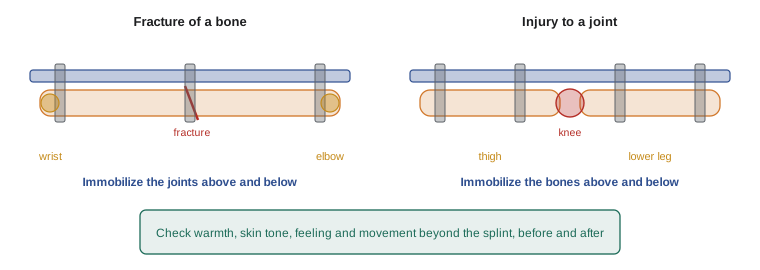
Arm and shoulder injuries are often supported with a sling made from a triangular bandage, holding the forearm across the chest. A person with a collarbone injury usually prefers to support the arm themselves against the body. Leg injuries are more difficult and usually wait for paramedics, who carry traction and vacuum splints.
Sprains, strains and bruises
For soft-tissue injuries such as sprains, strains and bruises, the traditional memory aid is RICE: rest, ice, compression and elevation. Current guidance keeps the core of this advice but emphasizes cold and protection in the first hours and gentle return to movement after that. Many programs teach:
- Rest and protect the injured part; stop the activity that caused it.
- Apply cold, such as a cold pack or ice in a plastic bag with a cloth between it and the skin, for about 20 minutes at a time, then remove it for at least the same time before repeating. Cold reduces pain and swelling. Never apply ice directly to the skin, and use cold with care in people with poor circulation or diabetes.
- A compression bandage may help reduce swelling, but it must not be so tight that it affects circulation; many first aid programs now leave compression to health care providers.
- Raising the injured limb, if it does not cause pain, may help reduce swelling.
Advise the person to see a health care provider if they cannot bear weight, if pain and swelling are severe, if there is deformity or numbness, or if the injury does not start to improve within a few days.
Worked problem
Planning cold therapy
A warehouse worker sprains an ankle at 09:00. They are sent home with advice to apply cold for 20 minutes, then leave it off for at least 40 minutes, repeating while awake for the first day. If they apply cold for the first time at 09:15, how many cold applications can they complete by 13:00, and when does each start?
Show solution
- Each cycle is \(20 + 40 = 60\) minutes long.
- Start times: 09:15, 10:15, 11:15 and 12:15.
- The fourth application runs from 12:15 to 12:35, before 13:00; a fifth would start at 13:15.
- So 4 applications are completed by 13:00.
Answer: Four applications, starting at 09:15, 10:15, 11:15 and 12:15, each for 20 minutes with at least 40 minutes off between them.
Muscle cramps
Cramps are sudden, painful, involuntary muscle contractions, often in the calf, thigh or hand, and often linked to heavy exertion, heat and dehydration. Help the person stop the activity, gently stretch and massage the muscle, and rest. If heat is involved, move them to a cool place and give water or an electrolyte drink if they are alert and not nauseated. Lesson 11 covers heat cramps and other heat illnesses.
Back injuries from lifting
Acute back pain after lifting is common and usually a muscle or ligament strain that improves within days to weeks. Help the person into a comfortable position, apply cold and advise them to see a health care provider if pain is severe. Call 9-1-1 if back pain follows a fall or blow, or comes with numbness or weakness in the legs, or loss of bladder or bowel control, which can signal nerve compression. Report back injuries promptly so the task can be reviewed; HSE-107 covers prevention.
Crush injuries
Crush injuries happen when part of the body is trapped under a heavy object or between machine parts, for example under a fallen load, in a press, or between a vehicle and a wall. As well as fractures and bleeding, prolonged crushing damages muscle, which releases substances into the blood when the pressure is removed. After long entrapment, often more than about 15 minutes for a large muscle mass such as a thigh, this can cause dangerous heart rhythms and kidney failure, a condition called crush syndrome.
First aid: make the scene safe and call 9-1-1 early, explaining that a person is trapped and for how long. If the object can be removed quickly and safely, current first aid guidance is generally to release the person as soon as possible, then treat bleeding and fractures, keep them still and warm and monitor them closely. Do not try to lift heavy loads without proper equipment; that is the job of trained rescuers. Note the time the crushing started and the time of release for paramedics. A tourniquet may be needed for severe limb bleeding once the person is released.
| Feature | Suggests a sprain or strain | Suggests a fracture or dislocation |
|---|---|---|
| Cause | Twisting, overstretching, lifting | Fall, direct blow, crushing |
| Sound at time of injury | Sometimes a pop | Snap or crack |
| Shape | Swollen but normal shape | Deformity, shortening, abnormal angle |
| Use | Painful but some use possible | Unable to use or bear weight |
| Circulation and feeling | Usually normal | May be reduced beyond the injury |
Whatever the injury, record what happened and the care given. Musculoskeletal injuries are among the most frequent causes of lost time at work, and a pattern of strains at the same task, or falls in the same area, is a signal to review the work design, as HSE-106 and HSE-107 explain.
Moving an injured person should be avoided unless they are in danger. If a casualty with a lower limb injury must be moved a short distance, for example out of traffic, support the injured limb, use as many helpers as needed and move slowly. Never ask a person with a suspected leg fracture to walk on it.
Common mistakes
MistakeTrying to straighten a deformed limb or pop a dislocated joint back in.
InsteadSupport the part in the position found and let health care providers reduce it.
MistakeSplinting only the broken bone.
InsteadImmobilize the joints above and below a fracture, or the bones above and below a joint injury.
MistakeTying a splint so tightly that fingers turn pale and numb.
InsteadSecure firmly but not tightly and check circulation before and after.
MistakeApplying ice directly to the skin for an hour.
InsteadWrap cold packs in a cloth and apply for about 20 minutes at a time.
MistakeAssuming a person who can move a limb has no fracture.
InsteadIf you are unsure, treat the injury as a fracture.
Summary and key terms
- Bone, joint and muscle injuries include fractures, dislocations, sprains, strains and bruises.
- A fracture cannot be ruled out without an X-ray; when unsure, treat as a fracture.
- Signs include deformity, swelling, severe pain, inability to move or bear weight and a snap at the time of injury.
- Support the part in the position found, do not straighten it, and check circulation, sensation and movement beyond the injury.
- Call 9-1-1 for open fractures, thigh, pelvis, hip, neck or back injuries and loss of circulation.
- Splint in the position found, immobilizing above and below, and recheck circulation after splinting.
- Treat soft-tissue injuries with rest, protection and cold for about 20 minutes at a time, with a cloth between ice and skin.
- Fracture
- A break or crack in a bone.
- Open fracture
- A fracture with a wound over it, sometimes with the bone visible.
- Dislocation
- Displacement of the bones at a joint from their normal position.
- Sprain
- Stretching or tearing of the ligaments at a joint.
- Strain
- Stretching or tearing of a muscle or tendon.
- Contusion
- A bruise caused by damage to small blood vessels in soft tissue.
- Splint
- A device that holds an injured part still.
- Sling
- A bandage that supports the forearm and shoulder.
- Circulation, sensation and movement
- Checks of warmth and colour, feeling and movement beyond an injury.
- RICE
- Rest, ice, compression and elevation; a traditional memory aid for soft-tissue injuries.
Practice problems
Work each problem on paper first, then reveal the answer to check.
What is the difference between a sprain and a strain?
Show answer
A sprain injures ligaments at a joint; a strain injures a muscle or tendon.
Name four signs that suggest a fracture.
Show answer
Deformity, swelling, severe pain, inability to bear weight (also a snap, grating, visible bone).
Why are thigh bone fractures dangerous?
Show answer
They can cause a large blood loss into the thigh and shock.
What should you do with a dislocated finger?
Show answer
Support it in the position found, apply cold and send the person for medical care; do not try to put it back.
What must you check before and after splinting?
Show answer
Circulation, sensation and movement beyond the injury.
Which joints should a forearm splint immobilize?
Show answer
The wrist and the elbow.
How long should cold be applied at a time?
Show answer
About 20 minutes, with a cloth between the cold pack and the skin.
For an open fracture, where should you press to control bleeding?
Show answer
Around the wound, not on the protruding bone.
What signs with back pain need 9-1-1?
Show answer
Pain after a fall or blow, numbness or weakness in the legs, or loss of bladder or bowel control.
When unsure whether an injury is a fracture, what should you do?
Show answer
Treat it as a fracture.
Lesson quiz · 5 questions
Score 60% or more to complete this lesson.
Create a free account to save your progress, take quizzes and earn a certificate.