
HSE-110 · Lesson 9 of 12 · 25 min
Breathing emergencies, choking and asthma
Breathing brings oxygen into the body, and the brain begins to suffer within minutes without it. Breathing emergencies can come from a blocked airway, as in choking; from narrowed airways, as in asthma and severe allergic reactions; from toxic or oxygen-poor air, as in confined spaces; from injuries to the chest; or from conditions that slow breathing, such as an opioid overdose. This lesson covers how to recognize breathing difficulty, how to respond to choking in adults, children and infants at an awareness level, how to help a person with asthma use their own medication, and how to approach breathing problems caused by hazardous atmospheres.
Recognizing breathing difficulty
A person in respiratory distress is working hard to breathe. Signs include breathing that is very fast or very slow, noisy breathing such as wheezing, gurgling, high-pitched sounds or snoring, using the neck and shoulder muscles to breathe, sitting upright and leaning forward to breathe, speaking in only a few words at a time, anxiety, and pale, grey or bluish skin, especially around the lips and fingertips. A person who is becoming drowsy or confused while struggling to breathe is tiring and may stop breathing; this is an emergency.
General first aid for breathing difficulty is to call 9-1-1 for anything more than mild, short-lived difficulty, help the person into the position they find easiest, usually sitting upright and leaning slightly forward, loosen tight clothing, remove them from any irritant or toxic atmosphere if it is safe to do so, help them use their own prescribed medication, reassure them, and monitor breathing and level of response. If they become unresponsive and stop breathing normally, start CPR.
Choking
Choking happens when food or an object blocks the airway. It is common during meals and breaks, and in people who are eating quickly, talking or laughing while eating, have been drinking alcohol, or have swallowing difficulties. Choking can be mild or severe:
- Mild airway obstruction: the person can cough forcefully, speak or cry, and breathe. Encourage them to keep coughing, which is the most effective way to clear the airway. Stay with them and be ready to act if it becomes severe. Do not slap their back while they are coughing effectively.
- Severe airway obstruction: the person cannot cough effectively, speak or breathe, may make high-pitched noises or none at all, and often clutches the throat, the universal sign of choking. Their skin may turn bluish. Without help, they will become unresponsive within minutes.
For a responsive adult or child over one year old with severe choking, the 2025 American Heart Association and Red Cross guidelines, and Canadian programs following international consensus, teach giving back blows and abdominal thrusts. The AHA now teaches alternating 5 back blows between the shoulder blades with 5 abdominal thrusts (the Heimlich manoeuvre) until the object comes out or the person becomes unresponsive. Some Canadian programs teach a similar combination and also include chest thrusts. For a person who is pregnant or too large to reach around, chest thrusts replace abdominal thrusts. Ask someone to call 9-1-1 as soon as you recognize severe choking.
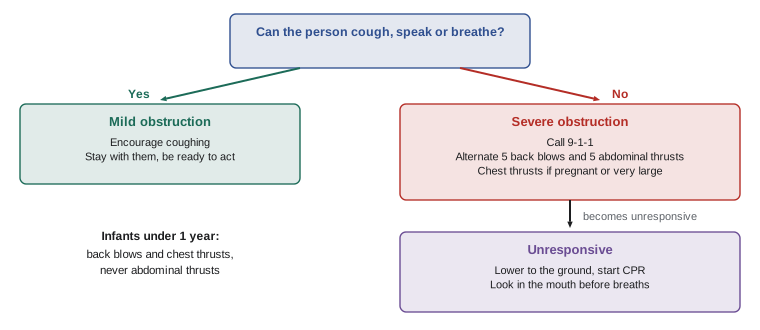
If the person becomes unresponsive, lower them carefully to the ground, make sure 9-1-1 has been called and start CPR, beginning with chest compressions, which can also dislodge the object. Each time you open the airway to give breaths, look in the mouth and remove any object you can see. Do not do blind finger sweeps. HSE-111 and certified CPR training cover this in detail.
For a choking infant under one year, the technique is different: the infant is supported face down along the rescuer's forearm with the head lower than the body, and the rescuer alternates 5 back blows with 5 chest thrusts using two fingers or the heel of one hand on the breastbone. Abdominal thrusts are not used on infants. Workplaces with child care, schools and health care settings need staff trained in infant and child first aid.
Anyone who has received abdominal thrusts should be checked by a health care provider afterwards, even if they feel well, because the thrusts can cause internal injury.
A person who is alone and choking can try to give themselves abdominal thrusts with a fist, or by pushing the upper abdomen hard against the back of a chair or a counter edge, and should call 9-1-1 if they can.
Asthma
Asthma is a long-term condition in which the airways become inflamed and narrow in response to triggers such as allergens, cold air, exercise, respiratory infections, smoke, strong smells and some workplace dusts and chemicals. Occupational asthma, caused or worsened by substances at work such as flour dust, isocyanates in spray paints, wood dust, latex and cleaning chemicals, is one of the commonest occupational lung diseases. During an asthma attack the person may wheeze, cough, feel tightness in the chest and struggle to breathe out.
Many people with asthma carry a reliever inhaler, usually blue, which opens the airways within minutes. First aid is to help the person sit upright and leaning slightly forward, stay calm and use their own reliever inhaler, with a spacer if they have one, as directed by their asthma action plan or the instructions on the label. You may help them get the inhaler, shake it, attach the spacer and hold it, but they should use their own prescribed medication. Remove them from the trigger if possible.
Call 9-1-1 if the person has no inhaler, if the inhaler does not help within a few minutes, if they cannot speak in full sentences, if their lips are turning blue, if they become drowsy or confused, or if this is their first known attack. Keep helping them use the reliever as their action plan directs while you wait. Severe asthma attacks can be fatal.
| Asthma attack | Mild to moderate | Severe: call 9-1-1 |
|---|---|---|
| Speech | Speaks in sentences or phrases | Can say only a few words or nothing |
| Breathing | Wheeze, cough, some shortness of breath | Very strained, may become quiet as airflow falls |
| Colour | Normal | Pale, grey or blue lips |
| Response to reliever | Improves within minutes | Little or no improvement |
| Alertness | Alert, may be anxious | Drowsy, confused or exhausted |
Hyperventilation and panic
Some people breathe very fast during anxiety or panic, which can cause tingling in the hands and around the mouth, dizziness and a feeling of not getting enough air. Reassure the person, move them to a quiet place and encourage slow breathing. Do not have them breathe into a paper bag, which can be dangerous if the cause is actually a medical problem such as asthma, a heart attack or low oxygen. If you are not sure that the cause is anxiety, or symptoms do not settle quickly, call for medical help.
Hazardous atmospheres
Some workplaces contain gases that can overcome workers quickly: hydrogen sulphide in sewers, oil and gas facilities and pulp mills; carbon monoxide from engines and heaters running indoors; and oxygen-deficient air in tanks and pits where oxygen has been displaced by nitrogen, argon or carbon dioxide or consumed by rusting. Workers who collapse in such places must be rescued only by trained people with atmospheric testing and supplied-air breathing apparatus. Once a casualty is in fresh air, check breathing, start CPR if needed, and call 9-1-1, telling the dispatcher the likely gas. Paramedics may give oxygen; first aid oxygen is used only by people trained and authorized to use it.
Worked problem
Why rescuers must not enter
Hydrogen sulphide (H2S) can cause loss of consciousness within a few breaths at around 500 to 1,000 ppm and is immediately dangerous to life and health at 100 ppm. A gas detector at the opening of a lift station reads 60 ppm, and readings near the bottom, where a worker has collapsed, are likely to be much higher because H2S is heavier than air. If the concentration at the bottom is 12 times the reading at the opening, what is it, and what does this mean for rescue?
Show solution
- Concentration at the bottom: \(60 \times 12 = 720\) ppm.
- Compare with the immediately dangerous level: \(720 \div 100 = 7.2\) times the 100 ppm level.
- 720 ppm is in the range that can cause collapse within a few breaths, so an unprotected rescuer would collapse too.
- Action: do not enter; call 9-1-1 and trained rescuers, ventilate if the procedure allows and only trained rescuers with supplied air and retrieval equipment should enter.
Answer: About 720 ppm, more than seven times the level immediately dangerous to life and health. Any unprotected rescuer would likely collapse; only trained rescuers with breathing apparatus may enter.
Chest injuries
Blows to the chest from falls, vehicle collisions and falling objects can fracture ribs, bruise the lungs or cause a collapsed lung. Signs include pain that worsens with breathing or coughing, shallow breathing, guarding the chest, bruising, uneven chest movement and increasing breathlessness. Help the person into the position they find easiest, usually sitting up and leaning towards the injured side, and call 9-1-1 for any chest injury with breathing difficulty.
An open chest wound, from a stab or penetrating object, can let air into the chest. Current first aid guidance is to leave a penetrating chest wound open to the air, or cover it loosely with a dressing that is not sealed, rather than sealing it with an airtight dressing, because a sealed dressing can trap air and make breathing worse. Control bleeding with pressure around the wound, do not remove an embedded object, and call 9-1-1.
| Age group | Severe choking technique taught |
|---|---|
| Adult and child over 1 year | Alternate 5 back blows and 5 abdominal thrusts (AHA 2025); some programs also use chest thrusts |
| Pregnant or very large person | Back blows and chest thrusts |
| Infant under 1 year | Alternate 5 back blows and 5 chest thrusts, head lower than body |
| Any age, becomes unresponsive | Call 9-1-1, start CPR, look in the mouth before breaths |
Smoke inhalation can also cause breathing difficulty after a fire, even without visible burns. Move the person to fresh air if it is safe, call 9-1-1 and tell the dispatcher about the smoke exposure, because carbon monoxide and other toxic gases may be involved and symptoms can worsen over hours.
Common mistakes
MistakeSlapping the back of a person who is coughing forcefully.
InsteadEncourage effective coughing and stay with them; act only if they cannot cough, speak or breathe.
MistakeDoing blind finger sweeps in the mouth.
InsteadRemove an object only if you can see it.
MistakeGiving abdominal thrusts to an infant.
InsteadUse back blows and chest thrusts for infants under one year.
MistakeGiving a person your own or someone else's inhaler.
InsteadHelp the person use their own prescribed reliever; call 9-1-1 if they have none or it is not working.
MistakeHaving a person with rapid breathing breathe into a paper bag.
InsteadReassure them and encourage slow breathing; get medical help if unsure of the cause.
Summary and key terms
- Signs of breathing difficulty include noisy or fast breathing, few words per breath, use of neck muscles and bluish skin.
- Help the person sit upright, remove irritants, help with their own medication and call 9-1-1 for anything serious.
- Mild choking: encourage coughing. Severe choking: call 9-1-1 and alternate back blows and abdominal thrusts.
- Use chest thrusts for pregnant or very large people, and back blows with chest thrusts for infants.
- If a choking person becomes unresponsive, start CPR and remove only visible objects.
- Help a person with asthma use their own reliever inhaler; call 9-1-1 if it does not help or the attack is severe.
- Never enter a hazardous atmosphere to rescue a collapsed worker; call trained rescuers.
- Respiratory distress
- Difficult, strained breathing.
- Airway obstruction
- A partial or complete blockage of the airway.
- Universal choking sign
- Clutching the throat with one or both hands.
- Back blows
- Firm blows between the shoulder blades to dislodge an object.
- Abdominal thrusts
- Inward and upward thrusts above the navel to force air out and dislodge an object.
- Chest thrusts
- Thrusts on the breastbone used for infants, pregnant people and very large adults.
- Asthma
- A long-term condition in which the airways become inflamed and narrow in response to triggers.
- Reliever inhaler
- A prescribed inhaler, usually blue, that quickly opens narrowed airways.
- Occupational asthma
- Asthma caused or worsened by substances at work.
- IDLH
- Immediately dangerous to life or health: a concentration that can cause death or serious harm quickly.
Practice problems
Work each problem on paper first, then reveal the answer to check.
What is the best treatment for mild choking?
Show answer
Encourage the person to keep coughing and stay with them.
What is the universal choking sign?
Show answer
Clutching the throat with one or both hands.
What technique does the AHA now teach for severe choking in adults?
Show answer
Alternating 5 back blows with 5 abdominal thrusts.
What replaces abdominal thrusts for a pregnant person?
Show answer
Chest thrusts.
What should you do if a choking person becomes unresponsive?
Show answer
Lower them to the ground, make sure 9-1-1 is called and start CPR, removing only visible objects.
Why should a person who received abdominal thrusts see a health care provider?
Show answer
The thrusts can cause internal injury.
Name three workplace causes of occupational asthma.
Show answer
Flour dust, isocyanates and wood dust (also latex and cleaning chemicals).
When should you call 9-1-1 for asthma?
Show answer
If there is no inhaler, it does not help, the person cannot speak in sentences, lips turn blue or they become drowsy.
Why is a quiet chest in a struggling asthma patient worrying?
Show answer
It may mean very little air is moving.
A worker collapses in a pit. What must you not do?
Show answer
Enter without training, testing and breathing apparatus.
Lesson quiz · 5 questions
Score 60% or more to complete this lesson.
Create a free account to save your progress, take quizzes and earn a certificate.