
HSE-110 · Lesson 10 of 12 · 26 min
Medical emergencies: heart attack, stroke, diabetes, seizures, allergies and overdose
Not every first aid call at work involves an injury. Workers, visitors and customers can suddenly become ill: chest pain in a supervisor, slurred speech in a driver, confusion in a worker with diabetes, a seizure on the shop floor, a severe allergic reaction after a bee sting or a snack, a faint in a hot room, or an unresponsive person in a washroom after an opioid overdose. Each of these is time-sensitive, and the first aider's job is to recognize the problem, call for help early, help the person use their own medication where appropriate and keep them safe until help arrives. This lesson covers the most common medical emergencies.
Heart attack
A heart attack happens when blood flow to part of the heart muscle is blocked, usually by a clot in a narrowed coronary artery. Heart muscle starts to die within minutes, and the faster blood flow is restored in hospital, the more muscle is saved. A heart attack can also trigger cardiac arrest.
Signs and symptoms vary. The classic symptom is chest pain or discomfort, often described as pressure, squeezing, tightness or heaviness, lasting more than a few minutes or coming and going. Pain may spread to the arms, neck, jaw, back or stomach. Other signs include shortness of breath, sweating, nausea, light-headedness, and pale, grey skin. Women, older adults and people with diabetes are more likely to have less typical symptoms, such as unusual fatigue, shortness of breath, nausea or back or jaw pain without obvious chest pain. Many people deny that anything serious is happening.
First aid: call 9-1-1 immediately and ask for an AED to be brought. Help the person rest in a comfortable position, usually sitting up with knees bent, and loosen tight clothing. If the person has their own prescribed nitroglycerin, help them take it as they have been directed. The dispatcher may advise the person to chew aspirin if they are not allergic and have no reason to avoid it; follow the dispatcher's advice and workplace rules. Do not let the person walk around or drive themselves. Monitor them closely, and if they become unresponsive and stop breathing normally, start CPR and use the AED as soon as it arrives.
Stroke
A stroke happens when blood flow to part of the brain is blocked by a clot or interrupted by bleeding. Brain cells die rapidly; one estimate is that about 1.9 million brain cells are lost every minute a major stroke goes untreated. Treatments that dissolve or remove clots work only within a few hours of symptom onset, so recognizing a stroke and calling 9-1-1 immediately is critical. Recording the time the person was last known to be well helps hospitals decide on treatment.
Heart and Stroke Canada teaches the FAST signs: Face, is it drooping? Arms, can you raise both? Speech, is it slurred or jumbled? Time to call 9-1-1 right away. Some programs add B for balance (sudden loss of balance or dizziness) and E for eyes (sudden loss or blurring of vision), giving BE-FAST. Other signs include sudden severe headache, numbness or weakness on one side of the body, confusion and trouble understanding speech.
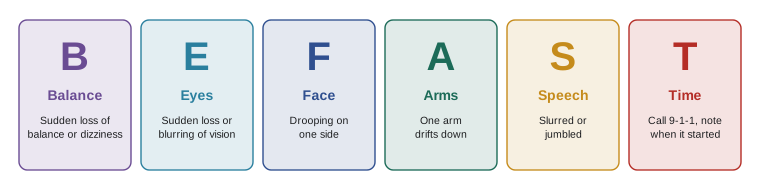
First aid: call 9-1-1 and tell the dispatcher you suspect a stroke. Note the time symptoms started, or the last time the person was seen well. Keep the person comfortable and still; if they are unresponsive and breathing, place them in the recovery position. Give nothing to eat or drink, because swallowing may be affected. Do not give aspirin for a suspected stroke, because some strokes are caused by bleeding. Reassure the person, who may understand you even if they cannot speak.
Worked problem
Recording the stroke time window
At 15:40 a co-worker finds a forklift operator sitting in the break room with a drooping face and slurred speech. He was last seen well at 15:05 when he spoke normally on the radio. Paramedics arrive at 15:52 and estimate a 25-minute drive to the stroke centre. How much time has passed since he was last known well when he arrives at hospital, and why does this matter?
Show solution
- Time from last known well to paramedic arrival: \(15{:}52 - 15{:}05 = 47\) minutes.
- Add about 5 minutes to load the patient and the 25-minute drive: arrival about 16:22.
- Time since last known well at arrival: \(16{:}22 - 15{:}05 = 77\) minutes, or about 1 hour 17 minutes.
- The hospital uses the last-known-well time, 15:05, not the time he was found, to decide whether clot-dissolving or clot-removal treatment is still possible.
Answer: About 77 minutes. Telling paramedics that he was last known well at 15:05 is essential, because treatment decisions depend on that time.
Diabetic emergencies
Diabetes affects how the body controls blood sugar (glucose). Many people with diabetes take insulin or other medicines that lower blood sugar. Two emergencies can occur:
- Low blood sugar (hypoglycemia) develops quickly, over minutes, often after missing a meal, extra physical work, or too much insulin. Signs include shakiness, sweating, pale skin, hunger, irritability, confusion, unusual behaviour that may look like drunkenness, and eventually seizures or unresponsiveness.
- High blood sugar (hyperglycemia) develops more slowly, over hours or days, with thirst, frequent urination, tiredness, a fruity smell on the breath and eventually confusion and unresponsiveness.
If a person with diabetes is confused or unwell and you are not sure which problem it is, treat it as low blood sugar, because low blood sugar is more immediately dangerous and a little sugar will not do significant harm to a person with high blood sugar. If the person is alert enough to swallow safely and follow instructions, give sugar by mouth: glucose tablets or gel are best, or regular fruit juice, regular (non-diet) pop or soda, or candy. A common guide is about 15 to 20 grams of sugar. Have them rest, and if they do not improve within about 15 minutes, give more sugar and call 9-1-1. Once they feel better, a snack or meal helps keep blood sugar up. Never put food or drink in the mouth of a person who cannot swallow safely or is unresponsive; place them in the recovery position and call 9-1-1.
Seizures
A seizure is a sudden burst of abnormal electrical activity in the brain. Epilepsy is the commonest cause, but seizures can also follow head injury, low blood sugar, stroke, heat stroke, drug or alcohol withdrawal and other conditions. In a generalized tonic-clonic seizure the person loses consciousness, stiffens, may cry out and fall, then jerks rhythmically, often for one to three minutes; they may bite their tongue or lose bladder control. Other seizures are subtle, with staring, confusion or repetitive movements.
First aid: stay calm and note the time the seizure started. Protect the person from injury by clearing hard or sharp objects away and cushioning the head. Do not restrain them and never put anything in their mouth. When the jerking stops, check breathing and place them in the recovery position. They may be confused and sleepy for some time; stay with them, reassure them and protect their privacy. Call 9-1-1 if it is a first seizure, if the seizure lasts more than 5 minutes or another follows without recovery, if the person is injured, pregnant or diabetic, if the seizure happened in water, or if breathing does not return to normal or they do not begin to recover within about 5 to 10 minutes.
Severe allergic reactions (anaphylaxis)
Anaphylaxis is a severe, rapidly developing allergic reaction that can be fatal within minutes. Common triggers include insect stings, foods such as peanuts, tree nuts, shellfish and sesame, medications and latex. Signs can include hives or flushing, swelling of the face, lips, tongue or throat, difficulty breathing or wheezing, a hoarse voice, vomiting, dizziness and collapse from low blood pressure.
Epinephrine (adrenaline) is the treatment, and it must be given early. Many people with known severe allergies carry an epinephrine auto-injector. If the person has one, help them use it, or use it for them if they cannot and you are trained and permitted to do so, following the instructions on the device: typically it is pressed firmly into the outer thigh, through clothing if necessary, and held for a few seconds. Call 9-1-1 immediately, even if symptoms improve, because symptoms can return. Help the person lie down with legs raised, or sit up if breathing is easier that way. If symptoms do not improve after about 5 to 15 minutes and a second auto-injector is available, it may be used as the device instructions and the person's action plan direct. Note the time of each use and give the used devices to paramedics.
Poisoning and overdose
Poisoning can happen by swallowing, breathing in, skin contact or injection. Check the scene for clues such as containers or a smell, protect yourself, and call the poison centre for your province or 9-1-1 if the person has signs of serious illness. Follow the advice given and send the product label or safety data sheet with the casualty. Do not make the person vomit unless a poison centre or doctor tells you to.
Opioid overdose has become a workplace issue as well as a public health crisis, with deaths in construction, trades and other industries. Signs include unresponsiveness or extreme drowsiness, slow, shallow or absent breathing, snoring or gurgling sounds, pinpoint pupils, and blue or grey lips and fingertips. Naloxone temporarily reverses the effects of opioids on breathing. Call 9-1-1, give naloxone if it is available and you are trained, following the instructions on the product, and support breathing; if the person is not breathing normally, start CPR. Naloxone wears off sooner than many opioids, so stay with the person and be ready to give another dose as the product instructions direct.
In Canada, nasal naloxone has been available without a prescription since 2016, and free naloxone kits are widely distributed through pharmacies and public health programs. Ontario's OHSA requires certain employers who are aware, or ought to be aware, of a risk of a worker opioid overdose to keep a naloxone kit and train workers to use it. The federal Good Samaritan Drug Overdose Act protects people who call 9-1-1 for an overdose from charges for simple possession.
Fainting
Fainting is a brief loss of consciousness caused by a temporary drop in blood flow to the brain, triggered by standing for long periods, heat, pain, fear or the sight of blood. Early signs include light-headedness, sweating, nausea and pale skin. If a person feels faint, help them sit or lie down; crossing the legs and tensing the muscles may help. A person who has fainted usually recovers within a minute once lying flat. Call 9-1-1 if they do not recover quickly, are injured, have chest pain, are pregnant or have fainted during exertion, which can signal a heart problem.
Common mistakes
MistakeWaiting to see whether chest pain goes away.
InsteadCall 9-1-1 immediately and send for an AED.
MistakeGiving aspirin to a person with suspected stroke.
InsteadGive nothing by mouth and note the time symptoms started.
MistakeGiving sugar to an unresponsive person with diabetes.
InsteadPlace them in the recovery position and call 9-1-1; give sugar only if they can swallow safely.
MistakePutting something in the mouth of a person having a seizure.
InsteadProtect the head, clear the area, time the seizure and never restrain.
MistakeDelaying epinephrine until breathing is very difficult.
InsteadHelp the person use their auto-injector early and call 9-1-1 even if they improve.
Summary and key terms
- Heart attack: chest pressure that may spread, with breathlessness and sweating; call 9-1-1, rest, get an AED, follow the dispatcher's advice.
- Stroke: use FAST or BE-FAST, call 9-1-1 and record the time the person was last known well.
- Low blood sugar comes on quickly; if the person can swallow, give sugar and call 9-1-1 if no improvement in about 15 minutes.
- Seizures: protect, time, never restrain or put anything in the mouth; call 9-1-1 for first seizures or seizures over 5 minutes.
- Anaphylaxis: help use the epinephrine auto-injector early in the outer thigh and call 9-1-1.
- Opioid overdose: call 9-1-1, give naloxone if available and trained, and support breathing or start CPR.
- Call poison control or 9-1-1 for poisoning, and do not induce vomiting unless told to.
- Heart attack
- Death of heart muscle caused by blocked blood flow in a coronary artery.
- Stroke
- Brain injury from blocked or bleeding blood vessels in the brain.
- FAST
- Face, arms, speech, time: the main signs of stroke and the need to call 9-1-1.
- Last known well
- The last time a person was seen without stroke symptoms.
- Hypoglycemia
- Low blood sugar, which can develop quickly and cause confusion or unresponsiveness.
- Hyperglycemia
- High blood sugar, which develops more slowly.
- Seizure
- A sudden burst of abnormal electrical activity in the brain.
- Anaphylaxis
- A severe, rapid, life-threatening allergic reaction.
- Epinephrine auto-injector
- A device that injects a pre-measured dose of epinephrine for anaphylaxis.
- Naloxone
- A medicine that temporarily reverses the effects of opioids on breathing.
Practice problems
Work each problem on paper first, then reveal the answer to check.
Why should women and people with diabetes be watched for atypical heart attack symptoms?
Show answer
They more often have symptoms such as fatigue, nausea or jaw or back pain without obvious chest pain.
What do the letters FAST stand for?
Show answer
Face, arms, speech, time.
Why record when a stroke casualty was last known well?
Show answer
Hospital treatment decisions depend on how long ago symptoms began.
Why should you not give aspirin for a suspected stroke?
Show answer
Some strokes are caused by bleeding.
A person with diabetes is confused but can swallow. What should you give?
Show answer
Sugar, such as glucose tablets, juice or regular pop, about 15 to 20 grams.
What should you never do during a seizure?
Show answer
Restrain the person or put anything in their mouth.
When should you call 9-1-1 for a seizure?
Show answer
First seizure, over 5 minutes, repeated seizures, injury, pregnancy, diabetes, in water or no recovery.
Where is an epinephrine auto-injector usually given?
Show answer
Into the outer thigh, through clothing if necessary.
Name three signs of opioid overdose.
Show answer
Unresponsiveness, slow or absent breathing and pinpoint pupils (also blue lips, snoring sounds).
Why must you stay with a person after giving naloxone?
Show answer
It may wear off before the opioid does, and breathing can slow again.
Lesson quiz · 5 questions
Score 60% or more to complete this lesson.
Create a free account to save your progress, take quizzes and earn a certificate.