
HSE-110 · Lesson 11 of 12 · 28 min
Environmental emergencies: heat, cold, bites and stings
Many workers spend their days outdoors or in hot or cold indoor environments: construction crews, farm and forestry workers, utility and road crews, delivery drivers, foundry and kitchen staff, cold storage workers and people who work on ice or water. Heat and cold can cause illnesses that range from uncomfortable to fatal, and outdoor work brings exposure to insects, ticks, plants and animals. This lesson covers recognizing and giving first aid for heat-related illness, hypothermia and frostbite, and for common bites and stings. Prevention, through work planning, shade, water, rest breaks, acclimatization and clothing, is covered in other safety courses, but first aiders are often the first to spot that a worker is in trouble.
How the body controls temperature
The body works best with a core temperature of about 37 °C (98.6 °F). In heat it loses heat mainly by sweating and by sending more blood to the skin. High humidity slows evaporation of sweat, so humid heat is more dangerous than dry heat at the same air temperature. Heavy physical work generates a great deal of internal heat, and protective clothing can trap it. In cold, the body reduces blood flow to the skin and extremities to protect the core, and shivers to generate heat. Wind and wet clothing greatly speed heat loss. People who are older, unfit, unacclimatized, dehydrated, ill, taking certain medications or affected by alcohol or drugs are at higher risk in both heat and cold.
Heat-related illness
Heat illnesses form a spectrum, and a person can move quickly from a mild to a life-threatening form.
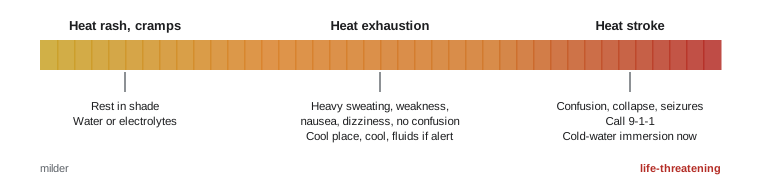
- Heat rash: small red bumps where sweat is trapped, often under clothing. Keep the skin cool and dry.
- Heat cramps: painful muscle spasms during or after heavy sweating. Rest in a cool place, stretch gently and drink water or an electrolyte drink.
- Heat syncope: fainting or dizziness from standing in heat or standing up suddenly. Lie the person down in a cool place and give fluids once they are fully alert.
- Heat exhaustion: heavy sweating, weakness, fatigue, headache, nausea or vomiting, dizziness, thirst, cool clammy skin and a fast pulse. Body temperature may be raised but the person is not confused. Move them to a cool, shaded or air-conditioned place, remove extra clothing and protective equipment, cool them with water, wet cloths and fanning, and give water or an electrolyte drink in small amounts if they are alert and not vomiting. Call 9-1-1 if they do not improve within about 15 to 30 minutes, if they vomit or if they get worse. They should not return to work that day.
- Heat stroke: a medical emergency in which the body's temperature control fails and core temperature rises, often above 40 °C (104 °F). The key sign is a change in mental state: confusion, slurred speech, strange behaviour, agitation, seizures or unresponsiveness. The skin may be hot and dry or still sweaty, especially in exertional heat stroke in workers. Heat stroke can kill or cause permanent organ damage.
First aid for heat stroke: call 9-1-1 and cool the person immediately and aggressively. Current first aid guidelines identify whole-body cold-water immersion, from the neck down in a tub or tank of cold or ice water, as the most effective method; it is used on many worksites and at sports events. If immersion is not possible, use whatever is available: move the person to shade, remove clothing, soak them with cold water from a hose or bottles, cover them with cold wet towels or ice packs over as much of the body as possible, and fan them. Do not wait for paramedics before starting to cool. Do not give fluids to a confused or unresponsive person. Place an unresponsive breathing person in the recovery position and be ready to start CPR.
Canadian provinces set heat stress requirements in their OHS regulations, and most use the threshold limit values of the American Conference of Governmental Industrial Hygienists (ACGIH), based on the wet bulb globe temperature, or humidex-based plans. Ontario, for example, expects employers to have heat stress policies under the general duty clause, and British Columbia's OHS Regulation requires heat stress assessment and control where workers may be exposed. Environment and Climate Change Canada issues heat warnings when local criteria are met.
Worked problem
Recognizing heat stroke and planning cooling
On a 34 °C (93 °F) humid afternoon, a roofer who started work only two days ago becomes confused, stumbles and says strange things. A co-worker estimates his core temperature may be over 40 °C (104 °F). A cooling tub on site can be filled with cold water in about 3 minutes, and the ambulance is 18 minutes away. Studies of cold-water immersion have reported cooling rates of roughly 0.15 to 0.35 °C per minute. Should the crew wait for paramedics, and how long might it take to bring his temperature from 41.5 °C to about 39 °C by immersion?
Show solution
- Confusion in the heat in a newly hired worker means heat stroke: call 9-1-1 and start cooling now; do not wait 18 minutes.
- Temperature drop needed: \(41.5 - 39.0 = 2.5\) °C.
- At 0.15 °C a minute: \(2.5 \div 0.15 \approx 17\) minutes. At 0.35 °C a minute: \(2.5 \div 0.35 \approx 7\) minutes.
- Including 3 minutes to fill the tub, cooling could be well under way or complete before the ambulance arrives, which greatly improves survival.
Answer: Do not wait. Call 9-1-1 and immerse him immediately; cold-water immersion could lower his temperature by 2.5 °C in roughly 7 to 17 minutes, much of it before paramedics arrive.
Hypothermia
Hypothermia occurs when the core body temperature falls below about 35 °C (95 °F). It can happen in obvious cold, such as winter work outdoors or falling through ice, but also in cool, wet, windy weather above freezing, in cold water at any time of year, and in people who are injured and lying still. Signs progress as the temperature falls:
| Stage | Typical signs |
|---|---|
| Mild | Shivering, cold pale skin, numb hands, clumsiness, slurred speech, poor judgement |
| Moderate | Violent shivering or shivering that stops, confusion, drowsiness, stumbling, irrational behaviour such as removing clothing |
| Severe | No shivering, rigid muscles, very slow breathing and pulse, unresponsiveness; may appear dead |
First aid: call 9-1-1 for anything beyond mild hypothermia. Handle the person gently, because rough movement can trigger dangerous heart rhythms in severe hypothermia. Move them out of the cold and wind into a warm shelter or vehicle. Remove wet clothing gently, cutting it off if needed, and replace it with dry clothing or blankets, covering the head and neck. Insulate them from the ground. Use a vapour barrier, such as a plastic sheet or emergency blanket, outside the insulation. Apply warm, not hot, packs or water bottles wrapped in cloth to the armpits, chest and groin if available, but not directly on the skin, and not to the arms and legs. If the person is alert and can swallow, give warm sweet drinks, but no alcohol or caffeine. Do not rub or massage the limbs and do not put a person with decreased responsiveness in a warm shower or bath. Check breathing carefully for up to a minute, because it may be very slow, and start CPR if they are not breathing.
Frostbite
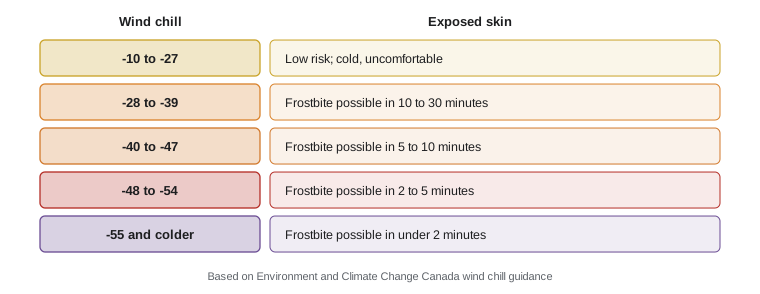
Frostbite is freezing of the skin and underlying tissues, most often affecting fingers, toes, ears, nose and cheeks. Frostnip, the mildest form, causes cold, white, numb skin that recovers fully with rewarming. Deeper frostbite makes the skin white, grey or waxy and hard, and blisters and blackened tissue may develop after rewarming. Wind chill greatly increases the risk: in Canada, Environment and Climate Change Canada's wind chill index estimates how quickly exposed skin can freeze.
First aid: move the person to a warm place and treat any hypothermia first. Remove rings and tight items. Do not rub the area or rub it with snow. If there is any chance the tissue will refreeze, for example during a long trip back to shelter, do not rewarm it, because thawing and refreezing causes worse damage; protect it and keep it from further cold. Once there is no risk of refreezing, current guidelines recommend rewarming the area in lukewarm water at about 37 to 40 °C (99 to 104 °F), roughly the temperature that feels warm but not hot to an unaffected hand, for 20 to 30 minutes, or letting it rewarm naturally if immersion is not possible. Rewarming is painful. Do not use direct heat from stoves, heaters or heating pads, which can burn numb skin. Do not break blisters. Cover loosely with dry, sterile dressings, place gauze between affected fingers or toes, avoid walking on frostbitten feet if possible and get medical care.
Worked problem
Using wind chill to plan exposure
Environment Canada forecasts minus 28 °C with winds of 30 km/h for an outdoor crew in Winnipeg, giving a wind chill of about minus 43. Using the wind chill guidance that exposed skin can freeze in 5 to 10 minutes at minus 40 to minus 47, how long should workers keep face and hands exposed, and what controls are needed?
Show solution
- At a wind chill of minus 43, exposed skin can freeze in 5 to 10 minutes, so assume 5 minutes as the safe maximum for exposed skin.
- Controls: cover all skin with face masks, balaclavas and insulated gloves; plan warm-up breaks in a heated shelter; work in pairs to watch each other's faces for white patches; schedule the heaviest outdoor work for the warmest part of the day.
- First aid readiness: have a warm shelter, dry clothing, blankets and warm sweet drinks available, and a way to call for help.
Answer: Exposed skin can freeze in as little as 5 to 10 minutes, so no skin should stay exposed; use full face and hand protection, warm-up breaks and a buddy system.
Bites and stings
- Insect stings: remove a bee stinger quickly by scraping or pulling; speed matters more than method. Wash the area, apply a cold pack and watch for anaphylaxis (Lesson 10). Workers with known severe allergies should carry their own auto-injector and tell their supervisor.
- Ticks: blacklegged ticks can carry Lyme disease, which is spreading in southern Canada, especially in parts of Ontario, Quebec, Nova Scotia, New Brunswick, Manitoba and British Columbia. Remove an attached tick as soon as possible with fine-tipped tweezers or a tick tool, grasping it close to the skin and pulling straight up with steady pressure. Clean the area, save the tick in a sealed container if possible, and advise the person to see a health care provider if they develop a rash, fever or joint pain in the following weeks.
- Animal and human bites: control bleeding, wash thoroughly with soap and water for several minutes, cover and send for medical care because of the risk of infection and, for animal bites, rabies.
- Snakebites: the only venomous snakes in Canada are a few rattlesnake species and the massasauga in parts of British Columbia, Alberta, Saskatchewan and Ontario. Keep the person calm and still, remove rings and tight items, keep the limb at about heart level and call 9-1-1. Do not cut, suck, ice or apply a tourniquet.
- Poisonous plants: wash skin promptly with soap and water after contact with poison ivy, giant hogweed or similar plants, wash clothing and tools, and seek medical care for severe reactions or eye exposure.
Common mistakes
MistakeWaiting for paramedics before cooling a person with heat stroke.
InsteadStart rapid cooling immediately, ideally by cold-water immersion, and call 9-1-1.
MistakeAssuming a sweating worker cannot have heat stroke.
InsteadConfusion or collapse in the heat is heat stroke until proven otherwise, even with sweating.
MistakeRubbing frostbitten skin or rubbing it with snow.
InsteadRewarm gently in lukewarm water once there is no risk of refreezing.
MistakeHandling a severely hypothermic person roughly or giving alcohol.
InsteadMove them gently, insulate, warm the core and give warm sweet drinks only if alert.
MistakeSqueezing a tick or burning it off.
InsteadPull straight up with fine-tipped tweezers close to the skin.
Summary and key terms
- Heat illness ranges from heat cramps and heat exhaustion to life-threatening heat stroke.
- Heat exhaustion: move to a cool place, cool and give fluids if alert; call 9-1-1 if no improvement.
- Heat stroke is shown by confusion or collapse in the heat; call 9-1-1 and cool immediately, ideally by cold-water immersion.
- Hypothermia: handle gently, remove wet clothing, insulate, warm the core and call 9-1-1 for anything beyond mild.
- Frostbite: do not rub; rewarm in lukewarm water once there is no risk of refreezing, then cover and get care.
- Wind chill indicates how quickly exposed skin can freeze and should guide outdoor work planning.
- Remove ticks promptly, scrape out stingers, wash bites and call 9-1-1 for venomous snakebites.
- Core temperature
- The temperature of the body's internal organs, normally about 37 °C (98.6 °F).
- Heat exhaustion
- A heat illness with heavy sweating, weakness and nausea but no confusion.
- Heat stroke
- A life-threatening heat illness with very high body temperature and altered mental state.
- Cold-water immersion
- Placing a person in cold water up to the neck to cool them rapidly.
- Acclimatization
- Gradual adaptation of the body to working in heat.
- Hypothermia
- A core body temperature below about 35 °C (95 °F).
- Frostnip
- Mild, reversible freezing of the skin surface.
- Frostbite
- Freezing of the skin and deeper tissues.
- Wind chill
- An index of how cold it feels on exposed skin when wind is combined with low temperature.
- Lyme disease
- A bacterial infection spread by blacklegged ticks.
Practice problems
Work each problem on paper first, then reveal the answer to check.
Why is humid heat more dangerous than dry heat?
Show answer
Humidity slows the evaporation of sweat, reducing cooling.
What is the key sign that separates heat stroke from heat exhaustion?
Show answer
A change in mental state, such as confusion, collapse or seizures.
What is the most effective cooling method for heat stroke?
Show answer
Whole-body cold-water immersion from the neck down.
Below what core temperature is hypothermia defined?
Show answer
About 35 °C (95 °F).
Why handle a severely hypothermic person gently?
Show answer
Rough movement can trigger dangerous heart rhythms.
Where should warm packs be placed for hypothermia?
Show answer
On the armpits, chest and groin, wrapped in cloth.
What water temperature is recommended for rewarming frostbite?
Show answer
About 37 to 40 °C (99 to 104 °F).
Why not rewarm frostbite if it may refreeze?
Show answer
Thawing and refreezing causes worse tissue damage.
How should a tick be removed?
Show answer
With fine-tipped tweezers close to the skin, pulling straight up with steady pressure.
Name three things not to do for a snakebite.
Show answer
Do not cut, suck or apply a tourniquet (also do not ice).
Lesson quiz · 5 questions
Score 60% or more to complete this lesson.
Create a free account to save your progress, take quizzes and earn a certificate.