
HSE-110 · Lesson 2 of 12 · 25 min
Scene safety, primary assessment and calling for help
Every first aid response starts the same way, whatever the injury or illness turns out to be. You make sure the scene is safe, you find out whether the person is responsive, you call for help and you check for the problems that can kill within minutes: a blocked airway, absent or abnormal breathing and severe bleeding. This structured first look is called the primary assessment. It takes less than a minute, and it tells you whether you are dealing with a life-threatening emergency that needs emergency services and an AED immediately, or a situation that allows a more careful look.
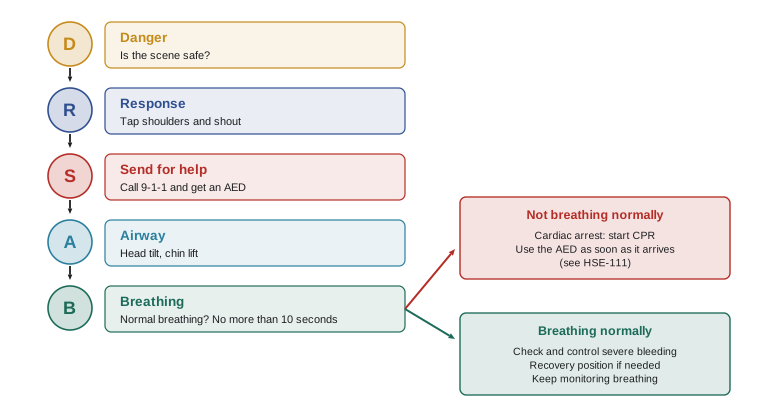
This lesson walks through each step. The order matters because it puts first the problems that will kill fastest. Training programs use slightly different memory aids, such as DRSABCD (danger, response, send for help, airway, breathing, CPR, defibrillation) or check, call, care, but the logic is the same.
Step 1: check the scene
Before you approach, stop and look. Ask yourself what happened, whether the danger that hurt the casualty is still present, how many people are involved and what help is available. Common workplace dangers include moving vehicles and forklifts, running machinery, electricity, falling objects, fire and smoke, toxic gases or oxygen-deficient air in confined spaces, chemical spills, unstable structures and traffic at roadside work. Violence or an aggressive person can also make a scene unsafe.
If the scene is not safe, do not enter. Make it safe if you can do so without risk, for example by pressing an emergency stop, shutting off power at a disconnect you are authorized to use, or turning off a vehicle engine. Otherwise keep others back and call for people with the right training and equipment, such as the fire department for confined space rescue or the utility for downed power lines. Many workers have died trying to rescue a co-worker who collapsed in a tank, pit or sewer: the same gas that overcame the first person overcomes the rescuer within seconds. Electrical contact is similar: never touch a person who may still be in contact with a live conductor.
Check also for clues about what happened. A ladder on the ground, a spilled container, a person slumped at the wheel of a forklift or a bottle of medication nearby can all suggest the cause. Put on gloves from the first aid kit before you touch the casualty if you can do so without delay.
Step 2: check for a response
Approach the person, ideally from the front so that they can see you, and kneel beside them. Tap their shoulders firmly and speak loudly: ask whether they are all right and tell them to open their eyes. Do not shake a person who may have a neck injury. A person who answers, moves purposefully or opens their eyes is responsive. A person who does not respond at all is unresponsive and is in a serious emergency.
Some first aid programs teach the AVPU scale to describe the level of response quickly: A for alert, V for responds to voice, P for responds only to pain (such as a firm pinch to the shoulder muscle) and U for unresponsive. A person who is only V or P is not fully alert and needs emergency care. Changes in the level of response over time are very important information for paramedics, so note the time and what you observed.
Step 3: call for help
If the person is unresponsive, or if you see any life-threatening problem, get emergency services on the way immediately. Shout for nearby help. If someone comes, send them to call 9-1-1 (or your local emergency number, or the workplace emergency number if your site uses one that connects to an internal response team and then to 9-1-1), to bring the first aid kit and the AED, and to come back and tell you that the call has been made. If you are alone with a mobile phone, call 9-1-1 and put the phone on speaker so you can follow the dispatcher's instructions while you give care. In parts of northern and rural Canada, 9-1-1 may not be available or may route to a distant centre; workplaces in such areas must have a written plan that names the right number and the closest medical facility.
Emergency dispatchers are trained to give instructions for CPR, bleeding control, choking and childbirth. Stay on the line and follow them. Give the dispatcher the exact location, including the site address, building, floor and entrance, what happened, how many people are hurt, the casualty's condition (responsive or not, breathing or not) and your callback number. Send someone to meet the ambulance at the gate or main entrance, unlock doors and clear a path. In large plants, mines, campuses and construction sites, finding the casualty can take longer than driving there, so the workplace plan should include clear directions and meeting points.
| Information for the dispatcher | Example |
|---|---|
| Exact location | 450 Industrial Road, Building C, loading dock 4, east entrance |
| What happened | A worker fell about 3 m from a mezzanine |
| Number of casualties | One |
| Condition | Responsive but confused, breathing, bleeding from the head |
| Hazards | Forklift traffic has been stopped |
| Callback number | The caller's mobile number |
| Who will meet the crew | Security guard at the main gate |
Step 4: open the airway
In an unresponsive person lying on their back, the tongue and soft tissues can fall back and block the airway. The standard technique to open it is the head tilt, chin lift: place one hand on the forehead and tilt the head back gently, and place the fingertips of the other hand under the bony part of the chin and lift. Look in the mouth only if you can see an obstruction such as vomit; remove it if you can do so easily, but do not do blind finger sweeps. Certified training teaches when to use a jaw thrust instead for a suspected spinal injury; in practice, an open airway takes priority over possible spinal injury because a person who cannot breathe will die.
Step 5: check breathing
With the airway open, look, listen and feel for normal breathing for no more than 10 seconds. Look for the chest rising and falling, listen for breath sounds and feel for air on your cheek. Occasional gasps, sometimes called agonal breathing, are not normal breathing. They are common in the first minutes after cardiac arrest and can be mistaken for signs of life. If the person is unresponsive and not breathing normally, assume cardiac arrest: make sure emergency services and an AED are on the way and start CPR. Those techniques are taught in HSE-111 and in certified CPR courses. Dispatchers will guide untrained callers through hands-only CPR.
If the person is unresponsive but breathing normally, check quickly for severe bleeding and control it, then consider the recovery position (Lesson 3) to keep the airway clear, and keep checking breathing until help arrives.
Step 6: check for severe bleeding
Look quickly over the whole body for blood pooling on the ground, soaking through clothing or spurting from a wound. Severe bleeding can kill in minutes and must be controlled immediately, often at the same time as you check breathing. Use firm direct pressure, and use a tourniquet for life-threatening limb bleeding if pressure does not work or cannot be applied, as Lesson 4 explains.
Several casualties at once
When more than one person is hurt, for example in a vehicle collision, an explosion or a structural collapse, a first aider has to decide whom to help first. This is called triage. In awareness terms, the priorities are simple. People who can walk usually have less severe injuries and can be directed to a safe place. People who are unresponsive, not breathing normally or bleeding heavily need help first, but only if their problem is one you can treat with the people and resources available. Professional responders use formal triage systems such as START (simple triage and rapid treatment) with colour-coded categories; first aiders should tell arriving crews how many casualties there are and which seem most serious.
Worked problem
Counting casualties at a multi-casualty scene
A propane cylinder flash fire injures workers in a warehouse. After the fire department makes the area safe, you find 9 people: 5 are walking and talking, 2 are lying down but responsive with burns to their arms, 1 is unresponsive and breathing, and 1 is unresponsive and not breathing. There are 3 trained first aiders. How should you summarize the scene for the dispatcher and allocate first aiders?
Show solution
- Count the total: \(5 + 2 + 1 + 1 = 9\) casualties.
- Group by apparent priority: 1 unresponsive and not breathing (cardiac arrest), 1 unresponsive and breathing (airway at risk), 2 responsive with burns (need cooling), 5 walking wounded (assess later).
- Allocate: one first aider starts CPR on the person not breathing and asks for the AED; one places the breathing unresponsive casualty in the recovery position and monitors breathing while overseeing burn cooling by helpers; one directs the walking wounded to a safe area and checks them for hidden injuries.
- Tell the dispatcher: nine casualties, one in cardiac arrest with CPR in progress, one unresponsive but breathing, two with arm burns, five walking.
Answer: Nine casualties: one in cardiac arrest, one unresponsive but breathing, two with burns and five walking wounded. Allocate one first aider each to the two unresponsive casualties and one to the walking wounded, and use helpers to cool the burns.
Calming the scene
Emergencies are frightening. Speak calmly, use the casualty's name if you know it, and give simple, clear instructions to bystanders: you call 9-1-1, you get the AED, you keep people back. Keep onlookers away and protect the casualty's privacy, for example by holding up a coat or blanket. Do not let people take photos or videos of the casualty. These simple actions reduce confusion and help you think clearly.
If you are alone
If you are alone with an unresponsive adult and have a mobile phone, call 9-1-1 first and use the speaker so you can begin care immediately. If you have no phone, leave briefly to call or raise the alarm, then return. Many workplaces have emergency buttons, radios or public address systems that summon trained responders and an AED; know where they are before you need them. A workplace AED should be visible, signed and reachable within about 3 minutes, and first aiders should know where the nearest one is from every part of the site.
Common mistakes
MistakeRushing in to help a worker who collapsed in a tank or pit.
InsteadAssume the atmosphere is deadly, stay out and call trained rescuers.
MistakeTreating occasional gasps as normal breathing.
InsteadGasping in an unresponsive person is a sign of cardiac arrest; start CPR and get an AED.
MistakeChecking breathing for 30 seconds or more.
InsteadTake no more than 10 seconds to decide whether breathing is normal.
MistakeAsking bystanders vaguely whether someone could call for help.
InsteadPoint to a specific person and tell them to call 9-1-1 and bring the AED.
MistakeHanging up before the dispatcher says so.
InsteadStay on the line, give the exact location and follow instructions.
Summary and key terms
- The primary assessment finds the problems that kill fastest: danger, unresponsiveness, airway, breathing and severe bleeding.
- Never enter an unsafe scene; make it safe only if you can do so without risk, otherwise call trained rescuers.
- Check for a response by tapping the shoulders and speaking loudly; the AVPU scale describes the level of response.
- Call 9-1-1 early for an unresponsive person or any life-threatening problem, and send for the AED.
- Open the airway with head tilt, chin lift and check breathing for no more than 10 seconds.
- Unresponsive and not breathing normally means cardiac arrest: start CPR and use an AED.
- At a multi-casualty scene, count and group casualties and report clearly to the dispatcher.
- Primary assessment
- A rapid check for immediate threats to life: response, airway, breathing and severe bleeding.
- Scene safety
- Checking for and controlling hazards before approaching a casualty.
- AVPU
- A scale for level of response: alert, voice, pain, unresponsive.
- Head tilt, chin lift
- The basic technique for opening the airway of an unresponsive person.
- Agonal breathing
- Occasional gasps that occur after cardiac arrest and are not normal breathing.
- Cardiac arrest
- Sudden loss of effective heart function, shown by unresponsiveness and absent or abnormal breathing.
- Dispatcher
- The trained emergency call-taker who sends help and gives instructions by phone.
- Triage
- Sorting casualties by priority when there are more than responders can treat at once.
- Walking wounded
- Casualties who can walk and usually have less severe injuries.
- Recovery position
- A stable side-lying position that keeps the airway open in an unresponsive breathing person.
Practice problems
Work each problem on paper first, then reveal the answer to check.
What is the first step in every first aid response?
Show answer
Check that the scene is safe.
A co-worker has collapsed inside a tank. What should you do?
Show answer
Stay out, raise the alarm and call trained rescuers; the atmosphere may be deadly.
What does AVPU stand for?
Show answer
Alert, voice, pain, unresponsive.
How long should you take to check breathing?
Show answer
No more than 10 seconds.
An unresponsive person is gasping occasionally. What does this suggest?
Show answer
Cardiac arrest; start CPR and get an AED.
List four things to tell the dispatcher.
Show answer
The exact location, what happened, the number of casualties and their condition (also hazards and a callback number).
Why send someone to meet the ambulance?
Show answer
Finding the casualty on a large site can take longer than driving there.
Which casualties are usually the lowest priority at a multi-casualty scene?
Show answer
The walking wounded.
When may you remove something from the mouth?
Show answer
Only if you can see it and remove it easily; do not do blind finger sweeps.
How can you protect a casualty's privacy?
Show answer
Keep onlookers back, shield them with a coat or blanket and stop people taking photos.
Lesson quiz · 5 questions
Score 60% or more to complete this lesson.
Create a free account to save your progress, take quizzes and earn a certificate.