
BUS-210 · Lesson 9 of 12 · 33 min
Corporate governance and directors' duties
A corporation is a legal person, but it can think and act only through people. Corporate governance is the system of rules and practices by which a corporation is directed and controlled: who makes which decisions, to whom they are accountable and how conflicts between owners, managers and other stakeholders are resolved. This lesson explains the roles of shareholders, directors and officers, the duties directors and officers owe, the remedies available when those duties are breached or minority shareholders are treated unfairly, and the basics of securities law, which governs how corporations raise money from investors.
Shareholders, directors and officers
Corporate law divides power among three groups. Shareholders own the corporation's shares but do not manage it; their main powers are to elect and remove directors, appoint the auditor, approve fundamental changes such as amalgamations, sales of substantially all assets and amendments to the articles, and receive dividends when declared. Directors, acting together as a board, manage or supervise the management of the business and affairs of the corporation: they set strategy, appoint and oversee officers, declare dividends, approve financial statements and major transactions. Officers, such as the chief executive officer, chief financial officer and corporate secretary, are appointed by the board and run the business day to day under its delegated authority.
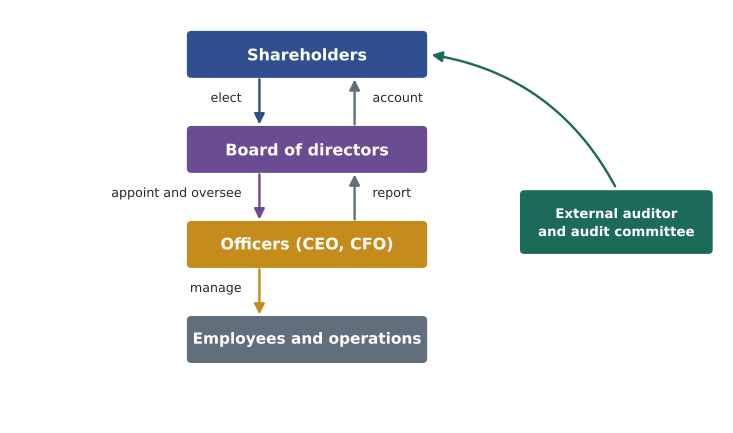
Shareholders act at meetings or by written resolution signed by all shareholders entitled to vote. Under the CBCA, an ordinary resolution requires a simple majority of the votes cast, and a special resolution requires at least two-thirds of the votes cast; special resolutions are needed for fundamental changes. Shareholders may requisition a meeting if they hold at least 5 % of the voting shares, and may submit proposals to be included in management's materials. Each share usually carries one vote, but corporations can create classes with different rights, such as non-voting or multiple-voting shares, preferred dividends or priority on liquidation. In a dual-class structure, founders hold multiple-voting shares that keep control while the public owns most of the equity, a common arrangement in Canadian companies.
Worked problem
Will the resolution pass?
Cedar Ridge Inc., a CBCA corporation, has 1,000,000 voting common shares. At a properly called meeting, holders of 640,000 shares are present in person or by proxy. The board proposes amending the articles to create a new class of preferred shares, which requires a special resolution. 420,000 shares vote for, 200,000 vote against and 20,000 abstain. Does the resolution pass?
Show solution
- A special resolution needs at least two-thirds of the votes cast.
- Votes cast = 420,000 + 200,000 = 620,000; abstentions are not votes cast.
- Two-thirds of 620,000 = 413,334 (rounded up).
- 420,000 for is more than 413,334, so the special resolution passes, narrowly.
- Under CBCA section 190, shareholders who voted against may be entitled to dissent and be paid fair value for their shares if the amendment affects their rights in a way the statute lists.
Answer: The voting threshold and its base (votes cast, shares present or shares outstanding) decide the outcome. Always check the statute, the articles and any shareholder agreement before counting.
Directors' fiduciary duty
Section 122(1) of the CBCA, and similar provincial provisions, require every director and officer in exercising their powers and discharging their duties to act honestly and in good faith with a view to the best interests of the corporation (the fiduciary duty) and to exercise the care, diligence and skill that a reasonably prudent person would exercise in comparable circumstances (the duty of care). The fiduciary duty is owed to the corporation, not to any particular shareholder or stakeholder. In Peoples Department Stores Inc. (Trustee of) v. Wise, 2004 SCC 68, and BCE Inc. v. 1976 Debentureholders, 2008 SCC 69, the Supreme Court held that in determining the best interests of the corporation, directors may consider the interests of shareholders, employees, creditors, consumers, governments and the environment, and must treat affected stakeholders fairly, but there is no rule that shareholder interests always prevail. A 2019 amendment, section 122(1.1), codified this list and added retirees, pensioners and the long-term interests of the corporation.
Loyalty demands that directors avoid conflicts of interest. A director who has a material interest in a contract with the corporation must disclose it and generally abstain from voting; the contract is then protected if it is approved by disinterested directors or shareholders and is fair to the corporation. Directors and officers must not take for themselves business opportunities that belong to the corporation. They must not use confidential corporate information for personal advantage, and they must not compete with the corporation.
The leading Canadian case on corporate opportunities is Canadian Aero Service Ltd. v. O'Malley (1974). Senior officers of Canaero worked on a topographical mapping contract for Guyana, then resigned, formed their own company and won the contract. The Supreme Court held them liable to account for their profits, because they had taken an opportunity that the corporation was actively pursuing and that they had learned of through their positions; their resignation did not end their fiduciary obligations for that opportunity. Section 120 of the CBCA requires directors and officers to disclose in writing the nature and extent of any interest in a material contract or transaction with the corporation, and directors must generally not vote on it.
Worked problem
Taking a corporate opportunity
Nadia is a director and the vice-president of business development of Polar Cold Storage, which operates refrigerated warehouses. While representing Polar at a trade show, she learns that a competitor's warehouse near the port is quietly for sale. Polar's board has discussed expanding near the port. Nadia resigns, forms her own company with a partner and buys the warehouse two months later. Polar sues. Analyze the claim.
Show solution
- Nadia, as a director and senior officer, owed Polar a fiduciary duty.
- She learned of the opportunity through her position and while acting for Polar.
- The opportunity was in Polar's line of business and one the board was actively considering, so it was a maturing business opportunity of the corporation.
- Under Canaero, resigning to take the opportunity does not end the duty where the resignation was prompted or influenced by a wish to acquire it.
- Polar can likely require Nadia and her company to account for the profits or hold the warehouse on constructive trust for Polar.
Answer: Nadia should have presented the opportunity to Polar's board. If the board, fully informed and without her participation, had declined it, she could generally have pursued it herself.
The duty of care and the business judgment rule
The duty of care requires the diligence of a reasonably prudent person, an objective standard. Directors are not expected to be infallible, and courts do not second-guess business decisions with hindsight. Under the business judgment rule, courts defer to decisions that fall within a range of reasonable alternatives, made honestly, prudently, in good faith and on reasonable grounds, after an appropriate process of gathering information (Peoples; BCE). Directors may rely in good faith on financial statements and on reports of professionals such as lawyers, accountants and engineers, which is a statutory defence under the CBCA. Directors who attend meetings, ask questions, read materials, seek expert advice for important decisions and record their reasoning in minutes are well protected.
Worked problem
Is the board protected?
The board of Linden Medical Devices approves a $40 million acquisition of a start-up. Before voting, directors receive a 60-page briefing a week in advance, hear presentations from management and an independent valuation firm, ask questions over two meetings and negotiate the price down by 8 %. Two years later, a competitor's new product makes the start-up's technology obsolete, and Linden writes off most of the investment. Shareholders allege the directors breached their duty of care.
Show solution
- The board followed a careful process: advance materials, independent valuation, questions, two meetings and active negotiation.
- There is no suggestion of a conflict of interest or bad faith.
- The loss resulted from an unforeseen market development, which hindsight cannot turn into negligence.
- The decision falls within a range of reasonable alternatives made on reasonable grounds, so the business judgment rule protects it.
Answer: The directors are well protected. Compare Smith v. Van Gorkom, where a rushed, uninformed approval was not. Process, not outcome, is what courts examine.
Shareholder remedies
Canadian corporate statutes give shareholders and others strong remedies. The oppression remedy (CBCA section 241) lets a security holder, creditor, director, officer or other proper person apply to court if the corporation's business or the conduct of its directors is oppressive or unfairly prejudicial to, or unfairly disregards, their interests. Under BCE, the court asks whether the complainant had a reasonable expectation that was violated and whether the conduct complained of amounts to oppression, unfair prejudice or unfair disregard. Reasonable expectations are judged objectively, considering factors such as commercial practice, the nature of the corporation, the relationship between the parties, past practice and representations made. Courts can make almost any order, including requiring the corporation or majority to buy the complainant's shares at fair value. The oppression remedy is used frequently in closely held corporations, for example when a minority shareholder is excluded from management and dividends while the majority pays itself large salaries.
A derivative action (CBCA section 239) lets a complainant bring an action in the name of the corporation, with the court's leave, to enforce a right of the corporation, typically against directors for breach of duty; the complainant must give notice to the directors, act in good faith and show that the action appears to be in the corporation's interests. Shareholders who object to fundamental changes, such as an amalgamation or sale of substantially all assets, have dissent and appraisal rights under section 190 and can require the corporation to pay the fair value of their shares.
Worked problem
Is the minority shareholder oppressed?
Jun, Lena and Owen founded Brightwater Tours, each holding one-third of the shares and each working full time. After a disagreement, Lena and Owen remove Jun as a director and employee, stop paying dividends after years of regular payments, and raise their own salaries from $90,000 to $250,000 each. Brightwater has no shareholder agreement. Jun cannot sell his shares because there is no market for them. What can Jun do?
Show solution
- Jun is a security holder and can apply for an oppression remedy.
- Reasonable expectations: in a small company founded by three equal partners who all worked in it, Jun could reasonably expect to participate in management and share profits; past practice of regular dividends supports that expectation.
- Removing him, stopping dividends and diverting profits through inflated salaries arguably unfairly prejudices and disregards his interests.
- A likely remedy is an order requiring the corporation or Lena and Owen to buy Jun's shares at fair value, possibly valued as of a date before the oppression, without a minority discount.
Answer: Jun has strong remedies, but litigation is expensive for everyone. A shareholder agreement with buy-sell provisions, a valuation formula and dispute resolution steps would have given all three a cheaper exit.
Securities regulation basics
When a corporation raises money by selling shares or other securities, securities law applies. Securities regulation in Canada is provincial: each province and territory has a securities act and a commission, coordinated through the Canadian Securities Administrators (CSA) and largely harmonized national instruments; efforts to create a cooperative national regulator have not been joined by every province. Issuers must file a prospectus, a detailed disclosure document reviewed by regulators, before distributing securities to the public, unless an exemption applies. The main exemptions in National Instrument 45-106 include the private issuer exemption for private companies selling to founders, family, close friends and business associates, the accredited investor exemption for investors meeting income or asset thresholds, the offering memorandum exemption and crowdfunding exemptions. Reporting issuers must make continuous disclosure, including annual and interim financial statements and timely disclosure of material changes, and insiders must report trades. Insider trading, buying or selling with knowledge of undisclosed material facts, is prohibited by provincial securities acts and the Criminal Code.
| Topic | Canadian approach |
|---|---|
| Regulator | Provincial securities commissions coordinated by the CSA |
| Public offering document | Prospectus filed with provincial regulators |
| Main private placement exemptions | Private issuer, accredited investor, offering memorandum and crowdfunding exemptions (NI 45-106) |
| Ongoing disclosure | Annual and interim filings, material change reports |
| Insider trading | Prohibited by securities acts and the Criminal Code |
| Officer certification | CEO and CFO certify filings under NI 52-109 |
Governance expectations keep evolving beyond legal minimums. Investors and stock exchanges expect independent directors, separate audit, compensation and nominating committees, a code of conduct, whistleblower procedures and board oversight of risks such as cybersecurity and climate. Rules on diversity and climate disclosure have shifted repeatedly in recent years in both countries and remain contested, so companies should check current requirements of their regulators and exchanges at the time of any filing.
Common mistakes
MistakeTreating a board meeting as a formality and approving major deals without materials or questions.
InsteadInsist on timely information, expert advice, real deliberation and minutes that record the process.
MistakeQuietly pursuing a business opportunity learned through your position.
InsteadDisclose it to the board and pursue it only if the disinterested directors, fully informed, decline it.
MistakeVoting on a contract in which you have a personal interest.
InsteadDisclose the interest in writing and abstain; let disinterested directors decide.
MistakeFreezing out a minority shareholder in a small company.
InsteadRespect reasonable expectations; use a shareholder agreement with buy-sell terms to manage exits.
MistakeRaising money from friends and investors without checking securities law.
InsteadUse a valid prospectus exemption and file required reports; unregistered offerings can give investors rescission rights.
Summary and key terms
- Shareholders elect directors and approve fundamental changes; directors manage or supervise; officers run daily operations.
- Ordinary resolutions need a majority and special resolutions two-thirds of votes cast.
- Directors must act honestly and in good faith in the corporation's best interests and may consider stakeholders (Peoples, BCE, section 122(1.1)).
- Corporate opportunities belong to the corporation (Canaero); conflicts must be disclosed under section 120.
- The business judgment rule protects informed, reasonable decisions made in good faith.
- The oppression remedy protects reasonable expectations; derivative actions need leave; dissent rights allow exit at fair value.
- Securities are regulated provincially; distributions need a prospectus or an exemption.
- Fiduciary duty
- A duty to act honestly, in good faith and in the best interests of the person or entity served.
- Duty of care
- The duty to act with the care, diligence and skill of a reasonably prudent person.
- Business judgment rule
- The principle that courts defer to informed, good-faith business decisions.
- Corporate opportunity
- A business opportunity belonging to the corporation that its fiduciaries may not take.
- Derivative action
- A lawsuit by a shareholder on behalf of the corporation.
- Prospectus
- A disclosure document required to offer securities to the public.
- Accredited investor
- An investor meeting income or asset thresholds who may buy securities under exemptions.
- Insider trading
- Trading securities while possessing undisclosed material information.
- Special resolution
- A shareholder resolution passed by at least two-thirds of votes cast.
- Oppression remedy
- A court remedy for conduct that is oppressive, unfairly prejudicial or unfairly disregards a stakeholder's interests.
Practice problems
Work each problem on paper first, then reveal the answer to check.
Name two powers of shareholders and two of directors.
Show answer
Shareholders elect directors and approve fundamental changes; directors set strategy and declare dividends.
620,000 votes are cast on a special resolution. How many votes for are needed?
Show answer
At least 413,334.
To whom do directors owe their fiduciary duty under Canadian law?
Show answer
To the corporation, while treating stakeholders fairly.
What should a director do on learning of a business opportunity in the corporation's line of business?
Show answer
Disclose it to the board and not take it unless the board, fully informed, declines it.
What test does the oppression remedy use after BCE?
Show answer
Whether a reasonable expectation was violated by oppressive, unfairly prejudicial or unfairly disregarding conduct.
Why did the directors in Smith v. Van Gorkom lose?
Show answer
They approved a merger after a short meeting without adequate information, a grossly negligent process.
What is a dissent right?
Show answer
The right of a shareholder who objects to a fundamental change to be paid fair value for their shares.
Name two prospectus exemptions under NI 45-106.
Show answer
The private issuer exemption and the accredited investor exemption.
What is insider trading?
Show answer
Buying or selling securities while possessing material information not generally disclosed.
Portfolio task: draft a one-page conflict-of-interest policy for a small company board.
Show answer
Answers vary; a good answer requires written disclosure, abstention, independent approval, minutes and annual declarations.
Lesson quiz · 5 questions
Score 60% or more to complete this lesson.
Create a free account to save your progress, take quizzes and earn a certificate.