
BUS-210 · Lesson 9 of 12 · 34 min
Corporate governance and directors' duties
A corporation is a legal person, but it can think and act only through people. Corporate governance is the system of rules and practices by which a corporation is directed and controlled: who makes which decisions, to whom they are accountable and how conflicts between owners, managers and other stakeholders are resolved. This lesson explains the roles of shareholders, directors and officers, the duties directors and officers owe, the remedies available when those duties are breached or minority shareholders are treated unfairly, and the basics of securities law, which governs how corporations raise money from investors.
Shareholders, directors and officers
Corporate law divides power among three groups. Shareholders own the corporation's shares but do not manage it; their main powers are to elect and remove directors, appoint the auditor, approve fundamental changes such as amalgamations, sales of substantially all assets and amendments to the articles, and receive dividends when declared. Directors, acting together as a board, manage or supervise the management of the business and affairs of the corporation: they set strategy, appoint and oversee officers, declare dividends, approve financial statements and major transactions. Officers, such as the chief executive officer, chief financial officer and corporate secretary, are appointed by the board and run the business day to day under its delegated authority.
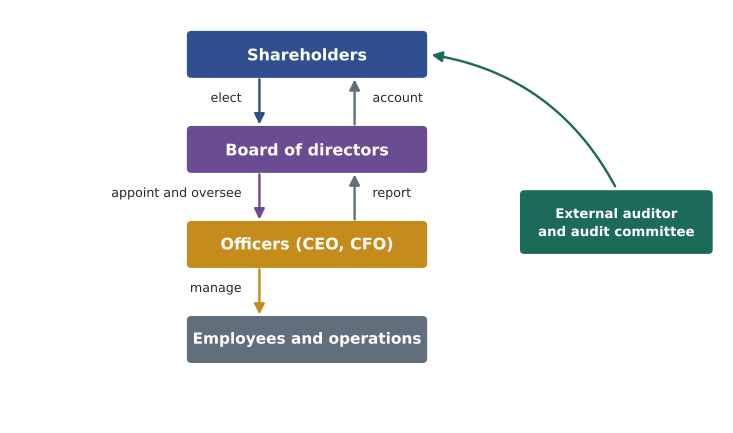
Shareholders act at meetings or, if permitted, by written consent. Under the Delaware General Corporation Law, most matters require a majority of the shares present and entitled to vote; directors are elected by plurality unless the company adopts majority voting, and fundamental changes such as mergers require approval by a majority of the outstanding shares. Public companies must also comply with federal proxy rules under the Securities Exchange Act of 1934, including Rule 14a-8, which lets qualifying shareholders include proposals in the company's proxy statement. Corporations can create classes of stock with different rights, such as non-voting shares or preferred dividends; dual-class structures that let founders keep control are common among technology companies.
Worked problem
Will the resolution pass?
Cedar Ridge Inc., a Delaware corporation, has 1,000,000 shares of voting common stock. The board proposes amending the certificate of incorporation to authorize a new class of preferred stock, which requires approval by a majority of the outstanding shares entitled to vote. At the meeting, holders of 640,000 shares are present; 420,000 vote for, 200,000 vote against and 20,000 abstain. Does the amendment pass?
Show solution
- The amendment needs a majority of outstanding shares, not of those present or voting.
- A majority of 1,000,000 is more than 500,000.
- 420,000 votes for is less than 500,000, so the amendment fails, even though it won a large majority of votes cast.
- Abstentions and shares not voted effectively count against such proposals, which is why companies work hard to maximize turnout.
Answer: The voting threshold and its base (votes cast, shares present or shares outstanding) decide the outcome. Always check the statute, the articles and any shareholder agreement before counting.
Directors' fiduciary duty
Directors and officers owe fiduciary duties to the corporation and its shareholders. In Delaware, which shapes national practice, the core duties are the duty of care, which requires directors to inform themselves of all material information reasonably available before deciding, and the duty of loyalty, which requires them to put the interests of the corporation and its stockholders ahead of their personal interests. Good faith is part of loyalty: directors who consciously disregard their responsibilities, or who fail to make a good-faith effort to oversee the business, breach the duty of loyalty. Delaware law generally treats long-term stockholder value as the objective, although directors may consider other stakeholders where doing so benefits the corporation, and more than 30 states have constituency statutes that expressly allow directors to consider employees, customers, communities and others. Public benefit corporations, available in Delaware and many other states, must balance stockholders' interests with a stated public benefit.
Loyalty demands that directors avoid conflicts of interest. A director who has a material interest in a contract with the corporation must disclose it and generally abstain from voting; the contract is then protected if it is approved by disinterested directors or shareholders and is fair to the corporation. Directors and officers must not take for themselves business opportunities that belong to the corporation. They must not use confidential corporate information for personal advantage, and they must not compete with the corporation.
Under the corporate opportunity doctrine set out in Guth v. Loft, Inc. (Delaware, 1939), a director or officer may not take a business opportunity for themselves if the corporation is financially able to exploit it, it is in the corporation's line of business, the corporation has an interest or expectancy in it and taking it would put the fiduciary in conflict with the corporation. Guth, the president of Loft, a candy and soft-drink retailer, personally acquired the Pepsi-Cola formula and trademark using Loft's money and staff; the court held the opportunity belonged to Loft. Under section 144 of the Delaware General Corporation Law, a transaction with an interested director is protected if it is approved by informed disinterested directors or stockholders or is fair to the corporation; the 2025 amendments strengthened these safe harbors. Transactions with controlling stockholders that lack such protections are reviewed under the demanding entire fairness standard.
Worked problem
Taking a corporate opportunity
Nadia is a director and the vice-president of business development of Polar Cold Storage, which operates refrigerated warehouses. While representing Polar at a trade show, she learns that a competitor's warehouse near the port is quietly for sale. Polar's board has discussed expanding near the port. Nadia resigns, forms her own company with a partner and buys the warehouse two months later. Polar sues. Analyze the claim.
Show solution
- Nadia, as a director and officer, owed Polar a duty of loyalty.
- Applying Guth v. Loft: the warehouse is in Polar's line of business, Polar had an expectancy (the board was considering port expansion), Polar was presumably able to finance it and taking it puts Nadia in conflict with Polar.
- She learned of it while acting for Polar, and resigning to take it does not cure the breach.
- Polar can likely obtain a constructive trust over the warehouse or an accounting of her profits.
Answer: Nadia should have presented the opportunity to Polar's board. If the board, fully informed and without her participation, had declined it, she could generally have pursued it herself.
The duty of care and the business judgment rule
Under the business judgment rule, courts presume that directors acted on an informed basis, in good faith and in the honest belief that the action was in the best interests of the company, and they will not second-guess decisions that can be attributed to any rational business purpose. To overcome the presumption, a plaintiff must show gross negligence in the decision-making process, a conflict of interest or bad faith. In Smith v. Van Gorkom (1985), directors of Trans Union approved a cash merger at a premium after a two-hour meeting, without reading the merger agreement or obtaining a valuation; the Delaware Supreme Court held them grossly negligent. In response, Delaware enacted section 102(b)(7), which lets a corporation's certificate eliminate directors' personal monetary liability for breaches of the duty of care, but not for breaches of loyalty, bad faith or intentional misconduct; since 2022, the protection can also extend to senior officers for direct (not derivative) claims. Directors also have a duty of oversight under In re Caremark (1996) and Marchand v. Barnhill (2019): they must make a good-faith effort to put in place reporting systems for mission-critical risks, such as food safety at an ice cream maker whose listeria outbreak killed three people, and must respond to red flags.
Worked problem
Is the board protected?
The board of Linden Medical Devices approves a $40 million acquisition of a start-up. Before voting, directors receive a 60-page briefing a week in advance, hear presentations from management and an independent valuation firm, ask questions over two meetings and negotiate the price down by 8 %. Two years later, a competitor's new product makes the start-up's technology obsolete, and Linden writes off most of the investment. Shareholders allege the directors breached their duty of care.
Show solution
- The board followed a careful process: advance materials, independent valuation, questions, two meetings and active negotiation.
- There is no suggestion of a conflict of interest or bad faith.
- The loss resulted from an unforeseen market development, which hindsight cannot turn into negligence.
- The business judgment rule presumption applies, and in any case a section 102(b)(7) exculpation clause would likely bar damages for a care claim.
Answer: The directors are well protected. Compare Smith v. Van Gorkom, where a rushed, uninformed approval was not. Process, not outcome, is what courts examine.
Shareholder remedies
In a derivative suit, a shareholder sues on behalf of the corporation to enforce a claim belonging to it, typically against directors or officers for breach of fiduciary duty. Because the board normally controls the corporation's litigation, the shareholder must first make a demand on the board to sue, or show that demand would be futile because a majority of directors are interested or lack independence. Any recovery goes to the corporation. In a direct suit, a shareholder sues for harm to their own rights, such as denial of voting rights, often as a class action. Shareholders who object to certain mergers can seek appraisal, a court determination of the fair value of their shares. In closely held corporations, many states protect minority shareholders against oppression: New York, for example, allows holders of at least 20 % to petition for dissolution on grounds of oppressive conduct, and courts often order a buyout instead; Massachusetts courts impose fiduciary duties of utmost good faith among shareholders of close corporations.
Federal securities law adds remedies for investors in public companies. Rule 10b-5 under the Securities Exchange Act prohibits material misstatements and omissions in connection with the purchase or sale of securities, and investors who bought at prices inflated by fraud can bring class actions, subject to the heightened pleading requirements of the Private Securities Litigation Reform Act of 1995. Sections 11 and 12 of the Securities Act of 1933 impose liability for misstatements in registration statements and prospectuses.
Worked problem
Is the minority shareholder oppressed?
Jun, Lena and Owen founded Brightwater Tours, each holding one-third of the shares and each working full time. After a disagreement, Lena and Owen remove Jun as a director and employee, stop paying dividends after years of regular payments, and raise their own salaries from $90,000 to $250,000 each. Brightwater has no shareholder agreement. Jun cannot sell his shares because there is no market for them. What can Jun do?
Show solution
- Removing Jun from management and employment harms him directly, but the inflated salaries also harm the corporation, so he may have both direct and derivative claims.
- Many states, such as New York, treat this as classic oppression of a minority shareholder in a close corporation, defeating his reasonable expectations of employment and a share of profits.
- A shareholder with 20 % or more in New York can petition for dissolution, and courts commonly order the majority to buy the minority's shares at fair value instead.
- In Massachusetts and similar states, Lena and Owen may have breached fiduciary duties of utmost good faith owed to Jun, unless they show a legitimate business purpose.
Answer: Jun has strong remedies, but litigation is expensive for everyone. A shareholder agreement with buy-sell provisions, a valuation formula and dispute resolution steps would have given all three a cheaper exit.
Securities regulation basics
When a corporation raises money by selling securities, federal and state securities laws apply. The Securities Act of 1933 requires every offer or sale of securities to be registered with the SEC, with a prospectus, unless an exemption applies. Common exemptions include Regulation D, especially Rule 506(b), which allows unlimited raising from accredited investors and up to 35 sophisticated non-accredited investors without general solicitation, and Rule 506(c), which allows general solicitation if all purchasers are verified accredited investors; Regulation Crowdfunding; and Regulation A. The Securities Exchange Act of 1934 regulates trading, requires public companies to file annual (10-K), quarterly (10-Q) and current (8-K) reports and prohibits fraud and insider trading. The Sarbanes-Oxley Act of 2002 requires CEOs and CFOs to certify financial reports and companies to maintain internal controls over financial reporting, and the Dodd-Frank Act of 2010 added say-on-pay votes and whistleblower rewards. State blue sky laws also apply, though federal law preempts state registration for many offerings.
| Topic | American approach |
|---|---|
| Regulator | The SEC, plus state securities regulators |
| Public offering document | Registration statement and prospectus filed with the SEC |
| Main private placement exemptions | Regulation D (Rules 504, 506(b) and 506(c)), Regulation Crowdfunding, Regulation A |
| Ongoing disclosure | Forms 10-K, 10-Q and 8-K |
| Insider trading | Prohibited under Rule 10b-5 and related law |
| Officer certification | CEO and CFO certify filings under Sarbanes-Oxley |
Governance expectations keep evolving beyond legal minimums. Investors and stock exchanges expect independent directors, separate audit, compensation and nominating committees, a code of conduct, whistleblower procedures and board oversight of risks such as cybersecurity and climate. Rules on diversity and climate disclosure have shifted repeatedly in recent years in both countries and remain contested, so companies should check current requirements of their regulators and exchanges at the time of any filing.
Common mistakes
MistakeTreating a board meeting as a formality and approving major deals without materials or questions.
InsteadInsist on timely information, expert advice, real deliberation and minutes that record the process.
MistakeQuietly pursuing a business opportunity learned through your position.
InsteadDisclose it to the board and pursue it only if the disinterested directors, fully informed, decline it.
MistakeVoting on a contract in which you have a personal interest.
InsteadDisclose the interest in writing and abstain; let disinterested directors decide.
MistakeFreezing out a minority shareholder in a small company.
InsteadRespect reasonable expectations; use a shareholder agreement with buy-sell terms to manage exits.
MistakeRaising money from friends and investors without checking securities law.
InsteadUse a valid prospectus exemption and file required reports; unregistered offerings can give investors rescission rights.
Summary and key terms
- Shareholders elect directors and approve fundamental changes; directors manage or supervise; officers run daily operations.
- Fundamental changes in Delaware usually need a majority of outstanding shares.
- Directors owe duties of care and loyalty, including good faith oversight (Caremark, Marchand).
- Corporate opportunities belong to the corporation (Guth v. Loft); interested transactions need disinterested approval or fairness.
- The business judgment rule presumes good faith; Van Gorkom shows the importance of process; section 102(b)(7) can eliminate care liability.
- Derivative suits require demand or futility; close corporation shareholders have oppression protections in many states.
- Securities offerings must be registered with the SEC or exempt; Rule 10b-5 and Sarbanes-Oxley protect investors.
- Fiduciary duty
- A duty to act honestly, in good faith and in the best interests of the person or entity served.
- Duty of care
- The duty to act with the care, diligence and skill of a reasonably prudent person.
- Business judgment rule
- The principle that courts defer to informed, good-faith business decisions.
- Corporate opportunity
- A business opportunity belonging to the corporation that its fiduciaries may not take.
- Derivative action
- A lawsuit by a shareholder on behalf of the corporation.
- Prospectus
- A disclosure document required to offer securities to the public.
- Accredited investor
- An investor meeting income or asset thresholds who may buy securities under exemptions.
- Insider trading
- Trading securities while possessing undisclosed material information.
- Entire fairness
- A strict standard requiring fair dealing and fair price in conflicted transactions.
- Exculpation clause
- A charter provision eliminating directors' personal liability for breaches of the duty of care.
Practice problems
Work each problem on paper first, then reveal the answer to check.
Name two powers of shareholders and two of directors.
Show answer
Shareholders elect directors and approve fundamental changes; directors set strategy and declare dividends.
A Delaware company has 2,000,000 outstanding shares. How many votes are needed to approve a merger requiring a majority of outstanding shares?
Show answer
More than 1,000,000.
What are the two core fiduciary duties in Delaware?
Show answer
The duty of care and the duty of loyalty (including good faith).
What should a director do on learning of a business opportunity in the corporation's line of business?
Show answer
Disclose it to the board and not take it unless the board, fully informed, declines it.
What must a shareholder do before bringing a derivative suit?
Show answer
Make a demand on the board or show demand would be futile.
Why did the directors in Smith v. Van Gorkom lose?
Show answer
They approved a merger after a short meeting without adequate information, a grossly negligent process.
What does section 102(b)(7) allow?
Show answer
Eliminating directors' (and since 2022 some officers') monetary liability for duty of care breaches.
Name two Regulation D exemptions.
Show answer
Rule 506(b) and Rule 506(c).
What is insider trading?
Show answer
Buying or selling securities while possessing material information not generally disclosed.
Portfolio task: draft a one-page conflict-of-interest policy for a small company board.
Show answer
Answers vary; a good answer requires written disclosure, abstention, independent approval, minutes and annual declarations.
Lesson quiz · 5 questions
Score 60% or more to complete this lesson.
Create a free account to save your progress, take quizzes and earn a certificate.