
BUS-210 · Lesson 1 of 12 · 34 min
The Canadian legal system
Every business decision has a legal dimension. Hiring a cashier creates an employment relationship with statutory minimums and rights that cannot be signed away. Accepting a purchase order forms a contract. Posting a review of a competitor's product can expose the company to a defamation claim. Leasing a delivery van, collecting customer email addresses, borrowing from a bank and firing an underperforming manager all trigger rules that managers are expected to know well enough to spot problems early and ask for advice before they become expensive. This course gives that working knowledge. It does not turn you into a lawyer, and nothing in it is legal advice; its goal is to help you recognize legal risk, speak the language of the professionals you hire and make better business decisions.
This first lesson explains how the Canadian legal system is built: where law comes from, how authority is divided between Parliament and the provinces, how the Canadian Charter of Rights and Freedoms affects business, how courts create binding precedent and how administrative agencies regulate whole industries. Later lessons build on this map. BUS-101 introduced the forms of business ownership and the business environment; this course goes deeper into the legal rules behind them.
What law is and why it matters to managers
Law is the body of rules that a society enforces through its institutions: legislatures make rules, courts interpret and apply them, and police, regulators and sheriffs enforce the results. Law differs from ethics and social norms because it is backed by state power. A business that breaks a social norm may lose customers; a business that breaks the law may pay damages, fines or penalties, lose its licence to operate or see its managers imprisoned. Many rules overlap: lying to a customer is unethical, and if the lie induces a contract it may also be an actionable misrepresentation or an offence under consumer protection law.
For a manager, legal knowledge serves four purposes. It prevents problems, because a well-drafted contract or a compliant hiring process costs far less than a lawsuit. It identifies opportunities, because intellectual property, limited liability and secured lending are legal tools that create value. It supports negotiation, because knowing what a court would likely do sets the bargaining range in a dispute. And it improves communication with lawyers, who can do their best work only when clients give them the right facts at the right time.
Classifying law
Lawyers classify rules in several ways, and the classification often decides who can sue, which court hears the case, what must be proved and what remedy is available. Public law governs the relationship between the state and individuals or organizations; it includes constitutional, administrative, criminal and tax law. Private law governs relationships between private parties; it includes contract, tort, property and corporate law. Substantive law defines rights and duties, such as the rule that a contract needs consideration; procedural law sets out how rights are enforced, such as the deadline to file a defence.
The most important distinction for business is between civil and criminal matters. In a civil case a private party, the plaintiff, sues another, the defendant, usually for money. The plaintiff must prove the case on a balance of probabilities, meaning that its version is more likely than not. In a criminal case the state prosecutes an accused person for conduct that harms society, and guilt must be proved beyond a reasonable doubt. Between these sits a large body of regulatory offences, such as breaches of workplace safety, environmental or securities rules, which are prosecuted by the state but usually carry fines rather than imprisonment and often allow a due diligence defence.
| Feature | Civil law matter | Criminal matter | Regulatory offence |
|---|---|---|---|
| Who starts it | A private plaintiff | The Crown (prosecutor) | A regulator or the Crown |
| Purpose | Compensate the injured party | Punish and deter conduct harmful to society | Protect the public through compliance |
| Standard of proof | Balance of probabilities | Beyond a reasonable doubt | Beyond a reasonable doubt, but often strict liability with a due diligence defence |
| Typical outcome | Damages, an injunction or specific performance | Imprisonment, fines, probation | Fines, orders, licence suspension |
| Business example | A supplier sues for an unpaid invoice | Fraud by an executive under the Criminal Code | A charge under the Occupational Health and Safety Act after an injury |
Sources of law
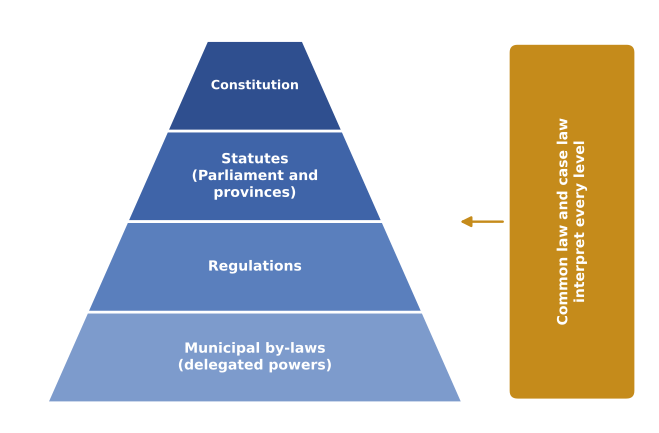
Canadian law comes from four main sources. The Constitution is the supreme law: it includes the Constitution Act, 1867, which divides legislative powers, and the Constitution Act, 1982, which contains the Charter of Rights and Freedoms and the amending formula. Any law inconsistent with the Constitution is of no force or effect to the extent of the inconsistency. Legislation, also called statutes or acts, is passed by Parliament or a provincial legislature; examples include the Canada Business Corporations Act and Ontario's Employment Standards Act, 2000. Regulations are detailed rules made by the government or an agency under authority delegated by a statute, such as the regulations that set provincial minimum wages. Finally, the common law, or case law, is the body of principles developed by judges deciding individual cases, which governs large areas such as contract and negligence where no statute applies.
Canada is bijural. Quebec uses the civil law tradition for private law: the Civil Code of Québec sets out general principles in a comprehensive code, and judges reason from the code rather than from precedent alone, although decisions remain highly persuasive. The other provinces and the territories use the English common law tradition for private law. Federal law, such as criminal law and bankruptcy law, applies across the country and is drafted to work with both traditions. A business operating in Quebec should expect different rules on topics such as contracts of adhesion, warranties, the language of commercial documents under the Charter of the French Language and some aspects of employment.
The division of powers
The Constitution Act, 1867 divides law-making authority between Parliament and the provinces. Section 91 gives Parliament power over matters of national concern, including trade and commerce, banking, currency, bankruptcy and insolvency, patents and copyrights, criminal law, interprovincial transportation and telecommunications. Section 92 gives the provinces power over property and civil rights in the province, local works and undertakings, the incorporation of provincial companies and the administration of justice. Because property and civil rights is a broad category, most everyday business law, including contracts, sale of goods, consumer protection, most employment law and real estate, is provincial. Courts resolve disputes over which level of government may legislate; where valid federal and provincial laws genuinely conflict, the doctrine of federal paramountcy makes the federal law prevail.
The result is that a manager must ask two questions about any regulated activity: which level of government has authority, and which province's law applies? Banks, airlines, railways, interprovincial trucking, telecommunications, broadcasting and federal Crown corporations are federally regulated, so their employees are covered by the Canada Labour Code rather than provincial employment standards. A retailer, restaurant or manufacturer is usually provincially regulated. Municipalities have no constitutional status of their own; they exercise powers delegated by provincial statute, such as zoning, business licensing and property taxes.
Worked problem
Deciding which level of government regulates
Northwind Group runs three businesses: a chain of coffee shops in Manitoba, a trucking company that hauls freight between Winnipeg and Thunder Bay, and a small federally chartered trust company. A manager asks which employment law covers each business and which government would regulate a dispute about the coffee shops' gift cards.
Show solution
- Coffee shops are local businesses under property and civil rights, so Manitoba's Employment Standards Code governs their employees.
- Interprovincial trucking is a federal undertaking (interprovincial transportation), so the Canada Labour Code governs the trucking employees.
- Banking and federally incorporated financial institutions fall under federal jurisdiction, so the trust company follows the Canada Labour Code as well.
- Gift-card terms are a consumer protection matter for the province; Manitoba's consumer protection rules on gift cards (like those of most provinces) restrict expiry dates and fees.
Answer: The same owner deals with two employment regimes: Manitoba law for the coffee shops and the Canada Labour Code for the trucking and trust businesses. Payroll, policies and training must be set up separately.
The Charter and business
The Canadian Charter of Rights and Freedoms protects rights such as freedom of expression (section 2(b)), protection against unreasonable search and seizure (section 8), equality rights (section 15) and mobility rights (section 6). Section 32 applies the Charter only to government: Parliament, the legislatures and government bodies and agents. A private employer that refuses to hire someone is not bound by the Charter, but it is bound by human rights legislation, such as the Canadian Human Rights Act or a provincial human rights code, which prohibits discrimination in employment, services and housing.
Businesses can rely on the Charter when government regulates them. Corporations have successfully challenged laws on the basis of freedom of expression, which includes commercial expression such as advertising. In RJR-MacDonald Inc. v. Canada (Attorney General), decided in 1995, the Supreme Court of Canada struck down parts of a federal ban on tobacco advertising as broader than necessary. Charter rights are not absolute: section 1 allows reasonable limits prescribed by law that can be demonstrably justified in a free and democratic society, tested using the framework from R. v. Oakes (1986), which asks whether the law has a pressing and substantial objective and whether its means are rationally connected, minimally impairing and proportionate. Section 33, the notwithstanding clause, lets Parliament or a legislature override certain rights for renewable five-year periods.
Precedent and how courts make law
In the common law system, judges follow precedent under the doctrine of stare decisis, Latin for to stand by things decided. A lower court must follow the decisions of higher courts in the same hierarchy on the same legal question; this is binding precedent. Decisions from other jurisdictions, or from courts of the same level, are persuasive: a judge may adopt their reasoning but need not. The binding part of a decision is the ratio decidendi, the legal principle necessary to decide the case on its material facts. Comments that are not necessary to the decision are obiter dicta and are only persuasive, although obiter from a top court carries great weight.
Precedent gives predictability, which business needs to plan. It also allows the law to evolve. Courts can distinguish a precedent by showing that the material facts of a new case are different, and the highest court can overrule its own earlier decisions when they are clearly wrong or out of step with social change. Because legislation overrides the common law, a legislature can also reverse a judge-made rule by statute, provided the statute is constitutional.
Worked problem
Reading a case citation
A lawyer's memo cites "Bhasin v. Hrynew, 2014 SCC 71" and "Donoghue v. Stevenson, [1932] A.C. 562 (H.L.)". Explain what each part means and how binding each case is on an Alberta trial court.
Show solution
- Bhasin v. Hrynew names the parties: Bhasin, the appellant at the Supreme Court, and Hrynew. The neutral citation 2014 SCC 71 means it was the 71st decision of the Supreme Court of Canada released in 2014.
- Because the Supreme Court of Canada sits at the top of the hierarchy, its decisions bind every Canadian court on the points it decided. Bhasin recognized a general organizing principle of good faith in contract performance.
- Donoghue v. Stevenson is reported in the Appeal Cases for 1932 at page 562 and was decided by the House of Lords, then the top court of the United Kingdom.
- English decisions are not binding in Canada today, but Donoghue is the foundation of the modern law of negligence and Canadian courts have adopted its reasoning, so in practice its principle is part of Canadian law through binding Canadian decisions that apply it.
Answer: An Alberta trial court must follow Bhasin directly. Donoghue is persuasive in form but its principle is binding through Canadian appellate decisions that adopted it.
Administrative agencies and regulation
Much of the law that affects business day to day is made and enforced by administrative bodies rather than courts. Examples include the Canadian Radio-television and Telecommunications Commission (CRTC), the Competition Bureau and the Competition Tribunal, the Canada Revenue Agency, provincial securities commissions such as the Ontario Securities Commission, workplace safety and insurance boards, labour relations boards and liquor and cannabis regulators. These bodies issue licences, make rules under delegated authority, investigate, hold hearings and impose penalties. A business that disagrees with a decision can usually ask for an internal review, appeal if the statute allows it or apply to a superior court for judicial review. In Canada (Minister of Citizenship and Immigration) v. Vavilov, 2019 SCC 65, the Supreme Court held that courts should generally review administrative decisions for reasonableness, deferring to decisions that are justified, transparent and intelligible, while reviewing some questions, such as constitutional questions, for correctness.
| Body | Main role | Example of business impact |
|---|---|---|
| Competition Bureau / Competition Tribunal | Competition and deceptive marketing | Penalties for drip pricing or misleading environmental claims |
| Provincial securities commissions | Capital markets | Prospectus rules when raising money from investors |
| Canada Revenue Agency | Federal tax administration | GST/HST registration, payroll deductions and audits |
| Office of the Privacy Commissioner | Federal private-sector privacy (PIPEDA) | Investigations after data breaches |
| Provincial labour and employment ministries | Employment standards | Orders to pay unpaid wages or termination pay |
| Workplace safety and insurance boards | Workers' compensation | Premiums and claims after injuries |
Law, ethics and the legal professions
Legal compliance is a floor, not a ceiling. Conduct can be legal but unethical, such as aggressively enforcing a contract term against a small supplier in crisis, and the reputational cost can exceed any legal gain. Conversely, ethical intentions do not excuse legal mistakes: a manager who sincerely believes a worker is a contractor still exposes the company to unpaid payroll taxes and penalties if the law says otherwise. Good legal risk management combines compliance programs, training, sound contracts, insurance and early advice. Lesson 12 pulls these tools together in a legal risk audit.
Legal services in Canada are regulated by provincial law societies. Lawyers, called barristers and solicitors in the common law provinces, must hold a licence from the law society of the province where they practise. Ontario also licenses paralegals to appear in Small Claims Court and before some tribunals. In Quebec, advocates (avocats) handle litigation and advice, while notaries (notaires) handle real estate transactions, wills and many contracts. Communications between a client and lawyer for the purpose of legal advice are protected by solicitor-client privilege, which is close to absolute; this is one reason to involve a lawyer early when a dispute or investigation looms.
Worked problem
Spotting the legal issues in a business scenario
Kestrel Kitchens, a Halifax caterer, has a busy week. A customer emails to cancel a wedding booking two weeks before the event and demands her deposit back. A delivery driver slips on ice in a client's parking lot. The Nova Scotia Department of Labour inspects the kitchen's payroll records. The owner wants to post a reply to an online review accusing a competitor of using expired ingredients. Identify the area of law for each issue.
Show solution
- Cancellation and deposit: contract law (the terms on deposits and cancellation) and consumer protection law (rules on unfair terms and refunds). Lessons 3 to 5 and 11.
- Driver injury: workers' compensation if the driver is an employee, because in Nova Scotia workers' compensation generally replaces the right to sue the employer; possible occupiers' liability claim against the client. Lesson 6.
- Payroll inspection: administrative and employment law; the inspector can order payment of unpaid wages. Lesson 10.
- Reply to review: tort law (defamation and injurious falsehood) if the accusation is false. Lesson 7.
Answer: One ordinary week touches contract, consumer, tort, employment and administrative law. Recognizing the category tells the owner what rules matter, what records to keep and whether to call a lawyer before acting, especially before posting the reply.
Common mistakes
MistakeAssuming constitutional rights apply between private parties, for example that a private employer violates free expression by disciplining an employee.
InsteadThe Charter binds government; human rights statutes and employment law govern private employers.
MistakeTreating a regulatory inspection like an informal conversation.
InsteadRegulators have statutory powers; know your rights and obligations, keep good records and get advice when penalties are possible.
MistakeRelying on a court decision from another jurisdiction as if it were binding.
InsteadCheck which court decided the case and whether it binds courts where your dispute would be heard.
MistakeAssuming the same rules apply in every province.
InsteadMost business law is provincial; check the law of each province where you operate, especially Quebec.
MistakeCalling a lawyer only after a dispute has escalated.
InsteadSeek advice early, when options are cheaper and privilege can protect candid discussions.
Summary and key terms
- Law is enforced by state power; it overlaps with but differs from ethics.
- Public, private, substantive, procedural, civil and criminal are key classifications; civil cases need proof on the balance of probabilities.
- Canadian law comes from the Constitution, legislation, regulations and the common law; Quebec uses the civil law for private law.
- Sections 91 and 92 of the Constitution Act, 1867 divide powers; most everyday business law is provincial.
- The Charter binds government; section 1 permits justified limits; human rights codes bind private businesses.
- Stare decisis makes higher-court rulings binding; the ratio is binding and obiter is persuasive.
- Administrative agencies make and enforce much business regulation, subject to judicial review.
- Early legal advice, protected by privilege, is a key risk management tool.
- Common law
- Law developed by judges through decisions in individual cases.
- Statute
- A law passed by a legislature.
- Regulation
- A detailed rule made under authority delegated by a statute.
- Stare decisis
- The doctrine that courts follow precedent set by higher courts.
- Ratio decidendi
- The legal principle necessary to decide a case, which is binding.
- Obiter dicta
- Comments in a judgment that are not necessary to the decision.
- Judicial review
- A court's review of whether a government or agency decision was lawful.
- Privilege
- Protection from disclosure for confidential communications with a lawyer for legal advice.
- Paramountcy
- The doctrine that valid federal law prevails over conflicting provincial law.
- Balance of probabilities
- The civil standard of proof: more likely than not.
Practice problems
Work each problem on paper first, then reveal the answer to check.
Distinguish public law from private law and give an example of each.
Show answer
Public law governs the state and individuals (criminal, constitutional, tax); private law governs private parties (contract, tort).
What standard of proof applies in a civil lawsuit?
Show answer
The balance of probabilities.
Under which section of the Constitution Act, 1867 do provinces regulate most contracts?
Show answer
Section 92(13), property and civil rights in the province.
Is a federally regulated bank covered by provincial employment standards?
Show answer
No; it is covered by the Canada Labour Code.
Does the Charter apply to a private retailer's hiring decisions?
Show answer
No; provincial human rights legislation applies instead.
Explain the difference between the ratio decidendi and obiter dicta.
Show answer
The ratio is the principle necessary to decide the case and is binding; obiter dicta are other remarks and are persuasive.
What does it mean to distinguish a precedent?
Show answer
To show that the material facts differ, so the precedent does not apply.
What standard of review did Vavilov establish as the default?
Show answer
Reasonableness.
Give two reasons to involve a lawyer early in a dispute.
Show answer
Options are cheaper early, and privilege protects candid communications.
Portfolio task: list five legal issues your workplace or a business you know faced in the past year and classify each.
Show answer
Answers vary; a good answer names the area of law (contract, tort, employment, regulatory) and the body that would decide it.
Lesson quiz · 5 questions
Score 60% or more to complete this lesson.
Create a free account to save your progress, take quizzes and earn a certificate.