
BUS-210 · Lesson 3 of 12 · 38 min
Contract law I: formation
Contracts are the legal backbone of business. Every sale, lease, loan, employment relationship, software subscription and supply chain rests on agreements that the law will enforce. A contract is a legally enforceable agreement: a promise or set of promises that the law will recognize and for whose breach it gives a remedy. This lesson covers how contracts are formed: offer and acceptance, consideration, intention, capacity, legality and form, including contracts made online. Lesson 4 covers what contracts mean and what happens when something goes wrong in their making or performance, and lesson 5 covers remedies and the special rules for sales of goods.
Contract law in the common law provinces is mostly judge-made, supplemented by statutes such as the sale of goods acts, consumer protection acts and electronic commerce acts. Quebec contract law is set out in the Civil Code of Québec, which shares many concepts with the common law but expresses them differently, for example by requiring good faith in the formation, performance and termination of every contract. This lesson focuses on the common law, with notes on Quebec where it differs sharply.
The elements of a contract
A valid contract requires an offer, an acceptance of that offer, consideration (something of value exchanged by each side), an intention to create legal relations, parties with legal capacity and a lawful purpose. Some contracts also require a particular form, such as writing. If an element is missing, there is no contract, and a party who performed may be limited to recovering the value of what it provided. Courts judge formation objectively, by asking what a reasonable person in the position of the other party would have understood from words and conduct, not what a party secretly intended.
| Element | Question to ask | Typical problem |
|---|---|---|
| Offer | Did one party make a definite proposal showing willingness to be bound? | An advertisement or price list is usually only an invitation to make offers |
| Acceptance | Did the other party unconditionally agree, in a permitted way, while the offer was open? | A reply that changes the terms is a counter-offer, not an acceptance |
| Consideration | Did each side give or promise something of value? | Gratuitous promises and past consideration are not enforceable |
| Intention | Would a reasonable person think the parties meant to be legally bound? | Social arrangements and "subject to contract" negotiations |
| Capacity | Were the parties legally able to contract? | Minors, people lacking mental capacity, unauthorized agents |
| Legality | Is the purpose lawful and consistent with public policy? | Contracts to commit crimes; unreasonable restraints of trade |
| Form | Does the law require writing or another formality? | Guarantees and interests in land in some provinces |
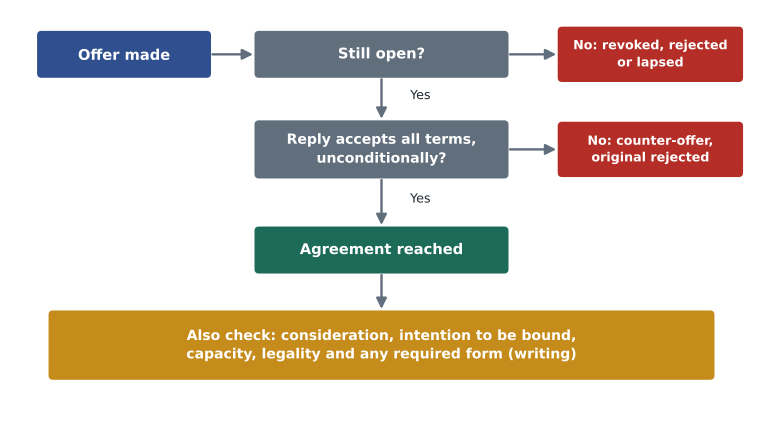
Offer
An offer is a proposal that shows a willingness to be bound on definite terms as soon as the other party accepts. It must be communicated to the offeree and must be sufficiently certain: the essential terms, such as the parties, the subject matter and the price or a way to determine it, must be clear enough for a court to enforce. An offer must be distinguished from an invitation to treat, which invites others to make offers. Advertisements, catalogues, price lists, goods displayed on shelves and websites showing products are usually invitations to treat, because a seller does not intend to be bound to sell to everyone who responds, perhaps beyond its stock.
The classic Canadian authorities follow English cases. In Pharmaceutical Society of Great Britain v. Boots Cash Chemists (1953), goods on a self-service shelf were held to be an invitation to treat: the customer makes the offer at the till and the cashier accepts. In Carlill v. Carbolic Smoke Ball Co. (1893), however, an advertisement promising £100 to anyone who used the company's smoke ball as directed and still caught influenza was held to be an offer of a unilateral contract, because it was specific, and the company had deposited £1,000 in a bank to show its sincerity. Mrs. Carlill accepted by performing the conditions, without needing to notify the company. A business that promises a reward or bonus in specific terms can be bound in the same way.
Offers do not last forever. An offer ends when it is revoked by the offeror before acceptance (revocation must be communicated, though it can come from a reliable third party), when it is rejected, when the offeree makes a counter-offer, when it lapses at the end of a stated time or, if no time is stated, after a reasonable time, and on the death or incapacity of a party in some situations. An offeror may revoke even after promising to keep the offer open, unless the offeree paid for that promise (an option contract) or the law provides otherwise.
| How an offer ends | Explanation | Business example |
|---|---|---|
| Revocation | The offeror withdraws before acceptance | A supplier emails withdrawing a quote before the buyer accepts |
| Rejection | The offeree says no | The buyer replies "not interested" |
| Counter-offer | The offeree proposes different terms, which rejects the original | "We accept if delivery is in 14 days instead of 30" |
| Lapse of time | A stated deadline passes, or a reasonable time if none | A quote valid for 30 days expires |
| Death or incapacity | The offeror or offeree dies or loses capacity, in many situations | A sole proprietor dies before the offer is accepted |
Canadian common law has no general firm offer rule: a promise to keep an offer open is binding only if the offeree gave consideration for it, creating an option, or if the promise was made under seal. In tendering, however, the Supreme Court of Canada in R. v. Ron Engineering & Construction (Eastern) Ltd. (1981) held that submitting a compliant bid in response to a call for tenders can create Contract A, under which the bidder cannot withdraw its bid and the owner must treat bidders fairly, separate from Contract B, the construction contract itself.
Acceptance
Acceptance is the offeree's unconditional agreement to all the terms of the offer, communicated to the offeror. Under the common law mirror image rule, a reply that adds or changes terms is not an acceptance but a counter-offer, which rejects the original offer. Acceptance must normally be communicated; silence is generally not acceptance, because one party cannot impose an obligation on another by saying that silence will count as agreement. Acceptance can be by words or conduct, such as shipping goods in response to an order. In a unilateral contract, acceptance is by performing the requested act.
The method of communication matters for timing. For instantaneous methods, such as telephone or in-person conversation, acceptance takes effect when the offeror receives it. Under the traditional postal acceptance rule, an acceptance sent by mail takes effect when it is posted, if mail was a reasonable method. For email and online communication, provincial electronic commerce statutes, such as Ontario's Electronic Commerce Act, 2000, address when an electronic message is sent and received, and courts generally treat email acceptances as effective when they reach the offeror's system. Offers that specify a method of acceptance must be accepted in that way.
Worked problem
Tracing offer, counter-offer and acceptance
On May 1 Delta Signs emails a quote to Harbour Café: 12 menu boards for $6,000, delivery in 30 days, quote valid for 14 days. On May 4 Harbour replies: "We accept, provided you include installation at no charge." On May 6 Delta replies: "Installation is $400 extra." On May 9 Harbour emails: "OK, we accept your original quote of May 1." On May 10 Delta says its prices have gone up and it will no longer sell at $6,000. Is there a contract?
Show solution
- May 1: Delta's quote is specific and states a period, so it is an offer.
- May 4: Harbour's reply adds a new term (free installation), so it is a counter-offer, which rejects the May 1 offer.
- May 6: Delta's reply rejects the counter-offer and arguably makes a new offer: boards plus installation for $6,400.
- May 9: Harbour purports to accept the May 1 offer, but that offer was destroyed by the counter-offer on May 4. The May 9 email is a new offer at the original terms.
- May 10: Delta rejects that offer. There is no contract.
Answer: There is no contract. Harbour's "acceptance with a condition" was the fatal step. In practice, Harbour should have accepted cleanly and then asked about installation as a separate question, or confirmed in writing that it was not rejecting the quote.
The battle of the forms arises when businesses exchange standard purchase orders and acknowledgements with conflicting fine print. Canadian courts generally apply the traditional approach from Butler Machine Tool Co. v. Ex-Cell-O Corp. (1979): each form that changes terms is a counter-offer, and the last form sent before performance, often the seller's acknowledgement accepted by the buyer taking delivery, usually wins. Courts sometimes look at the whole course of dealing instead. The practical lesson is to read the other side's forms and to negotiate key terms such as warranties and limitations of liability rather than rely on the fine print.
Worked problem
Resolving a battle of the forms
A Calgary restaurant group sends a purchase order for ovens stating that the seller warrants them for two years. The seller replies with an acknowledgement form stating a 90-day warranty and excluding liability for consequential losses, then ships. The buyer accepts delivery without objecting. One oven fails in month 8. Which warranty applies?
Show solution
- The acknowledgement changes the warranty term, so it is a counter-offer rather than an acceptance.
- The buyer accepted the counter-offer by conduct when it took delivery without objecting.
- Under the traditional last-shot approach, the seller's terms govern: a 90-day warranty and no consequential damages.
- A court might reach a different result if the parties had a course of dealing that showed agreement on the buyer's terms, or if a statutory implied condition under the Alberta Sale of Goods Act applies and was not validly excluded (lesson 5).
Answer: The seller probably wins on the 90-day warranty because its form was the last shot. The buyer should have objected in writing or negotiated a signed master agreement.
Consideration
In the common law, a promise is enforceable only if it is supported by consideration: something of value given in exchange for the promise. Consideration can be money, goods, services, a promise to do something or a promise not to do something one is entitled to do, such as forgo a legal claim. Courts do not ask whether the bargain was fair; consideration need only have some value in the eyes of the law, so a peppercorn can support a promise. What matters is that the consideration was bargained for. A promise to make a gift is not enforceable, and neither is past consideration, something already done before the promise was made, such as a promise to pay an employee a bonus for work completed last year without any earlier agreement.
A promise to perform an existing contractual duty is traditionally not good consideration for a new promise. If a contractor demands more money to finish a job it is already bound to complete, the owner's promise to pay more is unenforceable under the classic rule. Canadian courts have softened this. In Greater Fredericton Airport Authority Inc. v. NAV Canada (2008), the New Brunswick Court of Appeal held that a variation of an existing contract can be enforced without fresh consideration if it was not procured under economic duress. Promissory estoppel can also help: if a party makes a clear promise to alter legal relations and the other party relies on it, the promisor may be prevented from going back on the promise (Maracle v. Travellers Indemnity Co. of Canada, 1991 SCC). In Canada, promissory estoppel is traditionally a shield, a defence, not a sword that founds a new cause of action. A promise made under seal is enforceable without consideration, a formality still used for some guarantees and real estate documents.
Worked problem
Is the promise enforceable?
Pinecrest Builders agreed to build a warehouse for Orion Logistics for a fixed price of $2.4 million. Halfway through, steel prices rose sharply. Pinecrest told Orion it could not finish without an extra $150,000. Orion, which needed the warehouse for the holiday season and could not find another builder in time, agreed by email. After completion, Orion refused to pay the extra amount. Is Orion's promise enforceable?
Show solution
- Pinecrest was already bound to complete the warehouse for $2.4 million, so under the classic rule its performance is not fresh consideration.
- Under the NAV Canada approach, the variation may be enforceable without fresh consideration if Orion agreed freely and not under economic duress.
- Orion will argue economic duress: it had no practical alternative and Pinecrest exploited that. Pinecrest will argue the price rise was genuine and unforeseen and that it did not threaten bad faith.
- The result turns on the facts: whether the steel increase was truly unanticipated, whether Pinecrest acted in good faith and whether Orion protested at the time.
Answer: The outcome is uncertain, which is the practical lesson: when circumstances change, parties should document a variation properly, with fresh consideration (for example Pinecrest agreeing to an earlier completion date) and a clear statement that both sides agree freely, or use a price-adjustment clause from the start.
Intention, capacity and legality
Courts presume that parties to commercial agreements intend to create legal relations, and that family and social arrangements do not. The commercial presumption can be rebutted by clear words, such as a letter of intent stated to be non-binding or a statement that an agreement is subject to a formal contract. Letters of intent and memoranda of understanding are a common source of disputes: they should say clearly which provisions are binding (often confidentiality, exclusivity and costs) and which are not.
Minors, people under the age of majority, have limited capacity. The age of majority is 18 in Alberta, Manitoba, Ontario, Prince Edward Island, Quebec and Saskatchewan, and 19 in the other provinces and the territories. A contract with a minor is generally voidable at the minor's option, except for contracts for necessaries (such as food, clothing and shelter suited to the minor's situation), for which the minor must pay a reasonable price, and beneficial contracts of service. British Columbia's Infants Act makes most contracts with minors unenforceable against them unless a court approves. Adults who lack the mental capacity to understand a contract, because of illness or intoxication, may avoid it if the other party knew or ought to have known of the incapacity. Corporations have the capacity of a natural person under the Canada Business Corporations Act and provincial statutes, but individuals acting for them must have authority (lesson 8).
A contract with an illegal purpose, such as an agreement to fix prices or to pay a bribe, is void and courts will not enforce it. Contracts that offend public policy are also unenforceable. The most important category for business is restraint of trade: covenants not to compete or solicit, which are enforced only if reasonable in scope, duration and geography and necessary to protect a legitimate interest such as trade secrets or customer goodwill. Courts are stricter with employment restrictive covenants than with those in the sale of a business, and several jurisdictions now prohibit most employee non-competes outright. Lesson 10 covers these rules.
Form and electronic contracts
Most contracts can be made orally or by conduct, but writing makes proof far easier. Ontario's Statute of Frauds still requires a signed writing for guarantees of another person's debt and for contracts creating interests in land, and other provinces have similar rules; British Columbia's Law and Equity Act requires writing for land contracts and guarantees. Consumer protection statutes require written agreements with specific disclosures for many consumer contracts, such as internet agreements and future performance agreements. Electronic commerce statutes in every province confirm that electronic documents and signatures satisfy writing and signature requirements, with some exceptions such as wills and certain land documents.
Online, contracts are formed in several ways. In a clickwrap agreement, the user must click "I agree" after being shown the terms or a clear link to them; courts generally enforce these. In a browsewrap agreement, terms are posted somewhere on the site and the user is said to agree by using it; courts often refuse to enforce browsewrap terms because users may never see them. Sign-in-wrap agreements, which say that by creating an account the user agrees to linked terms, are generally enforced if the notice is clear and conspicuous. A business that wants its online terms to hold should require an affirmative act, display the terms clearly, keep records of acceptance and highlight unusual terms such as arbitration clauses.
Worked problem
Are the website terms binding?
Brightline Tickets sells event tickets online. Its checkout page has a "Buy now" button. Below the button, in small grey text, is the line "Terms of use" with a link; the terms include a clause requiring all disputes to be resolved by arbitration and limiting refunds. A customer who bought tickets for a cancelled concert sues for a refund. Are the terms part of the contract?
Show solution
- The customer did not have to click an "I agree" box or scroll through the terms, so this is not a true clickwrap.
- The link is small, grey and placed below the button, and nothing says that buying means agreeing to the terms, so the notice is not clear and conspicuous.
- A court would likely treat this as browsewrap and refuse to enforce the terms against the customer. Consumer protection law in many provinces would also limit an arbitration clause and require disclosure of refund terms in internet agreements.
- To fix the flow, Brightline should add an unticked box reading "I agree to the Terms of use", or text immediately next to the button stating that clicking it means agreeing to the linked terms, and keep a record of each acceptance.
Answer: The terms are probably not binding as presented. Clear presentation and an affirmative act are what make online terms enforceable.
Common mistakes
MistakeTreating an advertisement or quote request as a binding offer in every case.
InsteadAsk whether a reasonable person would see a definite willingness to be bound; most ads are invitations to treat.
MistakeAccepting an offer "subject to" a new condition.
InsteadAccept unconditionally, then negotiate changes separately; a conditional acceptance is a counter-offer.
MistakeRelying on standard forms to settle terms in a battle of the forms.
InsteadNegotiate key terms in a signed master agreement and object in writing to conflicting terms.
MistakePromising a bonus for work already completed and assuming it is enforceable.
InsteadPast consideration does not support a promise; agree on bonuses in advance or document fresh consideration.
MistakePosting website terms in a footer link and assuming customers agreed.
InsteadUse clickwrap with an affirmative act, clear notice and records of acceptance.
Summary and key terms
- A contract needs offer, acceptance, consideration, intention, capacity, legality and any required form.
- Advertisements are usually invitations to treat, but specific promises can be offers of unilateral contracts.
- Offers end by revocation, rejection, counter-offer, lapse or death or incapacity.
- Acceptance must mirror the offer; the last shot often wins the battle of the forms.
- Consideration must be bargained for; past consideration fails; variations without consideration may be enforced absent duress; promissory estoppel is a shield.
- Commercial agreements are presumed to be intended as binding; letters of intent must say what binds.
- Minors and those lacking capacity can usually avoid contracts, except for necessaries.
- Writing is required for guarantees and land contracts in many provinces; electronic signatures are valid.
- Clickwrap terms are generally enforced; browsewrap terms often are not.
- Offer
- A definite proposal showing a willingness to be bound on acceptance.
- Invitation to treat
- An invitation to others to make offers, such as most advertisements.
- Counter-offer
- A reply that changes the terms of an offer, rejecting it and making a new offer.
- Unilateral contract
- A contract accepted by performing a requested act.
- Consideration
- Something of value given in exchange for a promise.
- Promissory estoppel
- A doctrine preventing a promisor from going back on a promise the other party relied on.
- Option contract
- A paid promise to keep an offer open.
- Battle of the forms
- A dispute over terms when businesses exchange conflicting standard forms.
- Clickwrap
- An online agreement accepted by clicking to agree after notice of the terms.
- Contract A
- In tendering, the contract formed by submitting a compliant bid, which governs the bidding process.
Practice problems
Work each problem on paper first, then reveal the answer to check.
List the elements of a valid contract.
Show answer
Offer, acceptance, consideration, intention to create legal relations, capacity, legality and any required form.
Is a product displayed on a store shelf an offer?
Show answer
Usually no; it is an invitation to treat, and the customer offers to buy at the checkout.
A buyer replies to a quote: "We accept if you deliver by Friday." What is the legal effect?
Show answer
It is a counter-offer that rejects the original offer.
Can a seller revoke a quote it promised to keep open for 30 days?
Show answer
Yes, unless the buyer paid for the promise (an option) or it was under seal.
Why is past consideration not good consideration?
Show answer
Because it was not given in exchange for the promise; it was already done.
Is promissory estoppel a sword or a shield in Canada?
Show answer
Traditionally a shield (a defence), not a cause of action.
What is the age of majority in British Columbia?
Show answer
19.
What should a letter of intent say about binding effect?
Show answer
It should state clearly which provisions are binding and which are not.
Distinguish clickwrap from browsewrap.
Show answer
Clickwrap requires an affirmative act to agree after notice; browsewrap merely posts terms and is often unenforceable.
Portfolio task: review the online checkout or account sign-up of a business you know and say whether its terms would likely bind customers.
Show answer
Answers vary; a good answer checks for an affirmative act, conspicuous notice, proximity of the link and records of acceptance.
Lesson quiz · 5 questions
Score 60% or more to complete this lesson.
Create a free account to save your progress, take quizzes and earn a certificate.