
BUS-210 · Lesson 5 of 12 · 39 min
Remedies and the sale of goods
When a contract is broken, the innocent party wants to know what it can get. The law's main answer is money: damages designed to put the innocent party in the position it would have been in if the contract had been performed. In some cases courts order a party to perform or to stop doing something. This lesson explains how damages are measured and limited, when equitable remedies are available and how the law protects someone who has conferred a benefit without a valid contract. It then turns to the special rules for contracts for the sale of goods, which govern a huge share of business transactions.
The purpose of contract damages
Contract damages compensate; they do not punish. The usual measure is expectation damages, which give the innocent party the benefit of its bargain: the value it would have received from performance, minus any costs it saved by not having to perform. When expected profits are too speculative to prove, for example for a new venture, a court may award reliance damages, which reimburse expenses the innocent party incurred in reliance on the contract, putting it back where it was before the contract. Restitution returns to the innocent party the value of any benefit it conferred on the party in breach, preventing unjust enrichment.
Worked problem
Expectation versus reliance damages
Fernbrook Foods agreed to supply a new restaurant, Olive Lane, with a commercial kitchen fit-out for $120,000. Olive Lane paid a $30,000 deposit and spent $18,000 on design fees and permits that are useless without the fit-out. Fernbrook repudiated before starting work. Olive Lane found another supplier who will do the same job for $135,000, and the opening is delayed by a month. Its accountant estimates lost profit for the month at $12,000, based on a detailed forecast. Calculate Olive Lane's expectation damages and compare reliance damages.
Show solution
- Return of deposit: Fernbrook must repay the $30,000 deposit (restitution of money paid for a performance never given).
- Extra cost of substitute performance: $135,000 − $120,000 = $15,000.
- Lost profit from the delay: $12,000, if proven with reasonable certainty and foreseeable (see Hadley below).
- The $18,000 of design and permit costs is not lost: Olive Lane can still use the designs and permits with the new supplier, so it is not added to expectation damages.
- Expectation recovery = $30,000 + $15,000 + $12,000 = $57,000.
- Reliance damages, if profits were too speculative, would be the deposit plus wasted expenditure: here only expenses actually wasted would count.
Answer: Olive Lane recovers about $57,000 on an expectation basis. Expectation damages are usually larger, but reliance damages protect a plaintiff that cannot prove its lost profits, provided the defendant cannot show the contract would have lost money anyway.
Limits on damages: remoteness, mitigation and certainty
Not every loss that follows a breach is recoverable. Under the rule in Hadley v. Baxendale (1854), damages are limited to losses that arise naturally, in the usual course of things, from the breach, or that were in the reasonable contemplation of both parties when they made the contract as a probable result of breach. In Hadley, a mill's crankshaft broke and a carrier delayed delivering it for repair. The mill sued for profits lost while it stood idle. The court held the carrier was not liable, because it did not know that the mill had no spare shaft, and stopping a mill was not the natural consequence of a delayed parcel. The practical lesson is that a business that faces unusual losses if a supplier fails should tell the supplier when contracting, so those losses are in contemplation, and the supplier can price the risk or refuse it.
The innocent party must also mitigate: take reasonable steps to reduce its loss. It cannot recover losses it could reasonably have avoided, but it can recover reasonable costs of mitigating, even if the attempt fails. A landlord whose tenant abandons commercial premises, a seller whose buyer refuses goods and an employee who is wrongfully dismissed are all expected to seek substitute arrangements, and their damages are reduced by what they earned or should have earned. Finally, damages must be proved with reasonable certainty; courts do their best with difficult evidence, but they will not award damages based on pure speculation.
Canadian law also allows damages for mental distress in contracts whose object is to secure a psychological benefit, such as disability insurance or a holiday, where such distress was within the reasonable contemplation of the parties (Fidler v. Sun Life Assurance Co. of Canada, 2006 SCC 30). Punitive damages are exceptional in contract cases. In Whiten v. Pilot Insurance Co., 2002 SCC 18, an insurer that refused to pay a fire claim and falsely alleged arson was ordered to pay $1 million in punitive damages because its conduct was a separate actionable wrong, a breach of its duty of good faith, and was high-handed and malicious.
Worked problem
Applying remoteness and mitigation
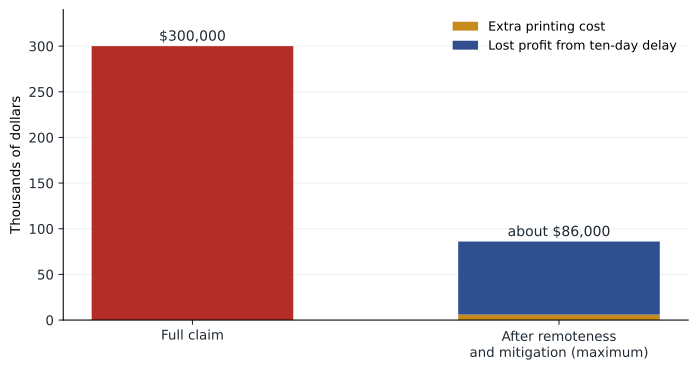
Granite Print agrees to deliver 50,000 printed catalogues to Norwood Outfitters by August 15 for $40,000. Norwood plans a back-to-school mail campaign it expects to generate $300,000 in profit, but it does not tell Granite about the campaign. Granite delivers on September 10. Norwood claims $300,000 in lost profit. A competing printer could have delivered by August 25 for $46,000 if Norwood had placed a rush order when it learned on August 1 that Granite was behind schedule, and an August 25 mailing would have earned an estimated $220,000 in profit.
Show solution
- Remoteness: catalogue delay naturally causes some lost sales, but the scale of a specific $300,000 campaign was not communicated, so Granite will argue only ordinary losses are recoverable.
- Mitigation: Norwood learned of the delay on August 1 and could have ordered elsewhere for delivery August 25. The loss it could reasonably have avoided is not recoverable.
- Had Norwood mitigated, its loss would have been the extra printing cost ($46,000 − $40,000 = $6,000) plus the lost profit from mailing ten days late ($300,000 − $220,000 = $80,000), if that profit was within contemplation.
- A court would likely cap recovery at no more than about $86,000, and possibly much less if the campaign profits were too remote, rather than $300,000.
Answer: Norwood's failure to warn Granite and failure to mitigate cut its recovery sharply. Businesses with time-critical needs should say so in the contract, and act quickly to limit losses once a breach is likely.
Liquidated damages and penalties
Parties often agree in advance on the damages payable for a breach, such as a fixed amount per day of construction delay. A liquidated damages clause is enforceable if it is a genuine pre-estimate of the loss when the contract was made. A clause that sets an amount out of all proportion to any likely loss, intended to frighten the other party into performing, is an unenforceable penalty, and the innocent party recovers only its actual damages. Canadian courts have also applied unconscionability analysis to penalty clauses, and some commentators expect the Supreme Court eventually to follow the United Kingdom, which in 2015 reframed the test to ask whether the clause protects a legitimate interest. Deposits paid as an earnest of performance are generally forfeited on the payer's breach, though courts may grant relief if forfeiture would be unconscionable.
Worked problem
Liquidated damages or penalty?
A contract to build a $3 million distribution centre provides that the builder will pay $4,000 for each day of delay past the completion date. The owner estimated when signing that each day of delay would cost about $3,500 in extra warehouse rental and lost shipping revenue. A second contract, for a $20,000 office renovation, provides for $5,000 per day of delay. Which clause is enforceable?
Show solution
- Warehouse: $4,000 per day is close to the $3,500 pre-estimate, and delay losses are hard to prove precisely. The clause is a genuine pre-estimate and likely enforceable, even if actual losses turn out lower.
- Office renovation: $5,000 per day on a $20,000 job bears no reasonable relationship to any likely loss from a delayed office renovation. It looks designed to coerce performance.
- The office clause is likely an unenforceable penalty, so the owner must prove its actual losses, such as temporary office rent.
Answer: The warehouse clause probably holds; the office clause probably fails. Documenting how the daily rate was calculated when the contract is signed helps defend a liquidated damages clause.
Equitable remedies and restitution
When damages are inadequate, courts may grant equitable remedies, which are discretionary. Specific performance orders a party to carry out the contract. It is available mainly when the subject matter is unique, so money cannot buy a substitute, such as a rare work of art, a specific business or, often, land. Courts will not order specific performance of personal service contracts, because forcing people to work together is impractical and close to servitude, nor of contracts requiring constant supervision. An injunction orders a party to do or, more commonly, not to do something, such as not to disclose confidential information or not to work for a competitor in breach of a valid covenant. Interlocutory injunctions can be granted urgently before trial when the applicant shows a serious issue to be tried (or a strong case, for some orders), irreparable harm and that the balance of convenience favours the order. Rectification corrects a written document that fails to record what the parties actually agreed.
In Semelhago v. Paramadevan (1996), the Supreme Court of Canada held that land is not automatically unique; a buyer seeking specific performance of a real estate contract must show that the property has a special value that damages cannot replace, which is harder for an investment property or a standard condominium unit.
Where one party has conferred a benefit on another without a valid contract, the law of unjust enrichment may require payment. A claimant must show an enrichment of the defendant, a corresponding deprivation of the claimant and the absence of a juristic reason for the enrichment, such as a contract or gift (Garland v. Consumers' Gas Co., 2004 SCC 25). A common business application is quantum meruit, a reasonable payment for work done at the defendant's request where the price was never agreed or the contract proved unenforceable.
| Remedy | What it does | When available |
|---|---|---|
| Expectation damages | Gives the benefit of the bargain | The usual remedy for breach |
| Reliance damages | Reimburses wasted expenses | When expected profits are too uncertain |
| Restitution or quantum meruit | Returns a benefit conferred | When there is no valid contract, or to recover a deposit or value of work |
| Liquidated damages | Pays an agreed amount | When the clause is a genuine or reasonable pre-estimate |
| Specific performance | Orders performance | Unique subject matter; not personal services |
| Injunction | Orders a party to do or not do something | Harm that money cannot repair |
| Rescission | Unwinds the contract | Misrepresentation, mistake, duress, undue influence |
| Rectification | Corrects the written document | Writing fails to record the actual agreement |
Sale of goods legislation
Every common law province has a Sale of Goods Act, based on the English Sale of Goods Act of 1893, that applies to contracts in which a seller transfers or agrees to transfer the property in goods to a buyer for money. Goods are tangible movable things; land, services and, generally, intangible items such as software licences fall outside the acts, although courts sometimes treat software on a physical medium as goods. The acts supply default rules that apply unless the parties agree otherwise, and they imply conditions that protect buyers. Quebec's rules are in the Civil Code. International sales between businesses in different contracting countries are governed by the United Nations Convention on Contracts for the International Sale of Goods (CISG), which Canada has implemented, unless the parties exclude it.
| Implied term (Ontario Sale of Goods Act) | What it requires | Notes |
|---|---|---|
| Title | The seller has the right to sell, and the buyer will enjoy quiet possession | A condition; cannot be excluded |
| Description | Goods correspond with their description | A condition, applies to all sales by description |
| Fitness for purpose | Goods are reasonably fit for a purpose the buyer made known, relying on the seller's skill | A condition, when the seller deals in such goods |
| Merchantable quality | Goods bought by description from a dealer are of merchantable quality | Not for defects the buyer examined and should have seen |
| Sample | Bulk corresponds with the sample, and the buyer can compare them | A condition in sales by sample |
In business-to-business sales, the parties can exclude the implied conditions by clear words, although courts read exclusions strictly and apply the Tercon test. In consumer sales, provincial consumer protection legislation prevents exclusion: Ontario's Consumer Protection Act, 2002 deems the implied conditions and warranties of the Sale of Goods Act to apply to goods supplied under consumer agreements and makes any attempt to exclude them void, and other provinces have similar provisions. Saskatchewan and New Brunswick have separate consumer product warranty statutes that also give consumers rights against manufacturers.
Transfer of ownership and risk
Sale of goods acts set rules for when property, and with it the risk of loss, passes from seller to buyer, unless the parties agree otherwise. Under the first rule, in an unconditional contract for specific goods in a deliverable state, property passes when the contract is made, even if payment and delivery are postponed. If something must be done to put specific goods in a deliverable state, property passes when it is done and the buyer has notice. For goods sold on approval, property passes when the buyer signals approval or keeps the goods beyond the agreed time. For unascertained or future goods sold by description, property passes when goods of that description in a deliverable state are unconditionally appropriated to the contract, for example by delivering them to a carrier for the buyer. Because risk generally follows property, businesses should state expressly when risk passes, and international traders use Incoterms such as FCA, CIF and DDP, published by the International Chamber of Commerce, to allocate costs and risk.
Worked problem
Who bears the loss in transit?
A Montreal furniture maker contracts to sell 40 identical chairs from its general inventory to an Ottawa café, with delivery by the maker's choice of carrier. The contract says nothing about risk. The maker labels 40 chairs for the café and hands them to a trucking company, notifying the café. The truck is in an accident and the chairs are destroyed. Who bears the loss? (Assume the common law Sale of Goods Act rules apply; Quebec's Civil Code would need separate analysis.)
Show solution
- The chairs were unascertained goods sold by description from general inventory.
- Property passed when goods in a deliverable state were unconditionally appropriated to the contract with the buyer's assent, here by labelling them and delivering them to the carrier for transmission to the buyer.
- Risk generally passes with property, so the café bears the loss and must pay for the chairs.
- The café's remedy is against the carrier or its own insurer. Had the contract specified delivered terms such as DDP Ottawa, the seller would have borne the risk.
Answer: Shipping terms are not mere logistics: they decide who must insure the goods in transit. Both sides should check that their insurance matches the risk allocation.
Remedies in sales of goods
A seller that has not been paid has remedies against the goods as well as against the buyer: a lien allowing it to keep goods still in its possession until paid, a right to stop goods in transit if the buyer becomes insolvent and a limited right to resell. It can sue for the price if property has passed, or for damages for non-acceptance, usually the difference between the contract price and the market price at the time of refusal. A buyer whose seller fails to deliver can claim the difference between the market price and the contract price, and can reject goods for breach of a condition if it has not yet accepted them. Under federal insolvency law, an unpaid supplier can also demand the return of goods delivered to a bankrupt or receivership purchaser in the 30 days before, if they remain identifiable and in the same state.
Worked problem
Calculating damages for non-delivery
Kestrel Brewing contracts to buy 20 tonnes of malted barley at $900 per tonne for delivery on April 1. On March 20 the seller says it will not deliver because prices have risen. Kestrel buys 20 tonnes elsewhere on March 25 at $1,080 per tonne, paying $600 extra freight. Kestrel also loses an expected $5,000 profit because the substitute barley arrived a week late, and the seller knew Kestrel needed the barley for a seasonal beer. Calculate Kestrel's damages.
Show solution
- Market-price measure: ($1,080 − $900) × 20 = $3,600, using the market price available when Kestrel reasonably bought substitute goods after the repudiation.
- Incidental cost of extra freight: $600.
- Lost profit: $5,000, if it was within the reasonable contemplation of both parties when contracting (the seller knew of the seasonal beer) and Kestrel mitigated reasonably.
- Total ≈ $3,600 + $600 + $5,000 = $9,200.
Answer: Kestrel recovers about $9,200. Buying substitute goods promptly both mitigated its loss and fixed the measure of damages.
Common mistakes
MistakeClaiming every loss that followed a breach.
InsteadOnly losses that were foreseeable when contracting (Hadley) and could not reasonably be avoided are recoverable.
MistakeWaiting for a defaulting supplier to come through while losses mount.
InsteadMitigate promptly, for example by buying substitute goods or re-letting premises, and document the steps.
MistakeSetting a liquidated damages amount to scare the other side.
InsteadBase it on a documented pre-estimate of likely loss; a penalty will not be enforced.
MistakeAssuming the buyer bears the risk as soon as goods leave the warehouse.
InsteadCheck the shipping terms and when property and risk pass; insure accordingly.
MistakeExcluding implied conditions in consumer sales.
InsteadConsumer protection statutes make such exclusions void; draft separate business and consumer terms.
Summary and key terms
- Expectation damages give the benefit of the bargain; reliance damages and restitution are alternatives.
- Hadley limits damages to losses arising naturally or in the parties' contemplation; the innocent party must mitigate.
- Mental distress damages are available where peace of mind is an object of the contract (Fidler); punitive damages require an independent wrong (Whiten).
- Liquidated damages are enforced if they are a genuine or reasonable pre-estimate; penalties are not.
- Specific performance and injunctions are discretionary remedies for unique subject matter and irreparable harm.
- Unjust enrichment and quantum meruit require payment for benefits conferred without a valid contract.
- Sale of Goods Acts imply conditions of title, description, fitness, merchantable quality and sample; consumer law prevents exclusion.
- Property and risk pass under statutory rules unless the contract says otherwise.
- Buyers and sellers have specific remedies based on market or substitute prices.
- Expectation damages
- Damages that put the innocent party where it would have been if the contract had been performed.
- Reliance damages
- Damages that reimburse expenses incurred in reliance on the contract.
- Remoteness
- The limit on damages to losses foreseeable when the contract was made.
- Mitigation
- The innocent party's duty to take reasonable steps to reduce its loss.
- Liquidated damages
- An agreed sum payable on breach that is a genuine pre-estimate of loss.
- Penalty
- An agreed sum designed to coerce performance rather than estimate loss, which is unenforceable.
- Specific performance
- An order to perform the contract.
- Quantum meruit
- A reasonable payment for work done where no price was agreed or no valid contract exists.
- Incoterms
- Standard trade terms published by the International Chamber of Commerce that allocate costs and risk.
- Merchantable quality
- The implied condition that goods bought by description from a dealer are of saleable quality.
Practice problems
Work each problem on paper first, then reveal the answer to check.
What is the goal of expectation damages?
Show answer
To put the innocent party where it would have been if the contract had been performed.
State the two limbs of the rule in Hadley v. Baxendale.
Show answer
Losses arising naturally from the breach, and losses in the reasonable contemplation of both parties when contracting.
A tenant abandons a lease with 10 months left at $5,000 a month; the landlord re-lets after 2 months at $4,500. What are the landlord's rent damages, ignoring costs?
Show answer
2 × $5,000 + 8 × $500 = $14,000.
Why might a court refuse specific performance of an employment contract?
Show answer
Courts will not force personal service relationships.
When is a liquidated damages clause enforceable?
Show answer
When it is a genuine or reasonable pre-estimate of the likely loss, not a penalty.
Name the five implied conditions in Ontario's Sale of Goods Act.
Show answer
Title, description, fitness for purpose, merchantable quality and sample.
Can a retailer exclude implied conditions in a consumer sale in Ontario?
Show answer
No; the Consumer Protection Act makes such exclusions void.
When does property pass for specific goods in a deliverable state under an unconditional contract?
Show answer
When the contract is made.
A seller fails to deliver goods priced at $10,000; the buyer covers for $11,500. What are the cover or market damages?
Show answer
$1,500, plus incidental and foreseeable consequential losses.
Portfolio task: rewrite a supplier's delivery clause to state clearly when risk and ownership pass.
Show answer
Answers vary; a good answer names an Incoterm or point of delivery, the moment risk passes and insurance obligations.
Lesson quiz · 5 questions
Score 60% or more to complete this lesson.
Create a free account to save your progress, take quizzes and earn a certificate.