
BUS-210 · Lesson 2 of 12 · 34 min
Courts, dispute resolution and litigation
Disputes are a normal part of business. Customers refuse to pay, suppliers deliver late, partners fall out and employees claim they were treated unfairly. Most disputes are settled by negotiation, and only a small fraction ever reach a trial, but every negotiation happens in the shadow of the courts: what a judge would probably decide, how long it would take and what it would cost set the bargaining range. This lesson explains how the courts are organized, how a lawsuit proceeds, how limitation periods and costs shape strategy and when alternatives such as mediation and arbitration are better choices.
How the courts are organized
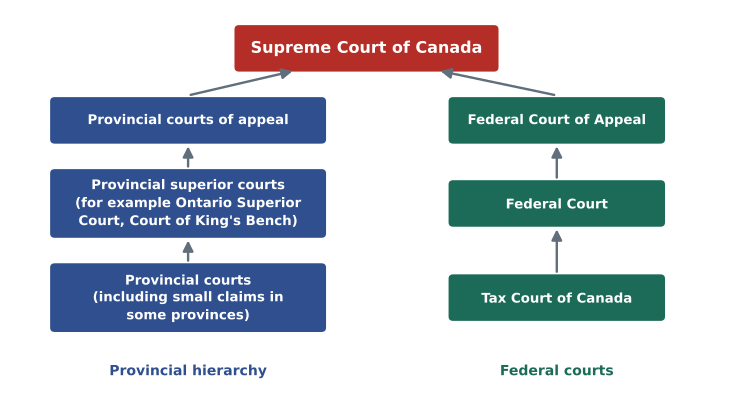
Canada has a unified court hierarchy in which provincial courts apply both federal and provincial law. At the top is the Supreme Court of Canada, which hears appeals from all courts, mostly with leave (permission), and chooses cases of public importance. Each province has a court of appeal, such as the Court of Appeal for Ontario or the Court of Appeal of Alberta, which hears appeals from trial courts as of right in most civil matters. Below it are the superior trial courts, such as the Ontario Superior Court of Justice, the Supreme Court of British Columbia and the Court of King's Bench in Alberta, Manitoba, Saskatchewan and New Brunswick, which have inherent jurisdiction to hear any matter not assigned elsewhere. Provincial courts, created by provincial statute, handle most criminal cases, family matters and, in several provinces, small claims. Separately, the Federal Court and Federal Court of Appeal hear matters assigned by federal statute, such as intellectual property, maritime law, federal tax appeals from the Tax Court of Canada and judicial review of federal agencies.
Jurisdiction also has a geographic side. A court can hear a case only if it has a real and substantial connection to the dispute, for example because the defendant lives or carries on business in the province, the contract was made or breached there, or the damage was suffered there. When courts in more than one province or country could hear a case, a court may decline jurisdiction if another forum is clearly more appropriate. Contracts often include a forum selection clause choosing the courts of a particular province and a choice of law clause choosing which law applies. Courts generally enforce these clauses between businesses, but in Douez v. Facebook, Inc., 2017 SCC 33, the Supreme Court of Canada refused to enforce a clause requiring British Columbia consumers to sue in California, citing unequal bargaining power and the public interest in privacy rights.
Alternative dispute resolution
Alternative dispute resolution (ADR) covers methods of resolving disputes outside the courtroom. Negotiation is direct discussion between the parties or their representatives, and it settles most disputes. Mediation adds a neutral third party who helps the parties communicate and find a solution but cannot impose one. It is quick, relatively cheap, confidential and good at preserving relationships, and some jurisdictions require it for certain civil cases. Arbitration is a private trial: the parties choose one or more arbitrators, who hear evidence and issue a binding award that courts will enforce, with very limited rights of appeal. Arbitration is common in construction, commercial and international disputes because the parties can pick experts as decision makers, keep the process confidential and enforce awards across borders under the New York Convention.
| Method | Who decides | Binding? | Typical cost and time | Best for |
|---|---|---|---|---|
| Negotiation | The parties | Only if they sign an agreement | Lowest; days to weeks | Most disputes, especially between ongoing partners |
| Mediation | The parties, helped by a mediator | Only if they sign a settlement | Low; often one day of mediation | Disputes where relationships matter or emotions run high |
| Arbitration | An arbitrator chosen by the parties | Yes; limited appeal | Moderate to high; months | Technical, confidential or international disputes |
| Litigation | A judge (sometimes a jury) | Yes; appeal available | Highest; often years | Disputes needing precedent, urgent orders or public vindication |
Arbitration clauses are generally enforced in Canada, and provincial arbitration acts direct courts to stay lawsuits brought in breach of them. There are important limits. In Uber Technologies Inc. v. Heller, 2020 SCC 16, an Uber driver challenged a standard-form clause requiring arbitration in the Netherlands, with up-front fees of about US$14,500, roughly his annual income from Uber. The Supreme Court held that the clause was unconscionable because of the inequality of bargaining power and the improvident result, and let the class action proceed. Consumer protection statutes in Ontario, Quebec and Alberta also prevent businesses from forcing consumers into arbitration or blocking class actions through pre-dispute clauses, and employment standards claims generally cannot be contracted out of.
Small claims courts
Small claims courts offer a simpler, cheaper process for modest disputes. Procedures are informal, paralegals or the parties themselves often appear, and costs awards are capped. Monetary limits differ by province and change from time to time. At the time of writing (October 2026), the limit is $50,000 in Ontario, raised from $35,000 on October 1, 2025, and $100,000 in Alberta's Civil Division of the Court of Justice. In British Columbia most claims up to $5,000 go to the online Civil Resolution Tribunal and claims from $5,001 to $35,000 to Provincial Court. Quebec's Small Claims Division hears claims up to $15,000, and corporations with more than ten employees cannot sue there, although they can be sued. Check the court's website before filing, because limits are raised periodically.
Worked problem
Choosing a forum for a debt claim
Lakeside Fixtures, an Ontario corporation, delivered $42,000 of shelving to a Toronto retailer that refuses to pay, claiming some units were damaged. The contract has no arbitration clause. Lakeside's lawyer estimates Superior Court litigation would cost about $45,000 in fees and take two years, while a Small Claims Court action would cost about $8,000 and take about a year. Which forum makes sense?
Show solution
- The claim of $42,000 is under Ontario's $50,000 Small Claims limit, so Small Claims Court is available.
- In Superior Court, the expected legal cost ($45,000) exceeds the claim; even with a partial costs award if Lakeside wins, it would recover only part of its fees.
- Small Claims Court caps costs awards, but its lower expense keeps the net recovery positive.
- Before suing, Lakeside should send a demand letter and offer mediation, documenting the delivery records and inspection reports that answer the damage claim.
Answer: Small claims is the rational forum unless the retailer counterclaims for a larger amount or the case raises a legal question worth a precedent. Preparing a strong file of delivery evidence also improves the chance of settlement before any hearing.
Stages of a civil lawsuit
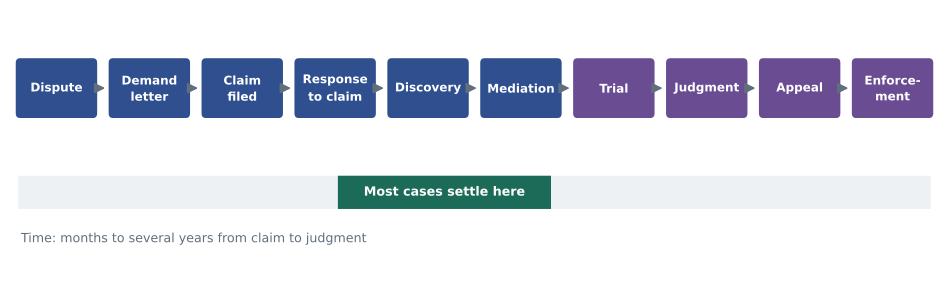
A civil action in a Canadian superior court follows the province's rules of civil procedure. The plaintiff starts the action by issuing a statement of claim, which sets out the facts and the remedy sought, and serves it on the defendant. The defendant responds with a statement of defence, and may add a counterclaim against the plaintiff or a third-party claim against someone else it blames. In the discovery stage each party must disclose all relevant documents in an affidavit of documents, including emails and electronic records, and representatives of each party may be examined under oath at an examination for discovery. Many provinces require mediation or a pre-trial conference. If the case does not settle, it proceeds to trial, usually before a judge alone; civil juries are uncommon outside Ontario and British Columbia personal injury cases. After judgment, the losing party may appeal, and the winner must enforce the judgment if it is not paid.
| Stage | What happens | Management task |
|---|---|---|
| Pre-action | Demand letter, preservation of evidence, settlement talks | Issue a litigation hold so no relevant records are deleted |
| Pleadings | Statement of claim, statement of defence, counterclaims | Give counsel accurate facts and documents early |
| Discovery | Affidavit of documents, examinations for discovery | Gather emails and records; prepare witnesses |
| Mediation and pre-trial | Mandatory mediation in some provinces; settlement conference | Set settlement authority based on expected value |
| Trial | Evidence, witnesses, argument; usually judge alone | Witnesses attend; business disruption |
| Judgment and appeal | Decision with reasons; appeal to the court of appeal | Decide whether to appeal or pay |
| Enforcement | Garnishment, seizure and sale of assets | Locate the debtor's assets |
A litigation hold is one of the most important management duties. Once a lawsuit is reasonably anticipated, a business must preserve relevant documents, including emails, chat messages and files on personal devices used for work. Routine deletion policies must be suspended for those records. Destroying evidence, called spoliation, can lead to sanctions, adverse inferences that the missing evidence would have hurt the party and, in serious cases, judgment against the party that destroyed it.
Who pays the costs
Canadian courts follow the loser pays principle: the court usually orders the unsuccessful party to pay part of the winner's legal costs. The usual scale, partial indemnity costs, covers very roughly half to two-thirds of actual fees; substantial or full indemnity costs may be ordered for misconduct or after a party rejects a formal offer to settle that turns out to be better than the judgment. Formal offers to settle therefore carry real strategic weight. Contingency fees, under which the lawyer is paid a percentage of any recovery, are permitted in all provinces subject to law society rules and, in some provinces, caps. Each province has a class proceedings act that lets one plaintiff sue on behalf of a group once the court certifies the class.
Worked problem
Deciding whether to settle: expected value
A customer sues Ridgeway Software in an Ontario Superior Court action for $300,000, claiming its system caused lost profits. Ridgeway's lawyer estimates a 40 % chance the customer wins the full amount, a 25 % chance it wins $100,000 and a 35 % chance it loses. Ridgeway's own fees to trial would be $120,000. If Ridgeway wins, it expects a partial indemnity costs award of $60,000; if it loses, it expects to pay $70,000 of the customer's costs. The customer offers to settle for $140,000. Should Ridgeway accept?
Show solution
- Full loss: pays $300,000 + $70,000 costs + $120,000 own fees = $490,000; weighted 0.40 × $490,000 = $196,000.
- Partial loss: pays $100,000 + $70,000 + $120,000 = $290,000; weighted 0.25 × $290,000 = $72,500.
- Win: pays own fees $120,000 − $60,000 costs recovered = $60,000; weighted 0.35 × $60,000 = $21,000.
- Expected cost of going to trial = $196,000 + $72,500 + $21,000 = $289,500.
- Settlement cost = $140,000 plus fees spent so far.
Answer: Settling at $140,000 saves about $150,000 in expected cost, before counting management time, publicity and the risk of a worse result. Expected value is only a starting point: a company might fight a weak claim to deter copycat suits, but it should do so knowingly.
Limitation periods
A limitation period is the deadline for starting a lawsuit. Miss it and the claim is lost, however strong it is. In Ontario, the Limitations Act, 2002 sets a basic limitation period of two years from the day the claim was discovered, meaning the day the claimant knew or ought to have known of the injury, that it was caused by the defendant and that a proceeding was appropriate. An ultimate limitation period of fifteen years from the act or omission applies regardless of discovery, with exceptions. British Columbia's Limitation Act and Alberta's Limitations Act also use a two-year basic period from discovery, with ultimate periods of fifteen and ten years respectively. Ontario allows business agreements to vary or exclude limitation periods, within limits, but consumer agreements cannot shorten them. Some statutes set their own shorter deadlines, such as notice periods for claims against municipalities.
Worked problem
Calculating a limitation deadline
A Mississauga manufacturer installed a defective chiller at a food plant on March 3, 2024. The chiller failed on June 10, 2024, spoiling inventory, but the plant reasonably believed the cause was a power surge. An engineer's report delivered on September 15, 2024 identified a manufacturing defect. When does the basic limitation period expire under Ontario law?
Show solution
- The claim is discovered when the plant knew or ought to have known the loss was caused by the manufacturer and a proceeding was appropriate.
- Before the engineer's report the plant reasonably believed another cause; on these facts discovery is arguably September 15, 2024.
- Two years from September 15, 2024 is September 15, 2026.
- A cautious lawyer would treat June 10, 2026 as the safe deadline, two years from the failure, in case a court finds the plant ought to have investigated sooner.
Answer: The plant should sue well before June 10, 2026 rather than rely on a later discovery date. Disputes about discovery are common, and the cost of missing a limitation period is total.
Judgments, interest and enforcement
A judgment is the court's formal order, usually to pay money. Courts add prejudgment interest from the date the claim arose (or another date set by statute) to the judgment date and postjudgment interest until payment, both usually at statutory rates. Interest matters in long cases: on a large claim, several years of interest can add a significant percentage to the award.
Worked problem
Adding interest to a judgment
A court awards $80,000 in damages for a breach that occurred 900 days before judgment. Assume an illustrative prejudgment interest rate of 4.5 % a year (Ontario publishes the actual rates quarterly under the Courts of Justice Act). The defendant pays 120 days after judgment, and the illustrative postjudgment rate is 5.5 %. Calculate the interest.
Show solution
- Prejudgment interest = $80,000 × 0.045 × 900 ÷ 365 ≈ $8,877.
- Judgment total = $80,000 + $8,877 = $88,877 (plus any costs award).
- Postjudgment interest = $88,877 × 0.055 × 120 ÷ 365 ≈ $1,607.
- Total paid ≈ $90,484 before costs.
Answer: Interest adds about 13 % here. Statutory rates vary by province and over time, so check the current rate tables.
Winning a judgment does not put money in the bank. If the debtor does not pay, the creditor uses enforcement tools under provincial law: a writ of seizure and sale filed with the sheriff and registered against land, garnishment of wages or bank accounts (subject to exemptions), and an examination in aid of execution, in which the debtor must answer questions under oath about income and assets. A judgment from another province can be registered and enforced through reciprocal enforcement statutes. A debtor with no assets is judgment-proof, which is why checking a defendant's ability to pay is part of deciding whether to sue.
Common mistakes
MistakeLetting routine email deletion continue after a lawsuit is threatened.
InsteadIssue a litigation hold immediately and preserve all relevant records, including chat messages and personal devices used for work.
MistakeWaiting to see whether a dispute resolves before checking the limitation period.
InsteadCalendar the earliest possible limitation date as soon as a problem appears.
MistakeChoosing litigation by default for a modest claim.
InsteadCompare small claims, mediation and arbitration on cost, time, confidentiality and relationship.
MistakeAssuming an arbitration clause will always be enforced.
InsteadCourts may refuse unconscionable clauses (Uber v. Heller), and consumer statutes limit forced arbitration.
MistakeSuing a party without checking whether it can pay.
InsteadInvestigate assets and insurance before investing in litigation.
Summary and key terms
- Canada has a unified hierarchy topped by the Supreme Court of Canada, plus Federal Courts for federal matters.
- Courts need a real and substantial connection; forum selection clauses usually bind businesses but not always consumers.
- Negotiation, mediation and arbitration resolve most disputes faster and more privately than litigation.
- Small claims courts handle modest claims cheaply; limits vary and change.
- Lawsuits move through pleadings, discovery, pre-trial steps, trial, judgment, appeal and enforcement; litigation holds are essential.
- The loser usually pays part of the winner's costs, so formal offers to settle matter.
- Limitation periods are strict; calendar the earliest possible deadline.
- Interest and enforcement determine what a judgment is really worth.
- Alternative dispute resolution
- Methods of resolving disputes outside court, such as negotiation, mediation and arbitration.
- Mediation
- A process in which a neutral third party helps the parties reach their own agreement.
- Arbitration
- A private process in which an arbitrator issues a binding decision.
- Discovery
- The pre-trial stage in which parties exchange evidence and question witnesses.
- Litigation hold
- An instruction to preserve all records relevant to an anticipated lawsuit.
- Spoliation
- The destruction or loss of relevant evidence.
- Limitation period
- The deadline for starting a lawsuit.
- Garnishment
- An enforcement process that diverts money owed to a debtor, such as wages, to the creditor.
- Judgment-proof
- Having no assets that can be seized to satisfy a judgment.
- Partial indemnity costs
- The usual costs award, covering part of the winner's legal fees.
Practice problems
Work each problem on paper first, then reveal the answer to check.
Which court hears appeals from the Ontario Superior Court of Justice in most civil cases?
Show answer
The Court of Appeal for Ontario.
Distinguish mediation from arbitration.
Show answer
A mediator helps the parties agree but cannot decide; an arbitrator issues a binding award.
What did the Supreme Court decide in Uber v. Heller?
Show answer
The arbitration clause was unconscionable and unenforceable.
What is the Small Claims Court limit in Ontario at the time of writing?
Show answer
$50,000.
What is a litigation hold and when must it start?
Show answer
An instruction to preserve relevant records, starting when litigation is reasonably anticipated.
What is the basic limitation period in Ontario, and when does it start?
Show answer
Two years from discovery of the claim.
A $50,000 judgment carries 6 % simple interest for 200 days. What is the interest?
Show answer
$50,000 × 0.06 × 200 ÷ 365 ≈ $1,644.
A claim has a 60 % chance of a $100,000 award and a 40 % chance of nothing; your fees to trial are $30,000 and not recoverable. What is the expected net value of suing?
Show answer
0.6 × $100,000 − $30,000 = $30,000.
What does judgment-proof mean?
Show answer
The defendant has no assets that can be seized to pay the judgment.
Portfolio task: draft a one-page dispute resolution clause for a supply contract and explain each choice.
Show answer
Answers vary; a good answer escalates from negotiation to mediation to arbitration or court, names a seat or forum and governing law, and addresses urgent injunctions.
Lesson quiz · 5 questions
Score 60% or more to complete this lesson.
Create a free account to save your progress, take quizzes and earn a certificate.