
BUS-210 · Lesson 6 of 12 · 37 min
Torts and negligence
A tort is a civil wrong, other than a breach of contract, for which the law gives a remedy, usually damages. Contract duties arise from agreement; tort duties are imposed by law on everyone. A business can commit torts through its employees and products, and it can be the victim of torts committed by competitors, customers and others. Tort claims are among the largest legal risks most businesses face: a single serious injury on business premises or caused by a delivery vehicle can produce a claim worth millions. This lesson covers intentional torts, the tort of negligence, liability for premises, professional negligence and vicarious liability. Lesson 7 covers torts aimed at business interests and product liability.
Intentional torts
Intentional torts involve deliberate conduct, although the defendant need not intend harm. Several arise in everyday business. Battery is intentional, harmful or offensive physical contact without consent; assault is causing someone to fear imminent contact. False imprisonment is intentionally confining a person without lawful authority, which is a real risk when store staff detain suspected shoplifters. Trespass to land is entering or placing things on land without permission. Conversion is wrongfully dealing with another's goods, such as refusing to return them or selling them. Nuisance is an unreasonable interference with a neighbour's use and enjoyment of land, such as noise, odours, vibration or dust from a business operation.
Retail staff in Canada may arrest a person they find committing a criminal offence on or in relation to the property, or within a reasonable time afterward if they believe on reasonable grounds that the person committed it, under section 494 of the Criminal Code, but they must then promptly hand the person to the police and use no more force than necessary. A mistaken or unreasonable detention exposes the store to damages for false imprisonment and possibly assault, and damage to reputation can far exceed the value of the goods. Many retailers therefore train staff to observe and report rather than detain.
The tort of negligence
Negligence is the most important tort for business. It covers careless, rather than deliberate, conduct that causes harm. The modern law of negligence grew from Donoghue v. Stevenson (1932), in which a woman became ill after drinking ginger beer from an opaque bottle that allegedly contained the remains of a decomposed snail. She had no contract with the manufacturer, because her friend bought the drink. The House of Lords held that the manufacturer owed her a duty of care, because Lord Atkin's neighbour principle requires people to take reasonable care to avoid acts or omissions that they can reasonably foresee would be likely to injure persons so closely and directly affected that they ought to have them in contemplation.
A plaintiff in a Canadian negligence action must prove five elements on a balance of probabilities: the defendant owed a duty of care, the defendant breached the standard of care, the plaintiff suffered damage, the breach caused the damage in fact, and the damage was not too remote. The Supreme Court restated the framework in Mustapha v. Culligan of Canada Ltd., 2008 SCC 27.
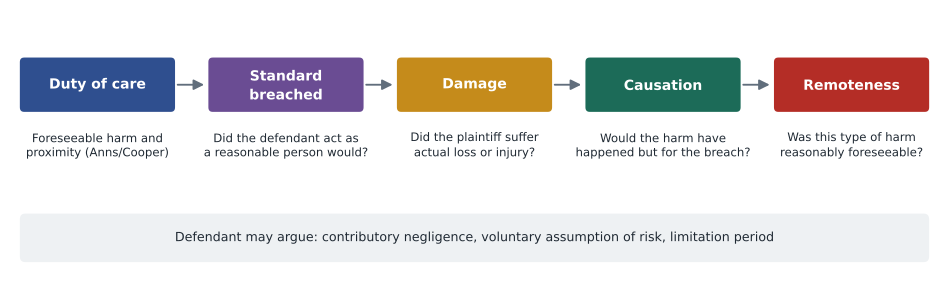
Duty of care. For recognized relationships, such as drivers and other road users, manufacturers and consumers, or occupiers and visitors, a duty is established. For new situations, Canadian courts apply the Anns/Cooper test from Cooper v. Hobart, 2001 SCC 79: was the harm a reasonably foreseeable consequence of the defendant's conduct, and was there sufficient proximity between the parties that it would be fair and just to impose a duty? If both are shown, a prima facie duty exists unless residual policy considerations, such as the risk of indeterminate liability, negate it.
Standard of care. The defendant must act as a reasonable person would in the circumstances. Courts consider the likelihood of harm, the severity of potential harm, the cost of precautions and the social value of the activity. Industry customs and regulatory standards are evidence of reasonable care but not conclusive: complying with a safety regulation does not automatically show the defendant was careful, and breaching a statute is evidence of negligence. Professionals are held to the standard of a reasonably competent member of the profession, and people who hold themselves out as having special skills must meet that higher standard.
One way to think about the standard is the Hand formula, from Judge Learned Hand's opinion in United States v. Carroll Towing Co. (1947): a defendant is negligent if the burden of a precaution (B) is less than the probability of the harm (P) multiplied by the gravity of the loss (L). Canadian and American courts do not apply the formula mechanically, and it is hard to quantify human injury, but it captures how courts weigh risk against the cost of avoiding it, and it is a useful tool for business risk decisions.
Worked problem
Using the Hand formula to evaluate a precaution
A grocery chain with 40 stores considers installing anti-slip mats and a mandatory 30-minute floor inspection schedule in its produce aisles. The cost is about $3,000 per store per year, $120,000 in total. Past records suggest that, without the precautions, about 12 serious slip injuries a year occur across the chain, each costing about $60,000 on average in damages and legal costs. The precautions are expected to prevent about 75 % of these injuries. Should the chain adopt them?
Show solution
- Expected annual loss without precautions = 12 × $60,000 = $720,000.
- Expected loss prevented = 75 % × $720,000 = $540,000 (this is P × L for the risk the precaution addresses).
- Burden B = $120,000.
- B ($120,000) is far less than P × L ($540,000), so failing to take the precautions would likely be found negligent.
- The chain also gains intangible benefits: fewer injured customers, lower insurance premiums and better reputation.
Answer: The precautions are clearly justified. A court reviewing a slip-and-fall claim would be unimpressed by a business that skipped a cheap precaution against a known risk. Recording inspections also provides evidence of reasonable care.
Causation. The plaintiff must usually show that the injury would not have occurred but for the defendant's negligence (Clements v. Clements, 2012 SCC 32). Where several defendants each may have caused the harm and the but-for test cannot identify which, a material contribution to risk approach may apply in rare cases. Remoteness. Even where the breach caused the harm, damages are recoverable only if the type of harm was reasonably foreseeable. In Mustapha, Mr. Mustapha saw dead flies in a bottle of water he was about to install in his home and developed a serious psychiatric illness. The Supreme Court held that the supplier breached its duty but that psychiatric injury of this severity was not reasonably foreseeable in a person of ordinary fortitude, so the damage was too remote.
Worked problem
Analyzing a negligence claim
A customer at a Saskatoon hardware store is hit by a box of tiles that falls from a high shelf when an employee pulls a pallet from the shelf beside it without securing the load. The customer suffers a fractured wrist and loses six weeks of work. The store says customers should keep away from employees moving stock. Analyze the claim.
Show solution
- Duty: a store owes customers a duty of care, both as an occupier and under the general neighbour principle.
- Standard: a reasonable retailer would secure loads, block off aisles while moving stock overhead and train employees accordingly. Failing to secure the load is a breach.
- Damage: a fractured wrist, medical costs and lost income.
- Causation: but for the unsecured pallet move, the box would not have fallen.
- Remoteness: physical injury from falling stock is exactly the foreseeable kind of harm.
- Defences: the store could argue contributory negligence if the customer ignored a barrier or warning, which would reduce damages under Saskatchewan's Contributory Negligence Act, but there is no evidence of that here.
Answer: The store is very likely liable, and its liability insurer will usually handle the claim. The real management lesson is in prevention: procedures for overhead stock movement and training.
Defences to negligence
Contributory negligence is the most common defence. If the plaintiff failed to take reasonable care for their own safety, such as not wearing a seat belt or ignoring a warning sign, provincial apportionment statutes, such as Ontario's Negligence Act, reduce damages in proportion to the plaintiff's share of fault. Where several defendants are at fault, they are generally jointly and severally liable to the plaintiff, meaning the plaintiff can recover all its damages from any one of them, and the defendants then share the burden among themselves by contribution. Voluntary assumption of risk (volenti non fit injuria) is a complete defence, but courts apply it narrowly: the plaintiff must have agreed, expressly or by clear implication, to accept both the physical and the legal risk. Waivers signed by participants in risky activities can be effective if they are clear, brought to the participant's attention and cover the negligence alleged, though consumer protection law limits them in some provinces.
Worked problem
Apportioning fault
A cyclist is hit by a delivery van that ran a stop sign in Toronto. The cyclist was not wearing a helmet, and a court finds the head injury would have been less severe with one. Damages are assessed at $400,000. The court apportions fault 85 % to the van driver and 15 % to the cyclist. The van driver was employed by a courier company. Calculate the recovery and identify who pays.
Show solution
- Under the Negligence Act, damages are reduced by the plaintiff's share of fault: $400,000 × (1 − 0.15) = $340,000.
- The courier company is vicariously liable for its employee's negligence in the course of employment (below), and in Ontario vehicle owners are also liable by statute for the negligence of drivers using the vehicle with consent.
- In practice, the company's automobile insurer pays.
Answer: The cyclist recovers $340,000. The case shows how apportionment, vicarious liability and insurance work together.
Occupiers' liability
Occupiers, the people or businesses with physical control over premises, owe duties to those who enter. In most common law provinces, statutes such as Ontario's Occupiers' Liability Act, the British Columbia Occupiers Liability Act and the Alberta Occupiers' Liability Act replace older common law categories with a general duty to take such care as in all the circumstances is reasonable to see that persons entering the premises, and their property, are reasonably safe. The duty can be modified by notice or agreement in some cases, and lower duties apply to trespassers and to people engaged in certain recreational activities. Both a landlord and a tenant can be occupiers, and contracts such as leases and snow-clearing agreements often allocate responsibility. A business with customers on its premises must inspect regularly, fix hazards promptly, warn of hazards it cannot fix and keep records that prove its system of inspection.
| Hazard | Reasonable precaution | Evidence to keep |
|---|---|---|
| Spills and wet floors | Regular sweeps, warning cones, mats at entrances | Inspection logs with times and initials |
| Ice and snow | Contracted clearing, salting, monitoring forecasts | Snow-clearing contract and service records |
| Falling stock | Secure loads; close aisles during overhead work | Training records and procedures |
| Poor lighting and trip hazards | Maintenance schedule, repairs, visible markings | Work orders and repair invoices |
| Crowds and security | Staffing, crowd control, security cameras | Incident reports and security plans |
Professional negligence and negligent misstatement
Professionals such as accountants, engineers, lawyers, architects and financial advisors owe their clients duties in both contract and tort. They can also be liable to third parties for negligent misstatement, careless statements that cause purely economic loss, following the English case Hedley Byrne & Co. v. Heller & Partners (1964). In Queen v. Cognos Inc. (1993), the Supreme Court held an employer liable for negligently misrepresenting the nature and security of a job during an interview. The court set out five requirements: a duty of care based on a special relationship, an untrue, inaccurate or misleading representation, made negligently, reasonable reliance by the plaintiff and resulting damage. To prevent indeterminate liability, courts limit the duty to cases where the defendant should reasonably foresee that the plaintiff will rely on the statement for a particular purpose. In Hercules Managements Ltd. v. Ernst & Young (1997), auditors who prepared statutory audit reports were held not liable to shareholders who used them to make investment decisions, because the reports were prepared to help shareholders oversee management as a group, not to guide individual investment. In Deloitte & Touche v. Livent Inc., 2017 SCC 63, the court applied these principles and held auditors liable to the audited company for part of its losses.
Worked problem
Is the consultant liable to a third party?
Juniper Valuations prepares a valuation of Lakeshore Marinas Inc. at the request of Lakeshore's owner, knowing it will be shown to a specific buyer, Coastline Holdings, which is negotiating to buy the company. The report carelessly overstates the marina's annual revenue by $1.2 million because of a spreadsheet error. Coastline relies on the report and pays $3 million more than the company is worth. Juniper's engagement letter with Lakeshore says the report is for "the client and prospective purchasers". Can Coastline sue Juniper?
Show solution
- Special relationship and proximity: Juniper knew the report would be given to Coastline for the specific purpose of the purchase, which satisfies the reasonable foreseeability and reliance requirements.
- Untrue representation made negligently: the revenue figure was wrong because of a careless spreadsheet error.
- Reasonable reliance and damage: Coastline relied on the report in setting its price and overpaid by about $3 million.
- Indeterminate liability is not a concern because the plaintiff was an identified party using the report for the very purpose it was prepared.
- Coastline probably has a claim for negligent misrepresentation, subject to any disclaimer in the report that clearly excludes reliance by third parties.
Answer: Professionals manage this risk through engagement letters, reliance letters that define who may rely, disclaimers and professional liability insurance. Buyers should obtain reliance letters before relying on reports commissioned by the seller.
Vicarious liability
An employer is vicariously liable for torts committed by employees in the course of their employment, even if the employer itself was not at fault. The rationale is that the employer created the risk, profits from the enterprise and is best placed to spread losses through insurance and prices. In Bazley v. Curry (1999), the Supreme Court held that an employer is liable where there is a strong connection between the risk the employer's enterprise created or enhanced and the wrong that occurred, including some intentional wrongs. Employers are not generally vicariously liable for independent contractors, which is one reason the employee-or-contractor question (lesson 10) matters. An employer may also be directly liable for its own negligence, for example in hiring, training or supervising staff.
| Situation | Employer likely liable? | Why |
|---|---|---|
| A delivery driver rear-ends a car while making deliveries | Yes | Negligence while doing the job |
| A driver detours ten minutes to pick up lunch and causes a crash | Usually yes | A minor deviation remains within the course of employment |
| An employee uses a company van on a weekend to move house without permission and crashes | Usually no | A frolic of the employee's own, though owner liability statutes may still apply to the vehicle |
| A security guard uses excessive force on a shopper | Usually yes | The wrong is closely connected to the job the employer created |
| An independent contractor painter damages a client's property | Usually no | No employment relationship, unless the employer was itself negligent in selecting the contractor |
Damages in tort
Tort damages aim to restore the plaintiff to the position it would have been in had the tort not occurred. Pecuniary damages cover measurable losses: past and future lost income, medical and care costs and property damage. Non-pecuniary damages compensate for pain, suffering and loss of enjoyment of life. In a 1978 trilogy of cases, beginning with Andrews v. Grand & Toy Alberta Ltd., the Supreme Court capped non-pecuniary damages for personal injury at $100,000 in 1978 dollars, adjusted for inflation; the cap was a little under $470,000 in 2025. Punitive damages are rare and reserved for high-handed, malicious conduct. Provincial automobile insurance schemes significantly modify these rules for road accidents, with no-fault benefits and thresholds and deductibles on pain and suffering claims in several provinces, and pure no-fault schemes in Quebec and, since 2021, British Columbia. Workers' compensation statutes generally bar injured workers from suing their employer or co-workers, in exchange for no-fault benefits.
Common mistakes
MistakeDetaining a suspected shoplifter on a hunch.
InsteadOnly arrest within the narrow Criminal Code power, hand over to police promptly and train staff to observe and report.
MistakeTreating regulatory compliance as proof of reasonable care.
InsteadCompliance is evidence, not a complete defence; ask what a reasonable business would do about known risks.
MistakeFailing to record inspections and maintenance.
InsteadKeep logs, work orders and training records; they are the main evidence of reasonable care in premises claims.
MistakeAssuming a valuation or audit can only lead to claims by the client.
InsteadDefine who may rely on reports through engagement and reliance letters, and carry professional liability insurance.
MistakeAssuming the business is not responsible for what employees do on the job.
InsteadEmployers are vicariously liable for employees' torts in the course of employment; hire, train and supervise carefully and insure.
Summary and key terms
- A tort is a civil wrong imposed by law; intentional torts include battery, false imprisonment, trespass, conversion and nuisance.
- Negligence requires duty, breach of the standard of care, damage, but-for causation and remoteness (Mustapha).
- The standard of care weighs likelihood and severity of harm against the cost of precautions, as in the Hand formula.
- Contributory negligence reduces damages proportionately; volenti is narrow.
- Occupiers' liability statutes impose a duty of reasonable care to make premises reasonably safe.
- Professionals can be liable to third parties for negligent misstatement within limits that avoid indeterminate liability.
- Employers are vicariously liable for employees' torts in the course of employment.
- Non-pecuniary damages are capped (a little under $470,000 in 2025); workers' compensation bars most suits against employers.
- Tort
- A civil wrong, other than breach of contract, for which the law gives a remedy.
- Negligence
- Careless conduct that breaches a duty of care and causes foreseeable harm.
- Duty of care
- A legal obligation to take reasonable care to avoid harming others.
- Standard of care
- The level of care a reasonable person would exercise in the circumstances.
- Hand formula
- The idea that a precaution is required if its burden is less than the probability times the gravity of harm.
- Negligent misstatement
- A careless statement that causes economic loss to someone who reasonably relied on it.
- Vicarious liability
- Liability of one party, such as an employer, for the torts of another, such as an employee.
- Remoteness
- The limit on damages to types of harm that were reasonably foreseeable.
- Contributory negligence
- A plaintiff's own carelessness, which reduces damages in proportion to fault.
- Occupier
- A person or business with physical control over premises.
Practice problems
Work each problem on paper first, then reveal the answer to check.
Distinguish an intentional tort from negligence.
Show answer
An intentional tort involves deliberate conduct; negligence involves careless conduct.
List the five elements of negligence in Canadian law.
Show answer
Duty, breach of the standard of care, damage, causation and remoteness.
A precaution costs $20,000; it would prevent a 5 % chance of a $1 million loss. Does the Hand formula suggest it is required?
Show answer
Yes; P × L = $50,000, which exceeds B = $20,000.
What did Mustapha v. Culligan decide about remoteness?
Show answer
Psychiatric injury of that severity was not foreseeable in a person of ordinary fortitude, so it was too remote.
A plaintiff with $200,000 damages is found 30 % at fault. What does it recover in a jurisdiction that apportions fault?
Show answer
$140,000.
What duty does an occupier owe under Ontario's Occupiers' Liability Act?
Show answer
To take reasonable care to see that entrants and their property are reasonably safe.
Why were the auditors in Hercules Managements not liable to shareholders?
Show answer
The reports were not prepared for individual investment decisions, so liability would be indeterminate.
Is an employer liable for a delivery driver's crash during a short lunch detour?
Show answer
Usually yes; a minor deviation is still within the course of employment.
Roughly what was the cap on non-pecuniary damages in 2025?
Show answer
A little under $470,000.
Portfolio task: walk through a business premises you know and list three hazards, precautions and the records you would keep.
Show answer
Answers vary; a good answer links each hazard to a precaution and a record that proves reasonable care.
Lesson quiz · 5 questions
Score 60% or more to complete this lesson.
Create a free account to save your progress, take quizzes and earn a certificate.