
BUS-210 · Lesson 4 of 12 · 37 min
Contract law II: terms, defects, performance and breach
Forming a contract is only the beginning. Disputes usually arise later, over what the contract means, whether one party was misled into signing it, whether an unexpected event excuses performance or whether a failure to perform justifies ending the relationship. This lesson covers the content of contracts, including express and implied terms, interpretation, exclusion clauses and good faith; the defects that can make a contract voidable or void; how contracts are discharged; and how the law classifies breach. Remedies follow in lesson 5.
Express and implied terms
Express terms are those the parties stated, orally or in writing. Implied terms are added by law or by the courts. Courts imply terms in three main ways: terms implied by statute, such as the conditions of quality and fitness in sale of goods law (lesson 5); terms implied by custom or trade usage, when a practice is so well known in an industry that the parties must have intended it; and terms implied in fact, to give business efficacy to a contract when the term is so obvious that it goes without saying. Courts will not imply a term merely because it would be reasonable, and will not imply a term that contradicts an express one.
When the meaning of a written contract is disputed, Canadian courts read the words in their ordinary and grammatical sense, consistent with the surrounding circumstances known to both parties when they made the contract. In Sattva Capital Corp. v. Creston Moly Corp., 2014 SCC 53, the Supreme Court held that contractual interpretation is a practical, common-sense exercise that considers the factual matrix, but that the surrounding circumstances cannot overwhelm the words the parties chose. The parol evidence rule generally prevents a party from using evidence of prior or contemporaneous oral agreements to add to, vary or contradict a written contract that the parties intended as their complete agreement, which is why contracts often contain an entire agreement clause. If a term remains ambiguous, the contra proferentem rule interprets it against the party that drafted it.
Worked problem
Interpreting an ambiguous clause
A commercial lease drafted by the landlord says the tenant must pay "all costs of maintaining the building". The landlord replaces the 30-year-old roof for $260,000 and bills the tenant, which occupies 40 % of the building, for $104,000. The tenant says replacing a roof is a capital improvement, not maintenance. The lease has an entire agreement clause, and during negotiations the landlord's agent emailed that "major structural items stay with the owner." How would a court approach the dispute?
Show solution
- Start with the ordinary meaning: "maintaining" usually means keeping in good repair, which arguably does not include replacing a major component at the end of its life.
- Read the lease as a whole: if another clause refers separately to "repairs and replacements" or "capital expenditures", the omission of replacement here suggests it was not intended.
- Consider the factual matrix known to both parties, such as the age of the roof, but do not let it override the words. The agent's email is prior negotiation; the parol evidence rule and entire agreement clause limit its use to vary the lease, though some courts would admit it to explain an ambiguity.
- If ambiguity remains, apply contra proferentem against the landlord, which drafted the lease.
Answer: The tenant has the stronger argument that roof replacement is not maintenance. The practical lesson is to define cost categories precisely in leases, often with a schedule listing which costs are recoverable and how capital items are amortized.
Exclusion and limitation clauses
Business contracts commonly limit or exclude liability: a cap on damages equal to the fees paid, an exclusion of consequential damages such as lost profits, or a disclaimer of implied warranties. These clauses allocate risk and affect price, and courts generally enforce them between sophisticated parties. They are read narrowly, however, and they must clearly cover the loss in question. Consumer protection statutes often prohibit or limit them in consumer contracts.
In Tercon Contractors Ltd. v. British Columbia (Transportation and Highways), 2010 SCC 4, the Supreme Court of Canada set out a three-step test for exclusion clauses. First, as a matter of interpretation, does the clause apply to the circumstances? Second, if it applies, was it unconscionable when the contract was made, for example because of unequal bargaining power? Third, even if valid, should the court refuse to enforce it because of an overriding public policy, such as a supplier knowingly selling a dangerous product while hiding behind an exclusion? The old doctrine of fundamental breach no longer automatically defeats exclusion clauses. In Tercon, the province had excluded liability for claims arising from participation in a tender, but the court held the clause did not cover the province's acceptance of a bid from an ineligible bidder.
Worked problem
Will the limitation clause hold?
Cobalt IT signed a contract to manage data backups for a Winnipeg accounting firm. The contract, negotiated by both sides' lawyers, caps Cobalt's liability at the fees paid in the previous 12 months ($36,000) and excludes lost profits. A Cobalt technician skipped required backup checks for six months; when a server failed, the firm lost client data and claims $400,000. Apply the Tercon test.
Show solution
- Step 1, interpretation: the cap applies to "any claim arising under this agreement", which covers failure to perform the backup service. Lost profits are excluded.
- Step 2, unconscionability: both parties had lawyers and similar bargaining positions, and the price reflected the cap, so the clause was not unconscionable when made.
- Step 3, public policy: careless failure to perform is not the kind of reprehensible conduct, such as knowingly endangering the public, that overrides freedom of contract.
- The cap likely applies: Cobalt's liability is limited to $36,000 of direct losses.
Answer: Limitation clauses are powerful risk-allocation tools, and the accounting firm should have bought cyber insurance or negotiated a higher cap for data loss. Cobalt should have insisted on documented procedures that make gross negligence hard to prove.
Good faith
Canadian contract law now recognizes good faith as a general organizing principle. In Bhasin v. Hrynew, 2014 SCC 71, the Supreme Court recognized a duty of honest performance: parties must not lie to or knowingly mislead each other about matters directly linked to the performance of the contract. In C.M. Callow Inc. v. Zollinger, 2020 SCC 45, condominium corporations that had decided to end a winter maintenance contract let the contractor believe the contract would be renewed, so it did extra summer work hoping to keep the business; the court held that this active deception breached the duty of honest performance even though the termination clause itself was valid. In Wastech Services Ltd. v. Greater Vancouver Sewerage and Drainage District, 2021 SCC 7, the court held that contractual discretion must be exercised reasonably, in line with the purposes for which it was granted. These duties do not require a party to put the other's interests first or to disclose all information, but they forbid lying and using discretion for an unconnected purpose. In Quebec, the Civil Code imposes good faith expressly.
Defects in formation
A contract that appears valid may be defective because of how it was made. A void contract never had legal effect; a voidable contract is valid until the innocent party chooses to rescind it. Rescission unwinds the contract and returns both parties to their original positions, so it is lost if that is no longer possible, if an innocent third party has acquired rights or if the innocent party affirms the contract after learning the truth.
| Defect | What happened | Usual result |
|---|---|---|
| Innocent misrepresentation | A false statement of fact, made honestly, induced the contract | Rescission; damages only if the statement became a term |
| Negligent misrepresentation | A false statement made carelessly by someone with a duty of care | Rescission and damages in tort |
| Fraudulent misrepresentation | A false statement made knowingly or recklessly | Rescission and damages, possibly punitive |
| Mistake | Both parties shared a fundamental mistaken assumption, or one party's mistake was known to the other | Void or voidable in limited cases; courts are reluctant |
| Duress | Agreement was obtained by threats or illegitimate economic pressure | Voidable |
| Undue influence | A dominant party in a relationship of trust exploited the weaker party | Voidable |
| Unconscionability | Inequality of bargaining power produced an improvident bargain | Unenforceable or reformed |
A misrepresentation is a false statement of fact that induces the other party to contract. Opinions, predictions and sales puffery, such as "the best pizza in town", are not statements of fact, although an opinion from someone with special expertise may imply facts. Silence is not usually misrepresentation, but a half-truth is, and so is failing to correct a statement that becomes false before the contract is signed. Some relationships, such as insurance and fiduciary relationships, require disclosure, and consumer and securities laws impose disclosure duties.
Canadian courts apply unconscionability using the two-part test from Uber Technologies Inc. v. Heller: an inequality of bargaining power and a resulting improvident bargain that unduly advantages the stronger party or disadvantages the weaker one. Inequality can arise from a standard-form contract presented on a take-it-or-leave-it basis with terms the weaker party could not be expected to understand. Consumer protection statutes add statutory unfair practices, such as unconscionable representations, which let consumers rescind and claim damages (lesson 11).
Discharge: how contracts end
Most contracts are discharged by performance: each party does what it promised. Contracts can also be discharged by agreement, for example when the parties agree to end the contract (mutual release), to replace it with a new one (novation) or to accept a different performance (accord and satisfaction). A contract may also end through a condition: a condition precedent must occur before obligations arise, such as financing approval in a real estate deal, and a condition subsequent ends obligations when it occurs.
A contract is frustrated when, without the fault of either party, an unforeseen event makes performance radically different from what the parties contemplated, such as the destruction of the subject matter or a change in law that makes performance illegal. In Naylor Group Inc. v. Ellis-Don Construction Ltd., 2001 SCC 58, the Supreme Court described frustration as occurring when a supervening event alters the nature of the obligations so significantly that holding the parties to them would be unjust. Frustration is not available because performance becomes more expensive or less profitable, or if the contract already allocated the risk. When a contract is frustrated, both parties are released from future obligations; provincial statutes, such as Ontario's Frustrated Contracts Act, adjust money already paid and expenses already incurred.
Because these doctrines are narrow and unpredictable, well-drafted contracts include force majeure clauses. A force majeure clause lists events beyond a party's control, such as natural disasters, war, epidemics, government orders and strikes, and states the consequence: suspension of performance, extension of time or termination after a period. Courts interpret these clauses according to their wording; a party that relies on one usually must show that the event falls within the clause, that it caused the failure to perform and that the party took reasonable steps to mitigate. The COVID-19 pandemic produced a wave of litigation over whether pandemics or government orders were covered, and many businesses rewrote their clauses afterwards.
Worked problem
Frustration or force majeure?
Summit Events booked a hotel ballroom and 200 rooms for a medical conference in a coastal city for October 2026, paying a $90,000 deposit. In September, a hurricane damages the hotel, which announces it cannot host events for three months. The contract's force majeure clause covers "acts of God, fire, flood, storms, epidemics and government orders" and provides that either party may terminate with a full refund of deposits. A second conference organizer's contract with the same hotel has no force majeure clause. What are each organizer's rights?
Show solution
- For Summit: the hurricane is a storm and an act of God within the clause, it caused the hotel's inability to perform and neither party could avoid it, so either party may terminate and Summit gets its $90,000 back.
- For the second organizer: with no clause, it must rely on frustration. Destruction or unavailability of the venue for the contracted dates radically changes performance, so the contract is probably frustrated and both parties are released.
- Under Ontario's Frustrated Contracts Act or similar statutes, money paid before frustration is generally recoverable, less an allowance for expenses the hotel incurred in performance, at the court's discretion.
- Both organizers must still deal with their own contracts with speakers, caterers and attendees, which have their own clauses.
Answer: Summit has certainty from its clause; the second organizer probably reaches a similar result but with more argument and risk. Force majeure clauses turn an unpredictable common law doctrine into a negotiated allocation of risk.
Breach of contract
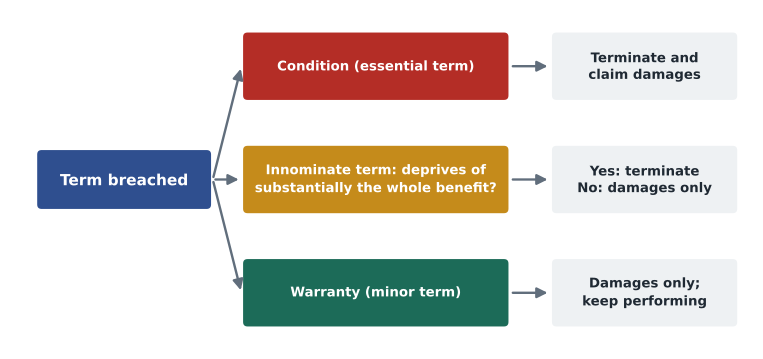
A breach occurs when a party fails to perform as promised without lawful excuse. The consequences depend on the importance of the term broken. A condition is an essential term; breach of a condition lets the innocent party treat the contract as ended and claim damages. A warranty is a minor term; breach of a warranty gives only damages. Many terms are innominate: whether the innocent party can terminate depends on whether the breach deprives it of substantially the whole benefit of the contract. A party that clearly indicates in advance that it will not perform commits an anticipatory breach (repudiation), and the innocent party may either accept the repudiation, ending the contract and suing immediately, or affirm the contract and wait for performance, keeping it alive for both sides.
Worked problem
Can the buyer terminate?
Maple Ridge Dental ordered a custom reception desk for $18,000, to be delivered and installed by March 1 for a clinic opening on March 3. The supplier delivers on March 1, but the desk's finish is a slightly different shade of walnut from the sample, and one drawer sticks. The clinic wants to refuse the desk and cancel the contract. What are its rights?
Show solution
- The contract is for goods with installation, so the provincial Sale of Goods Act applies to the desk (lesson 5).
- Correspondence with the sample is an implied condition under sale of goods law, but a slight colour variation may not be a breach of the condition if the desk corresponds in substance; the sticking drawer is a minor defect that can be fixed.
- Treating the breaches as warranty breaches or minor breaches of an innominate term, the clinic cannot terminate; it can claim damages for the cost of repairing the drawer and any loss in value from the finish.
- If the finish were dramatically different and the clinic had stressed colour matching, it might be a breach of condition allowing rejection, but the clinic would have to act before accepting the goods.
Answer: The clinic probably must accept the desk and claim damages. Parties who need strict compliance should say so in the contract, for example by making colour matching "of the essence".
Privity and third parties
Under the doctrine of privity, only parties to a contract can enforce it or be bound by it. Canadian courts have created a principled exception: a third party may rely on a contract term, such as a limitation of liability, if the parties intended the term to benefit that third party and the activities the third party was performing were the very activities contemplated. In London Drugs Ltd. v. Kuehne & Nagel International Ltd. (1992), warehouse employees who damaged a transformer could rely on their employer's $40 limitation clause, and in Fraser River Pile & Dredge Ltd. v. Can-Dive Services Ltd. (1999) the court extended the exception to a waiver of subrogation in an insurance policy. Statutes also create exceptions, for example letting beneficiaries enforce insurance policies. Rights under a contract can generally be assigned to another person, with written notice to the other party, but obligations cannot be transferred without the other party's consent.
Common mistakes
MistakeSigning a contract that does not reflect promises made in negotiations, relying on an oral assurance.
InsteadPut every important promise in the written contract; an entire agreement clause will usually exclude the rest.
MistakeAssuming a limitation clause will protect against any loss.
InsteadCourts interpret clauses narrowly and apply the Tercon test; draft clearly and price risk honestly.
MistakeLetting a contracting partner believe a relationship will continue while planning to end it.
InsteadDo not actively mislead; the duty of honest performance applies even to valid termination rights (Callow).
MistakeClaiming frustration or impossibility because costs rose.
InsteadUse price-adjustment and force majeure clauses; cost increases rarely excuse performance.
MistakeTerminating a contract for a minor breach.
InsteadCheck whether the breach goes to the root of the contract; wrongful termination is itself a repudiation that exposes you to damages.
Summary and key terms
- Terms may be express or implied by statute, custom or business efficacy.
- Interpretation reads the words in light of the factual matrix (Sattva); the parol evidence rule and entire agreement clauses limit outside evidence.
- Exclusion clauses are tested by interpretation, unconscionability and public policy (Tercon).
- The duty of honest performance and reasonable exercise of discretion apply to all contracts (Bhasin, Callow, Wastech).
- Misrepresentation, mistake, duress, undue influence and unconscionability can make contracts voidable or unenforceable.
- Contracts are discharged by performance, agreement, conditions, frustration or impossibility; force majeure clauses allocate risk of unforeseen events.
- Breach of a condition allows termination; breach of a warranty gives damages; innominate terms depend on seriousness.
- Privity limits who can enforce a contract, subject to the principled exception (London Drugs).
- Implied term
- A term added by statute, custom or the courts rather than stated by the parties.
- Parol evidence rule
- The rule limiting evidence of outside agreements that would vary a complete written contract.
- Contra proferentem
- The rule that ambiguous terms are interpreted against the drafter.
- Exclusion clause
- A term that limits or excludes a party's liability.
- Misrepresentation
- A false statement of fact that induces a contract.
- Rescission
- Unwinding a contract and restoring the parties to their original positions.
- Force majeure clause
- A clause allocating the risk of specified events beyond the parties' control.
- Anticipatory repudiation
- A clear indication before performance is due that a party will not perform.
- Frustration
- The ending of a contract when an unforeseen event makes performance radically different.
- Condition
- An essential term whose breach allows the innocent party to terminate.
- Warranty
- A minor term whose breach gives damages only.
Practice problems
Work each problem on paper first, then reveal the answer to check.
Name three ways courts imply terms into contracts.
Show answer
By statute, by custom or trade usage, and in fact to give business efficacy.
What is the purpose of an entire agreement clause?
Show answer
To show the written contract is the complete agreement, excluding earlier oral promises.
State the three steps of the Tercon test.
Show answer
Does the clause apply; was it unconscionable when made; is there an overriding public policy against enforcing it?
What did C.M. Callow v. Zollinger add to the duty of honest performance?
Show answer
Active deception about a contract's future, even when exercising a valid termination right, breaches the duty.
Is "the best coffee in Halifax" a misrepresentation if untrue?
Show answer
No; it is puffery, not a statement of fact.
Distinguish frustration (or impossibility) from a force majeure clause.
Show answer
Frustration is a narrow common law doctrine; a force majeure clause is a negotiated allocation of specified risks.
What may an innocent party do on breach of a condition?
Show answer
Terminate the contract and claim damages.
What two choices does an innocent party have after an anticipatory repudiation?
Show answer
Accept it and sue immediately, or affirm the contract and wait for performance.
What is the principled exception to privity?
Show answer
A third party can rely on a term the parties intended to benefit it, in the activities contemplated.
Portfolio task: find a force majeure clause in a real contract or template and evaluate whether it would cover a cyberattack.
Show answer
Answers vary; a good answer checks the list of events, any catch-all wording, causation and notice requirements.
Lesson quiz · 5 questions
Score 60% or more to complete this lesson.
Create a free account to save your progress, take quizzes and earn a certificate.