
BUS-210 · Lesson 8 of 12 · 37 min
Business organizations
BUS-101 introduced the main forms of business ownership and their advantages and disadvantages. This lesson looks at the legal rules underneath them: how agents bind the businesses they act for, how partners become liable for each other's acts, what it means for a corporation to be a separate legal person and when courts will look past it, and how franchises and joint ventures are structured and regulated. The choice of form is a legal decision with consequences for liability, tax, control and the ability to raise money, and it should be made deliberately with advice from a lawyer and an accountant. Corporate governance and directors' duties follow in lesson 9.
Agency: how businesses act
Every business acts through people. An agent is a person authorized to act on behalf of another, the principal, in dealings with third parties. Employees, partners, directors, officers, brokers and sales representatives are all agents for some purposes. When an agent acts within its authority, the principal is bound by the contract as if it had made it itself, and the agent usually drops out. Agency relationships can be created by express agreement, by implication from conduct or a position held, by ratification after the fact or, in some cases, by estoppel.
Authority comes in two kinds. Actual authority is what the principal has actually given the agent, expressly or by implication; a purchasing manager has implied authority to place ordinary orders for supplies. Apparent (or ostensible) authority arises when the principal's words or conduct lead a third party reasonably to believe that the agent has authority, even if the agent does not. If a company gives someone the title "vice-president of sales" and lets them negotiate deals, customers may reasonably assume they can sign standard sales contracts, even if an internal policy requires the CEO's approval. Internal limits do not bind outsiders who do not know of them. A principal may also ratify an unauthorized contract after the fact by accepting it, which binds the principal from the start.
Agents owe principals fiduciary duties: to act in good faith and in the principal's best interests, to avoid conflicts of interest, not to make secret profits, to keep confidences, to follow lawful instructions and to account for money and property. An agent who exceeds its authority and binds no one may be personally liable to the third party for breach of an implied warranty of authority. Principals are also liable for torts committed by agents within their authority, a form of the vicarious liability discussed in lesson 6.
Worked problem
Is the company bound by the deal?
Halcyon Furniture appoints Priya as "Director of Purchasing" and announces the appointment to its suppliers. Internally, the board limits her authority to contracts under $100,000 without the CFO's signature. Priya signs a $250,000 contract with a long-standing fabric supplier, Westweave, on Halcyon letterhead, without telling the CFO. Westweave has dealt with Priya for years, mostly on smaller orders, and knows nothing about the limit. Halcyon wants to cancel. Is it bound?
Show solution
- Priya had no actual authority above $100,000 because the board limited it.
- Halcyon gave her a senior purchasing title and announced it to suppliers, which is a representation by the principal that she can make purchasing contracts.
- Westweave reasonably relied on that representation and did not know of the internal limit, so Priya had apparent authority.
- Halcyon is probably bound. It may have a claim against Priya for breaching her instructions, and should consider whether to ratify the contract if it is commercially sensible anyway.
Answer: Internal limits on authority protect a business only if third parties know about them. Companies that want limits respected should tell key counterparties, require two signatures on large contracts and make sure titles do not imply more authority than the person has.
Sole proprietorships
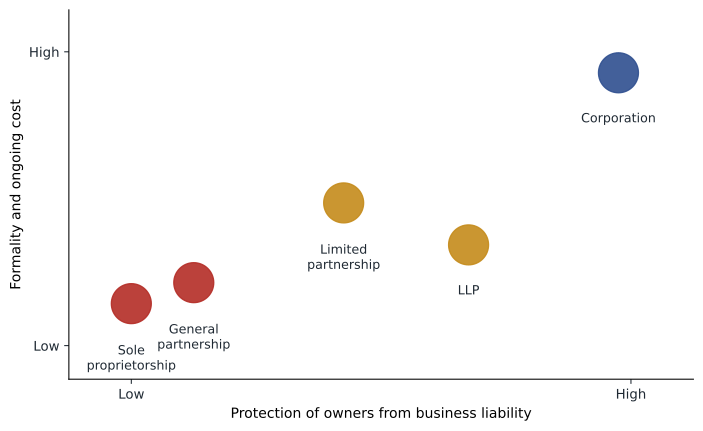
A sole proprietorship is a business owned by one individual without incorporating. There is no separate legal entity: the owner owns the assets, signs the contracts, is personally liable for all business debts and torts without limit and reports business income on their personal tax return. Little formality is required, although an owner who operates under a name other than their own legal name must register it under provincial business names legislation, such as Ontario's Business Names Act, and obtain any municipal licences and CRA program accounts needed, such as a GST/HST number. Personal liability is the main drawback; insurance can manage some risks, but not contractual debts.
Partnerships
Provincial partnership acts define a partnership as the relation that subsists between persons carrying on a business in common with a view to profit. A partnership can arise without any written agreement or even an intention to be partners, if people in fact carry on business together and share profits; sharing gross revenues or co-owning property does not by itself create a partnership. In Backman v. Canada, 2001 SCC 63, the Supreme Court stressed that the three elements, a business, carried on in common, with a view to profit, are judged on the facts as a whole. In a general partnership, each partner is an agent of the firm and the other partners for the purpose of the business, so one partner can bind the firm to contracts within the usual course of business. Partners are jointly liable for the firm's debts and jointly and severally liable for wrongs committed by a partner in the ordinary course of business, without limit and out of their personal assets.
A partnership agreement should cover capital contributions, profit and loss sharing, management and voting, admission of new partners, what happens when a partner dies, retires or becomes bankrupt, restrictions on competition and how disputes are resolved. Without an agreement, the statute supplies default rules that are rarely ideal: profits are shared equally regardless of contribution, every partner has an equal say in management, and in some cases the departure of a partner dissolves the partnership.
Two other forms limit liability. In a limited partnership, created by registration under provincial limited partnerships statutes, at least one general partner has unlimited liability and manages the business, while limited partners contribute capital and are liable only to the extent of their contribution, provided they do not take part in the control of the business; a limited partner who does may lose that protection. Limited partnerships are common in real estate, resource and investment funds, often with a corporation as the general partner. Limited liability partnerships (LLPs), available in most provinces mainly for regulated professions such as law and accounting, protect each partner from personal liability for the negligence of other partners, while each remains liable for their own negligence and that of people they supervise, and the firm's assets remain exposed.
Worked problem
Who pays the partnership's debts?
Ana, Ben and Chloé run a catering business as a general partnership, sharing profits equally, without a written agreement. Ben, while catering a wedding, carelessly starts a fire that causes $450,000 of damage to the venue. The partnership's insurance covers $200,000 and its assets are worth $70,000. Ana has personal assets of $300,000, Ben $40,000 and Chloé $90,000. How is the remaining liability met?
Show solution
- The fire occurred in the ordinary course of the partnership business, so the partnership and every partner are liable for Ben's wrong.
- Insurance pays $200,000 and partnership assets pay $70,000, leaving $180,000.
- Each partner is liable for the full remaining amount to the venue, which can choose to collect it from Ana, the partner with the most assets.
- Among themselves, the partners share losses equally by default: $60,000 each. If Ana pays $180,000, she can seek $60,000 each from Ben and Chloé, but Ben has only $40,000, so Ana and Chloé may end up bearing the shortfall.
- If the business had been a properly registered LLP or a corporation, Ana and Chloé's personal assets would generally have been protected from Ben's negligence.
Answer: Joint and several liability means a partner's personal wealth backs every other partner's mistakes. That risk, more than tax, is the main reason businesses with significant exposure choose a limited liability form.
Corporations
A corporation is a legal person separate from its shareholders, with the capacity, rights, powers and privileges of a natural person. It can own property, make contracts, sue and be sued and continue indefinitely regardless of changes in ownership. This principle comes from Salomon v. A. Salomon & Co. Ltd. (1897), in which the House of Lords held that a company formed by a boot maker, who held almost all its shares and was also a secured creditor, was a separate person from him, so its unsecured creditors could not reach his personal assets when it failed. Shareholders' liability is limited to what they paid or agreed to pay for their shares.
Businesses can incorporate federally under the Canada Business Corporations Act (CBCA) or under a provincial statute such as Ontario's Business Corporations Act (OBCA) or British Columbia's Business Corporations Act. Federal incorporation protects the corporate name across Canada and allows the corporation to carry on business in every province, although it must still register extra-provincially in the provinces where it operates. Incorporation requires filing articles of incorporation, which set out the name, registered office, classes and maximum number of shares, any restrictions on share transfers or business, and the number of directors. The corporation then adopts by-laws, which govern internal procedures such as meetings and officers, issues shares and records everything in a minute book and securities register. Most small corporations are private companies with restrictions on share transfers, and shareholders often sign a unanimous shareholder agreement that can transfer some of the directors' powers to the shareholders.
Corporations are taxed separately. A Canadian-controlled private corporation (CCPC) pays a reduced combined federal and provincial rate on its first $500,000 of active business income, through the small business deduction (federal rate 9 %), with personal tax due when profits are paid out as salary or dividends. Integration aims to make the total tax similar to earning the income personally, but the deferral available when profits are left in the corporation makes incorporation attractive for profitable businesses. Tax planning is a specialist area; BUS-110 and the accounting courses go further.
Lifting the corporate veil
Courts respect the separate legal personality of corporations in almost all cases, but they will disregard it, lifting or piercing the corporate veil, in narrow circumstances. Canadian courts generally require that the corporation be completely dominated and controlled by its owner and be used as a shield for fraudulent or improper conduct (Transamerica Life Insurance Co. of Canada v. Canada Life Assurance Co., 1996, Ontario). Simply owning all the shares, or forming a corporation to limit liability, is not enough: that is exactly what incorporation is for. Courts have also lifted the veil where a corporation was a sham created to evade an existing legal obligation, such as a restrictive covenant. More often, individuals are made liable directly, not by lifting the veil: an officer who personally commits a tort, such as fraudulent misrepresentation, is personally liable even if acting for the corporation, and statutes impose personal liability on directors for certain debts.
Worked problem
Will the court pierce the veil?
Marco owns all the shares of Marco's Renovations Ltd./Inc. He pays personal bills from the company account, has never held a directors' or shareholders' meeting, keeps no minutes and has transferred the company's trucks to his brother for $1 each after a customer won a $120,000 judgment against the company for faulty work. The company now has no assets. Can the customer collect from Marco personally?
Show solution
- Sole ownership and running a small company informally are not, on their own, enough to disregard the corporation.
- Commingling personal and company funds and ignoring formalities show complete domination and control.
- Stripping assets to the brother after the judgment, for nominal consideration, suggests the corporation is being used to defeat a creditor, which is improper conduct.
- A Canadian court could lift the veil, and in any case the customer has other remedies: provincial fraudulent conveyance and assignments and preferences legislation can set aside the transfers, and the oppression remedy (lesson 9) can be used by creditors in some cases.
- Marco may also be personally liable if he personally performed the faulty work negligently, as a tortfeasor in his own right.
Answer: The customer has good prospects of reaching Marco or the trucks. Owners who want to keep limited liability must respect the corporation as a separate entity: separate bank accounts, adequate capital, proper records and arm's-length transactions.
Statutory liabilities of directors
Limited liability protects shareholders, but directors face personal liability under many statutes, whether or not they own shares. Under the CBCA (section 119) and provincial equivalents, directors are jointly and severally liable for up to six months' unpaid wages owed to employees, subject to conditions. Under the Income Tax Act and Excise Tax Act, directors are personally liable for unremitted source deductions (income tax, Canada Pension Plan and Employment Insurance) and GST/HST, unless they exercised the degree of care, diligence and skill a reasonably prudent person would have exercised to prevent the failure. Environmental and occupational health and safety statutes can impose fines and orders on directors and officers personally. Directors' and officers' (D&O) insurance and indemnification by the corporation help manage these risks but do not cover every liability, such as unremitted deductions.
Limited liability companies and other forms
Canada has no equivalent of the American limited liability company (LLC); Canadian businesses that want limited liability incorporate or, for professionals, form LLPs or professional corporations. Canadians often encounter LLCs when doing business in the United States. For Canadian tax purposes, a US LLC is generally treated as a corporation, not a pass-through, which can cause double taxation for Canadian residents who own one, so tax advice is essential before using an LLC for cross-border activities. Co-operatives, governed by federal and provincial co-operative statutes, are owned by their members and follow the one-member, one-vote principle. Not-for-profit corporations operate under statutes such as the Canada Not-for-profit Corporations Act and Ontario's Not-for-Profit Corporations Act, 2010.
| Feature | Sole proprietorship | General partnership | Limited partnership | Corporation |
|---|---|---|---|---|
| Separate legal entity | No | No (a relationship, not a person) | No, but registered | Yes |
| Owner liability | Unlimited | Unlimited, joint and several | General partner unlimited; limited partners limited if not in control | Limited to investment (directors face statutory liabilities) |
| Formation | Name registration if needed | None required; agreement advisable | Registration under provincial statute | Articles of incorporation, by-laws, minute book |
| Taxation | Owner taxed personally | Partners taxed on their share | Partners taxed on their share | Corporation taxed; owners taxed on salary and dividends |
| Continuity | Ends with owner | May dissolve on a partner's exit | Depends on agreement | Perpetual |
Worked problem
Comparing tax on profits (illustrative)
Rowan earns $200,000 of business profit and needs only $100,000 to live on. Compare, using simplified illustrative rates, a sole proprietorship (assume an average personal tax rate of 32 % on $200,000) with a CCPC that pays a combined small-business rate of about 12 %, pays Rowan a $100,000 salary (assume 25 % average personal tax) and keeps the rest in the company. Ignore payroll contributions and other details.
Show solution
- Sole proprietorship: tax ≈ 32 % × $200,000 = $64,000, all paid now; $136,000 left after tax.
- CCPC: Rowan's salary is deductible, so corporate taxable income = $200,000 − $100,000 = $100,000; corporate tax ≈ 12 % × $100,000 = $12,000; $88,000 stays in the company.
- Personal tax on salary ≈ 25 % × $100,000 = $25,000.
- Total tax now ≈ $37,000, compared with $64,000, a deferral of about $27,000.
- When the $88,000 is later paid out as dividends, Rowan pays personal tax on them, so total tax over time is broadly similar under integration; the benefit is deferral and flexibility, at the cost of accounting and legal fees.
Answer: The best form depends on how much profit is reinvested, the owner's other income and the business's risks. These numbers are illustrative only; real decisions need current rates and professional advice.
Franchises and joint ventures
A franchise is a contractual relationship in which a franchisor licenses its trademarks and business system to franchisees, who pay fees and royalties and operate under the franchisor's controls. Six provinces have franchise disclosure legislation: Alberta, Ontario (the Arthur Wishart Act), Manitoba, New Brunswick, Prince Edward Island and British Columbia (the Franchises Act, in force since February 1, 2024). These statutes require the franchisor to give prospective franchisees a disclosure document with prescribed information, including financial statements and litigation history, at least 14 days before the franchisee signs any agreement or pays any money. If disclosure is late or materially deficient, franchisees can rescind within set periods and recover their losses. The statutes also impose a duty of fair dealing on both parties and protect franchisees' right to associate. A joint venture is a business arrangement in which parties combine resources for a specific project; it can be structured as a contract, a partnership or a jointly owned corporation, each with different liability and tax consequences.
Transparency rules are increasing. Since January 22, 2024, corporations under the CBCA must file information about individuals with significant control (generally those who own or control 25 % or more of the shares by votes or value, or exercise direct or indirect influence that results in control) with Corporations Canada, which makes most of it publicly searchable. Several provinces, including Ontario, British Columbia and Quebec, require corporations to keep similar registers, and Quebec makes its information public.
Common mistakes
MistakeAssuming internal approval limits protect the business from unauthorized deals.
InsteadTell counterparties about limits, require dual signatures for large contracts and choose titles that do not overstate authority.
MistakeGoing into business with a friend on a handshake.
InsteadA general partnership can arise by conduct; sign a partnership or shareholders' agreement covering contributions, control, exit and disputes.
MistakeTreating the company bank account as a personal account.
InsteadKeep finances separate, capitalize the company adequately and document transactions with owners to preserve limited liability.
MistakeLetting payroll remittances or GST/HST fall behind when cash is tight.
InsteadDirectors are personally liable for unremitted source deductions and GST/HST; remit first.
MistakeChoosing a business form for tax reasons alone.
InsteadWeigh liability, control, financing, exit and administrative cost alongside tax, with professional advice.
Summary and key terms
- Agents bind principals within actual or apparent authority; agents owe fiduciary duties.
- Sole proprietors are personally liable for all business debts.
- A partnership arises when people carry on business in common with a view to profit; partners are agents of the firm and personally liable.
- Limited partnerships protect limited partners who stay out of control; LLPs protect professionals from partners' negligence.
- A corporation is a separate legal person (Salomon) with limited shareholder liability.
- Courts pierce the veil only for domination plus fraud or improper conduct; individuals remain liable for their own torts.
- Directors are personally liable for unpaid wages, source deductions and GST/HST under statutes.
- Six provinces regulate franchise disclosure, with a 14-day disclosure period and rescission rights.
- Agent
- A person authorized to act for another, the principal.
- Apparent authority
- Authority a third party reasonably believes an agent has because of the principal's conduct.
- Ratification
- A principal's later approval of an unauthorized act, which binds it.
- General partnership
- An unincorporated business carried on in common for profit with unlimited partner liability.
- Limited partnership
- A partnership with general partners who manage and limited partners with limited liability.
- Separate legal personality
- The principle that a corporation is a legal person distinct from its shareholders.
- Piercing the corporate veil
- Disregarding corporate separateness to hold owners personally liable.
- Franchise
- A licence of a brand and business system in exchange for fees and controls.
- Individual with significant control
- A person who owns or controls a significant share of a corporation, who must be recorded in its register.
Practice problems
Work each problem on paper first, then reveal the answer to check.
Distinguish actual authority from apparent authority.
Show answer
Actual authority is given by the principal; apparent authority arises from the principal's representations to third parties.
Can a partnership exist without a written agreement?
Show answer
Yes; it can arise from conduct when people carry on a business together for profit.
Three partners share losses equally. One pays a $90,000 partnership debt alone. How much can she seek from each of the others?
Show answer
$30,000 each.
What risk does a limited partner face by taking part in control of the business?
Show answer
Losing limited liability.
What did Salomon v. A. Salomon & Co. establish?
Show answer
A corporation is a separate legal person from its shareholders.
Name three factors that support piercing the corporate veil.
Show answer
Commingling funds, ignoring formalities, undercapitalization and use of the company to commit fraud or evade obligations.
For how much unpaid employee wages can CBCA directors be personally liable?
Show answer
Up to six months' wages.
How many days before signing must franchise disclosure be given in Ontario?
Show answer
At least 14 days.
Why might an officer be personally liable even though the corporation signed the contract?
Show answer
An officer who personally commits a tort, such as fraud, is liable for it.
Portfolio task: recommend a business form for a two-founder software start-up and justify it.
Show answer
Answers vary; a good answer usually recommends a CCPC with a unanimous shareholder agreement, discussing liability, financing, tax deferral and vesting.
Lesson quiz · 5 questions
Score 60% or more to complete this lesson.
Create a free account to save your progress, take quizzes and earn a certificate.