
BUS-210 · Lesson 10 of 12 · 37 min
Employment law
Employment law governs one of the most important relationships in any business. It sets minimum standards that contracts cannot undercut, protects workers against discrimination and unsafe conditions, regulates unions and collective bargaining and determines what happens when the relationship ends. Mistakes are common and expensive: misclassifying workers, miscalculating overtime and mishandling terminations are among the most frequent legal claims against small and mid-sized businesses. This lesson focuses on the legal framework. BUS-130 discusses harassment, motivation and pay from an organizational behaviour perspective, and the HSE courses cover workplace health and safety law in depth.
Employment law in Canada is mostly provincial. About 94 % of workers are covered by the employment standards, human rights and labour relations laws of their province; the remainder, in federally regulated industries such as banking, interprovincial transportation, telecommunications and broadcasting, are covered by the Canada Labour Code and the Canadian Human Rights Act (lesson 1). On top of these statutes sits the common law of employment contracts, which gives non-unionized employees important rights, especially on termination. Unionized employees are governed instead by their collective agreement, enforced through grievance arbitration.
Employee or independent contractor?
The first question is whether a worker is an employee at all. Employees get the protection of employment standards, workers' compensation and other statutes, and employers must withhold and remit payroll taxes and contributions. Independent contractors run their own businesses and get none of these protections. Labels in a contract are not decisive: courts and agencies look at the substance of the relationship. Misclassification exposes a business to back wages, overtime, unpaid payroll taxes, penalties, interest and, in some cases, class actions.
In 671122 Ontario Ltd. v. Sagaz Industries Canada Inc., 2001 SCC 59, the Supreme Court held that the central question is whether the worker is performing services as a person in business on their own account. Relevant factors include the level of control the company has over the worker's activities, whether the worker provides their own equipment, whether the worker hires helpers, the degree of financial risk taken, the opportunity for profit and the worker's investment and management responsibilities. No single factor is decisive. Canadian courts also recognize an intermediate category, the dependent contractor: a worker who is a contractor but economically dependent on one business, often working exclusively for it for years, is entitled to reasonable notice of termination. Ontario's Digital Platform Workers' Rights Act, 2022, in force since July 1, 2025, gives app-based ride-share and delivery workers certain rights, such as a minimum wage for work periods and pay transparency, without deciding whether they are employees.
Worked problem
Classifying a worker
Coastline Media hires Maya as a "freelance" graphic designer. She works 40 hours a week at Coastline's office on Coastline's computer, follows a schedule set by the art director, is paid a fixed monthly fee, has worked only for Coastline for three years, and cannot send others in her place. Coastline does not deduct CPP, EI or income tax. Is she an employee?
Show solution
- Control: Coastline sets her schedule and supervises her work.
- Equipment: Coastline provides the office and computer.
- Helpers: she cannot hire or substitute others.
- Financial risk and profit: a fixed monthly fee with no investment means no real chance of profit or risk of loss.
- She is not in business on her own account; under Sagaz and the CRA's tests she is almost certainly an employee.
- Coastline owes unpaid CPP and EI contributions (employer and employee portions), may face penalties and interest, and must give her employment standards protections, including termination notice.
Answer: Calling a worker freelance changes nothing. Before engaging long-term contractors, test the relationship against the legal factors, and restructure it or hire the person as an employee if the factors point that way.
Minimum standards
Provincial employment standards statutes, such as Ontario's Employment Standards Act, 2000 (ESA), set minimums that employers cannot contract out of: minimum wage, hours of work and overtime, public holidays, vacation, leaves of absence, termination notice and severance pay. Any term that gives less than the statutory minimum is void. Rules vary by province, so employers must check the law where each employee works. In Ontario, for example, overtime at 1.5 times the regular rate is generally payable after 44 hours in a week, employees are entitled to at least two weeks' vacation (three after five years) with vacation pay of 4 % or 6 % of wages, and there are nine public holidays. The federal minimum wage under the Canada Labour Code rose to $18.15 an hour on April 1, 2026; provincial rates are set separately and change regularly, usually each year. Employment standards offices investigate complaints, can order payment of wages owed and can prosecute.
Worked problem
Calculating overtime
A warehouse worker in Ontario earns $22 an hour and works 50 hours in one week, with no averaging agreement. Calculate the week's pay. What changes if she works for a federally regulated trucking company instead?
Show solution
- Regular hours: 44 × $22 = $968.
- Overtime hours: 50 − 44 = 6, at 1.5 × $22 = $33 an hour, so 6 × $33 = $198.
- Total = $968 + $198 = $1,166.
- Under the Canada Labour Code, standard hours are 8 a day and 40 a week, so overtime starts after 40 hours: 40 × $22 = $880 plus 10 × $33 = $330, total $1,210.
Answer: The province or federal jurisdiction changes the threshold and the pay. Payroll systems must be set up for each employee's governing law.
Human rights and discrimination
Federal and provincial human rights statutes prohibit discrimination in employment on protected grounds, which typically include race, colour, ancestry, place of origin, ethnic origin, citizenship, creed or religion, sex (including pregnancy), sexual orientation, gender identity and expression, age, marital and family status and disability; some provinces add grounds such as social condition or record of offences. The prohibitions cover hiring, pay, promotion, discipline, termination and harassment. Discrimination does not require intent: a neutral rule that has an adverse effect on a protected group is discriminatory unless the employer shows it is a bona fide occupational requirement. Under the test from British Columbia (Public Service Employee Relations Commission) v. BCGSEU (the Meiorin case, 1999), the employer must show that the standard was adopted for a purpose rationally connected to the job, in an honest and good-faith belief that it was necessary, and that it is reasonably necessary, which requires showing that accommodating individual employees is impossible without undue hardship. Employers have a duty to accommodate employees' disability, religion and family status up to the point of undue hardship, considering cost, outside sources of funding and health and safety. Complaints are heard by human rights tribunals, which can order compensation, reinstatement and policy changes. Workplace harassment and violence are also governed by occupational health and safety statutes; BUS-130 and HSE-109 cover them.
Worked problem
Is accommodation required?
A Manitoba distribution centre requires all warehouse associates to be able to lift 25 kg. An associate with three years of good performance develops a back condition that limits her to lifting 10 kg for at least six months. About 20 % of the job involves heavy lifting; the rest is scanning, labelling and operating a pallet jack. The manager wants to terminate her. What does human rights law require?
Show solution
- Disability is a protected ground, and the lifting standard adversely affects her because of it.
- The employer must show the standard is a bona fide occupational requirement, including that accommodating her would cause undue hardship.
- Possible accommodations: reassigning heavy lifting tasks to co-workers, providing lifting aids, modifying duties temporarily or offering another available position she can do.
- With 80 % of the job unaffected and a large workforce, accommodation is very likely possible without undue hardship.
- Terminating her would likely be discrimination; the employer should engage in an accommodation process, documenting medical information about her restrictions (not her diagnosis) and the options considered.
Answer: Accommodation is a process, not a single decision. Employers that explore options in good faith, document them and involve the employee rarely lose these cases; employers that terminate first often do.
Ending employment: notice and just cause
Non-unionized employees in Canada can be dismissed in two ways. An employer can dismiss for just cause, meaning serious misconduct that is incompatible with the employment relationship, such as theft, serious dishonesty or wilful disobedience, without notice or pay in lieu. Courts take a contextual approach: in McKinley v. BC Tel, 2001 SCC 38, the Supreme Court held that dishonesty does not automatically justify dismissal; the question is whether the misconduct, in context, breached an essential condition of employment. Just cause is hard to prove, and employers often rely on documented progressive discipline. Alternatively, an employer can dismiss without cause at any time by giving reasonable notice or pay in lieu of notice.
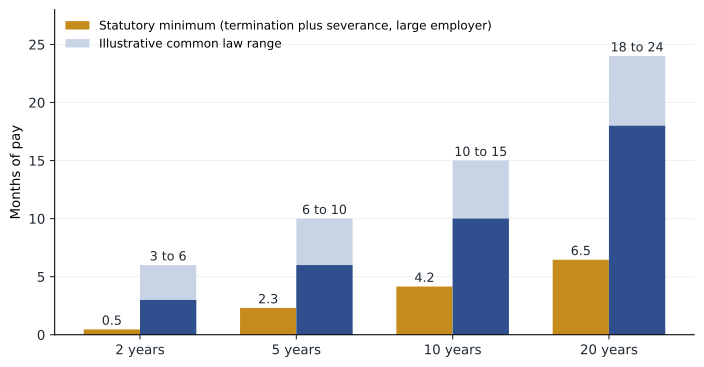
The employee's entitlement on dismissal without cause is the greater of the statutory minimum and the common law reasonable notice, unless a valid employment contract limits notice to the statutory minimum. Under Ontario's ESA, termination notice is generally one week per year of service up to eight weeks, and employers with a payroll of $2.5 million or more must also pay severance of one week per year of service, up to 26 weeks, to employees with five or more years of service. Common law reasonable notice is usually much longer. Courts apply the factors from Bardal v. Globe & Mail Ltd. (1960): the character of the employment, length of service, age and the availability of similar employment, considering the employee's experience, training and qualifications. Awards commonly range up to about 24 months for long-service senior employees, and occasionally more in exceptional cases. During the notice period, the employee is entitled to all compensation they would have earned, including benefits and, unless clearly excluded, bonuses (Matthews v. Ocean Nutrition Canada Ltd., 2020 SCC 26). The employee must mitigate by looking for comparable work.
Worked problem
Calculating entitlements on termination
Lucas, 52, has worked for 12 years as an operations manager earning $110,000 a year plus a $15,000 annual bonus and benefits worth 10 % of salary, at an Ontario company with a $20 million payroll. He is dismissed without cause. His contract has no termination clause. A court estimates reasonable notice at 15 months. Calculate his minimum statutory entitlement and his common law entitlement.
Show solution
- ESA termination pay: 8 weeks (maximum). ESA severance: 12 weeks (one week per year, payroll over $2.5 million, 5+ years). Total statutory minimum = 20 weeks.
- Weekly pay = $110,000 ÷ 52 ≈ $2,115; statutory minimum ≈ 20 × $2,115 = $42,300, plus benefit continuation for the 8-week notice period.
- Common law: 15 months of total compensation. Salary: $110,000 × 15/12 = $137,500. Bonus: $15,000 × 15/12 = $18,750. Benefits: 10 % of salary for 15 months = $13,750. Total ≈ $170,000.
- The statutory amounts are credited against, not added to, the common law entitlement. If Lucas finds a new job at a similar salary after 9 months, his damages are reduced by what he earns, subject to the statutory minimum, which is not subject to mitigation.
Answer: Lucas's common law entitlement (about $170,000) is roughly four times the statutory minimum. This gap is why Canadian employers draft enforceable termination clauses.
Employers can limit notice to the statutory minimum by contract, but courts scrutinize termination clauses closely and strike them down if any part could give less than the ESA requires. In Waksdale v. Swegon North America Inc., 2020 ONCA 391, the court held that an invalid just-cause provision invalidated the entire termination section, even though the without-cause provision was valid on its own; subsequent Ontario decisions have voided clauses that allowed termination at the employer's sole discretion or at any time. Clauses must also be agreed at the start of employment or supported by fresh consideration. Employers can also be liable for constructive dismissal, when they unilaterally make a substantial change to an essential term of employment, such as pay, duties or location, or make continued employment intolerable (Potter v. New Brunswick Legal Aid Services Commission, 2015 SCC 10). Finally, employers must act in good faith in the manner of dismissal; in Honda Canada Inc. v. Keays, 2008 SCC 39, the Supreme Court held that damages for bad faith conduct in dismissal, such as being untruthful, misleading or unduly insensitive, compensate actual harm caused, while punitive damages require separate, malicious conduct.
Restrictive covenants
Courts treat restrictive covenants in employment contracts as presumptively unenforceable restraints of trade, enforced only if reasonable in duration, geography and activity and necessary to protect a legitimate proprietary interest such as confidential information or customer relationships. In Shafron v. KRG Insurance Brokers (Western) Inc., 2009 SCC 6, a non-compete covering the "Metropolitan City of Vancouver", a term with no legal meaning, was struck down as ambiguous, and the court refused to rewrite it. Courts strongly prefer non-solicitation clauses to non-competition clauses. Since October 25, 2021, Ontario's ESA has prohibited non-compete agreements with employees, subject to exceptions for executives and for the sale of a business where the seller becomes an employee of the buyer. Confidentiality and non-solicitation clauses remain enforceable if reasonable.
Worked problem
Will the covenant be enforced?
An Alberta insurance brokerage requires a salaried account manager earning $65,000 to agree that for three years after leaving she will not work for any insurance business anywhere in Canada. She leaves after four years to join a competitor in Calgary. Is the covenant enforceable? What would differ if the brokerage were in Ontario?
Show solution
- A three-year, Canada-wide ban on working for any insurance business goes well beyond what is needed to protect the brokerage's client relationships.
- Courts will not rewrite it to a reasonable scope (Shafron), so it is likely unenforceable as a whole.
- A narrower non-solicitation clause preventing her from soliciting clients she personally served for 12 months would be much more likely to survive.
- In Ontario, the non-compete would be void under the ESA anyway, since she is not an executive, though a reasonable non-solicitation clause could still apply.
Answer: Narrow, targeted covenants protect legitimate interests far more reliably than sweeping non-competes. Employers should match the restraint to the employee's actual access to clients and confidential information.
Unions and collective bargaining
Provincial labour relations acts and the Canada Labour Code give employees the right to join unions and bargain collectively. A union becomes the exclusive bargaining agent for a bargaining unit through certification by a labour relations board, either by a secret ballot vote or, in some provinces and industries, by card check when enough employees sign membership cards. Employers must not interfere with organizing, for example by threatening, disciplining or promising benefits to employees to discourage union support. Once a union is certified, the employer must bargain in good faith, and strikes and lockouts are permitted only after the collective agreement expires and conciliation steps are completed. During the agreement, disputes go to binding grievance arbitration.
Common mistakes
MistakeLabelling a long-term, full-time, closely supervised worker an independent contractor.
InsteadApply the legal tests; misclassification brings back taxes, penalties and claims.
MistakeAssuming salaried employees are never owed overtime.
InsteadCheck the ESA's managerial and other exemptions, which depend on duties, not salary alone.
MistakeTerminating an employee with a disability or medical restriction without exploring accommodation.
InsteadEngage in a documented accommodation process before considering termination.
MistakeAssuming the ESA minimum is all a dismissed employee is owed.
InsteadWithout a valid termination clause, common law reasonable notice usually applies and can be many months.
MistakeUsing broad, standard non-compete clauses for all employees.
InsteadUse narrow non-solicitation and confidentiality clauses; non-competes are void for most Ontario employees.
Summary and key terms
- Employment law is mainly provincial; federally regulated industries follow the Canada Labour Code.
- Sagaz asks whether the worker is in business on their own account; dependent contractors get reasonable notice.
- Employment standards set non-waivable minimums for wages, hours, overtime, vacation, leaves and termination.
- Human rights laws prohibit discrimination and require accommodation to undue hardship (Meiorin).
- Dismissal without cause requires statutory notice and, absent a valid clause, common law reasonable notice under the Bardal factors.
- Termination clauses are strictly scrutinized (Waksdale); bad faith in dismissal can add damages (Honda v. Keays).
- Ontario bans most employee non-competes; elsewhere courts enforce only reasonable covenants (Shafron).
- Labour law protects the right to organize and requires good-faith bargaining.
- Independent contractor
- A person in business on their own account rather than an employee.
- Duty to accommodate
- The obligation to adjust rules or duties for protected characteristics up to undue hardship.
- Undue hardship
- The point at which accommodation would impose excessive cost or risk.
- Constructive dismissal
- A substantial unilateral change to essential employment terms, treated as a dismissal.
- Restrictive covenant
- A contractual restriction on competing, soliciting or using information after employment.
- Collective agreement
- A contract between an employer and a union setting terms of employment.
- Reasonable notice
- Common law notice of dismissal based on the Bardal factors.
- Just cause
- Serious misconduct justifying dismissal without notice.
- Bona fide occupational requirement
- A job standard justified as reasonably necessary, with accommodation to undue hardship.
Practice problems
Work each problem on paper first, then reveal the answer to check.
State the central question in Sagaz for classifying workers.
Show answer
Whether the worker is performing services as a person in business on their own account.
An Ontario employee earning $20 an hour works 48 hours in a week. What is the overtime pay?
Show answer
4 hours × $30 = $120.
What must an employer show to justify a job standard that adversely affects a protected group?
Show answer
That it is a bona fide occupational requirement, including that accommodation would cause undue hardship.
List the four Bardal factors.
Show answer
Character of employment, length of service, age and availability of similar employment.
What did Waksdale v. Swegon decide?
Show answer
An invalid just-cause provision can invalidate the whole termination clause.
An Ontario employee with 6 years' service at a company with a $3 million payroll is dismissed without cause. What are the ESA termination and severance entitlements?
Show answer
6 weeks' termination pay and 6 weeks' severance pay.
What is constructive dismissal?
Show answer
A substantial unilateral change to an essential term of employment, treated as a dismissal.
Since when has Ontario banned most employee non-competes?
Show answer
October 25, 2021.
Why are non-solicitation clauses more likely to be enforced than non-competes?
Show answer
They are narrower and more closely tied to protecting legitimate client relationships.
Portfolio task: audit an employment offer letter template against the law of your jurisdiction.
Show answer
Answers vary; a good answer checks classification, pay and overtime terms, termination provisions, restrictive covenants and required notices.
Lesson quiz · 5 questions
Score 60% or more to complete this lesson.
Create a free account to save your progress, take quizzes and earn a certificate.