
BUS-210 · Lesson 8 of 12 · 38 min
Business organizations
BUS-101 introduced the main forms of business ownership and their advantages and disadvantages. This lesson looks at the legal rules underneath them: how agents bind the businesses they act for, how partners become liable for each other's acts, what it means for a corporation to be a separate legal person and when courts will look past it, and how franchises and joint ventures are structured and regulated. The choice of form is a legal decision with consequences for liability, tax, control and the ability to raise money, and it should be made deliberately with advice from a lawyer and an accountant. Corporate governance and directors' duties follow in lesson 9.
Agency: how businesses act
Every business acts through people. An agent is a person authorized to act on behalf of another, the principal, in dealings with third parties. Employees, partners, directors, officers, brokers and sales representatives are all agents for some purposes. When an agent acts within its authority, the principal is bound by the contract as if it had made it itself, and the agent usually drops out. Agency relationships can be created by express agreement, by implication from conduct or a position held, by ratification after the fact or, in some cases, by estoppel.
Authority comes in two kinds. Actual authority is what the principal has actually given the agent, expressly or by implication; a purchasing manager has implied authority to place ordinary orders for supplies. Apparent (or ostensible) authority arises when the principal's words or conduct lead a third party reasonably to believe that the agent has authority, even if the agent does not. If a company gives someone the title "vice-president of sales" and lets them negotiate deals, customers may reasonably assume they can sign standard sales contracts, even if an internal policy requires the CEO's approval. Internal limits do not bind outsiders who do not know of them. A principal may also ratify an unauthorized contract after the fact by accepting it, which binds the principal from the start.
Agents owe principals fiduciary duties: to act in good faith and in the principal's best interests, to avoid conflicts of interest, not to make secret profits, to keep confidences, to follow lawful instructions and to account for money and property. An agent who exceeds its authority and binds no one may be personally liable to the third party for breach of an implied warranty of authority. Principals are also liable for torts committed by agents within their authority, a form of the vicarious liability discussed in lesson 6.
Worked problem
Is the company bound by the deal?
Halcyon Furniture appoints Priya as "Director of Purchasing" and announces the appointment to its suppliers. Internally, the board limits her authority to contracts under $100,000 without the CFO's signature. Priya signs a $250,000 contract with a long-standing fabric supplier, Westweave, on Halcyon letterhead, without telling the CFO. Westweave has dealt with Priya for years, mostly on smaller orders, and knows nothing about the limit. Halcyon wants to cancel. Is it bound?
Show solution
- Priya had no actual authority above $100,000 because the board limited it.
- Halcyon gave her a senior purchasing title and announced it to suppliers, which is a representation by the principal that she can make purchasing contracts.
- Westweave reasonably relied on that representation and did not know of the internal limit, so Priya had apparent authority.
- Halcyon is probably bound. It may have a claim against Priya for breaching her instructions, and should consider whether to ratify the contract if it is commercially sensible anyway.
Answer: Internal limits on authority protect a business only if third parties know about them. Companies that want limits respected should tell key counterparties, require two signatures on large contracts and make sure titles do not imply more authority than the person has.
Sole proprietorships
A sole proprietorship is a business owned by one individual without forming an entity. There is no separate legal person: the owner owns the assets, signs the contracts, is personally liable for all business debts and torts without limit and reports business income on Schedule C of their personal tax return, paying self-employment tax. Little formality is required, although an owner who operates under a name other than their own must usually file an assumed name or DBA (doing business as) certificate with the state or county, and obtain local licenses and, if it has employees, an Employer Identification Number. Personal liability is the main drawback; insurance can manage some risks, but not contractual debts.
Partnerships
Most states have adopted the Revised Uniform Partnership Act (RUPA), under which a partnership is an association of two or more persons to carry on as co-owners a business for profit, whether or not they intend to form a partnership. Sharing profits creates a presumption of partnership, but not if the profits are received as wages, rent, interest or payment for a business sold. Under RUPA, a partnership is an entity distinct from its partners, but each partner is an agent of the partnership for carrying on its ordinary business, and all partners are jointly and severally liable for all partnership obligations; a creditor must generally first pursue partnership assets before reaching partners' personal assets. Partnerships are pass-through entities for federal tax: the partnership files an information return (Form 1065), and partners pay tax on their share of income.
A partnership agreement should cover capital contributions, profit and loss sharing, management and voting, admission of new partners, what happens when a partner dies, retires or becomes bankrupt, restrictions on competition and how disputes are resolved. Without an agreement, the statute supplies default rules that are rarely ideal: profits are shared equally regardless of contribution, every partner has an equal say in management, and in some cases the departure of a partner dissolves the partnership.
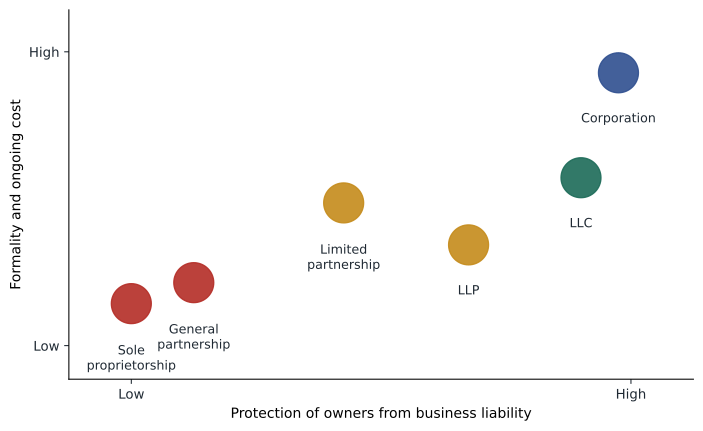
Two other forms limit liability. In a limited partnership (LP), formed by filing a certificate under state law based on the Uniform Limited Partnership Act, at least one general partner has unlimited liability and manages the business, while limited partners are liable only to the extent of their investment; under the 2001 version of the act, limited partners keep their protection even if they participate in management. LPs are common in real estate and private equity funds, usually with an LLC or corporation as general partner. A limited liability partnership (LLP), formed by filing with the state, protects partners from personal liability for partnership obligations, including other partners' malpractice, while each remains liable for their own wrongdoing; LLPs are popular with law and accounting firms. Some states also allow limited liability limited partnerships (LLLPs), which shield general partners too.
Worked problem
Who pays the partnership's debts?
Ana, Ben and Chloé run a catering business as a general partnership, sharing profits equally, without a written agreement. Ben, while catering a wedding, carelessly starts a fire that causes $450,000 of damage to the venue. The partnership's insurance covers $200,000 and its assets are worth $70,000. Ana has personal assets of $300,000, Ben $40,000 and Chloé $90,000. How is the remaining liability met?
Show solution
- The fire occurred in the ordinary course of the partnership business, so the partnership and every partner are liable for Ben's wrong.
- Insurance pays $200,000 and partnership assets pay $70,000, leaving $180,000.
- Each partner is liable for the full remaining amount to the venue, which can choose to collect it from Ana, the partner with the most assets.
- Among themselves, the partners share losses equally by default: $60,000 each. If Ana pays $180,000, she can seek $60,000 each from Ben and Chloé, but Ben has only $40,000, so Ana and Chloé may end up bearing the shortfall.
- If the business had been a properly registered LLP or a corporation, Ana and Chloé's personal assets would generally have been protected from Ben's negligence.
Answer: Joint and several liability means a partner's personal wealth backs every other partner's mistakes. That risk, more than tax, is the main reason businesses with significant exposure choose a limited liability form.
Corporations
A corporation is a legal person separate from its shareholders. It can own property, make contracts, sue and be sued and exists indefinitely regardless of changes in ownership. Shareholders' liability is limited to what they invested. The principle that a corporation is distinct from its shareholders, illustrated by the English case Salomon v. A. Salomon & Co. Ltd. (1897), in which a boot maker who held almost all the shares of his company was not personally liable for its debts, is fundamental to American corporate law as well.
Corporations are created under state law. A corporation may incorporate in any state, regardless of where it operates, and must register (qualify) to do business in other states where it has a presence. Delaware is the most popular state for large companies, because of its specialized Court of Chancery, extensive case law and flexible statute, the Delaware General Corporation Law; in 2025 Delaware amended its statute to add safe harbors for transactions involving controlling stockholders after several companies announced moves to Texas or Nevada. Most other states base their statutes on the Model Business Corporation Act. Incorporation requires filing articles (or a certificate) of incorporation, which state the name, purpose (usually any lawful business), authorized shares and registered agent. The corporation then adopts bylaws, elects directors, issues shares and keeps minutes. Small companies often adopt a shareholders' agreement, and many states allow close corporations to dispense with some formalities.
A regular corporation, called a C corporation, pays federal corporate income tax at a flat 21 %, plus state tax in most states, and shareholders pay tax again on dividends, a structure called double taxation. Eligible small corporations can elect S corporation status, under which income passes through to shareholders and is taxed only once; an S corporation may have no more than 100 shareholders, generally US citizens or residents, and only one class of stock. Pass-through owners may also qualify for the qualified business income deduction under section 199A, which the 2025 budget reconciliation act made permanent at 20 %, subject to limits. Tax planning is a specialist area; BUS-110 and the accounting courses go further.
Lifting the corporate veil
Courts respect corporate separateness in most cases but will pierce the corporate veil to hold shareholders personally liable in narrow circumstances. Most states require that the corporation be the alter ego of its owner, shown by factors such as commingling of funds, failure to observe corporate formalities, gross undercapitalization and the use of corporate assets as personal assets, and that respecting the separate entity would sanction fraud or promote injustice. In Walkovszky v. Carlton (1966), a taxi fleet owner put each of his cabs in a separate corporation with two cabs and only the minimum required insurance. A pedestrian injured by one cab tried to reach the owner and the other corporations. New York's highest court refused to pierce the veil simply because the corporations were thinly capitalized and part of a deliberate structure, though it allowed the plaintiff to try to plead that the owner was conducting business in his individual capacity. Veil piercing succeeds more often against small, closely held companies than public ones, and more often in tort than contract cases, because contract creditors can protect themselves by asking for guarantees.
Worked problem
Will the court pierce the veil?
Marco owns all the shares of Marco's Renovations Ltd./Inc. He pays personal bills from the company account, has never held a directors' or shareholders' meeting, keeps no minutes and has transferred the company's trucks to his brother for $1 each after a customer won a $120,000 judgment against the company for faulty work. The company now has no assets. Can the customer collect from Marco personally?
Show solution
- Sole ownership and running a small company informally are not, on their own, enough to disregard the corporation.
- Commingling personal and company funds and ignoring formalities show complete domination and control.
- Stripping assets to the brother after the judgment, for nominal consideration, suggests the corporation is being used to defeat a creditor, which is improper conduct.
- An American court applying the alter ego test would likely pierce the veil, and the customer can also challenge the transfers under the state's version of the Uniform Voidable Transactions Act, formerly the Uniform Fraudulent Transfer Act.
- Marco may also be personally liable if he personally performed the faulty work negligently, as a tortfeasor in his own right.
Answer: The customer has good prospects of reaching Marco or the trucks. Owners who want to keep limited liability must respect the corporation as a separate entity: separate bank accounts, adequate capital, proper records and arm's-length transactions.
Other personal liabilities of owners and managers
Limited liability protects shareholders, but individuals who manage a business can still be personally liable. Under the Internal Revenue Code's trust fund recovery penalty, any responsible person who willfully fails to collect or pay over withheld income and payroll taxes is personally liable for the full amount. Some states impose personal liability on officers or the largest shareholders of closely held companies for unpaid wages, and federal and state environmental and workplace safety laws can impose fines and even criminal penalties on responsible officers. Owners of small businesses also frequently sign personal guarantees for leases and bank loans, which make them liable notwithstanding the entity. Directors' and officers' (D&O) insurance and indemnification help manage these risks but do not cover every liability.
Limited liability companies
The limited liability company (LLC) combines limited liability for all owners, called members, with the flexibility of a partnership. Every state has an LLC statute. An LLC is formed by filing articles of organization, and its internal affairs are governed by an operating agreement, which can set almost any arrangement for management, profit sharing and transfers. An LLC can be member-managed, like a partnership, or manager-managed, like a corporation. For federal tax, the check-the-box regulations treat a single-member LLC as a disregarded entity and a multi-member LLC as a partnership by default, but either can elect to be taxed as a corporation, including as an S corporation. LLCs have become the most popular form for new small businesses. Members are generally not liable for the LLC's debts, though courts can pierce the veil of an LLC on similar grounds to corporations. Professionals may use professional LLCs or professional corporations, which do not shield them from their own malpractice.
| Feature | Sole proprietorship | General partnership | LLC | Corporation |
|---|---|---|---|---|
| Separate legal entity | No | Yes under RUPA, but partners liable | Yes | Yes |
| Owner liability | Unlimited | Unlimited, joint and several | Limited to investment | Limited to investment |
| Formation | DBA filing if needed | None required; agreement advisable | Articles of organization; operating agreement | Articles of incorporation, bylaws, minutes |
| Federal taxation | Owner taxed personally (Schedule C) | Pass-through (Form 1065) | Pass-through by default; can elect corporate treatment | C corporation (21 % plus tax on dividends) or S corporation pass-through |
| Continuity | Ends with owner | Partnership continues under RUPA unless dissolved | Per operating agreement | Perpetual |
Worked problem
Comparing tax on profits (illustrative)
Rowan earns $200,000 of business profit and needs only $100,000 to live on. Compare, using simplified illustrative rates, a single-member LLC taxed as a disregarded entity (assume an effective federal and state rate of 28 % after the 20 % QBI deduction, plus self-employment tax of about $23,000) with a C corporation that pays Rowan a $100,000 salary (assume 22 % effective personal and payroll tax on the salary, after the corporation's share of payroll taxes) and keeps the rest, paying 21 % federal plus 5 % state corporate tax. Ignore other details.
Show solution
- LLC: income tax ≈ 28 % × $200,000 = $56,000 plus self-employment tax ≈ $23,000 = $79,000; $121,000 left after tax.
- C corporation: salary of $100,000 is deductible, so corporate taxable income = $100,000; corporate tax ≈ 26 % × $100,000 = $26,000; $74,000 stays in the company.
- Personal and payroll tax on salary ≈ 22 % × $100,000 = $22,000.
- Total tax now ≈ $48,000, compared with $79,000, but the $74,000 retained will be taxed again as dividends (15 % to 20 % federally) when paid out.
- If Rowan withdraws everything every year, the C corporation's double tax usually costs more; retaining profits for growth narrows the gap. An S corporation election is another common option for reducing self-employment tax.
Answer: The best form depends on how much profit is reinvested, the owner's other income and the business's risks. These numbers are illustrative only; real decisions need current rates and professional advice.
Franchises and joint ventures
A franchise is a contractual relationship in which a franchisor licenses its trademarks and business system to franchisees, who pay fees and royalties and operate under the franchisor's controls. The FTC Franchise Rule requires franchisors to provide a Franchise Disclosure Document (FDD) with 23 prescribed items, including fees, litigation history, financial performance representations (if any) and audited financial statements, at least 14 calendar days before the prospective franchisee signs or pays. About a dozen states, including California, New York, Illinois and Maryland, also require franchisors to register their FDD with a state agency before offering franchises, and some states regulate termination and non-renewal. Joint ventures combine parties' resources for a specific project and can be structured as a contract, a partnership, an LLC or a jointly owned corporation, each with different liability and tax consequences; the LLC is a common choice.
Transparency rules have been in flux. The Corporate Transparency Act required most small companies to report their beneficial owners to the Financial Crimes Enforcement Network (FinCEN) from 2024, but after legal challenges FinCEN issued an interim final rule in March 2025 exempting companies created in the United States and their owners; at the time of writing, the reporting requirement applies mainly to foreign companies registered to do business in a state. Businesses should check FinCEN's current guidance and any state laws, such as New York's LLC Transparency Act, before relying on this.
Common mistakes
MistakeAssuming internal approval limits protect the business from unauthorized deals.
InsteadTell counterparties about limits, require dual signatures for large contracts and choose titles that do not overstate authority.
MistakeGoing into business with a friend on a handshake.
InsteadA general partnership can arise by conduct; sign a partnership or shareholders' agreement covering contributions, control, exit and disputes.
MistakeTreating the company bank account as a personal account.
InsteadKeep finances separate, capitalize the company adequately and document transactions with owners to preserve limited liability.
MistakeLetting payroll tax deposits fall behind when cash is tight.
InsteadResponsible persons are personally liable for unpaid trust fund taxes; deposit first.
MistakeChoosing a business form for tax reasons alone.
InsteadWeigh liability, control, financing, exit and administrative cost alongside tax, with professional advice.
Summary and key terms
- Agents bind principals within actual or apparent authority; agents owe fiduciary duties.
- Sole proprietors are personally liable for all business debts.
- Under RUPA, a partnership arises from co-ownership of a business for profit; partners are jointly and severally liable.
- LPs, LLPs and LLLPs offer varying liability protection.
- A corporation is a separate legal person (Salomon) with limited shareholder liability.
- Courts pierce the veil only for domination plus fraud or improper conduct; individuals remain liable for their own torts.
- Responsible persons are liable for unpaid payroll taxes; owners often sign personal guarantees.
- The FTC Franchise Rule requires an FDD 14 days before signing; some states require registration.
- Agent
- A person authorized to act for another, the principal.
- Apparent authority
- Authority a third party reasonably believes an agent has because of the principal's conduct.
- Ratification
- A principal's later approval of an unauthorized act, which binds it.
- General partnership
- An unincorporated business carried on in common for profit with unlimited partner liability.
- Limited partnership
- A partnership with general partners who manage and limited partners with limited liability.
- Separate legal personality
- The principle that a corporation is a legal person distinct from its shareholders.
- Piercing the corporate veil
- Disregarding corporate separateness to hold owners personally liable.
- Franchise
- A license of a brand and business system in exchange for fees and controls.
- LLC
- A limited liability company combining limited liability with partnership-style flexibility and pass-through taxation by default.
- S corporation
- A corporation that elects pass-through taxation, subject to ownership limits.
Practice problems
Work each problem on paper first, then reveal the answer to check.
Distinguish actual authority from apparent authority.
Show answer
Actual authority is given by the principal; apparent authority arises from the principal's representations to third parties.
Can a partnership exist without a written agreement?
Show answer
Yes; it can arise from conduct when people carry on a business together for profit.
Three partners share losses equally. One pays a $90,000 partnership debt alone. How much can she seek from each of the others?
Show answer
$30,000 each.
What is a key tax difference between a C corporation and an LLC?
Show answer
A C corporation is taxed separately and dividends are taxed again; an LLC is pass-through by default.
What did Salomon v. A. Salomon & Co. establish?
Show answer
A corporation is a separate legal person from its shareholders.
Name three factors that support piercing the corporate veil.
Show answer
Commingling funds, ignoring formalities, undercapitalization and use of the company to commit fraud or evade obligations.
Who can be liable under the trust fund recovery penalty?
Show answer
Any responsible person who willfully fails to pay over withheld payroll taxes.
How many days before signing must an FDD be provided?
Show answer
At least 14 calendar days.
Why might an officer be personally liable even though the corporation signed the contract?
Show answer
An officer who personally commits a tort, such as fraud, is liable for it.
Portfolio task: recommend a business form for a two-founder software start-up and justify it.
Show answer
Answers vary; a good answer often recommends a Delaware C corporation if venture capital is planned, or an LLC otherwise, discussing liability, financing and tax.
Lesson quiz · 5 questions
Score 60% or more to complete this lesson.
Create a free account to save your progress, take quizzes and earn a certificate.