
BUS-210 · Lesson 3 of 12 · 39 min
Contract law I: formation
Contracts are the legal backbone of business. Every sale, lease, loan, employment relationship, software subscription and supply chain rests on agreements that the law will enforce. A contract is a legally enforceable agreement: a promise or set of promises that the law will recognize and for whose breach it gives a remedy. This lesson covers how contracts are formed: offer and acceptance, consideration, intention, capacity, legality and form, including contracts made online. Lesson 4 covers what contracts mean and what happens when something goes wrong in their making or performance, and lesson 5 covers remedies and the special rules for sales of goods.
Contract law in the United States is mainly state law. For most contracts, such as services, employment and real estate, the common law applies, as summarized in the Restatement (Second) of Contracts. For contracts for the sale of goods, Article 2 of the Uniform Commercial Code (UCC) applies, and it relaxes several common law rules to suit commercial practice. When a contract mixes goods and services, such as the installation of an elevator, most courts apply the predominant purpose test to decide which body of law governs. This lesson flags the UCC rules where they differ.
The elements of a contract
A valid contract requires an offer, an acceptance of that offer, consideration (something of value exchanged by each side), an intention to create legal relations, parties with legal capacity and a lawful purpose. Some contracts also require a particular form, such as writing. If an element is missing, there is no contract, and a party who performed may be limited to recovering the value of what it provided. Courts judge formation objectively, by asking what a reasonable person in the position of the other party would have understood from words and conduct, not what a party secretly intended.
| Element | Question to ask | Typical problem |
|---|---|---|
| Offer | Did one party make a definite proposal showing willingness to be bound? | An advertisement or price list is usually only an invitation to make offers |
| Acceptance | Did the other party unconditionally agree, in a permitted way, while the offer was open? | A reply that changes the terms is a counter-offer, not an acceptance |
| Consideration | Did each side give or promise something of value? | Gratuitous promises and past consideration are not enforceable |
| Intention | Would a reasonable person think the parties meant to be legally bound? | Social arrangements and "subject to contract" negotiations |
| Capacity | Were the parties legally able to contract? | Minors, people lacking mental capacity, unauthorized agents |
| Legality | Is the purpose lawful and consistent with public policy? | Contracts to commit crimes; unreasonable restraints of trade |
| Form | Does the law require writing or another formality? | The statute of frauds: land, guarantees, contracts over a year, sales of goods of $500 or more |
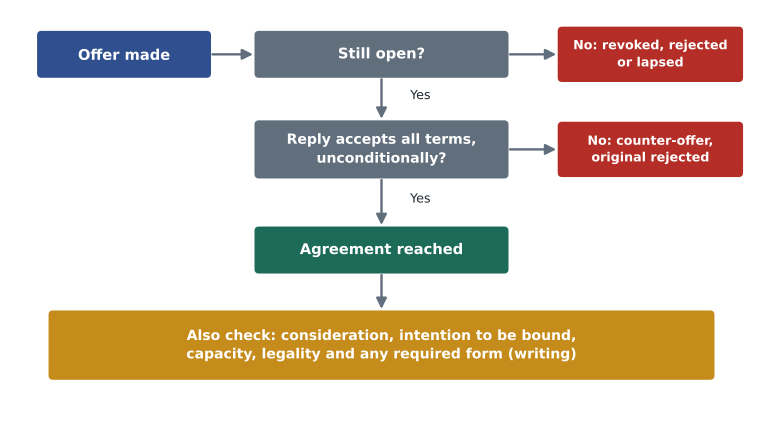
Offer
An offer is a proposal that shows a willingness to be bound on definite terms as soon as the other party accepts. It must be communicated to the offeree and must be sufficiently certain: the essential terms, such as the parties, the subject matter and the price or a way to determine it, must be clear enough for a court to enforce. An offer must be distinguished from an invitation to treat, which invites others to make offers. Advertisements, catalogs, price lists, goods displayed on shelves and websites showing products are usually invitations to treat, because a seller does not intend to be bound to sell to everyone who responds, perhaps beyond its stock.
Courts generally treat advertisements as invitations to deal, but an advertisement can be an offer when it is clear, definite and explicit and leaves nothing open for negotiation. In Lefkowitz v. Great Minneapolis Surplus Store (1957), a store advertised a fur stole worth $139.50 for $1, first come, first served. When the plaintiff arrived first, the store refused to sell, citing a house rule that the offer was for women only. The Minnesota Supreme Court held the advertisement was an offer that the plaintiff accepted by being first. Reward offers and specific bonus promises can create unilateral contracts accepted by performance, an idea also illustrated by the English case Carlill v. Carbolic Smoke Ball Co. (1893), which American casebooks still teach.
Offers do not last forever. An offer ends when it is revoked by the offeror before acceptance (revocation must be communicated, though it can come from a reliable third party), when it is rejected, when the offeree makes a counter-offer, when it lapses at the end of a stated time or, if no time is stated, after a reasonable time, and on the death or incapacity of a party in some situations. An offeror may revoke even after promising to keep the offer open, unless the offeree paid for that promise (an option contract) or the law provides otherwise.
| How an offer ends | Explanation | Business example |
|---|---|---|
| Revocation | The offeror withdraws before acceptance | A supplier emails withdrawing a quote before the buyer accepts |
| Rejection | The offeree says no | The buyer replies "not interested" |
| Counter-offer | The offeree proposes different terms, which rejects the original | "We accept if delivery is in 14 days instead of 30" |
| Lapse of time | A stated deadline passes, or a reasonable time if none | A quote valid for 30 days expires |
| Death or incapacity | The offeror or offeree dies or loses capacity, in many situations | A sole proprietor dies before the offer is accepted |
Under UCC section 2-205, a merchant's signed written offer to buy or sell goods that states it will be held open is irrevocable for the stated period, or for a reasonable time if none is stated, up to three months, even without consideration. This is called a firm offer. Outside the UCC, the Restatement (Second) of Contracts section 87 makes an offer irrevocable when the offeror should reasonably expect the offeree to rely on it and the offeree does so substantially, for example when a general contractor relies on a subcontractor's bid in preparing its own bid (Drennan v. Star Paving Co., 1958).
Acceptance
Acceptance is the offeree's unconditional agreement to all the terms of the offer, communicated to the offeror. Under the common law mirror image rule, a reply that adds or changes terms is not an acceptance but a counter-offer, which rejects the original offer. Acceptance must normally be communicated; silence is generally not acceptance, because one party cannot impose an obligation on another by saying that silence will count as agreement. Acceptance can be by words or conduct, such as shipping goods in response to an order. In a unilateral contract, acceptance is by performing the requested act.
Under the common law mailbox rule, an acceptance sent by a reasonable method takes effect when dispatched, even if it is lost, unless the offer says otherwise; a rejection or revocation takes effect only on receipt. For electronic records, the Uniform Electronic Transactions Act (UETA), adopted in almost every state, and the federal Electronic Signatures in Global and National Commerce Act (E-SIGN) of 2000 give electronic records and signatures the same legal effect as paper ones and set rules for when electronic messages are sent and received. Offers that specify a method of acceptance must be accepted in that way.
Worked problem
Tracing offer, counter-offer and acceptance
On May 1 Delta Signs emails a quote to Harbor Café: 12 menu boards for $6,000, delivery in 30 days, quote valid for 14 days. On May 4 Harbor replies: "We accept, provided you include installation at no charge." On May 6 Delta replies: "Installation is $400 extra." On May 9 Harbor emails: "OK, we accept your original quote of May 1." On May 10 Delta says its prices have gone up and it will no longer sell at $6,000. Is there a contract?
Show solution
- May 1: Delta's quote is specific and states a period, so it is an offer.
- May 4: Harbor's reply adds a new term (free installation), so it is a counter-offer, which rejects the May 1 offer.
- May 6: Delta's reply rejects the counter-offer and arguably makes a new offer: boards plus installation for $6,400.
- May 9: Harbor purports to accept the May 1 offer, but that offer was destroyed by the counter-offer on May 4. The May 9 email is a new offer at the original terms.
- May 10: Delta rejects that offer. There is no contract.
Answer: There is no contract. Harbor's "acceptance with a condition" was the fatal step. In practice, Harbor should have accepted cleanly and then asked about installation as a separate question, or confirmed in writing that it was not rejecting the quote.
UCC section 2-207 replaces the mirror image rule for sales of goods. A definite and seasonable expression of acceptance operates as an acceptance even if it states additional or different terms, unless acceptance is expressly made conditional on assent to them. Between merchants, additional terms become part of the contract unless the offer limits acceptance to its terms, the new terms materially alter the contract (such as a disclaimer of warranties) or the offeror objects. Most courts hold that conflicting terms knock each other out and are replaced by UCC default rules. If the writings do not form a contract but the parties behave as if they have one, the contract consists of the terms on which the writings agree plus UCC gap-fillers.
Worked problem
Resolving a battle of the forms
A Denver restaurant group sends a purchase order for ovens stating that the seller warrants them for two years. The seller replies with an acknowledgment form stating a 90-day warranty and excluding liability for consequential losses, then ships. Both are merchants. One oven fails in month 8. Which warranty applies under UCC section 2-207?
Show solution
- The acknowledgment is a definite expression of acceptance not expressly conditional on the new terms, so a contract formed on the buyer's offer.
- The warranty terms conflict. Under the majority knockout rule, both conflicting terms drop out.
- UCC default rules fill the gap: the implied warranty of merchantability applies, and the buyer has four years from delivery to sue under section 2-725.
- The seller's exclusion of consequential damages is an additional term that materially alters the contract, so it does not become part of the contract unless the buyer agrees.
Answer: The buyer probably recovers under the implied warranty of merchantability, and consequential damages are not excluded. The seller should have made its acceptance expressly conditional on its terms or negotiated a master agreement.
Consideration
In the common law, a promise is enforceable only if it is supported by consideration: something of value given in exchange for the promise. Consideration can be money, goods, services, a promise to do something or a promise not to do something one is entitled to do, such as forgo a legal claim. Courts do not ask whether the bargain was fair; consideration need only have some value in the eyes of the law, so a peppercorn can support a promise. What matters is that the consideration was bargained for. A promise to make a gift is not enforceable, and neither is past consideration, something already done before the promise was made, such as a promise to pay an employee a bonus for work completed last year without any earlier agreement.
A promise to perform an existing contractual duty is traditionally not good consideration for a new promise, so a contractor that demands more money to finish a job it is already bound to complete cannot enforce the owner's promise to pay more. The UCC changes this for goods: under section 2-209, an agreement modifying a sale-of-goods contract needs no consideration to be binding, though it must be made in good faith. The Restatement (Second) of Contracts section 89 also enforces fair modifications made in light of unanticipated circumstances. Promissory estoppel, set out in Restatement section 90, enforces a promise without consideration when the promisor should reasonably expect it to induce action or forbearance, the promisee does rely on it, and injustice can be avoided only by enforcement. American courts allow promissory estoppel to found a claim, not merely a defense. In Hoffman v. Red Owl Stores (1965), a franchisor that repeatedly assured a prospective franchisee he would get a store if he sold his bakery and raised more money was held liable for his reliance losses even though no final contract was formed.
Worked problem
Is the promise enforceable?
Pinecrest Builders agreed to build a warehouse for Orion Logistics for a fixed price of $2.4 million. Halfway through, steel prices rose sharply. Pinecrest told Orion it could not finish without an extra $150,000. Orion, which needed the warehouse for the holiday season and could not find another builder in time, agreed by email. After completion, Orion refused to pay the extra amount. Is Orion's promise enforceable?
Show solution
- Pinecrest was already bound to complete the warehouse for $2.4 million, so under the classic rule its performance is not fresh consideration.
- The contract is for construction services, so the common law, not UCC section 2-209, applies. Under Restatement section 89, a fair modification in light of circumstances not anticipated when the contract was made may be binding.
- Orion will argue economic duress: it had no practical alternative and Pinecrest exploited that. Pinecrest will argue the price rise was genuine and unforeseen and that it did not threaten bad faith.
- The result turns on the facts: whether the steel increase was truly unanticipated, whether Pinecrest acted in good faith and whether Orion protested at the time.
Answer: The outcome is uncertain, which is the practical lesson: when circumstances change, parties should document a variation properly, with fresh consideration (for example Pinecrest agreeing to an earlier completion date) and a clear statement that both sides agree freely, or use a price-adjustment clause from the start.
Intention, capacity and legality
Courts presume that parties to commercial agreements intend to create legal relations, and that family and social arrangements do not. The commercial presumption can be rebutted by clear words, such as a letter of intent stated to be non-binding or a statement that an agreement is subject to a formal contract. Letters of intent and memoranda of understanding are a common source of disputes: they should say clearly which provisions are binding (often confidentiality, exclusivity and costs) and which are not.
Minors, generally people under 18 (19 in Alabama and Nebraska and 21 in Mississippi for many purposes), may disaffirm most contracts before or within a reasonable time after reaching majority, though they must pay the reasonable value of necessaries, and some states require the minor to return what remains of the consideration. Many states make certain contracts, such as student loans, insurance or court-approved entertainment contracts, binding on minors by statute. Adults who lack mental capacity may avoid contracts, and a person adjudged incompetent by a court cannot make a valid contract at all. Intoxication can be a defense if the other party had reason to know the person could not understand the transaction. Corporations and LLCs have broad capacity under state statutes, but individuals acting for them must have authority (lesson 8).
A contract with an illegal purpose, such as an agreement to fix prices or to pay a bribe, is void and courts will not enforce it. Contracts that offend public policy are also unenforceable. The most important category for business is restraint of trade: covenants not to compete or solicit, which are enforced only if reasonable in scope, duration and geography and necessary to protect a legitimate interest such as trade secrets or customer goodwill. Courts are stricter with employment restrictive covenants than with those in the sale of a business, and several jurisdictions now prohibit most employee non-competes outright. Lesson 10 covers these rules.
Form and electronic contracts
Most contracts can be made orally, but the statute of frauds, enacted in some form in every state, requires a signed writing for certain types: contracts for the sale of an interest in land, contracts that cannot be performed within one year, promises to answer for another's debt (guarantees), promises made in consideration of marriage and, under UCC section 2-201, contracts for the sale of goods for $500 or more. The UCC writing requirement is relaxed: a writing that indicates a contract and states the quantity is enough, a merchant's written confirmation binds the recipient merchant unless it objects within ten days, and exceptions apply for specially manufactured goods, admissions in court and goods already paid for or accepted. UETA and E-SIGN confirm that electronic records and signatures satisfy writing and signature requirements.
Online, contracts are formed in several ways. In a clickwrap agreement, the user must click "I agree" after being shown the terms or a clear link to them; courts generally enforce these. In a browsewrap agreement, terms are posted somewhere on the site and the user is said to agree by using it; courts often refuse to enforce browsewrap terms because users may never see them. Sign-in-wrap agreements, which say that by creating an account the user agrees to linked terms, are generally enforced if the notice is clear and conspicuous. A business that wants its online terms to hold should require an affirmative act, display the terms clearly, keep records of acceptance and highlight unusual terms such as arbitration clauses.
Worked problem
Are the website terms binding?
Brightline Tickets sells event tickets online. Its checkout page has a "Buy now" button. Below the button, in small gray text, is the line "Terms of use" with a link; the terms include a clause requiring all disputes to be resolved by arbitration and limiting refunds. A customer who bought tickets for a canceled concert sues for a refund. Are the terms part of the contract?
Show solution
- The customer did not have to click an "I agree" box or scroll through the terms, so this is not a true clickwrap.
- The link is small, gray and placed below the button, and nothing says that buying means agreeing to the terms, so the notice is not clear and conspicuous.
- A court would likely treat this as browsewrap and refuse to enforce the terms, including the arbitration clause. Courts have enforced similar terms only when the notice is near the button and states clearly that clicking means agreeing.
- To fix the flow, Brightline should add an unticked box reading "I agree to the Terms of use", or text immediately next to the button stating that clicking it means agreeing to the linked terms, and keep a record of each acceptance.
Answer: The terms are probably not binding as presented. Clear presentation and an affirmative act are what make online terms enforceable.
Common mistakes
MistakeTreating an advertisement or quote request as a binding offer in every case.
InsteadAsk whether a reasonable person would see a definite willingness to be bound; most ads are invitations to treat.
MistakeAccepting an offer "subject to" a new condition.
InsteadAccept unconditionally, then negotiate changes separately; a conditional acceptance is a counter-offer.
MistakeRelying on standard forms to settle terms in a battle of the forms.
InsteadNegotiate key terms in a signed master agreement and object in writing to conflicting terms.
MistakePromising a bonus for work already completed and assuming it is enforceable.
InsteadPast consideration does not support a promise; agree on bonuses in advance or document fresh consideration.
MistakePosting website terms in a footer link and assuming customers agreed.
InsteadUse clickwrap with an affirmative act, clear notice and records of acceptance.
Summary and key terms
- A contract needs offer, acceptance, consideration, intention, capacity, legality and any required form.
- Advertisements are usually invitations to treat, but specific promises can be offers of unilateral contracts.
- Offers end by revocation, rejection, counter-offer, lapse or death or incapacity.
- The common law requires a mirror image, but UCC section 2-207 lets acceptances with different terms form contracts for goods.
- Consideration must be bargained for; the UCC enforces good-faith modifications without consideration; promissory estoppel can found a claim.
- Commercial agreements are presumed to be intended as binding; letters of intent must say what binds.
- Minors and those lacking capacity can usually avoid contracts, except for necessaries.
- The statute of frauds requires writing for land, guarantees, contracts over a year and goods of $500 or more; electronic signatures are valid.
- Clickwrap terms are generally enforced; browsewrap terms often are not.
- Offer
- A definite proposal showing a willingness to be bound on acceptance.
- Invitation to treat
- An invitation to others to make offers, such as most advertisements.
- Counter-offer
- A reply that changes the terms of an offer, rejecting it and making a new offer.
- Unilateral contract
- A contract accepted by performing a requested act.
- Consideration
- Something of value given in exchange for a promise.
- Promissory estoppel
- A doctrine preventing a promisor from going back on a promise the other party relied on.
- Option contract
- A paid promise to keep an offer open.
- Battle of the forms
- A dispute over terms when businesses exchange conflicting standard forms.
- Clickwrap
- An online agreement accepted by clicking to agree after notice of the terms.
- Firm offer
- Under UCC section 2-205, a merchant's signed written offer that is irrevocable for up to three months.
- Statute of frauds
- Laws requiring certain contracts to be evidenced by a signed writing.
Practice problems
Work each problem on paper first, then reveal the answer to check.
List the elements of a valid contract.
Show answer
Offer, acceptance, consideration, intention to create legal relations, capacity, legality and any required form.
Is a product displayed on a store shelf an offer?
Show answer
Usually no; it is an invitation to treat, and the customer offers to buy at the checkout.
A buyer replies to a quote: "We accept if you deliver by Friday." What is the legal effect?
Show answer
It is a counter-offer that rejects the original offer.
Can a merchant revoke a signed written offer to sell goods that says it will be held open for 30 days?
Show answer
No; it is a firm offer under UCC section 2-205.
Why is past consideration not good consideration?
Show answer
Because it was not given in exchange for the promise; it was already done.
Can promissory estoppel found a claim in the United States?
Show answer
Yes; under Restatement section 90 it can found a claim, as in Hoffman v. Red Owl.
What must a minor pay for when disaffirming contracts?
Show answer
The reasonable value of necessaries.
What should a letter of intent say about binding effect?
Show answer
It should state clearly which provisions are binding and which are not.
Distinguish clickwrap from browsewrap.
Show answer
Clickwrap requires an affirmative act to agree after notice; browsewrap merely posts terms and is often unenforceable.
Portfolio task: review the online checkout or account sign-up of a business you know and say whether its terms would likely bind customers.
Show answer
Answers vary; a good answer checks for an affirmative act, conspicuous notice, proximity of the link and records of acceptance.
Lesson quiz · 5 questions
Score 60% or more to complete this lesson.
Create a free account to save your progress, take quizzes and earn a certificate.