
BUS-210 · Lesson 2 of 12 · 35 min
Courts, dispute resolution and litigation
Disputes are a normal part of business. Customers refuse to pay, suppliers deliver late, partners fall out and employees claim they were treated unfairly. Most disputes are settled by negotiation, and only a small fraction ever reach a trial, but every negotiation happens in the shadow of the courts: what a judge would probably decide, how long it would take and what it would cost set the bargaining range. This lesson explains how the courts are organized, how a lawsuit proceeds, how limitation periods and costs shape strategy and when alternatives such as mediation and arbitration are better choices.
How the courts are organized
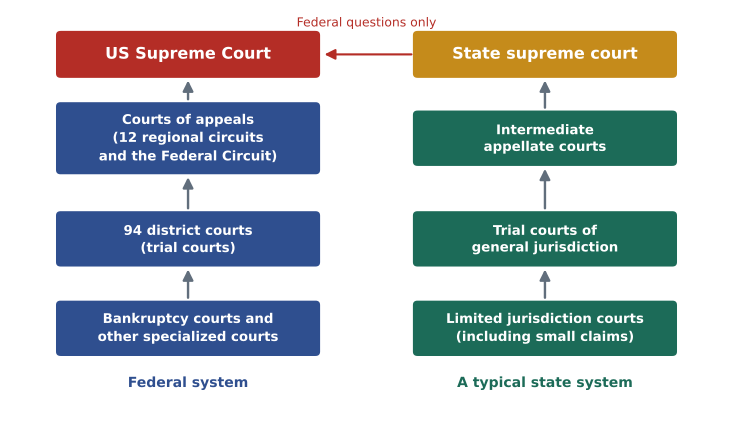
The United States has two parallel court systems. Federal courts have limited jurisdiction. The 94 district courts are the trial courts; the 13 courts of appeals (twelve regional circuits plus the Federal Circuit, which hears patent and certain government appeals) hear appeals as of right; and the Supreme Court hears a small number of cases each year, chosen by granting a writ of certiorari. Specialized federal courts include the bankruptcy courts, the Court of Federal Claims and the Tax Court. Each state has its own system, usually with trial courts of general jurisdiction (often called superior, district or circuit courts; in New York, confusingly, the trial court is the Supreme Court), intermediate appellate courts and a state supreme court, which is the final authority on that state's law. Most business litigation, including most contract and tort cases, is heard in state courts.
A federal court may hear a case only if it has subject-matter jurisdiction: a federal question (a claim arising under federal law, such as a federal antitrust or employment discrimination claim) or diversity jurisdiction (the parties are citizens of different states and more than $75,000 is in dispute). A court must also have personal jurisdiction over the defendant. Under International Shoe Co. v. Washington (1945) and later cases, a state's courts may hear a case against an out-of-state business only if it has minimum contacts with the state such that the suit does not offend traditional notions of fair play and substantial justice; a corporation is generally subject to suit on any claim in its state of incorporation and principal place of business. Contracts often include a forum selection clause and a choice of law clause, which courts usually enforce, even in consumer contracts, unless they are unreasonable or unjust.
Alternative dispute resolution
Alternative dispute resolution (ADR) covers methods of resolving disputes outside the courtroom. Negotiation is direct discussion between the parties or their representatives, and it settles most disputes. Mediation adds a neutral third party who helps the parties communicate and find a solution but cannot impose one. It is quick, relatively cheap, confidential and good at preserving relationships, and some jurisdictions require it for certain civil cases. Arbitration is a private trial: the parties choose one or more arbitrators, who hear evidence and issue a binding award that courts will enforce, with very limited rights of appeal. Arbitration is common in construction, commercial and international disputes because the parties can pick experts as decision makers, keep the process confidential and enforce awards across borders under the New York Convention.
| Method | Who decides | Binding? | Typical cost and time | Best for |
|---|---|---|---|---|
| Negotiation | The parties | Only if they sign an agreement | Lowest; days to weeks | Most disputes, especially between ongoing partners |
| Mediation | The parties, helped by a mediator | Only if they sign a settlement | Low; often one day of mediation | Disputes where relationships matter or emotions run high |
| Arbitration | An arbitrator chosen by the parties | Yes; limited appeal | Moderate to high; months | Technical, confidential or international disputes |
| Litigation | A judge (sometimes a jury) | Yes; appeal available | Highest; often years | Disputes needing precedent, urgent orders or public vindication |
The Federal Arbitration Act (FAA) makes arbitration clauses valid and enforceable, and the Supreme Court has read it broadly. In AT&T Mobility LLC v. Concepcion (2011) the Court held that the FAA preempts state rules that refuse to enforce class-action waivers in consumer arbitration agreements, and in Epic Systems Corp. v. Lewis (2018) it upheld class and collective action waivers in employment arbitration agreements. As a result, many consumers and employees must bring claims individually in arbitration. There are limits. Courts can refuse to enforce clauses that are unconscionable under general state contract law. The Ending Forced Arbitration of Sexual Assault and Sexual Harassment Act of 2021 lets employees choose court for those claims despite an arbitration agreement. And some businesses have faced mass arbitration, in which thousands of claimants file at once and trigger large filing fees the business agreed to pay.
Small claims courts
Small claims courts offer a simpler, cheaper process for modest disputes. Procedures are informal, parties often appear without lawyers (some states, such as California, bar lawyers from representing parties at the hearing) and filing fees are low. Limits are set by each state and change from time to time. At the time of writing (October 2026), typical limits include $12,500 for individuals and $6,250 for businesses in California, $10,000 in New York City (and $5,000 elsewhere in New York), $20,000 in Texas justice courts, $25,000 in Delaware and $10,000 in Illinois. Check the court's website before filing, because limits are raised periodically and some states set different limits for particular parties or claims.
Worked problem
Choosing a forum for a debt claim
Lakeside Fixtures, a Texas corporation, delivered $18,500 of shelving to a Houston retailer that refuses to pay, claiming some units were damaged. The contract has no arbitration clause. Lakeside's lawyer estimates district court litigation would cost about $30,000 in fees and take eighteen months, while a justice court small claims case would cost about $3,000 in time and fees and take a few months. Which forum makes sense?
Show solution
- The claim of $18,500 is under the Texas justice court limit of $20,000, so small claims is available.
- In district court, the expected legal cost ($30,000) exceeds the claim, and under the American rule Lakeside would pay its own lawyer even if it wins, unless a statute or the contract shifts fees. (Texas law does allow recovery of attorney's fees in some contract claims, which a lawyer should check.)
- Small claims keeps the net recovery positive and resolves the dispute faster.
- Before suing, Lakeside should send a demand letter and offer mediation, documenting the delivery records and inspection reports that answer the damage claim.
Answer: Small claims is the rational forum unless the retailer counterclaims for a larger amount or the case raises a legal question worth a precedent. Preparing a strong file of delivery evidence also improves the chance of settlement before any hearing.
Stages of a civil lawsuit
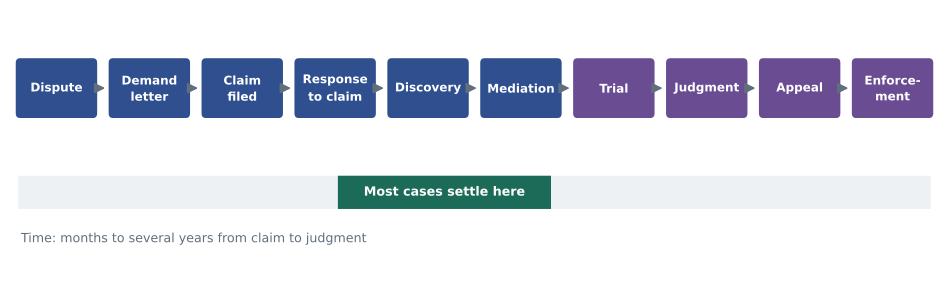
A civil action in federal court follows the Federal Rules of Civil Procedure; state courts have similar rules. The plaintiff files a complaint setting out the claims and serves it with a summons. The defendant responds with an answer, which may include affirmative defenses, counterclaims and third-party claims, or with a motion to dismiss for failure to state a claim. Discovery is extensive: parties exchange documents and electronically stored information, answer written interrogatories, respond to requests for admission and take oral depositions of witnesses under oath. Discovery is often the most expensive stage. Either party may move for summary judgment, arguing that there is no genuine dispute of material fact. The Seventh Amendment preserves the right to a jury trial in federal civil cases at common law, and most states guarantee it as well, so jury trials of business disputes are far more common than in other countries. After the verdict and judgment, the losing party may move for a new trial or appeal, and the winner must enforce the judgment if it is not paid.
| Stage | What happens | Management task |
|---|---|---|
| Pre-suit | Demand letter, preservation of evidence, settlement talks | Issue a litigation hold so no relevant records are deleted |
| Pleadings | Complaint, answer, motions to dismiss, counterclaims | Give counsel accurate facts and documents early |
| Discovery | Document production, e-discovery, interrogatories, depositions | Gather emails and records; prepare witnesses |
| Motions and mediation | Summary judgment motions; court-ordered mediation | Set settlement authority based on expected value |
| Trial | Jury selection, evidence, verdict | Witnesses attend; business disruption |
| Judgment and appeal | Judgment entered; post-trial motions; appeal | Decide whether to appeal or pay; possible appeal bond |
| Enforcement | Writs of execution, garnishment, liens | Locate the debtor's assets |
A litigation hold is one of the most important management duties. Once a lawsuit is reasonably anticipated, a business must preserve relevant documents, including emails, chat messages and files on personal devices used for work. Routine deletion policies must be suspended for those records. Destroying evidence, called spoliation, can lead to sanctions, adverse inferences that the missing evidence would have hurt the party and, in serious cases, judgment against the party that destroyed it.
Who pays the costs
American courts follow the American rule: each party pays its own lawyer, win or lose, unless a statute or contract shifts fees. Many statutes, such as federal civil rights and consumer protection laws, let a successful plaintiff recover reasonable attorney's fees, and many commercial contracts include a prevailing-party fee clause. Contingency fees, often around one-third of the recovery, are common in personal injury and employment cases, which makes it feasible for individuals to sue large businesses. Rule 23 of the Federal Rules of Civil Procedure and similar state rules permit class actions when a court certifies that common questions predominate and a class action is superior to individual suits. Under Rule 68, a defendant can make an offer of judgment; if the plaintiff rejects it and recovers less, the plaintiff must pay the defendant's court costs (though usually not attorney's fees) incurred after the offer.
Worked problem
Deciding whether to settle: expected value
A customer sues Ridgeway Software in a California state court for $300,000, claiming its system caused lost profits. Ridgeway's lawyer estimates a 40 % chance the customer wins the full amount, a 25 % chance it wins $100,000 and a 35 % chance it loses. Ridgeway's own fees to trial would be $120,000, paid regardless of outcome, and the contract has no fee-shifting clause. The customer offers to settle for $140,000. Should Ridgeway accept?
Show solution
- Full loss: pays $300,000 + $120,000 own fees = $420,000; weighted 0.40 × $420,000 = $168,000.
- Partial loss: pays $100,000 + $120,000 = $220,000; weighted 0.25 × $220,000 = $55,000.
- Win: pays own fees $120,000; weighted 0.35 × $120,000 = $42,000.
- Expected cost of going to trial = $168,000 + $55,000 + $42,000 = $265,000.
- Settlement cost = $140,000 plus fees spent so far.
Answer: Settling at $140,000 saves about $125,000 in expected cost, before counting management time, publicity and the risk of a worse result. Even winning costs $120,000 under the American rule, which is why defendants often settle claims they believe are weak.
Limitation periods
Each state sets statutes of limitations, which vary by type of claim. For contracts for the sale of goods, UCC section 2-725 sets four years from breach, which the parties may shorten to not less than one year by agreement. For other contracts, periods range widely: written contracts carry a four-year period in California and six years in New York, for example. Personal injury claims often carry two or three years. Many states apply a discovery rule, under which the clock starts when the plaintiff discovered or reasonably should have discovered the injury, and some add statutes of repose that bar claims a fixed number of years after an act, such as the completion of construction or the sale of a product, regardless of discovery. Federal claims carry their own deadlines; for example, an employee generally must file a discrimination charge with the EEOC within 180 days, or 300 days in states with their own fair employment agency, before suing.
Worked problem
Calculating a limitation deadline
A manufacturer sold and installed a defective chiller at a food plant in California on March 3, 2024, under a contract for the sale of goods with no clause shortening the limitation period. The chiller failed on June 10, 2024, spoiling inventory. When does the breach of warranty claim expire under the UCC?
Show solution
- Under UCC section 2-725, a breach of warranty occurs when tender of delivery is made, regardless of the buyer's knowledge, unless the warranty explicitly extends to future performance.
- Delivery and installation occurred on March 3, 2024.
- Four years from March 3, 2024 is March 3, 2028.
- If the plant also sues in tort for negligence or strict liability, a different period (two years for many California tort claims) may apply, starting when the injury was discovered, so a cautious lawyer would act well before June 10, 2026.
Answer: The contract claim is safe until March 2028, but tort claims may expire much sooner. Lawyers calendar the earliest possible deadline.
Judgments, interest and enforcement
A judgment is the court's formal order, usually to pay money. Courts add prejudgment interest from the date the claim arose (or another date set by statute) to the judgment date and postjudgment interest until payment, both usually at statutory rates. Interest matters in long cases: on a large claim, several years of interest can add a significant percentage to the award.
Worked problem
Adding interest to a judgment
A New York court awards $80,000 in damages for a breach of contract that occurred 900 days before judgment. New York's statutory interest rate is generally 9 % a year, simple. The defendant pays 120 days after judgment. Calculate the interest.
Show solution
- Prejudgment interest = $80,000 × 0.09 × 900 ÷ 365 ≈ $17,753.
- Judgment total = $80,000 + $17,753 = $97,753 (plus any costs).
- Postjudgment interest = $97,753 × 0.09 × 120 ÷ 365 ≈ $2,892.
- Total paid ≈ $100,645.
Answer: Interest adds about 26 % here. New York's 9 % rate is high compared with market rates, which gives defendants an incentive to settle or pay promptly; rates vary widely by state.
Winning a judgment does not put money in the bank. If the debtor does not pay, the creditor uses state enforcement tools: a writ of execution allowing the sheriff to seize and sell non-exempt property, judgment liens on real estate, garnishment of wages (limited by federal and state law) and bank accounts, and post-judgment discovery in which the debtor must disclose assets. Under the Full Faith and Credit Clause, a judgment from one state can be registered and enforced in another, usually through the Uniform Enforcement of Foreign Judgments Act. A debtor with no reachable assets is judgment-proof, which is why checking a defendant's ability to pay is part of deciding whether to sue.
Common mistakes
MistakeLetting routine email deletion continue after a lawsuit is threatened.
InsteadIssue a litigation hold immediately and preserve all relevant records, including chat messages and personal devices used for work.
MistakeWaiting to see whether a dispute resolves before checking the limitation period.
InsteadCalendar the earliest possible limitation date as soon as a problem appears.
MistakeChoosing litigation by default for a modest claim.
InsteadCompare small claims, mediation and arbitration on cost, time, confidentiality and relationship.
MistakeAssuming an arbitration clause will always be enforced.
InsteadCourts may refuse unconscionable clauses, and some claims, such as sexual harassment claims, can be taken to court despite an arbitration agreement.
MistakeSuing a party without checking whether it can pay.
InsteadInvestigate assets and insurance before investing in litigation.
Summary and key terms
- The United States has parallel federal and state court systems; most business disputes are heard in state courts.
- Federal courts need a federal question or diversity; personal jurisdiction requires minimum contacts.
- Negotiation, mediation and arbitration resolve most disputes faster and more privately than litigation.
- Small claims courts handle modest claims cheaply; limits vary and change.
- Lawsuits move through pleadings, discovery, pre-trial steps, trial, judgment, appeal and enforcement; litigation holds are essential.
- Each side usually pays its own lawyer under the American rule, unless a statute or contract shifts fees.
- Limitation periods are strict; calendar the earliest possible deadline.
- Interest and enforcement determine what a judgment is really worth.
- Alternative dispute resolution
- Methods of resolving disputes outside court, such as negotiation, mediation and arbitration.
- Mediation
- A process in which a neutral third party helps the parties reach their own agreement.
- Arbitration
- A private process in which an arbitrator issues a binding decision.
- Discovery
- The pre-trial stage in which parties exchange evidence and question witnesses.
- Litigation hold
- An instruction to preserve all records relevant to an anticipated lawsuit.
- Spoliation
- The destruction or loss of relevant evidence.
- Limitation period
- The deadline for starting a lawsuit.
- Garnishment
- An enforcement process that diverts money owed to a debtor, such as wages, to the creditor.
- Judgment-proof
- Having no assets that can be seized to satisfy a judgment.
- American rule
- The principle that each party pays its own lawyer unless a statute or contract shifts fees.
Practice problems
Work each problem on paper first, then reveal the answer to check.
What two bases give federal courts jurisdiction over most civil cases?
Show answer
Federal question and diversity (different states and more than $75,000).
Distinguish mediation from arbitration.
Show answer
A mediator helps the parties agree but cannot decide; an arbitrator issues a binding award.
What did the Supreme Court decide in AT&T Mobility v. Concepcion?
Show answer
The FAA preempts state rules refusing to enforce class-action waivers in arbitration agreements.
What is the small claims limit for individuals in California at the time of writing?
Show answer
$12,500 ($6,250 for businesses).
What is a litigation hold and when must it start?
Show answer
An instruction to preserve relevant records, starting when litigation is reasonably anticipated.
What limitation period does the UCC set for sale-of-goods claims?
Show answer
Four years from breach, which may be shortened by agreement to not less than one year.
A $50,000 judgment carries 6 % simple interest for 200 days. What is the interest?
Show answer
$50,000 × 0.06 × 200 ÷ 365 ≈ $1,644.
A claim has a 60 % chance of a $100,000 award and a 40 % chance of nothing; your fees to trial are $30,000 and not recoverable. What is the expected net value of suing?
Show answer
0.6 × $100,000 − $30,000 = $30,000.
What does judgment-proof mean?
Show answer
The defendant has no assets that can be seized to pay the judgment.
Portfolio task: draft a one-page dispute resolution clause for a supply contract and explain each choice.
Show answer
Answers vary; a good answer escalates from negotiation to mediation to arbitration or court, names a seat or forum and governing law, and addresses urgent injunctions.
Lesson quiz · 5 questions
Score 60% or more to complete this lesson.
Create a free account to save your progress, take quizzes and earn a certificate.