
BUS-210 · Lesson 10 of 12 · 38 min
Employment law
Employment law governs one of the most important relationships in any business. It sets minimum standards that contracts cannot undercut, protects workers against discrimination and unsafe conditions, regulates unions and collective bargaining and determines what happens when the relationship ends. Mistakes are common and expensive: misclassifying workers, miscalculating overtime and mishandling terminations are among the most frequent legal claims against small and mid-sized businesses. This lesson focuses on the legal framework. BUS-130 discusses harassment, motivation and pay from an organizational behavior perspective, and the HSE courses cover workplace health and safety law in depth.
Employment law in the United States is a mix of federal statutes, state statutes and state common law. Federal law sets floors, such as the Fair Labor Standards Act (FLSA) for minimum wage and overtime, Title VII and other laws against discrimination, the Family and Medical Leave Act and the National Labor Relations Act. States and cities often go further, with higher minimum wages, paid sick leave, broader anti-discrimination protections and limits on non-compete agreements. The common law default of employment at will gives employers more freedom to terminate than in most other countries, but many exceptions apply. Unionized employees are governed by their collective bargaining agreement, enforced through grievance arbitration.
Employee or independent contractor?
The first question is whether a worker is an employee at all. Employees get the protection of employment standards, workers' compensation and other statutes, and employers must withhold and remit payroll taxes and contributions. Independent contractors run their own businesses and get none of these protections. Labels in a contract are not decisive: courts and agencies look at the substance of the relationship. Misclassification exposes a business to back wages, overtime, unpaid payroll taxes, penalties, interest and, in some cases, class actions.
Different laws use different tests. The IRS uses a common-law control test, grouping factors into behavioral control, financial control and the relationship of the parties. The FLSA uses an economic reality test that asks whether the worker is economically dependent on the business or in business for themselves; the Department of Labor issued a rule in 2024 setting out six factors, and in early 2026 proposed replacing it with a test closer to its 2021 rule that emphasizes control and opportunity for profit or loss, so employers should check the current version. California, Massachusetts, New Jersey and several other states apply the stricter ABC test for some purposes: a worker is an employee unless the hiring entity proves (A) the worker is free from its control, (B) the work is outside the usual course of its business and (C) the worker is customarily engaged in an independently established trade or business. California adopted the ABC test in Dynamex (2018) and Assembly Bill 5 (2019), although voters exempted app-based drivers through Proposition 22 in 2020.
Worked problem
Classifying a worker
Coastline Media hires Maya as a "freelance" graphic designer in California. She works 40 hours a week at Coastline's office on Coastline's computer, follows a schedule set by the art director, is paid a fixed monthly fee, has worked only for Coastline for three years and cannot send others in her place. Coastline issues her a Form 1099 and does not withhold taxes. Is she an employee?
Show solution
- Under the ABC test, Coastline must prove all three parts. Part A fails because Coastline controls her schedule and work.
- Part B fails because graphic design is within the usual course of a media company's business.
- Part C fails because she does not run an independent design business serving other clients.
- She is an employee under California law, and almost certainly under the federal IRS and FLSA tests too.
- Coastline owes unpaid payroll taxes, may face penalties, must pay any overtime owed and must provide state benefits such as paid sick leave; California also imposes substantial civil penalties for willful misclassification.
Answer: Calling a worker freelance changes nothing. Before engaging long-term contractors, test the relationship against the legal factors, and restructure it or hire the person as an employee if the factors point that way.
Minimum standards
The FLSA requires covered employers to pay at least the federal minimum wage of $7.25 an hour, unchanged since 2009, and overtime at 1.5 times the regular rate for hours worked over 40 in a workweek. Most states and many cities set higher minimum wages, adjusted annually in many cases, and an employer must pay the highest applicable rate; some states, such as California, also require daily overtime after eight hours. Executive, administrative and professional employees are exempt from overtime if they meet duties tests and are paid a salary of at least $684 a week; a 2024 rule raising the threshold was struck down by a federal court in November 2024, and some states, such as California, New York and Washington, set much higher thresholds. The Family and Medical Leave Act gives eligible employees of employers with 50 or more employees up to 12 weeks of unpaid, job-protected leave a year for serious health conditions, childbirth and family care. There is no federal requirement for paid vacation or paid holidays, but many states and cities require paid sick leave and a growing number require paid family leave.
Worked problem
Calculating overtime
A warehouse worker in Texas earns $22 an hour and works 50 hours in one week. Calculate the week's pay. What changes if she works in California and works 10 hours a day for five days?
Show solution
- Under the FLSA, overtime is due after 40 hours in the workweek: 40 × $22 = $880.
- Overtime: 10 hours × 1.5 × $22 = 10 × $33 = $330.
- Total = $1,210 (Texas has no daily overtime rule).
- In California, overtime is also due after 8 hours in a day. Working 10 hours on each of five days gives 2 daily overtime hours × 5 = 10 overtime hours; the weekly and daily overtime are not double-counted, so the total is again $1,210. The difference would appear if she worked, say, four 12-hour days (48 hours): 16 daily overtime hours at 1.5 times, versus only 8 weekly overtime hours under the FLSA alone.
Answer: State law can produce more overtime than federal law. Payroll systems must apply whichever rule is more generous to the employee.
Human rights and discrimination
Federal law prohibits employment discrimination on several grounds. Title VII of the Civil Rights Act of 1964 applies to employers with 15 or more employees and covers race, color, religion, sex and national origin; in Bostock v. Clayton County (2020), the Supreme Court held that firing someone for being gay or transgender is sex discrimination. The Age Discrimination in Employment Act (ADEA) protects workers aged 40 and over at employers with 20 or more employees. The Americans with Disabilities Act (ADA) prohibits disability discrimination and requires reasonable accommodation unless it would cause undue hardship. The Pregnant Workers Fairness Act of 2023 requires reasonable accommodation of pregnancy-related limitations. The Equal Pay Act requires equal pay for equal work regardless of sex, and the Genetic Information Nondiscrimination Act protects genetic information. Discrimination can be disparate treatment (intentional) or disparate impact (a neutral practice that disproportionately excludes a protected group and is not job-related and consistent with business necessity). Retaliation against employees who complain or participate in investigations is separately prohibited and is now the most frequently filed charge with the EEOC. An employee must usually file a charge with the EEOC within 180 days, or 300 days where a state agency exists, before suing. State and local laws often apply to smaller employers and add protected grounds. Harassment law is covered in BUS-130.
Worked problem
Is accommodation required?
A distribution center in Ohio with 300 employees requires all warehouse associates to be able to lift 55 pounds. An associate with three years of good performance develops a back condition that limits her to lifting 20 pounds for at least six months. About 20 % of the job involves heavy lifting; the rest is scanning, labeling and operating a pallet jack. The manager wants to terminate her. What does the ADA require?
Show solution
- A back condition that substantially limits lifting is likely a disability under the ADA as amended in 2008, which is interpreted broadly.
- She can perform the essential functions with or without reasonable accommodation if heavy lifting is a marginal rather than an essential function, or if accommodations such as lifting aids or task swaps are feasible.
- The employer must engage in an interactive process to identify accommodations, such as reassigning lifting tasks, providing equipment or temporary light duty, or reassignment to a vacant position.
- With 80 % of the job unaffected and 300 employees, undue hardship is unlikely.
- Terminating her without exploring accommodation would expose the employer to an ADA claim; it should document the interactive process.
Answer: Accommodation is a process, not a single decision. Employers that explore options in good faith, document them and involve the employee rarely lose these cases; employers that terminate first often do.
Ending employment: at-will and its limits
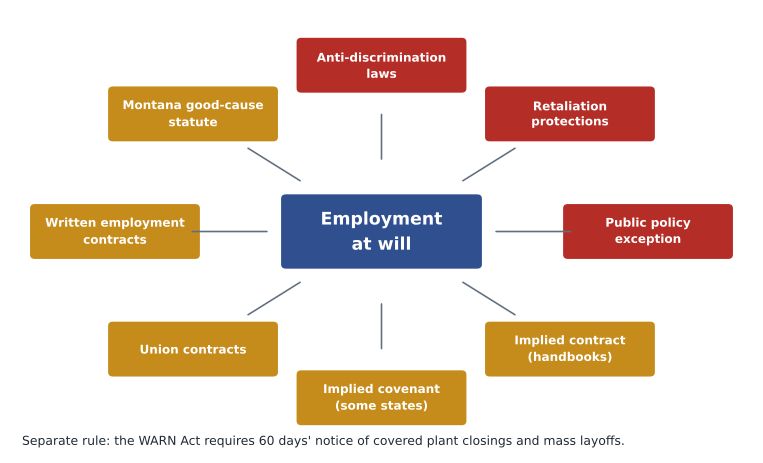
Most American employment is at will: unless a contract or collective agreement says otherwise, either party may end the relationship at any time, for any reason or no reason, with or without notice, as long as the reason is not illegal. Montana is the exception, with a statute requiring good cause after a probationary period. The at-will rule is limited by many exceptions. Employers may not fire employees for discriminatory reasons or in retaliation for protected activity, such as filing a discrimination charge, reporting safety violations, taking FMLA leave or engaging in concerted activity protected by the National Labor Relations Act. Most states recognize a public policy exception, protecting employees fired for refusing to break the law, serving on a jury, filing a workers' compensation claim or reporting wrongdoing. Many states recognize implied contracts based on employee handbooks or assurances of job security, unless the handbook clearly preserves at-will status, and a minority recognize an implied covenant of good faith in employment. Employment contracts for executives often require cause for termination or provide severance.
When an American employer terminates an at-will employee, it generally owes only wages earned to date, accrued vacation if state law or policy requires payout (California does), and continuation coverage rights under COBRA for group health insurance. Severance is not legally required unless a contract, policy or collective agreement provides it, although many employers offer severance in exchange for a release of claims. Releases of age discrimination claims must comply with the Older Workers Benefit Protection Act: the employee must be advised in writing to consult a lawyer, be given at least 21 days to consider the agreement (45 days in a group layoff, with information about who was selected) and have 7 days to revoke it after signing. The Worker Adjustment and Retraining Notification (WARN) Act requires employers with 100 or more employees to give 60 days' notice of plant closings and mass layoffs, and some states, such as New York, New Jersey and California, have stricter mini-WARN laws.
Worked problem
Planning a layoff lawfully
An Ohio manufacturer with 400 employees plans to close one plant and lay off 120 workers, including Lucas, 52, an operations manager with 12 years of service earning $110,000. The company wants to offer severance of two weeks' pay per year of service in exchange for a release of claims. What must it consider?
Show solution
- WARN Act: closing a plant and laying off 120 employees likely triggers the 60-day notice requirement; Ohio has no state mini-WARN law, but the federal rule applies.
- Severance: two weeks per year for Lucas = 24 weeks × ($110,000 ÷ 52 ≈ $2,115) ≈ $50,800. It is not legally required, so the company can condition it on a release.
- Older Workers Benefit Protection Act: because Lucas and others are over 40 and this is a group layoff, the release must give 45 days to consider, a 7-day revocation period and disclosure of the ages and job titles of those selected and not selected in the decisional unit.
- Selection criteria must be job-related and checked for disparate impact by age, race, sex and other protected characteristics before implementation.
Answer: Even without a severance obligation, a layoff touches several federal statutes. Getting notice, releases and selection right avoids the claims that layoffs often provoke.
Even at will, how a termination is handled matters. Inconsistent explanations, terminations soon after an employee complains, takes leave or files a claim, and departures from the employer's own policies are classic evidence of pretext in discrimination and retaliation cases. Employers reduce risk by documenting performance issues contemporaneously, applying policies consistently, having a second manager or HR review terminations and giving a truthful, consistent reason. Employers that change essential terms, such as cutting pay, generally may do so prospectively for at-will employees, but they must comply with state wage payment laws and any contract.
Restrictive covenants
Enforceability of non-compete agreements depends on state law. California voids almost all employee non-competes under Business and Professions Code section 16600 and since 2024 has required employers to notify employees that past non-competes are void; Minnesota (from 2023), North Dakota and Oklahoma also ban most employee non-competes, and many other states ban them for lower-wage workers or require advance notice. Elsewhere, courts enforce non-competes that are reasonable in duration, geography and scope and protect legitimate interests, and some courts will blue-pencil an overbroad covenant to a reasonable scope. The FTC adopted a rule in 2024 banning most non-competes, but a federal court set it aside, and in September 2025 the FTC dropped its appeals and abandoned the rule, saying it would pursue case-by-case enforcement against unfair non-competes instead. Non-solicitation, confidentiality and trade secret protections (lesson 7) remain important alternatives.
Worked problem
Will the covenant be enforced?
A Texas insurance brokerage requires a salaried account manager earning $65,000 to agree that for three years after leaving she will not work for any insurance business anywhere in the United States. She leaves after four years to join a competitor in Houston. Is the covenant enforceable? What would differ if she worked in California?
Show solution
- Texas enforces non-competes that are ancillary to an otherwise enforceable agreement and reasonable in time, geography and scope of activity.
- A three-year nationwide ban on any insurance work is broader than needed to protect client relationships.
- Texas law directs courts to reform an overbroad covenant to a reasonable scope rather than void it, so a court might enforce a narrower restriction, such as not soliciting her former clients for a shorter period.
- In California, the non-compete would be void under section 16600, and the employer could face liability for trying to enforce it, though trade secret protections would still apply.
Answer: Narrow, targeted covenants protect legitimate interests far more reliably than sweeping non-competes. Employers should match the restraint to the employee's actual access to clients and confidential information.
Unions and collective bargaining
The National Labor Relations Act (NLRA) gives most private-sector employees the right to form and join unions and to engage in concerted activities for mutual aid or protection, whether or not they are unionized. A union becomes the exclusive bargaining representative through a secret-ballot election supervised by the National Labor Relations Board (NLRB), or by voluntary recognition. Employers commit unfair labor practices by interfering with, restraining or coercing employees in exercising these rights, for example by threatening job losses, interrogating employees about union support or promising benefits to defeat a union. Section 7 protects non-union employees who discuss pay and working conditions together, including on social media, so overly broad confidentiality and social media policies can be unlawful. Once a union is certified, both sides must bargain in good faith. About half of the states have right-to-work laws prohibiting agreements that require employees to pay union dues as a condition of employment.
Common mistakes
MistakeLabeling a long-term, full-time, closely supervised worker an independent contractor.
InsteadApply the legal tests; misclassification brings back taxes, penalties and claims.
MistakeAssuming salaried employees are never owed overtime.
InsteadCheck both the FLSA duties tests and the salary threshold, plus stricter state rules.
MistakeTerminating an employee with a disability or medical restriction without exploring accommodation.
InsteadEngage in a documented accommodation process before considering termination.
MistakeAssuming at-will means any termination is risk-free.
InsteadDiscrimination, retaliation and public policy exceptions make the reason and process critical.
MistakeUsing broad, standard non-compete clauses for all employees.
InsteadCheck state law; use narrow non-solicitation and confidentiality clauses where non-competes are banned or risky.
Summary and key terms
- Federal law sets floors; states and cities often add more protection.
- The IRS, FLSA and ABC tests classify workers differently; misclassification is costly.
- The FLSA requires a $7.25 minimum wage and overtime after 40 hours; exemptions require duties and salary tests.
- Title VII, the ADEA, the ADA and other laws prohibit discrimination and retaliation and require accommodation.
- At-will employment is limited by statutory, public policy and contract exceptions; WARN and OWBPA govern layoffs and releases.
- Consistent, documented, truthful terminations reduce pretext and retaliation risk.
- Non-compete enforceability varies by state; the FTC abandoned its nationwide ban in 2025.
- Labor law protects the right to organize and requires good-faith bargaining.
- Independent contractor
- A person in business on their own account rather than an employee.
- Duty to accommodate
- The obligation to adjust rules or duties for protected characteristics up to undue hardship.
- Undue hardship
- The point at which accommodation would impose excessive cost or risk.
- Constructive dismissal
- A substantial unilateral change to essential employment terms, treated as a dismissal.
- Restrictive covenant
- A contractual restriction on competing, soliciting or using information after employment.
- Collective agreement
- A contract between an employer and a union setting terms of employment.
- Employment at will
- The default rule that either party may end employment at any time for any lawful reason.
- Exempt employee
- An employee not entitled to FLSA overtime because of duties and salary.
- WARN Act
- The federal law requiring 60 days' notice of plant closings and mass layoffs.
Practice problems
Work each problem on paper first, then reveal the answer to check.
State the three parts of the ABC test.
Show answer
Free from control; work outside the usual course of the business; customarily engaged in an independent trade or business.
A Texas employee earning $20 an hour works 48 hours in a week. What is the overtime pay?
Show answer
8 hours × $30 = $240.
What must an employer show to justify a job standard that adversely affects a protected group?
Show answer
That it is a bona fide occupational requirement, including that accommodation would cause undue hardship.
Name three exceptions to employment at will.
Show answer
Anti-discrimination and retaliation laws, the public policy exception and implied contracts (also the implied covenant in some states).
What does the OWBPA require for a release of age claims in a group layoff?
Show answer
45 days to consider, 7 days to revoke, advice to consult a lawyer and disclosure of selection information.
How much notice does the WARN Act require for a covered mass layoff?
Show answer
60 days.
What is constructive dismissal?
Show answer
A substantial unilateral change to an essential term of employment, treated as a dismissal.
Which state voids almost all employee non-competes under section 16600?
Show answer
California.
Why are non-solicitation clauses more likely to be enforced than non-competes?
Show answer
They are narrower and more closely tied to protecting legitimate client relationships.
Portfolio task: audit an employment offer letter template against the law of your jurisdiction.
Show answer
Answers vary; a good answer checks classification, pay and overtime terms, termination provisions, restrictive covenants and required notices.
Lesson quiz · 5 questions
Score 60% or more to complete this lesson.
Create a free account to save your progress, take quizzes and earn a certificate.