
BUS-210 · Lesson 1 of 12 · 35 min
The American legal system
Every business decision has a legal dimension. Hiring a cashier creates an employment relationship with statutory minimums and rights that cannot be signed away. Accepting a purchase order forms a contract. Posting a review of a competitor's product can expose the company to a defamation claim. Leasing a delivery van, collecting customer email addresses, borrowing from a bank and firing an underperforming manager all trigger rules that managers are expected to know well enough to spot problems early and ask for advice before they become expensive. This course gives that working knowledge. It does not turn you into a lawyer, and nothing in it is legal advice; its goal is to help you recognize legal risk, speak the language of the professionals you hire and make better business decisions.
This first lesson explains how the American legal system is built: where law comes from, how power is divided between the federal government and the fifty states, how the Constitution and the Bill of Rights affect business, how courts create binding precedent and how administrative agencies regulate whole industries. Later lessons build on this map. BUS-101 introduced the forms of business ownership and the business environment; this course goes deeper into the legal rules behind them.
What law is and why it matters to managers
Law is the body of rules that a society enforces through its institutions: legislatures make rules, courts interpret and apply them, and police, regulators and sheriffs enforce the results. Law differs from ethics and social norms because it is backed by state power. A business that breaks a social norm may lose customers; a business that breaks the law may pay damages, fines or penalties, lose its license to operate or see its managers imprisoned. Many rules overlap: lying to a customer is unethical, and if the lie induces a contract it may also be an actionable misrepresentation or an offense under consumer protection law.
For a manager, legal knowledge serves four purposes. It prevents problems, because a well-drafted contract or a compliant hiring process costs far less than a lawsuit. It identifies opportunities, because intellectual property, limited liability and secured lending are legal tools that create value. It supports negotiation, because knowing what a court would likely do sets the bargaining range in a dispute. And it improves communication with lawyers, who can do their best work only when clients give them the right facts at the right time.
Classifying law
Lawyers classify rules in several ways, and the classification often decides who can sue, which court hears the case, what must be proved and what remedy is available. Public law governs the relationship between the state and individuals or organizations; it includes constitutional, administrative, criminal and tax law. Private law governs relationships between private parties; it includes contract, tort, property and corporate law. Substantive law defines rights and duties, such as the rule that a contract needs consideration; procedural law sets out how rights are enforced, such as the deadline to file a defense.
The most important distinction for business is between civil and criminal matters. In a civil case a private party, the plaintiff, sues another, the defendant, usually for money. The plaintiff must prove the case by a preponderance of the evidence, meaning that its version is more likely than not. In a criminal case the government prosecutes a defendant for conduct that harms society, and guilt must be proved beyond a reasonable doubt. Between these sits a large body of regulatory offenses, such as breaches of workplace safety, environmental or securities rules, which are prosecuted by the state but usually carry fines rather than imprisonment and are often easier to prove than crimes.
| Feature | Civil matter | Criminal matter | Regulatory or administrative enforcement |
|---|---|---|---|
| Who starts it | A private plaintiff | The government (prosecutor or district attorney) | A federal or state agency |
| Purpose | Compensate the injured party | Punish and deter conduct harmful to society | Protect the public through compliance |
| Standard of proof | Preponderance of the evidence (more likely than not) | Beyond a reasonable doubt | Usually preponderance in civil enforcement; beyond a reasonable doubt if prosecuted criminally |
| Typical outcome | Damages, an injunction or specific performance | Imprisonment, fines, probation | Civil penalties, consent orders, license suspension |
| Business example | A supplier sues for an unpaid invoice | Wire fraud by an executive under federal law | An OSHA citation after a workplace injury |
Sources of law
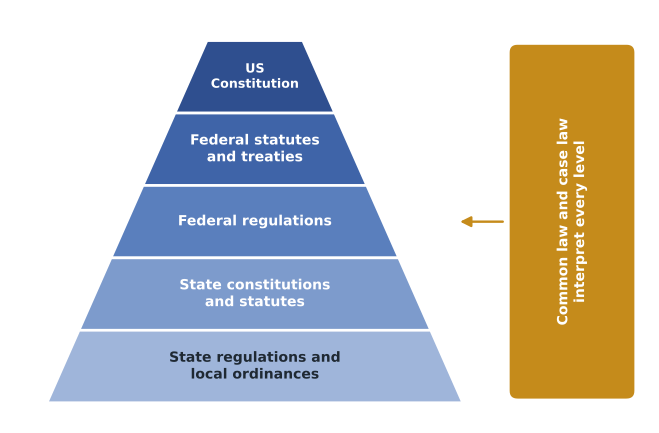
American law comes from four main sources. The United States Constitution is the supreme law of the land: it creates the three branches of the federal government, lists the powers of Congress and protects individual rights through the Bill of Rights and later amendments. Each state also has its own constitution. Statutes are passed by Congress or a state legislature; examples include the Fair Labor Standards Act and the Delaware General Corporation Law. Federal statutes are collected in the United States Code. Regulations are detailed rules made by agencies under authority delegated by a statute, such as the Department of Labor's overtime rules, and are published in the Code of Federal Regulations. Finally, the common law, or case law, is the body of principles developed by judges deciding individual cases, which governs large areas such as contract and negligence where no statute applies.
Most of the United States follows the English common law tradition. Louisiana is the exception: its private law is based on the civil law tradition, with a civil code influenced by French and Spanish law. To reduce differences between states, private organizations draft model or uniform laws that states may adopt. The most important for business is the Uniform Commercial Code (UCC), prepared by the Uniform Law Commission and the American Law Institute and adopted at least in large part by every state, which governs sales of goods, negotiable instruments, bank deposits and secured transactions. The American Law Institute also publishes Restatements of the Law, such as the Restatement (Second) of Contracts, which summarize the common law and are often cited by courts even though they are not binding.
Federalism and the Commerce Clause
The Constitution creates a federal system. Congress may legislate only on the subjects listed in Article I, Section 8, such as taxation, bankruptcy, patents and copyrights, currency and the regulation of commerce with foreign nations, among the states and with Indian tribes. The Tenth Amendment reserves all other powers to the states or the people, so states regulate most contracts, property, corporations, professional licensing and much of employment and consumer law. The Supremacy Clause in Article VI makes valid federal law prevail over conflicting state law, and Congress can preempt state law in a field either expressly or by occupying the field.
The Commerce Clause has been interpreted broadly. In Wickard v. Filburn (1942) the Supreme Court held that Congress could regulate wheat a farmer grew for his own use because, taken together with similar activity, it substantially affected interstate commerce. This broad reading supports federal laws on workplace safety, minimum wages, civil rights in employment and public accommodations, and environmental protection. There are limits: in United States v. Lopez (1995) the Court struck down a federal law banning guns near schools because it did not regulate economic activity. The dormant Commerce Clause also limits states, preventing them from discriminating against or unduly burdening interstate commerce, for example by taxing out-of-state goods more heavily than local ones. Cities and counties exercise powers granted by state law, such as zoning, business licensing and local taxes.
Worked problem
Deciding whether federal or state law applies
Northwind Group runs three businesses: a chain of coffee shops in Ohio, a trucking company that hauls freight between Ohio and Michigan, and a regional bank. A manager asks which laws govern the minimum wage at each business and who regulates gift-card terms at the coffee shops.
Show solution
- The federal Fair Labor Standards Act (FLSA) covers businesses engaged in interstate commerce above a revenue threshold, which includes the coffee chain, the trucking company and the bank.
- Ohio has its own minimum wage law, set above the federal $7.25 rate. Where both apply, the employer must pay the higher rate.
- Interstate truck drivers are also subject to federal motor carrier safety regulations on hours of service, and many are exempt from FLSA overtime under the motor carrier exemption.
- Gift cards are covered by the federal Credit CARD Act of 2009, which generally requires at least five years before expiry, and by state laws that may add stronger protections.
Answer: The same owner must comply with federal and state law at once, applying whichever gives employees or consumers more protection. This layering is typical of American business regulation.
The Bill of Rights and business
The Bill of Rights, the first ten amendments to the Constitution, and the Fourteenth Amendment protect rights such as freedom of speech and religion (First Amendment), protection against unreasonable searches (Fourth Amendment), due process and protection against takings of property without just compensation (Fifth and Fourteenth Amendments) and equal protection (Fourteenth Amendment). Under the state action doctrine these rights restrict government, not private parties. A private employer that fires someone for a political post does not violate the First Amendment, although state laws or federal labor law may still protect the employee in some situations. Discrimination by private businesses is addressed by statutes such as Title VII of the Civil Rights Act of 1964 and the Americans with Disabilities Act.
Businesses can rely on constitutional rights when government regulates them. Corporations have free speech rights, including in political spending (Citizens United v. FEC, 2010). Commercial speech, such as advertising, receives intermediate protection: under the test in Central Hudson Gas & Electric v. Public Service Commission (1980), the government may regulate truthful advertising about lawful products only if it has a substantial interest, the regulation directly advances it and the regulation is not more extensive than necessary. False or misleading advertising receives no protection. The Due Process Clauses require fair procedures before government takes property, and the Takings Clause requires just compensation when government takes private property for public use. Courts review most economic regulation under the deferential rational basis test, so laws on business are usually upheld if they are rationally related to a legitimate government interest.
Precedent and how courts make law
In the common law system, judges follow precedent under the doctrine of stare decisis, Latin for to stand by things decided. A lower court must follow the decisions of higher courts in the same hierarchy on the same legal question; this is binding precedent. Decisions from other jurisdictions, or from courts of the same level, are persuasive: a judge may adopt their reasoning but need not. The binding part of a decision is the ratio decidendi, the legal principle necessary to decide the case on its material facts. Comments that are not necessary to the decision are obiter dicta and are only persuasive, although obiter from a top court carries great weight.
Precedent gives predictability, which business needs to plan. It also allows the law to evolve. Courts can distinguish a precedent by showing that the material facts of a new case are different, and the highest court can overrule its own earlier decisions when they are clearly wrong or out of step with social change. Because legislation overrides the common law, a legislature can also reverse a judge-made rule by statute, provided the statute is constitutional.
Worked problem
Reading a case citation
A lawyer's memo cites "Palsgraf v. Long Island R.R. Co., 248 N.Y. 339 (1928)" and "Hadley v. Baxendale (1854) 9 Exch. 341". Explain what each part means and how binding each case is on a trial court in Ohio.
Show solution
- Palsgraf v. Long Island R.R. Co. names the parties. 248 N.Y. 339 means volume 248 of the New York Reports, beginning at page 339; the New York Reports publish decisions of the New York Court of Appeals, the state's highest court. (1928) is the year of decision.
- The decision binds New York courts. An Ohio court is not bound by it, but Palsgraf is one of the most famous tort cases in the country and is highly persuasive on proximate cause.
- Hadley v. Baxendale is an English case reported in volume 9 of the Exchequer Reports at page 341.
- English cases decided before American independence formed part of the inherited common law; later English decisions are only persuasive. Hadley's rule on foreseeable damages has been adopted by American courts and is reflected in UCC section 2-715 and the Restatement (Second) of Contracts, so it is effectively part of American law.
Answer: An Ohio trial court must follow decisions of the Ohio Supreme Court and Ohio's appellate districts, and federal law as interpreted by the US Supreme Court. Palsgraf and Hadley are persuasive, but their principles are widely followed.
Administrative agencies and regulation
Much of the law that affects business day to day is made and enforced by administrative agencies rather than courts. Federal examples include the Federal Trade Commission (FTC), the Securities and Exchange Commission (SEC), the Equal Employment Opportunity Commission (EEOC), the Occupational Safety and Health Administration (OSHA), the Environmental Protection Agency and the Internal Revenue Service; states have their own agencies for licensing, insurance, utilities and workers' compensation. Agencies make rules through notice-and-comment rulemaking under the Administrative Procedure Act, investigate, hold hearings before administrative law judges and impose penalties. A business that disagrees can seek internal review and then judicial review in court. In Loper Bright Enterprises v. Raimondo (2024) the Supreme Court overruled the Chevron doctrine, so courts no longer defer to an agency's reasonable interpretation of an ambiguous statute and must decide the best reading themselves, which has made agency rules easier to challenge.
| Body | Main role | Example of business impact |
|---|---|---|
| Federal Trade Commission | Consumer protection and competition | Orders and penalties for deceptive advertising or fake reviews |
| Securities and Exchange Commission | Capital markets | Registration and disclosure when raising money from investors |
| Internal Revenue Service | Federal tax administration | Employment tax deposits and audits |
| Equal Employment Opportunity Commission | Federal anti-discrimination law in employment | Charges of discrimination before a lawsuit |
| Department of Labor | Wages, hours and benefits | Back-pay orders under the FLSA |
| Occupational Safety and Health Administration | Workplace safety | Citations and penalties after inspections |
Law, ethics and the legal professions
Legal compliance is a floor, not a ceiling. Conduct can be legal but unethical, such as aggressively enforcing a contract term against a small supplier in crisis, and the reputational cost can exceed any legal gain. Conversely, ethical intentions do not excuse legal mistakes: a manager who sincerely believes a worker is a contractor still exposes the company to unpaid payroll taxes and penalties if the law says otherwise. Good legal risk management combines compliance programs, training, sound contracts, insurance and early advice. Lesson 12 pulls these tools together in a legal risk audit.
Lawyers in the United States, called attorneys, are licensed by each state after passing that state's bar examination or, increasingly, the Uniform Bar Examination, and generally may practice only in the states where they are admitted. Paralegals usually work under attorney supervision and are not separately licensed in most states, though a few states have created limited licenses for non-lawyers. Communications between a client and attorney for the purpose of legal advice are protected by the attorney-client privilege, and materials prepared in anticipation of litigation are protected by the work-product doctrine; these protections are one reason to involve counsel early when a dispute or investigation looms. In a corporation, the privilege belongs to the company, not to individual employees, which is why in-house counsel give employees an Upjohn warning before interviews.
Worked problem
Spotting the legal issues in a business scenario
Kestrel Kitchens, a Boston caterer, has a busy week. A customer emails to cancel a wedding booking two weeks before the event and demands her deposit back. A delivery driver slips on ice in a client's parking lot. A state wage-and-hour investigator inspects the kitchen's payroll records. The owner wants to post a reply to an online review accusing a competitor of using expired ingredients. Identify the area of law for each issue.
Show solution
- Cancellation and deposit: contract law (the terms on deposits and cancellation) and consumer protection law (rules on unfair terms and refunds). Lessons 3 to 5 and 11.
- Driver injury: workers' compensation if the driver is an employee, because workers' compensation is generally the exclusive remedy against the employer; possible premises liability claim against the client. Lesson 6.
- Payroll inspection: administrative and employment law; the inspector can order payment of unpaid wages. Lesson 10.
- Reply to review: tort law (defamation and injurious falsehood) if the accusation is false. Lesson 7.
Answer: One ordinary week touches contract, consumer, tort, employment and administrative law. Recognizing the category tells the owner what rules matter, what records to keep and whether to call a lawyer before acting, especially before posting the reply.
Common mistakes
MistakeAssuming constitutional rights apply between private parties, for example that a private employer violates free expression by disciplining an employee.
InsteadConstitutional rights restrict government; statutes such as Title VII and state laws govern private employers.
MistakeTreating a regulatory inspection like an informal conversation.
InsteadRegulators have statutory powers; know your rights and obligations, keep good records and get advice when penalties are possible.
MistakeRelying on a court decision from another jurisdiction as if it were binding.
InsteadCheck which court decided the case and whether it binds courts where your dispute would be heard.
MistakeAssuming the same rules apply in every state.
InsteadMost business law is state law; check the law of each state where you operate.
MistakeCalling a lawyer only after a dispute has escalated.
InsteadSeek advice early, when options are cheaper and privilege can protect candid discussions.
Summary and key terms
- Law is enforced by state power; it overlaps with but differs from ethics.
- Public, private, substantive, procedural, civil and criminal are key classifications; civil cases need proof on the balance of probabilities.
- American law comes from the federal and state constitutions, statutes, regulations and the common law; the UCC and Restatements promote uniformity.
- The Constitution limits Congress to enumerated powers; the Commerce Clause is broad, and states regulate most private law.
- Constitutional rights bind government under the state action doctrine; statutes govern private discrimination.
- Stare decisis makes higher-court rulings binding; the ratio is binding and obiter is persuasive.
- Administrative agencies make and enforce much business regulation, subject to judicial review.
- Early legal advice, protected by privilege, is a key risk management tool.
- Common law
- Law developed by judges through decisions in individual cases.
- Statute
- A law passed by a legislature.
- Regulation
- A detailed rule made under authority delegated by a statute.
- Stare decisis
- The doctrine that courts follow precedent set by higher courts.
- Ratio decidendi
- The legal principle necessary to decide a case, which is binding.
- Obiter dicta
- Comments in a judgment that are not necessary to the decision.
- Judicial review
- A court's review of whether a government or agency decision was lawful.
- Privilege
- Protection from disclosure for confidential communications with a lawyer for legal advice.
- Preemption
- The doctrine that valid federal law displaces conflicting state law.
- Preponderance of the evidence
- The civil standard of proof: more likely than not.
Practice problems
Work each problem on paper first, then reveal the answer to check.
Distinguish public law from private law and give an example of each.
Show answer
Public law governs the state and individuals (criminal, constitutional, tax); private law governs private parties (contract, tort).
What standard of proof applies in a civil lawsuit?
Show answer
The preponderance of the evidence.
Which clause of the Constitution supports most federal regulation of business?
Show answer
The Commerce Clause in Article I, Section 8.
If federal and state minimum wages differ, which applies?
Show answer
The higher rate, because the employer must comply with both.
Does the First Amendment protect an employee from being fired by a private company for speech?
Show answer
No; it restricts government, though other statutes may protect some speech.
Explain the difference between the ratio decidendi and obiter dicta.
Show answer
The ratio is the principle necessary to decide the case and is binding; obiter dicta are other remarks and are persuasive.
What does it mean to distinguish a precedent?
Show answer
To show that the material facts differ, so the precedent does not apply.
What did Loper Bright (2024) change?
Show answer
Courts no longer defer to agencies' reasonable interpretations of ambiguous statutes (Chevron was overruled).
Give two reasons to involve a lawyer early in a dispute.
Show answer
Options are cheaper early, and privilege protects candid communications.
Portfolio task: list five legal issues your workplace or a business you know faced in the past year and classify each.
Show answer
Answers vary; a good answer names the area of law (contract, tort, employment, regulatory) and the body that would decide it.
Lesson quiz · 5 questions
Score 60% or more to complete this lesson.
Create a free account to save your progress, take quizzes and earn a certificate.