
MELU-326 · Lesson 8 of 12 · 18 min
Contractor licensing, insurance and bonding
▶ Video coming soon A video version of this lesson is on the way.
Danielle's master license will let her supervise and permit electrical work. It will not, by itself, let her or anyone else run an electrical contracting business. In the District the business needs its own credentials: an electrical trade contractor license backed by a designated master and two bonds, a company registration in good standing, tax registration, and the business licensing and insurance that DLCP and customers require. This lesson walks through Brookland Current Electric's stack of company credentials and explains the difference between the bonds the District requires and the insurance the company carries.
The electrical trade contractor license
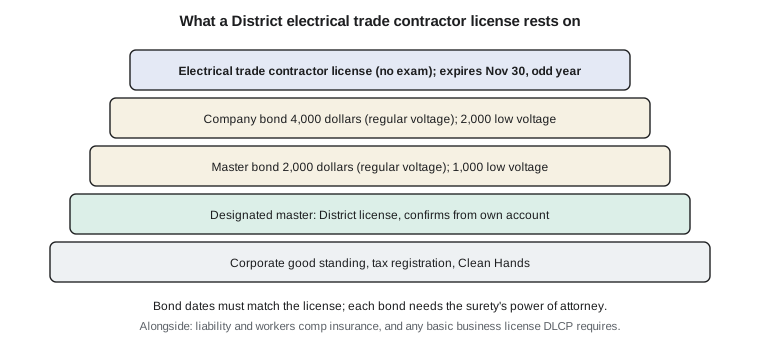
DLCP's trade contractor fact sheet sets out the license that lets a company contract for electrical work. The company must be registered with DLCP's Corporations Division and in good standing, and it must have a certificate of good standing. It must name a designated master, a District-licensed master electrician who supervises the work and the people doing it. It must file surety bonds for the company and for the master. And it applies online, paying the fees by card. There is no exam for the trade contractor license itself; the exam was the master's.
The designated master confirms the designation through his or her own account on the Board of Industrial Trades site, and the fact sheet says the application cannot be completed without that confirmation. That step is a protection for masters: no company can list a master without the master's knowledge. When Brookland Current changes its designated master from Vernon to Danielle, Danielle will confirm the designation from her own account.
The two bonds
The District requires two surety bonds for an electrical trade contractor, one in the company's name and one in the designated master's name. DLCP's fact sheet lists the amounts by trade. For regular voltage electrical work, the company bond is 4,000 dollars and the master bond is 2,000 dollars. For low voltage electrical work, the company bond is 2,000 dollars and the master bond is 1,000 dollars. For comparison, plumbing and gasfitting contractors and refrigeration and air conditioning contractors file 5,000-dollar company and master bonds, and elevator contractors file only a 4,000-dollar company bond.
Bond forms are part of the online application. Each bond must be accompanied by the surety's power of attorney form, which shows that the person signing for the surety has authority to bind it, with all required signatures. The bond's expiration date must match the license's expiration date: for electrical licenses, November 30 of an odd-numbered year. When the license renews, the bonds must be renewed or continued to the new date.
| Trade | Company bond | Master bond | Bond and license expire |
|---|---|---|---|
| Electrical, regular voltage | 4,000 dollars | 2,000 dollars | November 30, odd year |
| Electrical, low voltage | 2,000 dollars | 1,000 dollars | November 30, odd year |
| Elevator | 4,000 dollars | Not required | November 30, odd year |
| Plumbing and gasfitting | 5,000 dollars | 5,000 dollars | March 31, even year |
| Refrigeration and air conditioning | 5,000 dollars | 5,000 dollars | September 30, even year |
What a bond does and what insurance does
Bonds and insurance are often confused, and the exam likes the difference. A surety bond is a three-party promise. The contractor is the principal, the surety company guarantees the contractor's obligation, and the obligee, here the District on behalf of the public, can claim against the bond if the contractor fails to meet the obligations the bond covers, such as complying with the licensing law and the codes. If the surety pays a claim, it expects the contractor to pay it back. A bond protects the public, not the contractor.
Insurance is a two-party contract that protects the insured. General liability insurance pays for claims by third parties for bodily injury or property damage caused by the contractor's operations. Workers compensation insurance pays benefits to the contractor's own injured employees. Commercial auto insurance covers the trucks. The insurer does not expect the contractor to repay a covered claim, beyond the deductible. A small bond amount like 2,000 dollars is not a sign of how much risk the company carries; it is a licensing requirement, and the company's real protection against a large loss is its insurance.
Common mistakes
MistakeThinking the 4,000-dollar company bond protects the company from lawsuits.
InsteadA bond protects the public; the surety expects repayment. Liability insurance protects the company.
MistakeLetting the master bond expire on its own anniversary date.
InsteadBond expiration dates must match the license expiration, November 30 of an odd year for electrical.
MistakeListing a master without the master's confirmation.
InsteadThe designated master must confirm the designation from his or her own account.
MistakeAssuming the trade contractor license needs an exam.
InsteadDLCP's fact sheet says there is no exam for the contractor license.
MistakeTreating a basic business license as a substitute for the trade contractor license.
InsteadThey are separate credentials; electrical contracting needs the trade contractor license.
Insurance the company carries
DLCP's trade contractor fact sheet does not list a general liability insurance minimum for the electrical trade contractor license; the bonds are the licensing requirement. Insurance still matters for three reasons. First, other District credentials require proof of insurance: DLCP's basic business license categories for contractors, including general contractor and home improvement contractor, require a certificate of liability insurance, and the District's business licensing regulations in Title 17 DCMR, including section 3902, address it. Second, customers and general contractors require it by contract, usually with specific limits, additional insured endorsements and waivers of subrogation. Third, workers compensation insurance is required by District law for employers, as Lesson 10 explains.
Brookland Current carries general liability, commercial auto, workers compensation and an umbrella policy, and it keeps certificates ready for the general contractors it works for. The limits it carries are set by its contracts and its insurance broker, not by the trade contractor rules. On the exam, the safe answers are that the District requires the bonds for the license, that liability insurance protects the contractor against third-party claims, and that workers compensation is required for employers.
Business licensing, tax and Clean Hands
Beyond the trade contractor license, a District company needs the ordinary credentials of any District business. It must be registered and in good standing with the Corporations Division, with a registered agent. It must register with the Office of Tax and Revenue for the taxes it owes. It must have a certificate of occupancy for a commercial location in the District, or a home occupation permit if it runs from a home. And it must pass DLCP's Clean Hands check, which confirms that the applicant does not owe the District government more than 1,000 dollars in taxes, fees or fines; secondary sources describe that limit, and DLCP applies it to its license applications.
DLCP issues basic business licenses in many categories. A general contractor or construction manager category exists for companies that manage construction projects, and a home improvement contractor category exists for companies that contract directly with homeowners for repairs and improvements. DLCP's home improvement contractor page lists a 25,000-dollar surety bond, a certificate of liability insurance, a sample home improvement contract and at least one licensed home improvement salesperson. Whether an electrical trade contractor that takes residential jobs directly from homeowners also needs a home improvement or other basic business license depends on what the company actually does and on DLCP's current rules, so a company in that position should ask DLCP before taking the work. Lesson 9 shows why it matters: a lien claim on a home improvement contract must include a copy of that contract.
Changing the designated master
When a designated master leaves, the company must name a new one before it can keep contracting. The steps for Brookland Current, once Danielle is licensed, will be to update the trade contractor license in DLCP's portal to name Danielle, have Danielle confirm the designation from her account, file a new master bond in her name with the surety's power of attorney, and make sure the bond and license expiration dates match. DLCP's pages do not state a grace period for a company left without a designated master, so the safe plan is to make the change before the old master leaves, not after.
# Company credential check before the next permit (dates illustrative)
from datetime import date
today = date(2026, 11, 10)
items = {
    "trade contractor license": date(2027, 11, 30),
    "company bond (4,000)": date(2027, 11, 30),
    "master bond (2,000)": date(2027, 11, 30),
    "general liability certificate": date(2027, 4, 1),
    "workers compensation policy": date(2027, 4, 1),
}
license_end = items["trade contractor license"]
for name, end in items.items():
    flag = ""
    if "bond" in name and end != license_end:
        flag = "  <- must match the license date"
print(f"{name}: expires {end} ({(end - today).days} days){flag}")trade contractor license: expires 2027-11-30 (385 days) company bond (4,000): expires 2027-11-30 (385 days) master bond (2,000): expires 2027-11-30 (385 days) general liability certificate: expires 2027-04-01 (142 days) workers compensation policy: expires 2027-04-01 (142 days)
Shopping for bonds and insurance
Small license bonds are usually written by surety companies through insurance agents or brokers, and the premium is a small fraction of the bond amount, depending on the company's and the owner's credit. The surety may ask for a personal indemnity from the company's owners. The application in DLCP's portal provides the District's bond forms, and the surety completes them and attaches its power of attorney. Brookland Current uses the same broker for its bonds and its insurance, which makes it easier to keep all the expiration dates aligned.
Insurance is a larger decision. A broker who works with electrical contractors can explain the coverages customers ask for, such as general liability with products and completed operations coverage, commercial auto, workers compensation, an umbrella, and sometimes professional liability for design-build work. The company's contracts drive the limits. Vernon reviews the insurance requirements in every new contract before signing it, because a contract that requires coverage the company does not carry creates a breach on the first day.
Certificates of insurance
General contractors and owners ask for a certificate of insurance before the company starts work, and often for endorsements that name them as additional insureds. A certificate only summarizes the policy; it does not change it. Priya keeps a log of every certificate issued and every endorsement requested, and she asks the broker to confirm that each requested endorsement is actually on the policy. Brookland Current also collects certificates from its own subcontractors, such as a low voltage company it uses for data cabling, and checks that the subcontractor holds its own District license and bonds.
A final point for the exam and for practice is the difference between the company's license and the master's. If the company loses its license, for example because a bond is canceled, the master's individual license is not automatically affected, but the company cannot contract or obtain permits until the license is restored. If the master's license is suspended, the company loses its designated master and with it the basis for its license. Each depends on the other, which is why both are tracked on the same calendar.
When the company bids on public work for the District government, the bid documents will add their own bond and insurance requirements, such as bid bonds, performance and payment bonds and higher insurance limits. Those are contract requirements, separate from the license bonds, and Lesson 9 explains why the payment bond matters to subcontractors and suppliers.
Summary and key terms
- An electrical trade contractor license needs company good standing, a designated master who confirms the designation, and two bonds; there is no exam.
- Regular voltage electrical bonds are 4,000 dollars for the company and 2,000 dollars for the master; low voltage bonds are 2,000 and 1,000.
- Bond expiration dates must match the license, November 30 of an odd year for electrical.
- A bond protects the public and the surety expects repayment; insurance protects the contractor.
- DLCP's trade contractor fact sheet lists no liability insurance minimum, but business licenses, contracts and District law require insurance.
- Companies also need corporate good standing, tax registration, a certificate of occupancy or home occupation permit, and a clean hands check.
- Trade contractor license
- DLCP's license allowing a company to contract for a trade, backed by a designated master and bonds.
- Surety bond
- A three-party guarantee in which a surety backs the contractor's obligations to the obligee.
- Power of attorney
- The surety's form showing that the person signing the bond may bind the surety.
- Clean Hands
- DLCP's check that an applicant does not owe the District more than the allowed amount.
- Basic business license
- DLCP's general business license, issued in categories such as general contractor and home improvement contractor.
Practice problems
Work each problem on paper first, then reveal the answer to check.
What bonds does Brookland Current file for regular voltage electrical work?
Show answer
A 4,000-dollar company bond and a 2,000-dollar master bond.
A low voltage contractor asks about bonds. What are they?
Show answer
2,000 dollars for the company and 1,000 dollars for the master.
Does the trade contractor license require an exam?
Show answer
No; the master's license required the exam.
A customer sues the company for water damage caused by its crew. Which coverage responds?
Show answer
General liability insurance, not the license bond.
What must the master do to complete a company's designation?
Show answer
Confirm the designation from his or her own account on the Board's licensing site.
Lesson quiz · 5 questions
Score 60% or more to complete this lesson.
Create a free account to save your progress, take quizzes and earn a certificate.