
MELU-326 · Lesson 12 of 12 · 19 min
Practice exam review and test-day strategy
▶ Video coming soon A video version of this lesson is on the way.
Danielle's approval is expected soon, and she is aiming for a late January 2027 exam date. That gives her about ten weeks. She knows the trade, and she has spent a month working through the core courses and this one. What she needs now is a method: a way to use practice exams to find and fix her weak spots, and a plan for the five hours in the testing room. This lesson gives her both. The dates after today in this lesson are plans; nothing about her exam has happened yet.
What a practice exam is for
A practice exam is a diagnostic, not a score to feel good or bad about. Its value is in the review afterward, when every missed or guessed question is traced to a cause. The causes fall into a small number of groups: the candidate did not know where to look in the code, found the wrong section, misread the question, made a calculation error, or ran out of time. Each cause has a different fix. Knowledge gaps need study. Lookup problems need practice with the index and tabs. Misreading needs slower reading of the question stem. Calculation errors need a written, step-by-step method. Time problems need the pacing plan later in this lesson.
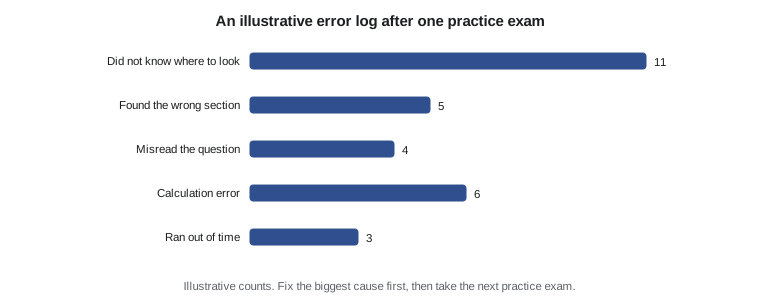
Danielle's first full practice exam, taken under exam conditions on a Saturday morning, produced the log in the figure. The biggest group was not knowledge but lookup: eleven questions where she knew the topic but could not find the answer quickly in the 2011 NEC. That told her to spend the next two weeks on navigation drills rather than rereading chapters she already understood.
A ten-week plan
A workable plan for the weeks before the exam has three phases. In the first four weeks, the candidate works through the reported content outline area by area, weighted by the number of questions, with untimed practice and the error log. In the next four weeks, the candidate takes one full timed practice exam a week, reviews it the same week, and drills the weakest areas between exams. In the last two weeks, the candidate takes a final full practice exam, reviews only the misses, prepares the exam-day copy of the books as the bulletin allows, confirms the appointment and the identification, and rests the day before.
| Weeks | Focus | Output |
|---|---|---|
| 1 to 4 | Content areas weighted by the outline; untimed practice | Error log by area and cause |
| 5 to 8 | One timed full exam per week; targeted drills | Score trend and a shrinking error log |
| 9 | Final timed exam; review misses only | Confidence in pacing |
| 10 | Books prepared per the bulletin; ID and appointment confirmed; rest | A calm exam day |
Weighting study by the outline
The reported content outline from Lesson 4 is a study budget. Wiring methods and materials, services, and branch circuits and conductors together carry about half the reported questions, so they deserve about half the study time. A candidate who is already strong in services can shift time to the areas the error log shows are weak, but should not drop any area entirely. Motors, feeders and control devices carry fewer questions, but motor calculations in particular are reliable points for a candidate who knows the method in Article 430 and the tables at the end of that article.
Calculation questions deserve a written method. For a dwelling service, Danielle writes the same steps every time: general lighting and receptacle load from Article 220, small appliance and laundry circuits, demand factors, fixed appliances, the larger of heating or cooling, the range, the dryer, and the conversion to amperes and conductor size. For a motor feeder, she writes the full-load currents from the Article 430 tables, the largest motor's multiplier, the sum and the conductor and protection rules. Writing the method on the scratch paper the test center provides prevents most calculation errors.
Reading the question
Many wrong answers on code exams come from questions read too fast. A good habit is to read the last sentence of the question first, to see what is actually being asked; then read the whole stem, marking the conditions that change the answer, such as dwelling or not, copper or aluminum, the number of current-carrying conductors, the temperature rating, wet or damp locations, and whether the question asks for a minimum or a maximum. Words such as except, not, minimum and maximum flip the answer, so they deserve a second look.
The answer choices give clues too. If two choices differ only by a factor such as 125 hundredths, the question is probably testing a continuous load or a motor rule. If one choice is a section number from a different edition, it is a distractor for candidates who studied the wrong book. On the District exam, as DLCP's fact sheet states it, the right edition is the 2011 NEC.
The three-pass plan for the testing room
If the exam is 100 questions in five hours, as publishers report, the average of three minutes a question hides a wide spread. A three-pass plan keeps the hard questions from eating the easy ones' time. In the first pass, the candidate answers every question that can be answered in about a minute and a half, and flags the rest. In the second pass, the candidate works the flagged lookups and calculations, in order of how confident he or she feels. In the third pass, with whatever time remains, the candidate checks flagged answers and makes sure every question has an answer, because an unanswered question earns nothing.
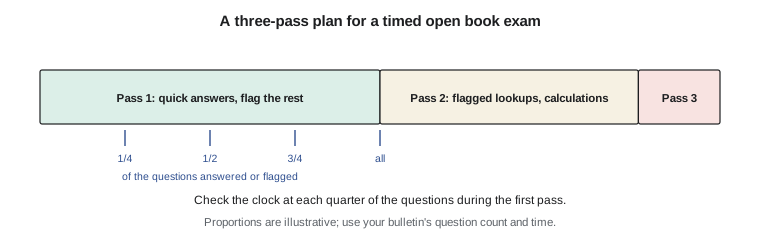
Checkpoints keep the plan honest. During the first pass, Danielle checks the clock after every quarter of the questions. If she is behind, she flags more aggressively. If she is ahead, she does not slow down; the time goes to the second pass, where it is worth more.
# Checkpoints for a 100-question, 300-minute exam (reported format; confirm in the bulletin)
total_q, total_min = 100, 300
pass1_share = 0.50
pass1_min = total_min * pass1_share
for q in (25, 50, 75, 100):
    print(f"After question {q}: about {pass1_min * q / total_q:.0f} minutes into pass 1")
print(f"Pass 2 and 3 time left: {total_min - pass1_min:.0f} minutes")After question 25: about 38 minutes into pass 1 After question 50: about 75 minutes into pass 1 After question 75: about 112 minutes into pass 1 After question 100: about 150 minutes into pass 1 Pass 2 and 3 time left: 150 minutes
Practice questions in the District style
The practice questions below test the District-specific knowledge from this course, the kind a candidate should not have to look up on exam day even though the exam itself is mostly code. The final exam for this course mixes these with the NEC skills from the core courses.
Practice problems
Work each problem on paper first, then reveal the answer to check.
Which office approves a District master candidate before the exam is booked?
Show answer
The Board of Industrial Trades, through DLCP.
Which NEC edition does DLCP's fact sheet list for the exam?
Show answer
The 2011 edition.
What does the District require of every journeyman and master applicant besides experience?
Show answer
A code class on the District's electrical code supplement, or an equivalent, within two years before applying.
What bonds back a regular voltage electrical trade contractor?
Show answer
A 4,000-dollar company bond and a 2,000-dollar master bond.
When must a District notice of intent to hold a lien be recorded?
Show answer
During construction or within 90 days after the earlier of completion or termination.
Who must obtain an electrical trade permit?
Show answer
A District master, or an employee with the master's fresh letter of authorization.
Exam day
The day before, Danielle packs the bag the bulletin allows: the approved books in clean condition, the identification the bulletin names, the confirmation of her appointment and any permitted calculator. She checks the test center's address and parking, and she plans to arrive early enough to finish check-in and the book inspection without hurrying. She will eat before the exam, because five hours is a long time, and she will use any allowed break to stretch, not to worry about a hard question.
In the room, she will start with the first pass and not let any single question take more than a few minutes before she flags it. If she meets a question that looks unfamiliar, she will look for the condition in the stem that tells her which article applies. And she will remember that a passing score does not require a perfect exam.
After the exam
If she passes, she will complete the license step in DLCP's portal and pay the license fee, as Lesson 3 explained, and then she and Vernon will start the designated master handover from Lesson 8. If she does not pass, the score report's breakdown by content area becomes her next study plan. She will rebuild the error log around the weakest areas, follow the retake instructions in the score report and the bulletin, and book again. Many good masters passed on the second attempt; what they had in common was a review method, not luck.
Either way, the exam is a step and not the end. The District's next code package is coming, the company's work will keep changing, and the habits from this course, such as checking the bulletin, reading the regulations, keeping records and planning by deadlines, will serve her for the length of her license.
A sample timed drill
Between full practice exams, short timed drills build speed. Danielle's favorite drill is twenty lookup questions in thirty minutes, with the rule that she must write the NEC section number beside each answer. The section number proves the lookup and makes review faster. She keeps a running score of how many answers she got right and how many section numbers she found within ninety seconds, and she watches the second number rise more than the first.
Calculation drills work the same way. She takes five dwelling or motor calculations, sets a timer for twenty-five minutes, and writes every step. Afterward she checks each step against the code, not just the final number, because a right answer reached by a wrong method will fail on the next question that changes one condition.
Managing nerves
Five hours is long enough for nerves to matter. Candidates who do well tend to follow routines that reduce surprise: they know the route and the parking, they have handled their exam books for weeks so that the tabs feel familiar, they have practiced in a quiet room at the same time of day as the exam, and they have a plan for the moment they meet a question they cannot answer, which is to flag it and move on. A few slow breaths at the start, and again at each checkpoint, help more than most people expect.
The week before
In the final week, the work is light. Danielle will do one short drill a day, review her error log and study notebook, confirm the appointment with PSI, reread the bulletin's rules on identification and books, and check her books against those rules. She will not start any new topic in the last three days. The night before, she will set out her identification, books and confirmation, check the test center's opening time and get a full night's sleep.
On the morning itself, she plans a normal breakfast, an early start to allow for traffic on the way to the test center, and a few minutes in the car to look over her list of the sections she uses most. Then she will leave the list in the car, because nothing but the allowed books goes into the room.
When the score arrives, she will record it, and the date, in the status sheet Priya keeps for Vernon, whatever the result. The habit of writing down results and dates, rather than relying on memory, is the same one that keeps a license, a bond and a lien calendar in order.
Common mistakes
MistakeTaking practice exams without reviewing them.
InsteadThe value is in the review; log every miss by cause and fix the biggest cause first.
MistakeStudying all areas equally.
InsteadWeight study by the outline and the error log.
MistakeWorking the exam strictly in order.
InsteadAnswer the quick questions first, flag the rest and return.
MistakeLeaving questions blank.
InsteadAnswer every question before time runs out.
MistakeStudying with a different NEC edition than the exam uses.
InsteadPractice with the edition the bulletin names, as DLCP's fact sheet states it the 2011 NEC.
Summary and key terms
- Use practice exams as diagnostics and log every miss by cause.
- Weight study time by the reported content outline and the error log.
- Write a fixed method for each type of calculation.
- Read the question's last sentence first and mark conditions that change the answer.
- Use a three-pass plan with checkpoints and answer every question.
- If a retake is needed, the score report's content breakdown is the next study plan.
- Error log
- A record of missed practice questions grouped by cause.
- Three-pass plan
- A pacing method that answers quick questions first, then flagged ones, then checks.
- Checkpoint
- A planned clock check during the exam.
- Distractor
- A wrong answer choice designed to look right.
- Score report
- The result document that shows performance by content area.
Lesson quiz · 5 questions
Score 60% or more to complete this lesson.
Create a free account to save your progress, take quizzes and earn a certificate.