
MELU-326 · Lesson 3 of 12 · 18 min
Applying, approval and booking the exam
▶ Video coming soon A video version of this lesson is on the way.
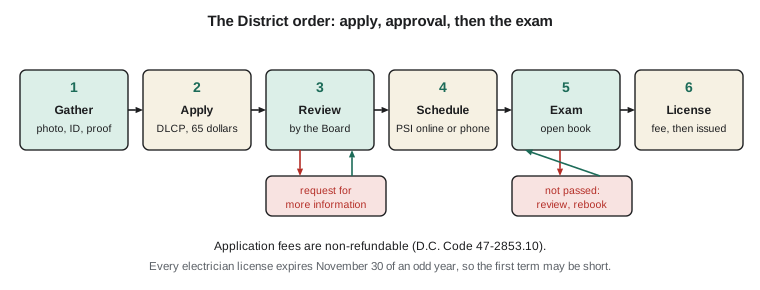
In the District the order is apply first, then test. A master candidate does not book the master exam on his or her own and bring the score to DLCP. The candidate applies to the Board of Industrial Trades through DLCP's online licensing portal, the Board reviews the experience and documents, and only an approved candidate is cleared to schedule the exam with the testing company, PSI. After passing, the candidate completes the license step and pays the license fee. This lesson follows Danielle through each step and the paperwork that keeps it moving.
Step 1: gather the documents
DLCP's electrician fact sheet lists what an applicant needs before starting. Every applicant needs one passport-style photo, two inches square, saved as a JPEG file; a government-issued photo ID such as a driver's license; and a debit or credit card for the fees. An exam applicant for the master also needs the experience proof covered in Lesson 2: tax records, employment verification letters signed by the supervising master, and a code class certificate from within the past two years. A reciprocity applicant needs the other state's license and the letter of good standing.
Priya set up a folder for Danielle with one scanned file per item, each named clearly: the photo, the driver's license, the W-2 forms by year, the employment letters by employer, the apprenticeship completion certificate, her current journeyman license and the code class certificate. The portal accepts uploads, and a clean set of files avoids the most common reason for delay, which is a request for a missing or unreadable document.
Step 2: apply online and pay the application fee
New applicants apply through DLCP's online portal for occupational and professional licenses, reached from the Board of Industrial Trades page. Existing license holders, like Danielle with her journeyman license, already have an account and can start a new application from it. The application asks for personal details, the license class sought, the basis of eligibility, work history and the uploads, and it ends with payment.
DLCP lists an application fee of 65 dollars for all trades. Under D.C. Code 47-2853.10, application fees are not refundable, even if the applicant withdraws or is found not qualified. That is a good reason to check eligibility carefully before paying, and to read the application's instructions on the date you apply, since fees and forms change. The exam fee is paid separately to PSI when the candidate books, and the license fee is paid after passing.
Step 3: Board review
The Board of Industrial Trades decides whether the applicant meets the statute. Board staff check the file for completeness, and the Board or its staff may ask for more information: a clearer employment letter, a missing tax year, a newer code class certificate, or an explanation of a gap. The Board meets quarterly, but staff handle routine review between meetings. DLCP does not publish a guaranteed review time, so a candidate with a deadline should apply early and answer any request quickly.
Danielle submitted her application on November 3, 2026. Two days later the portal showed a request for a clearer copy of her 2016 W-2, which Priya rescanned and uploaded the same afternoon. The rest of the file was in order. Danielle is waiting for approval as of the date of this lesson, and she and Vernon have planned around a decision in the next few weeks.
Step 4: schedule the exam with PSI
Once approved, the candidate schedules the exam with PSI, the testing company that delivers the District's trade exams. DLCP's Board page gives two ways. Online, the candidate creates or logs into an account at the PSI website, chooses to schedule an examination, selects Government or State Licensing Agencies, then District of Columbia, then the account for the license type, here the master electrician. By phone, the candidate calls PSI's scheduling line at 1 (855) 557-0616. The candidate then picks a test center and a date.
The PSI candidate information bulletin for the District's electrician exams is the document that governs exam day. It lists the exam's content, the time allowed, the reference books allowed and how they may be marked, the identification to bring, the rules for rescheduling and canceling, and how scores are reported. Lesson 4 covers the format and the references. For booking, the important points are to read the bulletin's rescheduling deadline before choosing a date, to bring exactly the identification it names, and to arrive early enough to check in with the books.
Danielle has not booked yet, because she cannot until the Board approves her. She and Vernon have chosen a target window in late January 2027, after the holiday rush on the company's service work, and she has started studying now so that she can book the first good date once the approval arrives.
| Step | Who acts | What the candidate does | What to check |
|---|---|---|---|
| Gather documents | Candidate | Photo, ID, tax records, employment letters, code class | Code class within 2 years; letters signed by the supervising master |
| Apply | Candidate through DLCP's portal | Complete the application and pay the fee | Application fee is non-refundable |
| Review | Board of Industrial Trades | Answer any request for information | No guaranteed review time |
| Schedule | Candidate with PSI | Book online or by phone | Bulletin's rescheduling and ID rules |
| Exam | PSI | Sit the open book exam | Allowed references and how they may be marked |
| License | DLCP | Complete the license step and pay the license fee | Expiration date: November 30 of an odd year |
Step 5: the exam and the result
Scores are reported under PSI's procedures in the candidate bulletin. A candidate who passes moves on to the license step. A candidate who fails receives a score report that usually breaks the result down by content area, which is the most useful study tool there is for a retake, and Lesson 12 shows how to use it. DLCP's pages do not state a waiting period or attempt limit for retakes, so the candidate should follow the instructions in the score report, the bulletin and the portal, which may include paying a new exam fee and rescheduling through PSI. If an approval or eligibility period applies to the account, the candidate should confirm how long it lasts before planning a retake months away.
Step 6: the license step and the first term
After passing, the candidate completes the license step in the portal and pays the license fee. Secondary sources list an initial license fee of 120 dollars, but the candidate should confirm the amount shown in the portal. The license is then issued and appears in DLCP's online license verification.
Every electrician license in the District expires on November 30 of an odd-numbered year, whenever it was issued. That has a practical effect on timing. If Danielle's master license is issued in February 2027, it will expire on November 30, 2027, less than a year later, and she will renew it then for a full two-year term ending November 30, 2029. DLCP's pages do not say whether a short first term reduces the license fee, so she should not assume it does. Lesson 11 covers renewal.
Reciprocity applicants
A master licensed by exam in Maryland or Virginia follows the same portal, uploads the other state's license and the letter of good standing instead of the experience file, and pays the application fee. If the Board approves the reciprocity application, the candidate goes straight to the license step without the District exam. Reciprocity applicants should still study the District's code supplement and the business rules in this course, because they will be working under them from the first permit.
Keeping the company in the loop
Danielle's application is personal, but the company's plans depend on it. Priya keeps a short status sheet for Vernon: date applied, any requests from the Board, date approved, exam date, result, date licensed and license number. When the license issues, the company will update its trade contractor license to name Danielle as designated master, and Danielle will file her own master bond. Lesson 8 covers that change.
# Danielle's timeline (dates after today are planned, not certain)
from datetime import date, timedelta
applied = date(2026, 11, 3)
planned_approval = applied + timedelta(weeks=6)      # assumption, no published review time
planned_exam = date(2027, 1, 27)                     # target window, not yet booked
planned_license = planned_exam + timedelta(weeks=3)  # assumption
first_expiry = date(2027, 11, 30)                    # November 30 of the next odd year
print("Planned approval around:", planned_approval)
print("Planned exam:", planned_exam)
print("Planned license around:", planned_license)
print("Days in the first term:", (first_expiry - planned_license).days)Planned approval around: 2026-12-15 Planned exam: 2027-01-27 Planned license around: 2027-02-17 Days in the first term: 286
Common reasons applications stall
Most delays in the District's process come from a handful of avoidable problems. A photo that does not meet the size or format rule. An employment letter that gives dates but no description of the work, or that is signed by an office manager instead of the supervising master. A code class certificate that is a few weeks past the two-year window by the time the application is reviewed. Tax records for some years but not others. A name on the identification that does not match the name on the application. Each of these generates a request for information, and each request adds days or weeks.
A short self-check before submitting catches most of them. Danielle and Priya read the application once more against DLCP's fact sheet, opened each uploaded file to make sure it was legible, compared the dates in the employment letters with the dates on the W-2 forms, and confirmed that the code class certificate would still be inside the two-year window for several months. They also made sure that Danielle's contact email in the portal was one she checks daily, because the Board's requests arrive there.
Fees at a glance
A candidate should expect three separate payments on the way to the license: the 65-dollar application fee to DLCP when applying, the exam fee to PSI when booking, and the license fee to DLCP after passing. A retake means another exam fee. The bond for a designated master and the company's renewal fees come later and belong to the business side. Budgeting all of them at the start avoids surprises, and the receipts belong in the same folder as the application documents.
Danielle also kept a copy of every page of the submitted application as a PDF, along with the payment receipt. If the portal ever lost a document or a question came up about what was submitted and when, the copy would answer it at once.
Common mistakes
MistakeBooking the master exam with PSI before applying.
InsteadIn the District the candidate applies to the Board first and schedules with PSI only after approval.
MistakeExpecting the application fee back if the Board denies the application.
InsteadD.C. Code 47-2853.10 makes application fees non-refundable.
MistakeAssuming a license lasts two years from the date it is issued.
InsteadAll electrician licenses expire on November 30 of an odd-numbered year.
MistakeBringing marked-up code books without reading the bulletin.
InsteadThe PSI bulletin sets how references may be marked or tabbed; read it before exam day.
MistakeLetting the Board's request for information sit.
InsteadAnswer requests promptly; the Board cannot approve an incomplete file.
Summary and key terms
- The District's order is apply to the Board through DLCP, receive approval, then schedule with PSI.
- Applicants need a two-inch photo, a government ID, a card for fees and the experience documents from Lesson 2.
- DLCP lists a 65-dollar application fee, which D.C. Code 47-2853.10 makes non-refundable.
- PSI scheduling is online through the District of Columbia account or by phone at 1 (855) 557-0616.
- The PSI candidate bulletin governs the exam's content, time, references, ID and rescheduling rules.
- All electrician licenses expire on November 30 of an odd-numbered year, so the first term may be short.
- Board approval
- The Board of Industrial Trades' decision that an applicant meets the eligibility rules and may test.
- PSI
- The testing company that delivers the District's trade examinations.
- Candidate information bulletin
- PSI's document setting the exam content, time, references and test-day rules.
- Application fee
- The fee paid with the Board application, not refundable under D.C. Code 47-2853.10.
- License verification
- DLCP's online lookup showing whether a license is active.
Practice problems
Work each problem on paper first, then reveal the answer to check.
Danielle is approved on December 10. What does she do next?
Show answer
Schedule the master exam with PSI online or by phone and pick a date that fits the bulletin's rules.
A candidate withdraws his application after paying. Does he get the 65 dollars back?
Show answer
No; the application fee is not refundable.
A master license is issued on March 1, 2027. When does it first expire?
Show answer
November 30, 2027.
Which document lists the books allowed in the exam room?
Show answer
The PSI candidate information bulletin for the District's electrician exams.
Does a Virginia master licensed by exam take the District master exam?
Show answer
Not if the Board approves the reciprocity application.
Lesson quiz · 5 questions
Score 60% or more to complete this lesson.
Create a free account to save your progress, take quizzes and earn a certificate.