
MELU-326 · Lesson 4 of 12 · 17 min
The exam format and the references allowed
▶ Video coming soon A video version of this lesson is on the way.
Danielle has taken one open book exam before, her journeyman exam in 2019, and she remembers the clock more than the questions. The master exam is longer and harder, and the difference between passing and failing is often not knowledge but speed: knowing where in the code book an answer lives and getting there in under two minutes. This lesson covers what the District's master exam looks like, which books are allowed and how to prepare them, and why the code edition on the exam may not be the one she works under every day.
What the official sources say
DLCP's electrician fact sheet states the essentials plainly. The exam is open book. The references listed are the National Electrical Code, 2011 edition, and Ugly's Electrical References. The exam is delivered by PSI, as Lesson 3 explained, and the PSI candidate information bulletin for the District's electrician exams sets the details: the number of questions, the time allowed, the content outline, the passing score, the identification required, and the rules for what may be written in or attached to the books.
The bulletin is the controlling document. If it differs from a study guide, a website or a coworker's memory, the bulletin wins. Candidates should download the current version when they are approved and again a week before the exam, because PSI updates bulletins without much announcement and a change in the allowed code edition is the kind of update that matters most.
The format reported for the master exam
Exam prep publishers that track the District's PSI bulletin describe the master electrician exam as 100 multiple-choice questions with five hours allowed, delivered on computer at a PSI test center. They also publish a content outline that weights the questions by topic. The figure below shows that outline as the approximate number of questions in each area out of 100. These numbers come from secondary sources rather than DLCP, so this course treats them as a guide to confirm in the bulletin, not as a promise. DLCP does not state the passing score on its pages, and the course does not guess at one; the bulletin and the score report state it.
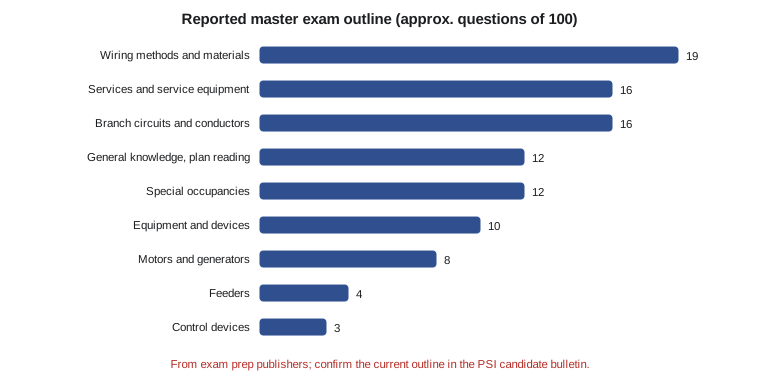
Read as a study plan, the outline says three things. First, nearly a third of the exam is wiring methods and services, which live in Chapters 2 and 3 of the NEC. Second, branch circuits, conductors and feeders together account for about a fifth, which means ampacity, conductor sizing and load calculations. Third, the smaller areas, such as motors, special occupancies and control devices, are still worth enough points together to decide a close result, so none can be skipped.
| Content area | Approx. questions | Where to look first in the NEC |
|---|---|---|
| Wiring methods and materials | 19 | Chapter 3, Articles 300 to 399 |
| Services and service equipment | 16 | Article 230, with Article 250 for service grounding |
| Branch circuits and conductors | 16 | Articles 210 and 310 |
| General knowledge and plan reading | 12 | Articles 90, 100 and 110; drawings and symbols |
| Special occupancies, equipment and conditions | 12 | Chapters 5, 6 and 7 |
| Equipment and devices | 10 | Articles 400 to 490 |
| Motors and generators | 8 | Articles 430 and 445 |
| Feeders | 4 | Articles 215 and 220 |
| Control devices | 3 | Article 430 Part VI, Article 725 |
The allowed references
The two references DLCP lists are the core. The first is the National Electrical Code, NFPA 70. The fact sheet names the 2011 edition. The second is Ugly's Electrical References, a pocket book of formulas, tables and conversions; publishers report that the bulletin accepts any edition of Ugly's. Some study guides also list optional books the bulletin may allow in original binding with no notes, such as a code index or tab guide keyed to the 2011 NEC, a practice calculations book and a formulas card. Before buying any of those, a candidate should confirm the exact titles and editions in the current bulletin, because a book that is not on the list will not enter the testing room.
Rules about marking are as important as the list. Publishers report that the District bulletin does not allow writing or notes in the reference books and that books are inspected at check-in. Many PSI bulletins allow permanent tabs and highlighting but not loose papers or handwritten notes; the District's bulletin sets its own rule. Danielle plans to buy a clean 2011 NEC for the exam, tab it with a commercial tab set if the bulletin allows tabs, highlight only if it allows highlighting, and leave her working copy, full of notes from eleven years of jobs, at home.
The edition problem
Danielle works every day under the District's construction codes, whose electrical code is based on an edition of the NEC newer than 2011, with District amendments and a 2021 rule that replaced the solar article with the 2020 edition's version. The exam, as DLCP's fact sheet states it, uses the 2011 NEC. That means she has to study the older edition for the exam while working under a newer one, and she has to notice where the two differ.
Most of the code's structure is stable from edition to edition, but numbers and rules move. In the 2011 edition, the familiar table of conductor ampacities for not more than three current-carrying conductors is Table 310.15(B)(16); in the 2020 and 2023 editions the same table is numbered 310.16. Ground-fault and arc-fault protection requirements in Articles 210 and 406 have expanded with each edition. Requirements in Articles 690 and 705 for solar and interconnected power sources have been rewritten more than once. On the exam, the right answer is the one in the book the bulletin names, even if a newer edition says something different and even if DOB would enforce the newer rule on a job.
The practical rule is to study with the same edition you will carry into the exam. Practice question books keyed to a newer edition can still teach calculation methods, but their section numbers and some answers will not match the 2011 book, so Danielle checks every practice answer against her 2011 NEC before trusting it.
How the time works
If the exam is 100 questions in five hours, the average is three minutes a question. That sounds generous until a few questions take ten minutes each. Calculation questions, such as a dwelling service load or a motor feeder, take longest. Lookup questions, such as the maximum number of conductors in a box or the minimum burial depth for a cable, are fast if the candidate knows where to look and slow if not. A good plan answers the fast questions first, marks the long ones, and returns to them with time in hand. Lesson 12 builds that plan in detail.
# Time budget for a 100-question, 5-hour open book exam (reported format; confirm in the bulletin)
questions = 100
minutes = 5 * 60
avg = minutes / questions
print(f"Average time per question: {avg:.1f} minutes")
quick, long_calc = 70, 30          # illustrative split
quick_minutes = quick * 1.5
long_minutes = long_calc * 5.5
reserve = minutes - quick_minutes - long_minutes
print(f"Quick lookups: {quick_minutes:.0f} min; calculations: {long_minutes:.0f} min; reserve: {reserve:.0f} min")Average time per question: 3.0 minutes Quick lookups: 105 min; calculations: 165 min; reserve: 30 min
Getting fast with the book
Speed comes from three habits. The first is learning the code's map: Chapters 1 through 4 apply generally, Chapters 5 through 7 modify them for special occupancies, equipment and conditions, Chapter 8 covers communications systems, and Chapter 9 holds the tables, including conduit fill and conductor properties, with the annexes after that. The second is the index. The 2011 NEC has a detailed index at the back, and many lookups are faster through it than through the table of contents. The third is tabs, if allowed: a small number of well-placed tabs for the articles used most, such as 210, 220, 230, 240, 250, 310, 314, 430 and Chapter 9, beats a book bristling with dozens.
Danielle practices with a timer. Each evening she takes twenty questions from a practice book, sets a sixty-minute limit, and logs every miss by cause: did not know where to look, found the wrong section, misread the question, or made a calculation error. After two weeks her log showed that most misses were lookup problems in Chapter 3, not knowledge gaps, which told her where to spend the next two weeks.
Exam day basics
The bulletin lists what to bring and what to leave. In general, PSI requires a current government-issued photo ID whose name matches the registration, and it does not allow phones, smart watches, bags or loose papers in the testing room. Calculators are governed by the bulletin's rules, which commonly allow a silent, non-programmable calculator. The candidate should arrive early, because books are checked before the exam starts, and a late arrival can mean forfeiting the appointment and the fee.
Practice question sources
Good practice questions come from several places. Commercial exam prep books for the District's master exam follow the reported content outline and the allowed references. Core courses in this series, MELU-101 through MELU-107, include NEC practice organized by topic. Apprenticeship and trade association programs in the region often run exam prep classes with timed mock exams. Whatever the source, a candidate should check that practice answers match the 2011 NEC, because many current practice books are keyed to newer editions.
A good practice set has explanations, not just answer keys. When Danielle misses a question, she reads the explanation, finds the section in her own 2011 NEC, and writes the section number and a one-line note in her study notebook, which stays at home. Over ten weeks that notebook becomes a personal index of the sections she needed most, and the act of writing it is itself navigation practice.
What the exam does not usually test
The master exam is mainly a code exam. It is not a test of the District's lien deadlines, bond amounts or permit procedures, which this course covers because a District master needs them in practice. The reported content outline includes general knowledge and plan reading, which can touch on terms, drawings and basic administrative rules, but a candidate should not expect many law questions. The District-specific knowledge in this course is what makes a master good at the job after passing, and it is also what other jurisdictions' business and law exams test, so it is worth knowing well.
Finally, candidates should remember that a calculator rule, a book rule or an identification rule in the bulletin applies exactly as written. A test center can turn away a candidate whose book has an unallowed note or whose identification does not match the registration, and the fee is usually lost. Reading the bulletin twice is cheap insurance against losing an appointment that took weeks to book.
Common mistakes
MistakeStudying only from a newer NEC because it is the one used on the job.
InsteadThe exam tests the edition the bulletin names; DLCP's fact sheet lists the 2011 NEC.
MistakeBringing a code book full of handwritten notes.
InsteadPublishers report the bulletin forbids writing in the books; check the current rule and bring a clean copy.
MistakeAssuming the passing score is the same as in another state.
InsteadUse the score stated in the District bulletin and score report.
MistakeSpending ten minutes on the first hard calculation.
InsteadMark long questions and return after answering the quick ones.
MistakeTrusting a practice answer keyed to another edition without checking.
InsteadVerify section numbers and answers in the edition you will carry into the exam.
Summary and key terms
- DLCP's fact sheet says the exam is open book with the 2011 NEC and Ugly's Electrical References.
- Publishers report 100 questions in five hours with a weighted content outline; confirm in the PSI bulletin.
- About a third of the reported outline is wiring methods and services.
- The bulletin controls the allowed books, how they may be marked, ID and the passing score.
- Study the exam edition, and note where it differs from the code DOB enforces.
- Speed comes from knowing the code's structure, using the index and timed practice.
- Open book exam
- An exam in which approved reference books may be used.
- Ugly's Electrical References
- A pocket reference of electrical formulas and tables allowed on many electrician exams.
- Content outline
- The bulletin's list of exam topics and how many questions each carries.
- Exam edition
- The NEC edition the exam bulletin names, which may differ from the adopted code.
- Table 310.15(B)(16)
- The 2011 NEC location of the common conductor ampacity table, renumbered 310.16 in later editions.
Practice problems
Work each problem on paper first, then reveal the answer to check.
Which NEC edition does DLCP's fact sheet list for the exam?
Show answer
The 2011 edition.
A practice book keyed to the 2023 NEC cites Table 310.16. Where is the matching table in the 2011 NEC?
Show answer
Table 310.15(B)(16).
At 100 questions in five hours, what is the average time per question?
Show answer
Three minutes.
Can Danielle bring her working code book full of job notes?
Show answer
Not if the bulletin forbids notes in the books, as publishers report; she should bring a clean copy.
Which reported content area carries the most questions?
Show answer
Wiring methods and materials, about 19 of 100.
Lesson quiz · 5 questions
Score 60% or more to complete this lesson.
Create a free account to save your progress, take quizzes and earn a certificate.