
MELU-326 · Lesson 2 of 12 · 18 min
Eligibility for the Master Electrician License
▶ Video coming soon A video version of this lesson is on the way.
Danielle's first question to Vernon was simple: am I eligible yet? The answer turned out to depend on three things the District looks at together. The first is her journeyman foundation, which the statute defines by hours, years and a recent code class. The second is the time she has spent working as a licensed journeyman, which the statute counts in years and DLCP's fact sheet counts in total hours of trade work. The third is proof, because the Board decides eligibility on documents, not on what an applicant says. This lesson works through each part and ends with Danielle's own count.
The rule in the statute
D.C. Code 47-2853.92 sets the eligibility requirements for every class of electrician license. For a journeyman electrician, and for the master electrician class limited to low voltage work, an applicant must show the Board of Industrial Trades three things. First, completion of a class on Title 12C of the D.C. Municipal Regulations, the District's electrical code supplement, or an equivalent code class, within two years before applying. Second, one of three experience paths: at least 8,000 hours as an apprentice over at least four years; a degree in electrical engineering from an accredited college or university plus at least two years of practical electrical work certified by a licensed master electrician; or comparable experience, or a mix of education and experience, that the Board finds equivalent. Third, any additional evidence the Board requires for a specialty license.
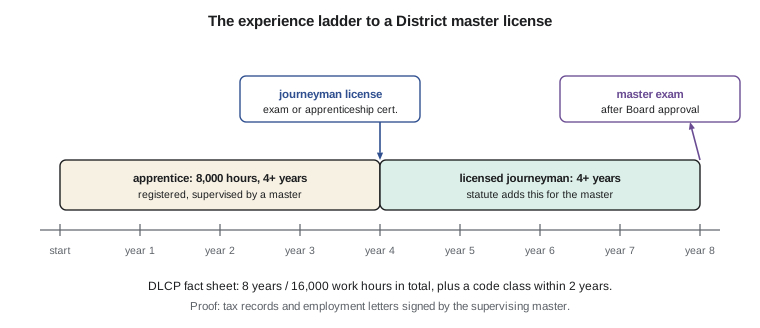
For a master electrician, the statute adds one more requirement on top of the journeyman qualifications: the applicant must have worked as a journeyman electrician for at least four years. In practice that means a master candidate has built two layers of experience. The first is the apprenticeship or its equivalent, which earned the journeyman license. The second is at least four years of licensed journeyman work.
How DLCP's fact sheet counts it
DLCP's electrician fact sheet states the master requirement as a single total: eight years, or 16,000 work hours, documented with tax records, an employment verification letter and a code class certificate from within the past two years. The two ways of counting describe the same ladder. Four years and 8,000 hours of apprenticeship plus four years of journeyman work add up to eight years. Two thousand hours is a full year of full-time work, so eight full years is 16,000 hours.
The hours matter as much as the years. A candidate who worked part time or had long gaps may reach the eighth calendar year without reaching 16,000 hours. The Board looks at both, so a candidate who is short on hours should keep working and documenting until the total is clear, rather than applying early and having the application held or denied. When the statute and the fact sheet seem to differ, the safe course is to meet both: four years as a licensed journeyman, and eight years and 16,000 hours of trade work in total.
| Path | Statute (47-2853.92) | DLCP fact sheet | Documents |
|---|---|---|---|
| Journeyman by exam | 8,000 apprentice hours over at least 4 years, or degree or equivalent | 4 years / 8,000 work hours | Tax records, employment letter, code class within 2 years |
| Journeyman by apprenticeship certificate | National certifying organization certificate in place of exam and experience | Waives the journeyman exam | Certificate of completion or official transcripts |
| Master by exam | Journeyman qualifications plus at least 4 years as a journeyman | 8 years / 16,000 work hours | Tax records, employment letter, code class within 2 years |
| Master by reciprocity | Board rules | Maryland or Virginia license by exam | License and letter of good standing |
The code class
The District is unusual in requiring a recent code class from every journeyman and master applicant. The statute names a class on Title 12C, the electrical code supplement, or an equivalent code class, taken within two years before applying. DLCP's fact sheet lists it as an NEC code class certificate taken within two years. The point is that a District master should know not only the National Electrical Code but the District's own amendments to it, and should have studied them recently.
The two-year window is easy to miss. Danielle took a code update class in 2023 when she first ran crews. By the time she applies in late 2026 that certificate will be more than two years old, so she signed up for a District code class at a local training center this fall. Many apprenticeship and trade association programs in the region offer classes that meet the requirement, but the safe choice is a class whose certificate names the District code supplement and states the hours and date.
Proving the experience
The Board decides on paper. DLCP's fact sheet lists three kinds of proof for an exam applicant. Tax records show that the applicant was actually employed in the trade, usually through W-2 forms or tax transcripts. An employment verification letter from each employer describes the work and the period, and the fact sheet says the employer, meaning the master electrician who supervised the work, must sign it. The code class certificate shows the recent code study.
A good employment letter answers the questions the Board will ask. It is on company letterhead, names the applicant, gives start and end dates, describes the kind of electrical work in plain words, estimates the hours, states whether the applicant worked as an apprentice or a licensed journeyman during each period, and is signed by the supervising master with his or her license number and contact details. Letters from employers outside the District are acceptable in principle, but they should still be signed by the person who supervised the work and should make clear which license, if any, the applicant held at the time.
Gaps cause most delays. A former employer may have closed or the supervising master may have retired or died. In those cases a candidate should gather what else exists, such as pay stubs, union hours records, apprenticeship transcripts or a letter from another master who supervised the work, and should ask DLCP before applying how the Board will treat the gap. The statute's equivalent-experience path gives the Board room to accept other proof, but only the Board can decide that.
Education in place of experience
The electrical engineering degree path is narrow. It requires a degree from an accredited college or university plus at least two years of practical electrical work certified by a licensed master electrician, and it meets the journeyman-level requirement. A master applicant on that path still needs the four years as a journeyman that the statute adds for masters. Trade school and community college courses do not appear in the statute as a separate path, but a candidate may ask the Board to count them as part of comparable experience or a combination of education and experience.
Reciprocity
DLCP's fact sheet lists a reciprocity path for masters who are already licensed by exam in Maryland or Virginia. The applicant submits a valid, active state-issued license and a letter of good standing from the state where he or she took the exam, and the letter must explicitly say the license was obtained by exam. For journeymen the reciprocity path on the fact sheet is narrower and lists Virginia only. Reciprocity applicants still apply through the Board's portal and pay the application and license fees, but they may skip the District exam. A Maryland master who earned the license through a grandfathering provision rather than an exam would not qualify by this route.
The low voltage master class
The statute names a master electrician class limited to low voltage, and DLCP defines low voltage work as work at 49 volts and below. That class covers people whose work is limited to systems such as communications, data, security, fire alarm signaling and similar low energy wiring. The statute groups it with the journeyman for its basic requirements: the code class, and 8,000 hours, a degree with experience, or an equivalent. The low voltage license does not allow work on power wiring above that limit, and a low voltage contractor files lower bond amounts, as Lesson 8 shows. This course focuses on the unlimited master electrician license.
Danielle's count
Danielle laid out her own record with Priya Natarajan, Brookland Current's office manager. She was a registered apprentice from June 2015 to June 2019 and logged about 8,300 hours in that period. She has held her journeyman license since July 2019 and has worked full time since, about 2,050 hours a year. Her four years as a journeyman were complete in July 2023, and her total trade hours passed 16,000 in early 2023. Her code class certificate will be dated October 2026. On every count she is eligible, and the only open question is proof for one year in 2016 when her first employer, now closed, signed nothing. She has her W-2 forms for that year and a signed letter from the master who supervised her there, who now works for another shop.
# Danielle's eligibility check (hours are illustrative estimates)
apprentice_hours = 8300          # June 2015 to June 2019
journeyman_years = 7.3           # July 2019 to November 2026
journeyman_hours_per_year = 2050
total_hours = apprentice_hours + journeyman_years * journeyman_hours_per_year
print(f"Apprentice hours: {apprentice_hours} (needs 8,000 over at least 4 years)")
print(f"Years as a journeyman: {journeyman_years} (statute needs at least 4)")
print(f"Total trade hours: {total_hours:,.0f} (DLCP fact sheet: 16,000)")
code_class_age_years = 0.1       # class taken October 2026
print("Code class within 2 years:", code_class_age_years <= 2)Apprentice hours: 8300 (needs 8,000 over at least 4 years) Years as a journeyman: 7.3 (statute needs at least 4) Total trade hours: 23,265 (DLCP fact sheet: 16,000) Code class within 2 years: True
When the Board asks for more
If the Board's staff question part of the experience record, the request usually names the gap: a year without a tax record, a letter without hours, or work that sounds like it may have been outside the electrical trade. The best answer is short and documented. A cover note explains the gap in two or three sentences, and the attachments prove it. Danielle prepared her note on the 2016 year before she applied, so that a reviewer would see the explanation and the supporting letter together rather than having to ask.
One more point is worth making about timing. Because the code class must fall within two years before the application, and because the Board may take weeks to review, a candidate who takes the class just under two years before applying risks having it expire during review. Taking it within the year before applying leaves a comfortable margin.
Common mistakes
MistakeCounting apprentice years toward the four years as a journeyman.
InsteadThe statute requires at least four years working as a licensed journeyman, in addition to the journeyman qualifications.
MistakeRelying on a code class from three years ago.
InsteadThe code class must be taken within two years before applying.
MistakeHaving a coworker sign the employment letter.
InsteadThe fact sheet says the employer, the supervising master, must sign the employment verification letter.
MistakeAssuming every Maryland master qualifies by reciprocity.
InsteadThe letter of good standing must state that the license was obtained by exam.
MistakeTreating the low voltage master as a full master license.
InsteadThe low voltage class is limited to work at 49 volts and below.
Summary and key terms
- D.C. Code 47-2853.92 sets eligibility: a recent code class plus 8,000 apprentice hours over at least four years, a degree with experience, or an equivalent.
- A master also needs at least four years working as a licensed journeyman.
- DLCP's fact sheet states the master requirement as eight years and 16,000 work hours.
- Proof includes tax records, an employment verification letter signed by the supervising master and a code class certificate from within two years.
- Masters licensed by exam in Maryland or Virginia may qualify by reciprocity with a letter of good standing.
- The low voltage master class covers work at 49 volts and below.
- Code class
- A class on the District's electrical code supplement, Title 12C, or an equivalent, taken within two years before applying.
- Employment verification letter
- A letter from an employer, signed by the supervising master, describing the applicant's work and dates.
- Equivalent experience
- Experience or a mix of education and experience the Board accepts in place of the standard hours.
- Letter of good standing
- A letter from another state confirming an active license obtained by exam, used for reciprocity.
- Low voltage
- Work at 49 volts and below, under DLCP's definition.
Practice problems
Work each problem on paper first, then reveal the answer to check.
A journeyman licensed in March 2023 asks to apply for the master in January 2026. Does the statute's journeyman-years rule allow it?
Show answer
No; that is less than three years as a journeyman, and the statute requires at least four.
A candidate's code class certificate is dated September 2024 and she applies in November 2026. Is it recent enough?
Show answer
No; it is more than two years old, so she needs a new class.
Who must sign an employment verification letter?
Show answer
The employer, meaning the supervising master electrician.
A Virginia master licensed by exam wants a District master license. What does DLCP's fact sheet ask for?
Show answer
A valid, active Virginia license and a letter of good standing stating that the license was obtained by exam.
How many hours does DLCP's fact sheet list for the master?
Show answer
16,000 work hours over eight years.
Lesson quiz · 5 questions
Score 60% or more to complete this lesson.
Create a free account to save your progress, take quizzes and earn a certificate.