
MELU-326 · Lesson 1 of 12 · 19 min
How electrical licensing works in the District of Columbia
▶ Video coming soon A video version of this lesson is on the way.
Danielle Mensah has spent eleven years in the electrical trade in Washington. She started in 2015 as a registered apprentice with a shop in Northeast, finished an apprenticeship program in 2019, and earned her District of Columbia journeyman electrician license that year. Since 2021 she has run crews for Brookland Current Electric, LLC, a twelve-person contractor with a shop near the Monroe Street Market in Brookland. The company is invented for this course, but the questions it faces are real. Its owner, Vernon Tolliver, has held a District master electrician license since 1996 and is the designated master behind the company's electrical trade contractor license. Vernon is sixty-three and wants to step back over the next two years. He has asked Danielle to earn her own master license so that she can become the company's designated master, and this course follows her from her first question to exam day.
This is the District of Columbia course in the HSM University master electrician exam prep series. The core courses, MELU-101 through MELU-107, teach the National Electrical Code skills that every master-level exam tests: navigating the code, load calculations, conductors and overcurrent protection, grounding and bonding, motors and transformers, special occupancies, and business and law. This course adds what is specific to the District: who licenses electricians, how the master exam works, which code applies to a job, how permits and inspections run through the Department of Buildings, how the company side is licensed and bonded, and the lien, safety and workers compensation rules a District master is expected to know.
Two cautions apply to every lesson. First, licensing rules change. The facts in this course were checked in November 2026 against the D.C. Code, the Department of Licensing and Consumer Protection's licensing pages and fact sheets, the Department of Buildings' code and permit pages, and Title 12 of the D.C. Municipal Regulations, and the lessons say so when a fact comes from a secondary source or could not be confirmed. Before you apply, pay a fee or book an exam, check the current pages yourself. Second, electrical codes are copyrighted. This course cites code articles and sections by number and explains them in plain words, but it never reproduces their text, tables or figures. Keep your own copy of the code your exam uses open beside you.
One jurisdiction, three offices
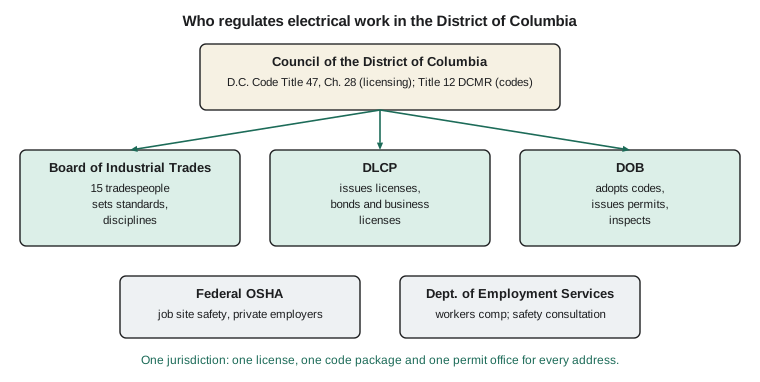
The District is not a state, but for electrical licensing it works like one with a single city inside it. There are no counties or separate towns to deal with. One set of laws, passed by the Council of the District of Columbia under the Home Rule Act and subject to review by Congress, covers every address from Anacostia to Tenleytown. A license issued in the District is good everywhere in the District, and a permit for a job in Brookland is issued by the same office that issues one for a job in Georgetown.
Three government bodies matter most to an electrician. The Board of Industrial Trades sets the standards for electricians, plumbers, refrigeration mechanics, steam engineers, elevator mechanics and asbestos workers. It is made up of fifteen tradespeople appointed by the Mayor and meets quarterly. The Department of Licensing and Consumer Protection, usually called DLCP, runs the licensing office that takes applications, issues and renews licenses, registers businesses and issues basic business licenses. The Department of Buildings, called DOB, adopts and enforces the construction codes, issues permits and runs inspections. Until October 2022 both of those departments were part of a single agency, the Department of Consumer and Regulatory Affairs, or DCRA. Older forms, study guides and letters still use that name, and some online portals still carry DCRA addresses.
What the D.C. Code says about electricians
The law for electricians sits in Title 47, Chapter 28 of the D.C. Code, in the part on the Board of Industrial Trades. Section 47-2853.91 defines an electrician broadly: a person who designs, installs, maintains, alters, converts, changes, repairs, removes or inspects electrical wiring in buildings and structures, with narrow exceptions for some lifts and conveyances. Section 47-2853.92 sets the eligibility rules for each class of license, and section 47-2853.93 makes it unlawful for an unlicensed person to call himself or herself an electrician, a licensed electrician or a master electrician in a way that suggests they may do electrical work in the District.
The statute and DLCP's fact sheet describe a ladder of individual credentials. An apprentice is registered without an exam and may work only under the direct personal supervision and control of a licensed master electrician or master electrician specialist. A journeyman electrician has finished the apprenticeship years or their equivalent and either passed the journeyman exam or qualified through a recognized national apprenticeship certificate. A master electrician has the journeyman qualifications plus years working as a journeyman, and has passed the master exam. The statute also names a master electrician limited to low voltage work, which DLCP defines as work at 49 volts and below. Lesson 2 works through the eligibility rules in detail.
| Credential | Exam? | Main eligibility point | Who it is for |
|---|---|---|---|
| Apprentice electrician | No | Registration; employment or school enrollment | Learners working under a master's supervision |
| Journeyman electrician | Yes, or national apprenticeship certificate | 8,000 hours over at least 4 years, plus a recent code class | Licensed electricians doing the work |
| Master electrician | Yes | Journeyman qualifications plus years as a journeyman | Electricians who plan, supervise and take responsibility |
| Master electrician, limited (low voltage) | Yes | Experience in low voltage work | Work at 49 volts and below |
| Electrical trade contractor | No exam for the company | A designated D.C. master and two bonds | The business that contracts for work |
The person and the company
The District separates the individual from the business. Danielle's master license will belong to her, follow her from job to job and carry her name. Brookland Current Electric holds a separate electrical trade contractor license. DLCP issues that license to a company that is registered and in good standing with its Corporations Division, that names a designated master who holds a District master license, and that files two surety bonds, one for the company and one for the master. There is no exam for the company license itself. The master confirms the designation from his or her own account in the licensing portal, and the application cannot be completed without that confirmation.
That split explains Vernon's plan. As long as he is the designated master, the company's license rests on his. When he steps back, the company needs another District master to take his place, file the master bond and confirm the designation. If Danielle has her master license by then, the change is a short administrative step. If she does not, the company would have to find and hire a master from outside or stop contracting. Lesson 8 covers the trade contractor license and the bonds in detail.
What stays with each job
Licensing tells you who may do the work. The code and the permit tell you how it must be done. The District adopts a single package of construction codes for every building, known as the District of Columbia Construction Codes and published as Title 12 of the D.C. Municipal Regulations. Its electrical part takes the National Electrical Code and amends it in subtitle 12-C. Electrical work that needs a permit must be done by licensed electricians, and the permit is issued by DOB to a licensed master or to someone the master has authorized in writing. Inspections are requested through DOB, and DOB also accepts inspections by approved third-party agencies on some work. Lesson 5 covers code adoption and Lesson 6 permits and inspections.
Danielle has learned that the District's single code does not mean a single edition in every conversation. The construction codes in force since May 29, 2020 are based on an older edition of the NEC, a 2021 rule replaced one article with a newer edition, the master exam bulletin names yet another edition, and DOB is preparing a new code package. Lesson 4 and Lesson 5 untangle those editions, because the exam will test the one its bulletin names, while her jobs are inspected under the one DOB enforces.
Enforcement
Enforcement in the District runs on two tracks. DLCP and the Board handle licensing discipline: they can deny, suspend or revoke a license, and the Board can act on complaints about incompetence, fraud or unlicensed work. DOB handles enforcement on the job: inspectors can reject work, issue stop work orders and cite violations of the construction codes, and DOB can refuse a permit to an applicant without a valid license. A homeowner or a general contractor who hires an unlicensed electrician also risks trouble, because the work cannot be legally permitted and may have to be torn out.
For a master, enforcement is personal. The master's license appears on the permit, the master's bond backs the company's work, and the master is the person the Board will look to if a permit is pulled for work the master never supervised. Vernon has told Danielle that the best protection is dull paperwork: a current license and bond, letters of authorization only for people who actually work for the company, permits pulled before work starts, inspections called on time, apprentices registered and supervised, and a file for every job. Lesson 7 returns to those habits.
Safety and workers compensation
Two federal and District systems sit beside licensing. The District has no state plan under the Occupational Safety and Health Act for private employers, so federal OSHA enforces workplace safety for Brookland Current Electric's crews, while the Department of Employment Services offers free safety consultation through its Office of Occupational Safety and Health. Workers compensation is a District program under Chapter 15 of Title 32 of the D.C. Code, also run through the Department of Employment Services, with its own deadlines for reporting injuries. Lesson 10 covers both.
How this course is organized
The lessons follow Danielle's path. Lesson 2 covers eligibility for the master license, Lesson 3 the application, approval and booking process, and Lesson 4 the exam format and the references allowed. Lesson 5 explains the NEC as adopted in the DC Construction Codes and Lesson 6 permits and inspections. Lesson 7 covers the duties of a master, Lesson 8 contractor licensing, insurance and bonding, and Lesson 9 contracts and mechanics' liens. Lesson 10 covers safety law, OSHA and workers compensation, Lesson 11 renewal and continuing education, and Lesson 12 a practice review and test-day strategy. Every lesson ends with a quiz that mixes multiple choice, true or false, number, ordering and matching questions, and the course ends with a final exam.
The calculator below shows the first planning Danielle did. Vernon wants to step back in about twenty months. Danielle needs time to gather proof of her experience, take a code class if her last one is too old, apply to the Board, wait for approval, book and sit the exam, allow for a possible retake, receive the license and let the company change its designated master. Change the numbers to fit your own plan.
# Danielle's planning check (illustrative months)
months_until_vernon_steps_back = 20
steps = {
    "gather tax records and employment letters": 1,
    "take a code class (if the last one is over 2 years old)": 1,
    "apply to the Board and wait for approval": 2,
    "study for the master exam": 4,
    "book and sit the exam with PSI": 1,
    "retake allowance, if needed": 2,
    "license issued; company names Danielle as designated master": 1,
}
needed = sum(steps.values())
for step, months in steps.items():
    print(f"{step}: {months} months")
print(f"Total: {needed} months; margin: {months_until_vernon_steps_back - needed} months")gather tax records and employment letters: 1 months take a code class (if the last one is over 2 years old): 1 months apply to the Board and wait for approval: 2 months study for the master exam: 4 months book and sit the exam with PSI: 1 months retake allowance, if needed: 2 months license issued; company names Danielle as designated master: 1 months Total: 12 months; margin: 8 months
Common mistakes
MistakeCalling DCRA the licensing agency today.
InsteadSince October 2022, DLCP issues licenses and DOB issues permits; DCRA is the former combined agency.
MistakeThinking a master license lets the company contract.
InsteadThe company needs its own electrical trade contractor license with a designated master and bonds.
MistakeAssuming different neighborhoods have different licensing rules.
InsteadThe District is one jurisdiction; one license and one code apply throughout.
MistakeBelieving an apprentice may work alone once experienced.
InsteadAn apprentice works only under the direct personal supervision and control of a licensed master or master specialist.
MistakeTreating the exam's NEC edition as the edition DOB enforces.
InsteadThe exam tests the edition its bulletin names; jobs are inspected under the adopted DC Construction Codes.
Summary and key terms
- The District is a single jurisdiction for electrical licensing, codes and permits.
- The Board of Industrial Trades sets standards, DLCP issues licenses and DOB issues permits and inspects.
- D.C. Code 47-2853.91 to 47-2853.93 define the electrician, set eligibility and protect the titles.
- Credentials run from apprentice to journeyman to master, with a master limited to low voltage work at 49 volts and below.
- A company contracts under an electrical trade contractor license backed by a designated master and two bonds.
- Check current D.C. Code sections, DLCP pages and DOB pages before relying on any detail.
- Board of Industrial Trades
- The fifteen-member board of tradespeople that sets standards for electricians and other trades in the District.
- DLCP
- The Department of Licensing and Consumer Protection, which issues occupational and business licenses.
- DOB
- The Department of Buildings, which adopts the construction codes, issues permits and inspects.
- Designated master
- The licensed master electrician who supports a company's electrical trade contractor license.
- DCRA
- The Department of Consumer and Regulatory Affairs, the former agency split into DLCP and DOB in 2022.
Practice problems
Work each problem on paper first, then reveal the answer to check.
Which office issues Danielle's master license?
Show answer
DLCP, on the standards set by the Board of Industrial Trades.
Which office issues the permit for a service upgrade in Anacostia?
Show answer
The Department of Buildings, the same office for every address in the District.
Can Brookland Current Electric contract for work on Vernon's master license alone?
Show answer
No; it needs its own trade contractor license, which names Vernon as designated master and carries two bonds.
What voltage limit applies to the low voltage master class?
Show answer
DLCP defines low voltage work as work at 49 volts and below.
Who enforces safety rules on a private job site in the District?
Show answer
Federal OSHA; the District has no state plan for private employers.
Lesson quiz · 5 questions
Score 60% or more to complete this lesson.
Create a free account to save your progress, take quizzes and earn a certificate.