
MELU-326 · Lesson 5 of 12 · 17 min
The NEC as adopted in the DC Construction Codes
▶ Video coming soon A video version of this lesson is on the way.
Every electrical job in the District is built to one code package, but that package has layers, and a master is expected to know which layer governs a given question. At the bottom is the National Electrical Code as published by the National Fire Protection Association. On top of it sit the District's own amendments, adopted as regulations. Around both are the administrative rules for permits, inspections and transition from one edition to the next. This lesson explains how the District adopts the NEC, which edition is in force, what changed in 2021, what is coming, and how Danielle answers the question her customers ask most: which code applies to my job?
How the District adopts codes
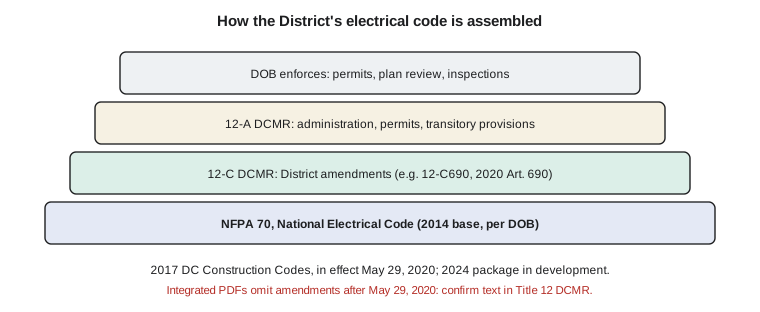
The District's construction codes are regulations, not ordinances. The Construction Codes Approval and Amendments Act authorizes the District to adopt model codes and amend them, and the codes are published as Title 12 of the D.C. Municipal Regulations, known as DCMR. Title 12 is divided into subtitles. Subtitle 12-A is the building code supplement, which also carries the administrative chapter used across the codes. Subtitle 12-C is the electrical code supplement. Other subtitles cover the mechanical, plumbing, fuel gas, energy, residential, existing building, fire, green and property maintenance codes, running through subtitle 12-M.
A supplement does not reprint the model code. It adopts the model code by reference and then lists District amendments: sections deleted, sections added and sections replaced. The NEC itself, as amended, is the District's electrical code. That is why a District master needs two documents on the desk: the NEC edition the District adopted, and the current text of 12-C DCMR, which shows what the District changed.
The code in force: the 2017 DC Construction Codes
The District's current package is called the 2017 District of Columbia Construction Codes. DOB's code page states that it took effect on May 29, 2020, and that it is built on the 2015 editions of the International Code Council's model codes, the 2014 National Electrical Code and ASHRAE 90.1-2013, as amended by Title 12 DCMR, subtitles A through M. The year 2017 in the name refers to the District's code cycle, not to an NFPA edition, which confuses many people the first time they see it. The electrical supplement is titled the Electrical Code Supplement of 2017.
DOB publishes integrated versions of the codes that merge the model text and the District's amendments for convenience. Its page warns that those integrated PDFs do not include amendments adopted after May 29, 2020, and that Title 12 DCMR should be used to confirm the official text. That warning matters for electrical work, because at least one major amendment came later.
The 2021 change to the solar article
In 2021 the District replaced the solar photovoltaic article of its electrical code. The final rule, published at 68 DCR 7439 on July 30, 2021, created chapter 12-C690, which replaces Article 690 of the District's electrical code with the 2020 edition of NFPA 70's Article 690. The District did this because solar installation practice had moved quickly, and the newer article reflects rapid shutdown, system grouping and other changes the older edition did not address.
The effect is a code with mixed editions. For most work, Danielle follows the edition in the 2017 package. For a photovoltaic system, she follows the 2020 Article 690 as adopted in 12-C690, together with the rest of the code as it applies, and she checks 12-C for any other District amendments that touch the installation. The integrated PDF on DOB's site will not show the 2021 change, so the solar crews at Brookland Current keep a printout of chapter 12-C690 in the truck file.
| Package | Model codes | NEC edition | In effect |
|---|---|---|---|
| 2013 DC Construction Codes | 2012 ICC codes | 2011 | Permit applications from March 28, 2014 |
| 2017 DC Construction Codes | 2015 ICC codes | 2014, with District amendments in 12-C | From May 29, 2020 |
| 2021 amendment, 12-C690 | Not applicable | 2020 Article 690 replaces Article 690 | Final rule published July 30, 2021 |
| 2024 DC Construction Codes | 2024 ICC codes | Most recent edition, per DOB | In development; final rules anticipated late 2027 |
What the District amends
The District's amendments are cited by chapter and section numbers that mirror the NEC, with the 12-C prefix. Chapter 12-C690 is the solar chapter, and rules such as 12-C210.64, which deals with electrical service areas, follow the NEC's own numbering. Some District amendments tighten administrative or safety requirements, some adjust rules to the District's building stock of rowhouses, apartment buildings and large commercial structures, and some coordinate the electrical code with the District's fire, energy and green codes. This course does not reproduce the amended text. Before a job that touches an unusual system, a master should open 12-C DCMR and search for the article number.
Earlier District supplements included requirements unusual among United States jurisdictions, such as periodic preventive maintenance of large switchboards by a licensed master electrician with a maintenance report to the District's electrical inspection office. Whether a given requirement of that kind is in the current supplement is a question to answer from the current text of 12-C, not from memory or an old study guide. The exam is more likely to test the general principle, that District amendments change the NEC and must be checked, than any single amendment.
Transition rules
Every new code package comes with transitory provisions that say which projects may continue under the old code. When the 2017 package took effect in 2020, projects with an executed design contract could use the 2013 codes for a permit for up to a year, projects that already had permits or had filed under the old code kept their timelines, and first-generation tenant spaces could follow the code the base building was designed under. The details are in the administrative chapter of 12-A. The general rule a master should take from this is that the code for a job is usually fixed by the date and basis of the permit application, not by the date the electrician arrives.
What is coming: the 2024 DC Construction Codes
DOB is preparing the next package, the 2024 DC Construction Codes, built on the 2024 editions of eleven ICC codes and, for electrical work, the most recent NEC edition. In 2026 DOB held public listening sessions and planned a notice of proposed rulemaking with a public comment period; public reporting in 2026 said final rules were anticipated in late 2027. Until those rules are final and take effect, the 2017 package, with the 2021 solar amendment, remains in force. Danielle reads DOB's code updates every few months, because when the new package takes effect the company's estimating, material lists and training will all have to change.
Three editions, one master
Danielle's situation shows why a District master has to keep editions straight. Her exam, as DLCP's fact sheet states it, tests the 2011 NEC, the edition behind the District's codes from 2014 to 2020. Her jobs are inspected under the 2017 package's edition with District amendments, except solar, which follows the 2020 Article 690. And the next package will bring in the newest NEC. On the exam she answers from the 2011 book. On the job she follows the adopted code. When a customer asks what code applies, she answers with the package and the permit date.
# Which code applies? A simple lookup by permit application date (illustrative)
from datetime import date
def package_for(applied):
    if applied >= date(2020, 5, 29):
        return "2017 DC Construction Codes (2014 NEC base, 12-C amendments; solar per 12-C690)"
    if applied >= date(2014, 3, 28):
        return "2013 DC Construction Codes (2011 NEC base)"
    return "earlier package; check the transitory provisions"
for d in [date(2019, 6, 1), date(2021, 9, 15), date(2026, 11, 2)]:
print(d, "->", package_for(d))2019-06-01 -> 2013 DC Construction Codes (2011 NEC base) 2021-09-15 -> 2017 DC Construction Codes (2014 NEC base, 12-C amendments; solar per 12-C690) 2026-11-02 -> 2017 DC Construction Codes (2014 NEC base, 12-C amendments; solar per 12-C690)
The code above is deliberately simple. Real projects can fall under a transitory provision, a permit revision can raise questions about which package applies to the changed work, and the 2024 package will add another branch to the lookup. When a job is near a code change, the answer belongs in writing from DOB's plan review or code staff.
Using the code in practice
On an ordinary job, Danielle's routine is short. She confirms the permit application date and the package it falls under. She works from the NEC edition for that package. She checks 12-C DCMR for any District amendment in the articles the job touches, which takes a few minutes with a search. For solar work she follows chapter 12-C690. And if the job is a renovation, she also checks the existing building code supplement, because work in existing buildings can trigger requirements outside the electrical code itself.
Where to find the official text
The official text of the District's construction codes is Title 12 DCMR as published by the District's Office of Documents and Administrative Issuances. The District's online register and regulations site lets a reader search by subtitle and section, and it shows the history of each rule, including the D.C. Register citation for each change. The NEC itself is published by NFPA, which offers free read-only online access to its codes in addition to the printed books. DOB's code page links to the integrated codes and to its code updates and bulletins. A master who keeps these three sources bookmarked can answer most which-code questions in a few minutes.
When a question cannot be answered from the text, DOB's code staff can give an interpretation. A written answer is worth far more than a phone conversation, because it can be shown to the inspector and kept in the job file. Danielle asks for written answers on anything unusual, such as an unfamiliar system or a question about which package applies to a permit revision, before the crew starts work.
The same discipline applies to the exam. When a practice question asks about a rule that the District has amended, the exam answer still comes from the 2011 NEC as published, because the bulletin names that book and not the District's supplement. Danielle marks such cases in her notebook with a note on how the District's code differs, so that she does not confuse the two in the testing room or on the job.
A last practical point: when a customer or general contractor sends drawings that cite a code edition, the master should check that the edition matches the package that applies to the permit. Engineers working across several jurisdictions sometimes note the wrong edition, and catching it before bidding avoids disputes later.
Common mistakes
MistakeReading the 2017 in the package's name as the NEC edition.
InsteadThe 2017 DC Construction Codes use the 2014 NEC as their electrical base, according to DOB.
MistakeRelying on DOB's integrated PDF for the solar article.
InsteadThe integrated PDFs omit amendments after May 29, 2020; 12-C690 replaced Article 690 with the 2020 version in 2021.
MistakeApplying the 2024 package before it takes effect.
InsteadThe 2024 DC Construction Codes are in development; follow the package in force until DOB's final rules take effect.
MistakeAssuming the NEC as published is the whole District code.
InsteadThe District amends the NEC in 12-C DCMR, and the administrative rules are in 12-A.
MistakeChoosing the code edition by the date work starts.
InsteadThe package is usually fixed by the permit application date and the transitory provisions.
Summary and key terms
- The District adopts codes as regulations in Title 12 DCMR, with the electrical supplement in subtitle 12-C.
- The 2017 DC Construction Codes took effect May 29, 2020, built on the 2015 ICC codes and, per DOB, the 2014 NEC.
- A 2021 rule, 68 DCR 7439, replaced Article 690 with the 2020 edition's Article 690 in chapter 12-C690.
- DOB's integrated PDFs omit amendments after May 29, 2020; confirm text in Title 12 DCMR.
- The 2024 DC Construction Codes are in development, with final rules anticipated in late 2027.
- The exam's 2011 NEC, the adopted code and solar's 2020 article are three different editions a District master must keep straight.
- DCMR
- The District of Columbia Municipal Regulations; Title 12 holds the construction codes.
- 12-C DCMR
- The electrical code supplement that adopts and amends the NEC for the District.
- Transitory provision
- A rule saying which projects may continue under the previous code package.
- Integrated code
- DOB's merged text of a model code and District amendments, published for convenience.
- 12-C690
- The District chapter that replaced Article 690 with the 2020 NEC version.
Practice problems
Work each problem on paper first, then reveal the answer to check.
A homeowner applies for a solar permit in 2026. Which Article 690 applies?
Show answer
The 2020 edition's Article 690, adopted in 12-C690.
Where would you look for a District amendment to Article 210?
Show answer
In 12-C DCMR, under the matching 12-C210 section.
When did the 2017 DC Construction Codes take effect?
Show answer
May 29, 2020.
Is the 2024 DC Construction Codes package in force today?
Show answer
No; it is in development, with final rules anticipated in late 2027.
Why is the integrated PDF not enough for every question?
Show answer
It omits amendments adopted after May 29, 2020, such as 12-C690.
Lesson quiz · 5 questions
Score 60% or more to complete this lesson.
Create a free account to save your progress, take quizzes and earn a certificate.