
MELU-326 · Lesson 11 of 12 · 18 min
Renewal and continuing education
▶ Video coming soon A video version of this lesson is on the way.
Earning the master license is a one-time event. Keeping it is a cycle that repeats every two years for the rest of a career. In the District the cycle is easy to remember, because every electrician license expires on the same day, November 30 of an odd-numbered year, no matter when it was issued. This lesson covers the renewal steps and fees, the continuing education picture, what happens to the company's credentials at renewal, and how a District master works across the river in Maryland and Virginia.
One expiration date for everyone
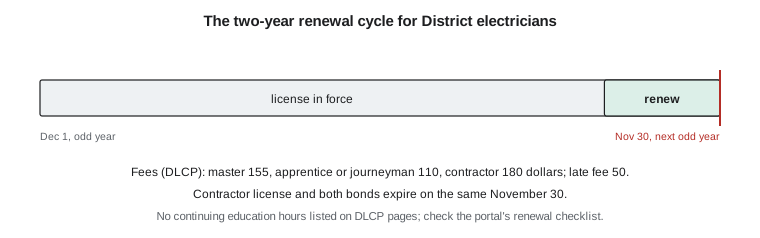
DLCP's Board of Industrial Trades page lists the expiration date and renewal year for each trade. Electrician licenses, at every level, expire on November 30 in odd-numbered years. Elevator maintenance licenses share that date. Plumbing and gasfitting licenses expire on March 31 in even years, refrigeration and air conditioning and steam and other operating engineer licenses on September 30 in even years, and asbestos worker licenses on July 31 in odd years. The electrical trade contractor license and its bonds, as Lesson 8 showed, also expire on November 30 of the odd year.
The common date has two consequences. First, a license issued in an even year, or late in an odd year, has a short first term, as Lesson 3 showed. Second, renewal season is crowded: thousands of electricians and contractors renew in the same autumn. Renewing early avoids portal congestion and leaves time to fix a problem, such as a bond that has not been continued or a Clean Hands issue, before the deadline.
Renewal steps and fees
Renewal is done online through DLCP's licensing portal. The licensee logs in, starts the renewal, confirms or updates personal details, answers the renewal questions, completes any renewal requirements the portal lists, and pays the fee by card. DLCP's Board page lists the renewal fees: 110 dollars for an apprentice or journeyman electrician, 155 dollars for a master electrician and 180 dollars for an electrical contractor. A late renewal fee of 50 dollars applies to renewals after the expiration date. A duplicate license and a records verification each cost 30 dollars. Fees change, so the amount in the portal on the day of renewal controls.
| Item | Fee listed by DLCP | Notes |
|---|---|---|
| Master electrician renewal | 155 dollars | Every two years |
| Apprentice or journeyman renewal | 110 dollars | Every two years |
| Electrical contractor renewal | 180 dollars | Bonds must match the new expiration |
| Late renewal | 50 dollars | In addition to the renewal fee |
| Duplicate license or records verification | 30 dollars each | On request |
Work after November 30 on an expired license is unlicensed work. A master whose license lapses cannot obtain permits or support the company's trade contractor license until it is renewed, and the company may find permits on hold. DLCP's pages reviewed for this course do not state how long an expired license may be renewed with only a late fee before reinstatement or reapplication is required, so a master whose license has lapsed should contact DLCP at once rather than assume.
Continuing education
Unlike many states, the District does not publish a continuing education hour requirement for electrician license renewal on the DLCP pages reviewed for this course, and secondary sources that track licensing rules list none at this time. A renewing master should still read the renewal checklist in the portal each cycle, because the Board can add requirements by rule, and a requirement that appears in the portal applies even if a study guide says otherwise.
The District does require recent code study at the front end. Every journeyman and master applicant must have completed a class on the District's electrical code supplement, or an equivalent code class, within two years before applying, as Lesson 2 explained. That requirement applies to applications, so a journeyman planning to apply for the master in a few years should time the code class to fall within two years of the application.
The absence of a renewal hour requirement is not a reason to stop learning. The District's code is about to change: DOB is preparing the 2024 DC Construction Codes with the most recent NEC, and final rules were anticipated in late 2027 when this course was checked. A master who has not studied the changes between editions will be estimating, installing and supervising to an outdated code on the day the new package takes effect. Brookland Current budgets for each licensed electrician to take a code update class in the year a new package is adopted, and Danielle plans to take one as soon as the 2024 package's final rules are published.
Renewing the company side
The trade contractor license renews on the same cycle, and its renewal depends on the master's. Before renewing the company license, the office should confirm that the designated master's license is renewed or being renewed, that both bonds are continued to the new November 30 date with the surety's power of attorney, that the company is in good standing with the Corporations Division, that the company passes the Clean Hands check, and that any basic business license the company holds is current. A company that renews its contractor license but lets the master bond lapse will find the license incomplete.
# Renewal readiness check for the 2027 cycle (dates after today are planned)
from datetime import date
expiry = date(2027, 11, 30)
plan = {
    "master license renewal submitted": date(2027, 10, 1),
    "journeyman licenses renewed": date(2027, 10, 15),
    "company bond continued to 2029-11-30": date(2027, 10, 1),
    "master bond continued to 2029-11-30": date(2027, 10, 1),
    "contractor license renewal submitted": date(2027, 10, 20),
}
for item, when in plan.items():
print(f"{item}: planned {when}, {(expiry - when).days} days before expiry")master license renewal submitted: planned 2027-10-01, 60 days before expiry journeyman licenses renewed: planned 2027-10-15, 46 days before expiry company bond continued to 2029-11-30: planned 2027-10-01, 60 days before expiry master bond continued to 2029-11-30: planned 2027-10-01, 60 days before expiry contractor license renewal submitted: planned 2027-10-20, 41 days before expiry
Working in Maryland and Virginia
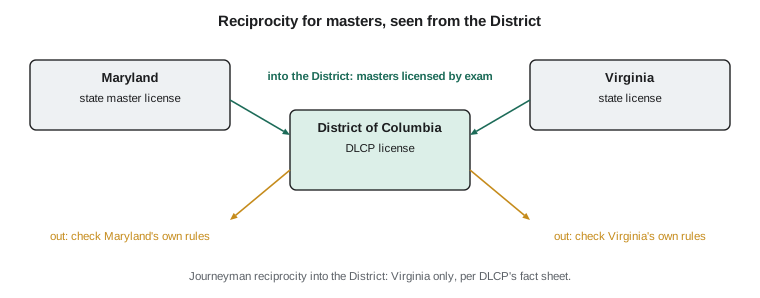
A District master's license is good only in the District. Brookland Current takes jobs in Prince George's and Montgomery counties in Maryland and in Arlington and Alexandria in Virginia, and each of those places requires its own state credentials. Reciprocity runs in one direction more clearly than the other. DLCP's fact sheet lets masters licensed by exam in Maryland or Virginia apply for a District master license by reciprocity. Whether Maryland or Virginia grants a license to a District master without an exam depends on those states' own rules and any agreements they have; Maryland's state Board of Master Electricians and Virginia's Board for Contractors and its tradesman licensing set them. A District master planning work across the line should read the other state's current rules or call its board before bidding.
The business side multiplies too. Working in Maryland or Virginia means meeting those states' contractor licensing, insurance and bonding rules, pulling local permits from the county or city, and following the code edition each has adopted, which is usually not the District's. Priya keeps a sheet for each jurisdiction the company works in, with the license numbers, renewal dates and permit contacts, much like the District's own renewal calendar.
Changes between renewals
A master should update DLCP between renewals when something important changes: a new mailing address or email, a name change, a change of employer, or a change in the company the master is designated for. Out-of-date contact details are the most common reason licensees miss renewal notices. A master who leaves a company should make sure the company names a new designated master, because the master's bond and responsibility remain tied to the company's license until the designation changes.
Keeping a licensing calendar
A company that works in several jurisdictions lives by its calendar. Brookland Current's calendar lists every license, bond, insurance policy and registration with its expiration date and the date the renewal work should start, usually ninety days before. For the District, the November 30 odd-year date covers the master, journeyman and contractor licenses and both bonds at once. For Maryland and Virginia, the dates are different. The calendar also lists the date of the next District code package once it is announced, so that training and estimating updates are scheduled in advance.
Each renewal is also a chance to check the records. When Priya renews the company's licenses, she compares the list of employees with the list of licenses and registrations, makes sure every apprentice's registration is current, removes anyone who has left, and confirms that the company's insurance and bonds name the right entity and address. The work takes a few hours every two years and prevents most of the surprises that come from stale records.
When a license lapses
If a license lapses despite the calendar, the first step is to stop licensed work under it at once, the second is to contact DLCP, and the third is to tell anyone who relies on it, such as the company's general contractors on open jobs. The longer a master waits, the more work is done on an expired license and the harder it is to explain. A lapse caught in December usually costs a late fee and some embarrassment. A lapse that runs for months can raise questions about every permit issued in the meantime.
Planning a career beyond the license
Many District masters also hold licenses in Maryland or Virginia, and some go on to related credentials, such as low voltage, fire alarm or solar certifications, or into estimating, project management and inspection. The habits that keep a District license current, such as reading the regulations, tracking dates and keeping a record of training, are the same ones those paths need. Danielle has told Vernon that once she is licensed she wants to add a Maryland license within two years, because so much of the company's growth is in Prince George's County.
The renewal cycle is also a natural time to look back. Every two years, Vernon and Danielle review the company's inspection log, injury log and customer complaints for the cycle, decide what training the crews need next, and set goals for the following two years. A license renewal is paperwork, but the review that goes with it is how the company keeps improving.
For individual electricians, the cycle is a reminder to keep their own records too: a copy of each license, a list of classes taken with dates and certificates, and the contact details of the masters who supervised their work. Those records make the next application, whether for a master license, a license in another state or a new job, far easier.
Common mistakes
MistakeThinking a license renews two years from its issue date.
InsteadAll electrician licenses expire on November 30 of an odd-numbered year.
MistakeAssuming the District requires a fixed number of continuing education hours at renewal.
InsteadDLCP's pages list no hour requirement; check the portal's renewal checklist each cycle.
MistakeRenewing the contractor license without continuing the bonds.
InsteadBonds must be continued to the new expiration date.
MistakeUsing a District master license for a job in Arlington.
InsteadVirginia and its localities require their own credentials and permits.
MistakeIgnoring the 2024 code process because no CE is required.
InsteadThe new package will change the code; plan to study it before it takes effect.
Summary and key terms
- Every District electrician license expires on November 30 of an odd-numbered year.
- DLCP lists renewal fees of 155 dollars for a master, 110 for an apprentice or journeyman and 180 for a contractor, with a 50-dollar late fee.
- DLCP's pages list no continuing education hour requirement for renewal; check the portal's checklist.
- A code class within two years is required before applying for a journeyman or master license.
- The contractor license and both bonds renew on the same cycle and must match the license date.
- Masters licensed by exam in Maryland or Virginia may get a District license by reciprocity; the reverse depends on those states' rules.
- Renewal cycle
- The two-year period ending on November 30 of an odd-numbered year for District electricians.
- Late renewal fee
- The extra 50-dollar fee for renewing after the expiration date.
- Records verification
- DLCP's confirmation of a license record, listed at 30 dollars.
- Reciprocity
- Licensing based on an existing license from another jurisdiction, without retesting.
- Renewal checklist
- The list of renewal requirements shown in DLCP's portal for each credential.
Practice problems
Work each problem on paper first, then reveal the answer to check.
Danielle's master license is issued in February 2027. When does she first renew?
Show answer
By November 30, 2027.
What does DLCP list as the master renewal fee?
Show answer
155 dollars.
Vernon renews on December 5 after his license expired. What extra fee applies?
Show answer
The 50-dollar late renewal fee, in addition to the renewal fee.
Does the District require continuing education hours to renew?
Show answer
DLCP's pages list none; check the renewal checklist in the portal each cycle.
Can Brookland Current wire a job in Montgomery County on Danielle's District license?
Show answer
No; Maryland and the county require their own credentials and permits.
Lesson quiz · 5 questions
Score 60% or more to complete this lesson.
Create a free account to save your progress, take quizzes and earn a certificate.