
MELU-326 · Lesson 10 of 12 · 18 min
Workplace safety law and OSHA for electrical contractors
▶ Video coming soon A video version of this lesson is on the way.
Electrical work kills and injures people every year, and a master is responsible not only for the code compliance of the installation but for the safety of the crew that builds it. In the District, two bodies of law apply. Federal OSHA enforces workplace safety for private employers, because the District has no state plan for them. The District's Workers' Compensation Act, administered by the Department of Employment Services, governs benefits for workers injured on the job and sets reporting deadlines for employers. This lesson covers both from the master's side: what the rules require, which clocks start when someone is hurt, and how Brookland Current builds safety into ordinary work.
Who enforces safety in the District
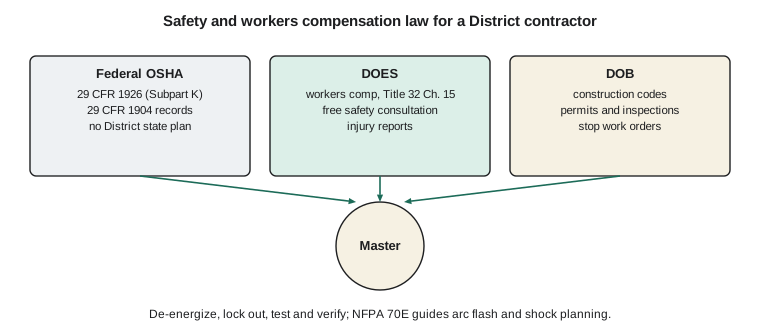
Under the federal Occupational Safety and Health Act, a state or territory may run its own OSHA-approved state plan. The District does not run one for private employers, so federal OSHA inspects private job sites in the District, investigates complaints and accidents, and issues citations. The District's Department of Employment Services has an Office of Occupational Safety and Health that offers free, voluntary onsite consultation to private employers: safety surveys, training and program help, with recommendations but not citations. Consultation is separate from enforcement, and a company that asks for a consultation visit agrees to correct serious hazards the consultant finds.
The OSHA standards electricians meet most
Construction work falls under the construction standards in 29 CFR Part 1926, and electrical contractors also meet general industry standards in Part 1910 when they work in operating facilities. The electrical subpart of the construction standards, Subpart K, covers installation safety requirements and safety-related work practices, including the requirement to protect employees from contact with energized circuits, ground-fault protection for temporary power through ground-fault circuit interrupters or an assured equipment grounding conductor program, and the rules for lockout and tagging of circuits being worked on. The general industry electrical work practice rules in 29 CFR 1910.331 through 1910.335 address work on or near exposed energized parts, qualified and unqualified persons, and protective equipment.
Other standards matter as much on a typical job: fall protection in Subpart M, ladders in Subpart X, scaffolds in Subpart L, excavation in Subpart P for underground work, and the hazard communication standard for the chemicals crews handle. OSHA also refers to consensus standards such as NFPA 70E, Standard for Electrical Safety in the Workplace, for practical guidance on arc flash and shock hazards and on choosing protective equipment. NFPA 70E is not itself a federal regulation, but OSHA can cite an employer under its general duty clause or its own standards when recognized hazards are ignored.
For an electrical contractor the most important practice is the simplest: de-energize, lock out, test and verify before work, and treat a circuit as energized until it has been proven otherwise. Energized work should be the rare exception, justified in writing, planned with an energized work permit, and done by qualified people with the right equipment.
Recordkeeping and reporting clocks
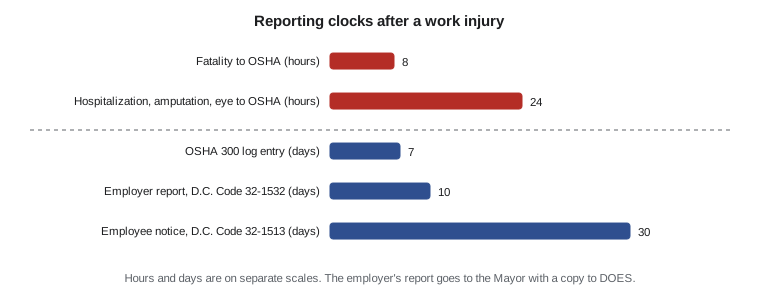
OSHA's recordkeeping rules in 29 CFR Part 1904 require most employers with more than ten employees to keep a log of recordable injuries and illnesses, the OSHA 300 log, with incident reports and an annual summary posted each February through April. Electrical contractors are not in the partially exempt industries, so Brookland Current, with twelve employees, keeps the log. Separately, 29 CFR 1904.39 requires every employer, regardless of size, to report a work-related fatality to OSHA within eight hours, and an in-patient hospitalization, an amputation or the loss of an eye within twenty-four hours.
District workers compensation law starts its own clocks. Under D.C. Code 32-1513, an injured employee must give notice of the injury to the employer and the Mayor within 30 days after the injury, or within 30 days after the employee knew or should have known that the injury was related to work. Under D.C. Code 32-1532, the employer must send a report of the injury to the Mayor, with a copy to the Department of Employment Services, within ten days from the date of the injury or of learning of it, and an employer that fails or refuses to send a required report faces a civil penalty of up to 1,000 dollars for each failure. The employee's claim for compensation has its own time limit, generally one year under the Act, with rules about when the clock starts; an injured worker or employer with a question about a claim deadline should check the current statute.
| Event | Report to | Deadline | Source |
|---|---|---|---|
| Work-related fatality | OSHA | 8 hours | 29 CFR 1904.39 |
| In-patient hospitalization, amputation or loss of an eye | OSHA | 24 hours | 29 CFR 1904.39 |
| Any compensable injury (employer's report) | The Mayor, copy to DOES | 10 days | D.C. Code 32-1532 |
| Employee's notice of injury | Employer and the Mayor | 30 days | D.C. Code 32-1513 |
| Recordable injury | OSHA 300 log | Within 7 calendar days of learning of it | 29 CFR 1904.29 |
Workers compensation coverage
The District's Workers' Compensation Act, in Chapter 15 of Title 32 of the D.C. Code, requires employers to secure payment of compensation for their employees, usually by buying workers compensation insurance or by qualifying as a self-insurer. The Act provides medical care and wage replacement for work injuries without the employee having to prove fault, and in exchange the employee generally cannot sue the employer for the injury. An employer that fails to secure coverage faces penalties and can be liable for the full cost of an injury. Every Brookland Current employee, from apprentice to estimator, is covered under the company's policy.
Misclassification is a trap. A contractor that treats electricians as independent contractors to avoid payroll taxes and insurance may find, after an injury, that the worker was legally an employee and that the company is responsible for benefits it never insured. It also raises licensing questions, because a licensed electrician working for the company is supposed to be under the master's supervision. Brookland Current puts every electrician and apprentice on the payroll and requires certificates of insurance from any subcontractor.
Utilities, public space and underground work
Work near utilities brings more rules. Before any excavation, the District's underground facility protection law requires a call to the one-call notification system, reached by dialing 811, so that buried lines are marked. Work in public space, such as a sidewalk vault or a service run under the street, needs a public space permit from the District Department of Transportation in addition to DOB's electrical permit. And work on or near Pepco's service equipment follows the utility's rules on who may open meters and connect services. A master planning a service job confirms all three before the crew arrives.
Building safety into ordinary work
Brookland Current's safety program is not elaborate. It has a written plan reviewed each year, a short weekly toolbox talk, a lockout and tagging procedure with personal locks for every electrician, a policy that energized work needs Danielle's or Vernon's written approval, a fall protection plan for every job with work above six feet, ground-fault protection on all temporary power, and a rule that any injury is reported to the office the same day. Priya keeps the OSHA 300 log and calendars the ten-day workers compensation report whenever an injury occurs.
When a crew member cut his hand badly on a panel cover last spring, the system worked as designed. The foreman sent him to urgent care, called the office, and Priya filed the employer's report within the ten-day window. The injury required stitches and a few days of restricted work, so it was recorded on the OSHA 300 log; it did not involve in-patient hospitalization, so no OSHA report was due within twenty-four hours.
# Which clocks start? A quick check for one injury (illustrative)
from datetime import datetime, timedelta
injury = datetime(2026, 4, 14, 10, 30)
event = {"fatal": False, "inpatient": False, "amputation": False, "eye_loss": False, "recordable": True}
if event["fatal"]:
    print("Report fatality to OSHA by", injury + timedelta(hours=8))
if event["inpatient"] or event["amputation"] or event["eye_loss"]:
    print("Report to OSHA by", injury + timedelta(hours=24))
print("Employer's report to the Mayor and DOES by", (injury + timedelta(days=10)).date())
print("Employee's notice due by", (injury + timedelta(days=30)).date())
if event["recordable"]:
print("Enter on OSHA 300 log by", (injury + timedelta(days=7)).date())Employer's report to the Mayor and DOES by 2026-04-24 Employee's notice due by 2026-05-14 Enter on OSHA 300 log by 2026-04-21
Arc flash and shock planning
Before any work on or near energized equipment, NFPA 70E calls for a shock risk assessment and an arc flash risk assessment. The assessments identify the hazards, the boundaries within which unqualified people must stay out, the protective equipment needed and the safe work practices to use. Many large District buildings have arc flash labels on their switchboards and panelboards from an engineering study; where they do not, the company uses the 70E tables or asks the owner for the study. Either way, the best result of an assessment is usually a decision to de-energize.
Lockout and tagging is the everyday form of that decision. Brookland Current's procedure requires each electrician to place a personal lock on the disconnect for the circuit being worked on, to test the circuit for absence of voltage with a meter checked on a known live source before and after the test, and to remove only his or her own lock when the work is done. On jobs in occupied buildings, the foreman coordinates shutdowns with the building engineer and posts notice to occupants. The procedure is written, taught to every new hire and checked during job visits.
Training records
OSHA expects employers to train workers on the hazards of their jobs and to be able to show it. Brookland Current keeps a training file for each employee with the date and topic of every toolbox talk attended, OSHA 10-hour or 30-hour construction course cards, qualified-person training for electrical work, fall protection and ladder training, and first aid. When an OSHA inspector asks how a worker was trained, the file answers. When the company bids on public work, the same file often answers the bid's safety questions.
The District's own agencies add requirements on some projects. District government contracts can require safety plans, certified payroll and training credentials, and large private projects often have owner safety programs stricter than OSHA's minimums. A master reading a new contract checks its safety section along with its insurance and payment terms.
Finally, the master should plan what happens on the worst day. Brookland Current's written plan lists who calls emergency services, who secures the area and the equipment, who calls the office, who calls OSHA if a reportable event occurs, and who preserves the scene and the evidence. Each foreman carries the plan in the truck. The company hopes never to use it, but the time to decide who makes the OSHA call is not in the hour after a serious injury.
Common mistakes
MistakeCalling a District agency to report a fatality instead of OSHA.
InsteadFatalities are reported to federal OSHA within eight hours; the District has no state plan for private employers.
MistakeTreating DOES consultation as an enforcement inspection.
InsteadDOES's Office of Occupational Safety and Health offers free, voluntary consultation, separate from OSHA enforcement.
MistakeWaiting a month to file the employer's report.
InsteadD.C. Code 32-1532 requires it within ten days.
MistakeAssuming NFPA 70E is a federal regulation.
InsteadIt is a consensus standard; OSHA enforces its own standards and the general duty clause.
MistakePaying electricians as independent contractors to save on insurance.
InsteadMisclassification can leave the company liable for uninsured injuries and raises supervision problems.
Summary and key terms
- Federal OSHA enforces workplace safety for private employers in the District; DOES offers free consultation.
- 29 CFR 1926 Subpart K and 1910.331 to 1910.335 cover electrical safety; de-energize, lock out and verify before work.
- Report fatalities to OSHA within 8 hours and in-patient hospitalizations, amputations or eye loss within 24 hours.
- The employer's injury report goes to the Mayor and DOES within 10 days under D.C. Code 32-1532, with penalties up to 1,000 dollars per failure.
- The employee's notice is due within 30 days under D.C. Code 32-1513.
- Employers must secure workers compensation coverage under D.C. Code Title 32, Chapter 15.
- State plan
- An OSHA-approved state or territorial safety program; the District has none for private employers.
- OSHA 300 log
- The employer's log of recordable work injuries and illnesses.
- Subpart K
- The electrical subpart of OSHA's construction standards, 29 CFR 1926.400 and following.
- NFPA 70E
- The consensus standard for electrical safety in the workplace.
- DOES
- The District's Department of Employment Services, which runs workers compensation and safety consultation.
Practice problems
Work each problem on paper first, then reveal the answer to check.
An electrician is hospitalized overnight after a shock. What OSHA deadline applies?
Show answer
Report to OSHA within 24 hours.
When is Brookland Current's employer report due after an injury on March 3?
Show answer
Within ten days, by March 13.
Who enforces safety on a private job site in Brookland?
Show answer
Federal OSHA.
What does DOES's Office of Occupational Safety and Health offer?
Show answer
Free, voluntary onsite consultation for private employers.
What must happen before excavating for an underground service?
Show answer
A call to 811 so that buried facilities are marked.
Lesson quiz · 5 questions
Score 60% or more to complete this lesson.
Create a free account to save your progress, take quizzes and earn a certificate.