
MELU-326 · Lesson 6 of 12 · 18 min
Permits, inspections and the inspection authority
▶ Video coming soon A video version of this lesson is on the way.
In the District, the Department of Buildings is the inspection authority for every electrical job, from a single circuit in a rowhouse to the service for a new office tower. DOB issues the permits, sets the inspection process and decides whether work passes. The rule underneath all of it is simple: electrical work that requires a permit must be done by licensed electricians, and the permit must be obtained by a District master or by someone the master has authorized in writing. This lesson follows a permit from application to final approval and covers the instant permits, inspections, third-party agencies and the paperwork that keeps a master out of trouble.
Who may obtain a permit
The administrative chapter of the District's building code supplement, 12-A DCMR, requires that electrical, mechanical, plumbing, elevator and fuel work requiring a permit be performed by appropriately licensed persons, and DOB's permit pages say trade permits, including electrical permits, must be obtained by a District master licensed professional. A master can apply in his or her own name. A company employee who is not the master can apply only with a letter of authorization from the master.
DOB's trade permit submission requirements spell out what that letter must look like. It is typed on company letterhead, carries the current date and the master's original signature, and lists the project address and the authorized individual's name. With it the applicant includes a copy of the master's license and, where the trade permit relates to building work, a copy of the associated building permit. DOB does not accept prior proxy letters reused from another job, faxes, copies or emails of the letter, expired licenses, or letters with handwritten addresses or names. Each permit needs a fresh letter.
The letter is a convenience, not a transfer of responsibility. The permit still rests on the master's license, and the master is accountable for the work done under it. Vernon signs letters only for Brookland Current employees he knows and supervises, and only for jobs on the company's schedule. He never signs one for an outside company that wants to borrow his license, because that is license lending, a ground for discipline covered in Lesson 7.
Kinds of electrical permits
DOB offers instant permits online for small, well-defined electrical jobs and full permits, with plan review where required, for everything else. DOB's instant permit page lists two electrical types. The general electrical instant permit covers installing up to 10 new outlets and up to 10 new lighting fixtures, replacing or repairing up to 10 existing outlets and up to 10 existing fixtures, installing up to 10 new outlets in a power-limited system, and, for residential projects only, installing or replacing one residential electric appliance. The heavy-up instant permit covers upgrading one existing electrical system to a maximum of 200 amperes, can be issued only to licensed contractors, and does not cover erecting a service or meter box in public space.
Work beyond those limits needs a full permit application, often tied to a building permit, with drawings for plan review when the scope calls for them. New services above 200 amperes, new buildings, large renovations, fire alarm work in many buildings, generators and solar systems are typical examples. The utility, Pepco, has its own service application and requirements for new or changed services, which run in parallel with DOB's permit and must be coordinated before the service can be energized.
| Job | Likely permit path | Who applies | Notes |
|---|---|---|---|
| Add 6 outlets and 4 fixtures in a rowhouse | General electrical instant permit | Master, or authorized employee with letter | Within the 10 and 10 limits |
| Replace a 100 A panel with a 200 A service | Heavy-up instant permit | Licensed contractor through its master | Maximum 200 A; coordinate with Pepco |
| Upgrade to a 400 A service | Full electrical permit | Master or authorized employee | Beyond heavy-up limit; plan review likely |
| Rooftop solar on a single-family home | Full permit path | Master or authorized employee | Article 690 as adopted in 12-C690 |
| Tenant fit-out in an office building | Electrical permit with the building permit | Master or authorized employee | Copy of the building permit required |
The inspection cycle
Every permitted electrical job is inspected. DOB's instant permit page tells the permit holder to schedule the DOB inspection once the work is completed, and larger jobs have inspections at stages as the work progresses. The usual stages follow the order of construction: underground or slab work before it is covered, rough-in before walls and ceilings are closed, the service before it is energized, and a final inspection when the work is complete and the equipment is installed. Fire alarm, generator and solar work may have additional inspections or acceptance tests.
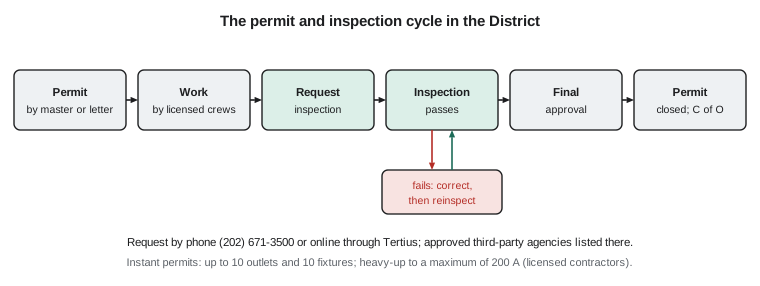
DOB's inspection page gives two ways to request an inspection for work under an electrical permit: by phone at (202) 671-3500, or online through Tertius, DOB's construction inspection marketplace. The request needs the permit number and the address, and it should be made only when the work for that stage is actually ready. Calling an inspector to a job that is not ready wastes everyone's time and can cost a reinspection.
Third-party inspections
The District allows inspections by approved third-party inspection agencies on some work. DOB's inspection page says customers can use Tertius to schedule a third-party inspection and that the list of approved agencies is available there. Third-party agencies are private companies approved by DOB to perform code inspections; the permit holder hires and pays the agency, and the agency reports its results to DOB. The option can speed up large projects with tight schedules, but it does not change the code or the master's responsibility, and DOB keeps the authority to review the agency's work and to inspect itself. A master using a third-party agency should confirm that the agency is approved for electrical inspections of that type and that its reports are filed correctly.
When work fails
An inspector who finds a violation fails the inspection and lists the corrections. The master's job is to fix every item, document the correction with photos where useful, and request a reinspection. Arguing with the inspector on site rarely helps. If the master believes the inspector misread the code, the better course is to ask for the specific code section in writing, and if the disagreement continues, to ask DOB's electrical supervisors for a review. The District's construction codes provide an appeal route for code decisions, and the administrative chapter of 12-A explains it. Lesson 7 covers keeping the record that makes a review possible.
DOB can also issue stop work orders when work proceeds without a permit, by unlicensed persons, or in a dangerous way, and can cite the permit holder or the owner. Work done without a required permit may have to be opened up for inspection or removed. For a master, the lesson is that an unpermitted shortcut on one job can put the license itself at risk.
Final approval and the certificate of occupancy
When the electrical work passes final inspection, the permit can be closed. For new buildings, changes of use and many tenant spaces, the owner also needs a certificate of occupancy, which DOB issues after the required inspections, including electrical, have passed. DOB's inspection page says an inspection is required for final approval of a certificate of occupancy and that applications go through its certificate of occupancy system. The electrician's final inspection is often one of the last items holding up an owner's opening date, which is why Danielle schedules finals as early as the work allows.
Danielle's permit routine
Danielle runs a short checklist before work starts on any job. Is the job within an instant permit's limits, or does it need a full permit? Has the permit been issued, and is it posted on site? If someone other than Vernon applied, is there a fresh, signed letter of authorization in the job file? Does the service work need a Pepco application, and has it been submitted? Which inspections will be needed, and who will call them? She also keeps a log of every inspection: date, stage, inspector, result and corrections, because a clean log answers most questions later.
# Inspection log check for one job (illustrative)
log = [
    ("2026-09-08", "rough-in", "failed", "box fill in unit 2 kitchen"),
    ("2026-09-11", "rough-in", "passed", ""),
    ("2026-10-02", "service", "passed", ""),
    ("2026-10-20", "final", "passed", ""),
]
fails = [e for e in log if e[2] == "failed"]
print(f"Inspections: {len(log)}, failed: {len(fails)}")
for d, stage, result, note in log:
    print(d, stage, result, note)
print("Ready to close permit:", log[-1][1] == "final" and log[-1][2] == "passed")Inspections: 4, failed: 1 2026-09-08 rough-in failed box fill in unit 2 kitchen 2026-09-11 rough-in passed 2026-10-02 service passed 2026-10-20 final passed Ready to close permit: True
Coordinating with Pepco and other trades
A new or upgraded service in the District involves more than DOB. Pepco, the electric utility, requires its own application for new services and service changes, sets requirements for meter locations, service entrance equipment and clearances, and schedules disconnects and reconnects. DOB's approval of the service inspection is usually what allows Pepco to energize. A master planning a heavy-up therefore runs two parallel tracks: the DOB permit and inspection, and the Pepco service request. Missing either one can leave a customer without power for days.
Other trades share the schedule. On a renovation, the building permit holder, usually the general contractor, sequences the work so that electrical rough-in is inspected before insulation and drywall, and the electrical final follows other finishes. Brookland Current's foremen attend the general contractor's coordination meetings and tell the superintendent when each electrical inspection is expected, so that covering work does not start too early.
Documenting what the inspector saw
A photo record of rough-in work, taken just before the inspection, has saved the company more than once. When a dispute came up months later about how a feeder had been run in a wall, the dated photos showed the installation the inspector had approved. The company now photographs every panel, every box with more than a few conductors and every concealed run before cover, and it stores the photos by permit number. The habit costs a few minutes a day and settles arguments that would otherwise depend on memory.
Inspection results also feed the company's training. Every few months Danielle reviews the inspection log for patterns. When two rough-ins failed in the same quarter for box fill, she ran a toolbox talk on Article 314 box fill calculations and added a box fill check to the rough-in checklist. The next quarter's log showed no box fill failures.
Common mistakes
MistakeReusing last month's letter of authorization.
InsteadDOB does not accept prior proxy letters; each permit needs a fresh, dated, signed letter.
MistakeSending the letter of authorization by email.
InsteadDOB does not accept faxes, copies or emails of the letter.
MistakeUsing a heavy-up instant permit for a 400 A service.
InsteadThe heavy-up instant permit is limited to a maximum of 200 amperes.
MistakeThinking a third-party inspection lets the job skip DOB's rules.
InsteadThe agency inspects to the same code, and DOB keeps its authority.
MistakeRequesting an inspection before the work is ready.
InsteadRequest inspections only when the stage is complete, to avoid failures and reinspections.
Summary and key terms
- DOB is the inspection authority for all electrical work in the District.
- Trade permits must be obtained by a District master or an employee with a valid letter of authorization.
- The letter must be typed on letterhead, dated, originally signed and list the address and authorized name.
- General electrical instant permits cover up to 10 outlets and 10 fixtures; heavy-up instant permits go to a maximum of 200 A for licensed contractors.
- Inspections are requested by phone at (202) 671-3500 or online through Tertius, which also lists approved third-party agencies.
- Final approval closes the permit and supports the certificate of occupancy.
- Letter of authorization
- A master's signed letter allowing a named employee to apply for a specific permit.
- Instant permit
- An online permit issued at once for small, defined jobs.
- Heavy-up
- An upgrade of an existing electrical service, limited on the instant permit to 200 amperes.
- Tertius
- DOB's online construction inspection marketplace for scheduling inspections.
- Third-party inspection agency
- A private agency approved by DOB to perform code inspections.
Practice problems
Work each problem on paper first, then reveal the answer to check.
Priya wants to apply for a permit for Vernon. What does she need?
Show answer
A typed letter of authorization on company letterhead, dated, originally signed by Vernon, naming her and the project address, plus a copy of his license and any related building permit.
A customer wants 12 new outlets. Does the general instant permit cover it?
Show answer
No; it covers up to 10 new outlets, so the job needs a different permit path.
What is the maximum service size on the heavy-up instant permit?
Show answer
200 amperes.
How can Danielle request an inspection?
Show answer
By phone at (202) 671-3500 or online through Tertius.
Does a third-party inspection change who is responsible for the work?
Show answer
No; the master remains responsible, and DOB keeps its authority.
Lesson quiz · 5 questions
Score 60% or more to complete this lesson.
Create a free account to save your progress, take quizzes and earn a certificate.