
MELU-326 · Lesson 7 of 12 · 18 min
Duties and responsibilities of the Master Electrician License holder
▶ Video coming soon A video version of this lesson is on the way.
A District master license is more than a higher pay grade. It is the credential that lets a person plan and supervise electrical work, take out permits, support a company's trade contractor license and stand behind the company's work with a personal bond. With those powers come duties, and the Board of Industrial Trades can discipline a master who neglects them. This lesson describes what Vernon does every week as Brookland Current's designated master, what Danielle will take on when she replaces him, and the mistakes that most often bring masters before the Board.
Supervision
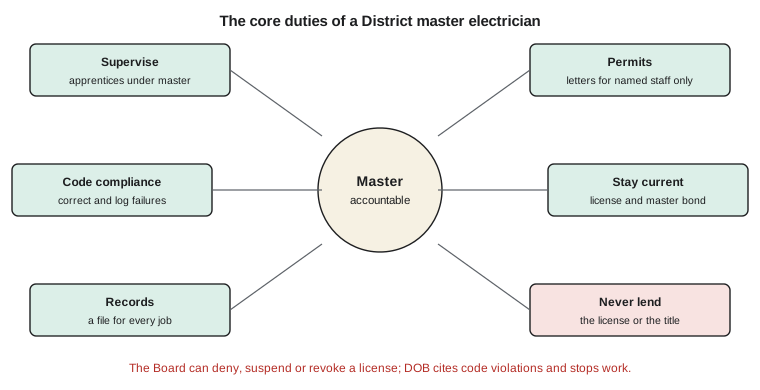
The first duty is supervision. D.C. Code 47-2853.92 says an apprentice electrician may work only under the direct personal supervision and control of a licensed master electrician or licensed master electrician specialist. In practice, a District company meets that rule by organizing crews so that every apprentice works under licensed electricians who are themselves under the master's direction, and by making sure the master actually controls how the work is done: assigning crews, setting methods, checking work and correcting it. A master who is a name on a license but never sees the work is not supervising it.
DLCP's pages reviewed for this course do not publish a numeric apprentice-to-journeyman ratio for electricians, and the course does not state one. A master should check the Board's current rules and any apprenticeship program standards, since a registered apprenticeship program sets its own ratio and supervision rules that the employer agrees to follow. Whatever the rule, the master should be able to show who supervised each apprentice on each job.
Supervision also means keeping work within license classes. A journeyman may perform electrical work but does not hold the master's planning and permit authority. A low voltage master may not supervise work above 49 volts. An unlicensed helper may not perform electrical work that requires a license. If an inspector or the Board finds unlicensed people doing licensed work, the master who supervised the job is the first person asked to explain.
Permits and letters of authorization
The second duty is the permit. Lesson 6 explained that trade permits are obtained by a District master or by an employee carrying a fresh letter of authorization signed by the master. Every letter Vernon signs puts his license behind a specific job at a specific address. He signs them only for named Brookland Current employees, only for jobs on the company's schedule, and only after the estimator has confirmed the scope. The company keeps a copy of each letter in the job file and a running list of letters issued, so that the master can see at a glance every permit open on his license.
That list is also how Vernon catches problems. If DOB shows an open permit on his license for an address he does not recognize, someone has used his license without his knowledge, and he must report it to DOB and DLCP at once. A master who discovers misuse and stays silent shares the risk.
Code compliance and corrections
The third duty is that the work meets the code. The master does not personally install every device, but he or she is responsible for methods, materials and checks that make code compliance the normal result. Vernon's crews use a short checklist at rough-in and before final, he or Danielle walks larger jobs before calling an inspection, and failed inspections are corrected promptly and logged. When the company is wrong, it fixes the work. When the company believes an inspector is wrong, it asks for the code section in writing and, if needed, a supervisory review, rather than covering the work and hoping.
Keeping credentials current
The fourth duty is keeping the paperwork alive. A master's license expires on November 30 of every odd-numbered year and must be renewed on time; a late renewal costs an extra fee, and work done on an expired license is unlicensed work. The master bond, which Lesson 8 covers, must stay in force and expire on the same date as the license. The company's trade contractor license, its basic business license and its corporate good standing must also be current, because a lapse in any of them can stop permits. Priya keeps one calendar for all of these dates, with reminders ninety and thirty days before each.
A master should also keep DLCP's records accurate: a current mailing address and email, the company the master is designated for, and any change in that designation. When Vernon steps back, he and Danielle will update the trade contractor license together so that there is no gap in which the company has no designated master.
Records
The fifth duty is records. The District does not publish a single list of records a master must keep, but a master who is asked by the Board or DOB to explain a job needs evidence. Brookland Current keeps, for every job, the contract or work order, the permit and any letter of authorization, the drawings and changes, the inspection log, photos of rough-in before cover, crew assignments showing who supervised whom, and the final approval. It also keeps payroll records showing that electricians and apprentices are employees, along with their license or registration numbers. Lesson 10 adds the injury and safety records.
Never lend the license
The most serious mistake a master can make is lending the license. Lending means letting another person or company use the master's license to obtain permits or contract for work the master does not actually supervise, often for a monthly payment. It misleads DOB, the owner and the public, and it undermines the whole licensing system. The Board treats it as grounds for discipline, and a master who lends a license may also face liability for the work done under it. The trade contractor rules make the risk concrete: the master's own bond backs the company's work, so a master who lends a license can lose that bond on work he or she never saw.
The same principle covers titles. D.C. Code 47-2853.93 prohibits an unlicensed person from using the words electrician, licensed electrician or master electrician in a way that implies authority to do electrical work in the District. A master who lets an unlicensed company advertise under his or her name is helping it violate that section.
Discipline
The Board of Industrial Trades can deny, suspend or revoke a license, reprimand a licensee, and impose civil penalties under the general provisions of Chapter 28 of Title 47. Typical grounds include fraud or deception in obtaining a license, incompetence or negligence in practice, practicing outside the license's scope, aiding unlicensed practice, and violating the Board's rules or the construction codes. DOB can separately cite code violations and issue stop work orders. Penalty amounts change, and this course does not state them; a master facing a complaint should read the current rules and consider professional advice. The exam is more likely to ask who may discipline and for what than to ask for a dollar figure.
| Situation | The duty involved | Better practice |
|---|---|---|
| An apprentice is working alone on a service change | Supervision | Assign a licensed electrician; document supervision |
| An outside company asks to pull permits on the master's license | Never lend the license | Refuse; the master's license and bond would back work he does not supervise |
| A rough-in fails for box fill | Code compliance | Correct, log and request reinspection |
| The master bond's expiration does not match the license | Keep credentials current | Renew the bond to match November 30 of the odd year |
| DOB shows an unknown permit on the master's license | Permits | Report to DOB and DLCP at once |
Danielle's plan for the handover
Danielle and Vernon have agreed on a handover. For six months after she is licensed, Vernon will remain designated master while Danielle signs letters of authorization only for jobs she runs, so that she builds the habit under his eye. Then the company will change its designated master to Danielle, she will file her master bond, and Vernon will stay on as a licensed master doing estimates and training. The dates after today are plans, and they depend on her passing the exam.
# Open permits on a master's license, checked against the job schedule (illustrative)
schedule = {"1207 Monroe St NE", "4410 12th St NE", "2309 Good Hope Rd SE"}
open_permits_on_license = ["1207 Monroe St NE", "4410 12th St NE", "88 Unknown Ct NW"]
for address in open_permits_on_license:
    status = "ours" if address in schedule else "NOT ON SCHEDULE: report to DOB and DLCP"
print(f"{address}: {status}")1207 Monroe St NE: ours 4410 12th St NE: ours 88 Unknown Ct NW: NOT ON SCHEDULE: report to DOB and DLCP
Supervision in practice
On Brookland Current's jobs, every crew has a licensed lead, and every apprentice is assigned to a named licensed electrician for the day. The assignment sheet, which Priya keeps, shows who worked where and with whom. Vernon or Danielle visits each active job at least weekly and the larger jobs more often, reviews the work against the drawings and the code, and signs the job's checklist. That record is what a master would show the Board if asked how a particular apprentice was supervised.
Supervision also means saying no. When a general contractor asked the company to have an apprentice finish a small job alone over a weekend to save money, Vernon declined and sent a journeyman with the apprentice. The general contractor grumbled, but the alternative was a supervision violation on Vernon's license.
When the master is away
Masters take vacations, get sick and retire. A company with only one master should plan for the master's absence: who will sign letters of authorization, who will make field decisions, and what happens if the master is unavailable for weeks. A company with two masters, as Brookland Current will have when Danielle is licensed and Vernon stays on, has a natural backup. A company with one should at least avoid starting jobs that need the master's decisions while the master is away, and should never let someone else sign the master's name.
Masters also have duties to customers that sit outside the licensing law but matter to the Board when complaints arrive: honest estimates, clear contracts, timely work, and prompt response to problems. Many complaints to licensing boards start as ordinary customer service failures, such as a job left unfinished or a call not returned, that later turn into questions about permits and supervision. A master who answers the phone and finishes the work avoids most of them.
Finally, a master should know where to find the rules. The statute is in Chapter 28 of Title 47 of the D.C. Code, and the Board's regulations are published in the D.C. Municipal Regulations. DLCP's Board page links to both and posts meeting notices. Reading the Board's rules once a year takes an afternoon and prevents surprises.
Common mistakes
MistakeSigning a letter of authorization for anyone who asks.
InsteadSign only for named employees on jobs the master actually supervises.
MistakeAssuming a journeyman may supervise apprentices in the master's place.
InsteadThe statute requires direct personal supervision and control by a licensed master or master specialist; organize crews so the master controls the work.
MistakeLetting the license lapse for a week after November 30.
InsteadWork on an expired license is unlicensed; renew on time.
MistakeKeeping no record of who supervised whom.
InsteadKeep crew assignments and inspection logs for every job.
MistakeThinking only DOB can act against a master.
InsteadThe Board can deny, suspend or revoke a license and impose penalties; DOB enforces the codes.
Summary and key terms
- Apprentices work only under the direct personal supervision and control of a licensed master or master specialist.
- Masters obtain permits or sign fresh letters of authorization only for named employees on supervised jobs.
- Masters are responsible for code compliance, prompt corrections and documented appeals.
- The license, master bond, contractor license and business licenses must all stay current.
- Lending a license or lending the master title is a ground for discipline.
- The Board disciplines licensees; DOB cites code violations and can stop work.
- Direct personal supervision
- Supervision in which the master controls how an apprentice's work is done.
- License lending
- Letting another person or company use a license for work the holder does not supervise.
- Designation
- The record naming a master as the qualifier for a company's trade contractor license.
- Master specialist
- A licensed master in a specialty class, also allowed by statute to supervise apprentices.
- Stop work order
- A DOB order halting work on a job until a violation is resolved.
Practice problems
Work each problem on paper first, then reveal the answer to check.
An apprentice finishes a job alone while the crew lead leaves early. Which duty is at risk?
Show answer
Supervision; the apprentice must work under direct personal supervision and control.
A friend's company offers Vernon a monthly fee to list him as its master without supervising any work. What is this?
Show answer
License lending, a ground for discipline.
Who can suspend Danielle's license?
Show answer
The Board of Industrial Trades.
Why should the master bond expire on the same date as the license?
Show answer
DLCP requires bond expiration dates to match the license expiration dates.
What should a master do on finding an unknown permit on his license?
Show answer
Report it to DOB and DLCP right away.
Lesson quiz · 5 questions
Score 60% or more to complete this lesson.
Create a free account to save your progress, take quizzes and earn a certificate.