
MELU-324 · Lesson 9 of 12 · 19 min
Contracts and construction liens in Wisconsin
▶ Video coming soon A video version of this lesson is on the way.
In the fall of 2025, Red Cedar finished the wiring on a new lake home near Chetek for a builder who then stopped returning calls. The homeowners had paid the builder in full. The builder had not paid Red Cedar the last 18,000 dollars. Beth had served the lien notice to the owners within the first few weeks of the job, as she always did on houses, and that one sheet of paper turned out to be the reason Red Cedar was paid at all. "If I'd skipped it," she told Carla, "we would have been a creditor of a builder with no money." Carla had seen Beth's notices go out for years without thinking about them. Now she wanted to understand them.
This lesson covers the contracts an electrical contractor signs, the parts of a contract that matter most, change orders, Wisconsin's construction lien law in chapter 779 of the Statutes, the notice steps and deadlines for residential and commercial work, how a lien is enforced, and the protections that apply on public projects where liens are not available. Lien law is technical and deadlines are strict, so this lesson summarizes the framework; a construction lawyer should handle any real claim.
The contract comes first
Most payment disputes are settled by the contract, not by the lien law, so a master who will run a company should read contracts as carefully as code books. The core terms are the scope of work, the price or the method of pricing, the schedule, how changes are handled, how and when payment is made, retainage, warranty, insurance and indemnity, and how disputes are resolved. On a subcontract, the general contractor's form often includes pay-if-paid or pay-when-paid language, flow-down clauses that pass the owner's terms to the subcontractor, and notice requirements for claims. Each of those can decide whether and when a subcontractor gets paid.
Change orders deserve their own rule. Any change to the scope, price or schedule should be written and signed before the work is done, or as soon as possible after an emergency change. Unwritten changes are the most common source of disputes in electrical contracting, because the customer remembers the request differently from the crew, and because a lien claim or a lawsuit is much stronger when every dollar claimed matches a signed document. Red Cedar's crews carry a change order pad in every van.
| Contract term | Why it matters to an electrical contractor |
|---|---|
| Scope and drawings | Defines what is included and what is extra |
| Payment and retainage | Sets when money arrives and how much is held back |
| Change orders | Controls how extra work is priced and approved |
| Pay-if-paid or pay-when-paid | May tie the subcontractor's payment to the owner paying the prime |
| Insurance and indemnity | Sets required coverage and who bears certain losses |
| Dispute resolution | Sets mediation, arbitration or court, and notice deadlines for claims |
What a construction lien does
A construction lien gives a contractor, subcontractor or supplier who improves real property a claim against that property for unpaid work and materials. If the debt is not paid, the lien can be enforced in court, and the property can be sold to satisfy it. Wisconsin's lien law is in chapter 779. Its strength is that it follows the property, so it can protect a subcontractor even when the party that hired it cannot pay. Its weakness is that it depends on strict notices and deadlines; a claimant who misses one may lose the lien entirely.
Residential notice
On residential projects, Wisconsin requires early notice to the owner so that owners know who might claim a lien. As summarized by lien services and trade sources, a prime contractor that contracts directly with the owner must include the statutory notice in its written contract or serve it within 10 days after first furnishing labor or materials. Subcontractors and suppliers who do not contract with the owner must serve their own notice on the owner within 60 days after first furnishing. A notice served late may still protect work furnished after it is served, but not work furnished before it. The wording of the notices is set in the statute, and the safest practice is to use it exactly.
Beth's practice on every house is to send the notice in the first week, by a method that proves delivery, and to keep a copy with the proof in the job file. It costs a stamp and five minutes. For the Chetek house, the notice let Red Cedar claim a lien against the owners' property even though the owners had paid the builder, which is exactly the situation the notice warns owners about. The owners had the option of protecting themselves by paying subcontractors directly or getting lien waivers; they did not, and the lien law put the risk on them.
Commercial projects
On commercial projects, the preliminary notice rules are different. Lien summaries describe a commercial exception under which the early notice generally is not required for certain commercial work, but the exception has conditions, and some claimants still serve notice to be safe. A contractor working on commercial jobs should have a lawyer confirm how the rules apply to its typical projects and should not rely on a general description when a large amount is at stake.
Intent to file, the claim and the suit
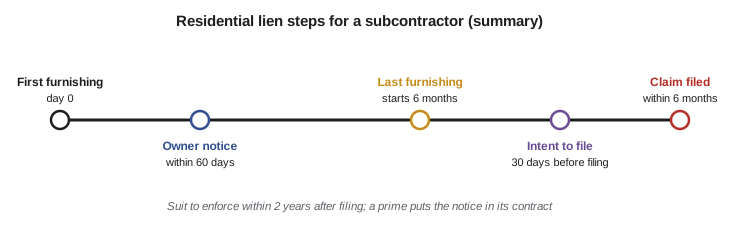
Whatever the project type, the steps that follow are similar. Before filing a lien claim, the claimant must serve a notice of intent to file a lien claim on the owner at least 30 days before filing. The lien claim itself must be filed with the clerk of circuit court in the county where the property is located within six months after the claimant last furnished labor or materials. To enforce the lien, the claimant must start a lawsuit within two years after filing the claim. Each deadline is counted from a specific event, and missing any of them can end the lien.
# Lien deadlines for a subcontractor on a house (simplified study aid; confirm with chapter 779 and a lawyer)
from datetime import date, timedelta
def add_months(d, months):
    m = d.month - 1 + months
    y = d.year + m // 12
    m = m - (m // 12) * 12 + 1
    return date(y, m, min(d.day, 28))
first = date(2025, 6, 9)
last = date(2025, 9, 26)
notice_by = first + timedelta(days=60)
claim_by = add_months(last, 6)
intent_by = claim_by - timedelta(days=30)
suit_by = add_months(claim_by, 24)
print("first furnished:", first, " owner notice by:", notice_by)
print("last furnished:", last, " claim filed by about:", claim_by)
print("intent to file served by about:", intent_by)
print("suit started by about (if filed on the last day):", suit_by)first furnished: 2025-06-09 owner notice by: 2025-08-08 last furnished: 2025-09-26 claim filed by about: 2026-03-26 intent to file served by about: 2026-02-24 suit started by about (if filed on the last day): 2028-03-26
The dates in the output are approximate, because the study aid rounds the day of the month and counts months simply. A real claim should count each deadline from the exact event under the statute, with time to spare. The useful lesson is the order: the owner notice early in the job, the intent notice at least 30 days before filing, the claim within six months of last furnishing, and the suit within two years after the claim.
Lien waivers and payment
Owners and general contractors often ask for lien waivers in exchange for payment. A waiver releases lien rights for the amount paid, or sometimes for all work through a date. A contractor should sign a waiver only for money actually received, and should read whether it is conditional on payment clearing or unconditional. Signing an unconditional waiver for a check that later bounces can give away the lien right for that money. Beth's rule is conditional waivers until the money clears, and unconditional waivers only for amounts in the bank.
Public projects
A lien cannot be placed on public property such as a school, a state building or a municipal facility. For public work, subcontractors and suppliers rely instead on the payment bond the prime contractor provides and, in some cases, on a claim against funds the public body still holds. These remedies have their own notice and filing deadlines, generally shorter and stricter than private liens, and they depend on the type of public owner and the bond terms. A contractor working on public projects should learn the steps for each one from the bond documents and a lawyer at the start of the job, not after a payment is missed.
Worked problem
Protecting a payment on a house
Red Cedar is a subcontractor wiring a new house for a builder. Work starts on May 1 and the last work is August 15. The builder has not paid the final invoice by October. What should Beth have done and what should she do now?
Show solution
- Within 60 days of May 1, she should have served the statutory notice on the owners, which she did on May 6.
- Now she should serve a notice of intent to file a lien claim on the owners at least 30 days before filing.
- She should file the claim within six months after August 15, so by mid-February.
- If the claim is not paid, Red Cedar must start a suit within two years after filing to enforce the lien.
Answer: Owner notice early in the job, then the intent notice, the claim within six months of last furnishing and a suit within two years.
Keeping the paperwork
Every lien right depends on proof. Beth's job file for each project holds the contract or purchase order, the date of first furnishing, a copy of the owner notice with proof of delivery, every change order, every invoice and payment, every lien waiver signed, and the date of last furnishing with something that shows it, such as a delivery slip or a daily report. When a payment goes wrong, a lawyer can work from that file in an afternoon. Without it, the lawyer has to rebuild the job from memory and phone calls, and a lien claim built that way is easier to challenge. The Chetek claim was settled within a month because every date in it was documented.
Liens on the exam
Exam questions on liens usually test the deadlines and who must give which notice. Know the difference between the prime's notice in the contract or within 10 days and a subcontractor's notice within 60 days, the 30-day intent notice, the six-month claim deadline and the two-year suit deadline, and the fact that liens are not available on public projects. Put the timeline on a punched page in the binder if the permitted list allows it.
Common mistakes
MistakeWaiting to see if the builder pays before sending the owner notice.
InsteadServe the residential notice early; a late notice does not protect earlier work.
MistakeFiling a lien claim without the intent notice.
InsteadServe a notice of intent at least 30 days before filing.
MistakeCounting the six months from the invoice date.
InsteadThe claim deadline runs from the last date labor or materials were furnished.
MistakeTrying to lien a public school.
InsteadLiens are not available on public property; use the payment bond and related remedies.
Summary and key terms
- Most payment disputes are decided by the contract, so read scope, payment, changes, retainage and claim notice terms carefully.
- On residential work, a prime puts the lien notice in its contract or serves it within 10 days; subcontractors and suppliers serve it within 60 days of first furnishing.
- A notice of intent must be served at least 30 days before filing a lien claim.
- The claim is filed within six months after last furnishing, and a suit to enforce must start within two years after filing.
- Liens are not available on public projects, where payment bonds and claims against held funds take their place.
- Construction lien
- A claim against improved property for unpaid labor or materials, under chapter 779.
- Owner notice
- The early written statement to a residential owner that lien rights may arise.
- Intent to file
- The written statement served at least 30 days before a lien claim is filed.
- Lien waiver
- A document releasing lien rights, usually in exchange for payment.
- Change order
- A signed agreement changing a contract's scope, price or schedule.
Practice problems
Work each problem on paper first, then reveal the answer to check.
A subcontractor first furnished on April 2 on a house. By when must it serve the owner notice?
Show answer
Within 60 days, so by about June 1.
How long before filing must the intent notice be served?
Show answer
At least 30 days.
From what event does the six-month claim deadline run?
Show answer
The last date the claimant furnished labor or materials.
Can a subcontractor file a lien on a county highway garage?
Show answer
No. Liens are not available on public property; use the payment bond.
Lesson quiz · 5 questions
Score 60% or more to complete this lesson.
Create a free account to save your progress, take quizzes and earn a certificate.