
MELU-324 · Lesson 10 of 12 · 19 min
Workplace safety law and OSHA for electrical contractors
▶ Video coming soon A video version of this lesson is on the way.
Josh Vang was in his second year at Red Cedar, a registered electrician working toward his apprenticeship, when he put a screwdriver into a panel at a feed mill in Bloomer that everyone on the crew believed was dead. It was not. The arc flash lasted a fraction of a second, burned his sleeve and singed his eyebrows, and left him shaking in the parking lot. He was lucky. The crew had shut off the wrong disconnect, nobody had tested the panel before work, and nobody had applied a lock. Gene shut down every job that afternoon for a safety meeting. "I've been doing this for thirty-five years," he said, "and the only thing that's ever kept me alive is testing before touching." Carla ran the meeting the next week, because Gene wanted the company's next master to own it.
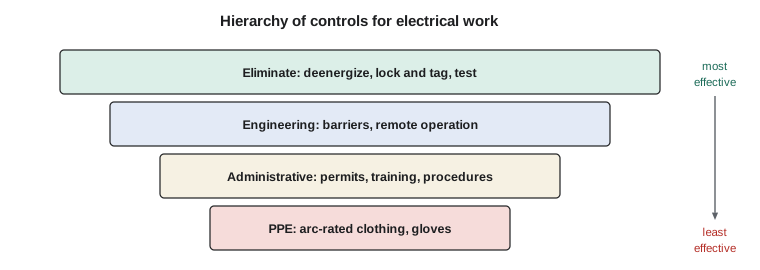
This lesson covers how workplace safety law applies to Wisconsin electrical contractors: federal OSHA's jurisdiction over private employers, the construction and general industry standards that matter for electrical work, the consensus standard for electrical safety in the workplace, establishing an electrically safe work condition, the hierarchy of controls, training and safety programs, injury records and reporting, incident rates and the master's role in all of it.
Who enforces safety law
The Occupational Safety and Health Act of 1970 is federal law. States may run their own OSHA-approved plans, but Wisconsin does not have one for private employers, so private electrical contractors in Wisconsin are covered directly by federal OSHA and inspected by its area offices in the state. Public employers, such as cities, counties, school districts and the state itself, are handled under a separate state program for public employee safety. For a private contractor like Red Cedar, the rules are the federal standards, the inspectors are federal compliance officers, and the penalties are federal.
OSHA inspections happen for several reasons: a reported death or serious injury, a complaint from an employee, a referral from another agency, a targeted program aimed at high-hazard work, or a compliance officer who sees an obvious hazard from the road. Construction sites with open trenches, fall exposures and electrical work draw attention. An inspection can lead to citations with penalties, and a contractor can contest them within a short deadline. A master who runs a company should know how to handle an inspection: be courteous, ask for the reason and the scope, accompany the officer, take the same photos and notes, and talk to a lawyer before agreeing to anything significant.
The standards that matter
Two sets of OSHA standards cover most of an electrical contractor's work. The construction standards in 29 CFR Part 1926 apply on construction sites, and Subpart K covers electrical safety in construction, including ground-fault protection for temporary power, safe work practices, and lockout and tagging of circuits. The general industry standards in 29 CFR Part 1910 apply to maintenance and service work in existing facilities, and Subpart S covers electrical safety there. Other parts that matter include fall protection, ladders and scaffolds, excavation, personal protective equipment and hazard communication.
NFPA 70E is a consensus standard rather than a regulation, but OSHA uses it as evidence of what a reasonable employer does to protect workers from electrical hazards. It covers establishing an electrically safe work condition, risk assessment for shock and arc flash, approach boundaries, energized work permits, arc-rated clothing and other protective equipment, and training. Many general contractors and facility owners write NFPA 70E compliance into their contracts. Red Cedar's safety program follows it.
| Rule or standard | Where it applies | Main electrical topics |
|---|---|---|
| 29 CFR 1926 Subpart K | Construction sites | Temporary power, ground-fault protection, safe work practices, lockout |
| 29 CFR 1910 Subpart S | Existing workplaces and maintenance | Safe work practices, qualified persons, protective equipment |
| NFPA 70E | Referenced by OSHA and contracts | Electrically safe work condition, risk assessment, arc flash |
| Other OSHA parts | All sites | Falls, ladders, excavation, hazard communication |
The electrically safe work condition
The most important idea in electrical safety is that the safest way to work on a circuit is with it deenergized and verified. Establishing an electrically safe work condition means identifying every source of supply, opening the disconnecting means, verifying the disconnect is open where possible, applying lockout and tagout devices, testing each conductor for absence of voltage with a properly rated tester that has been checked on a known source, and grounding where stored or induced energy is a possibility. Only then is the equipment considered safe to work on. The feed mill near-miss skipped three of those steps.
Energized work is permitted only in limited cases, such as when deenergizing would create a greater hazard or when the task, like some troubleshooting, cannot be done without voltage present. In those cases NFPA 70E calls for a written justification and an energized work permit, a risk assessment, the right protective equipment and qualified workers. Convenience and schedule are not reasons to work energized. Red Cedar's policy, which Carla wrote after the incident, says that no one works on energized equipment above 50 volts without an approved permit signed by a master.
Training, programs and qualified persons
OSHA requires that only qualified persons work on or near exposed energized parts. A qualified person has been trained to recognize and avoid the electrical hazards of the specific equipment and task, knows the approach distances, and can use the protective equipment and test instruments properly. Being licensed as an electrician is not the same as being qualified for every task; a journeyman who has never worked on medium-voltage switchgear is not qualified for it until trained. Training must be documented and repeated when work practices change or an employee's performance shows a gap.
A written safety program ties these pieces together: hazard assessment for each job, a lockout procedure, an energized work permit process, protective equipment rules, temporary power and ground-fault protection, fall protection, a training schedule and a way to report and investigate incidents and near misses. A small company can keep it short, but it should be real, used and updated. After the feed mill, Red Cedar added a ten-minute safety talk to every Monday crew meeting and a near-miss report that anyone can fill out without blame.
Records, reporting and rates
Employers with more than ten employees at any time in the year generally must keep OSHA injury and illness records: the log of work-related injuries and illnesses, the incident report for each case and the annual summary, which is posted from February through April. Construction is not among the industries that are partly exempt. Separately, every employer must report a work-related death to OSHA within 8 hours and an inpatient hospitalization, amputation or loss of an eye within 24 hours.
Owners and general contractors often compare contractors by their incident rate. The total recordable incident rate is the number of recordable cases times 200,000, divided by the hours worked by all employees. The 200,000 stands for 100 full-time workers working 40 hours a week for 50 weeks, so the rate is the number of cases per 100 full-time workers. A related measure, the experience modification rate used in workers' compensation pricing, compares a company's claims to what is expected for its size and trade.
# Total recordable incident rate (TRIR) for a year (illustrative numbers)
recordable_cases = 2
hours_worked = 29400        # 14 employees, about 2,100 hours each
trir = recordable_cases * 200000 / hours_worked
print("TRIR:", round(trir, 2), "recordable cases per 100 full-time workers")
target = 3.0
print("below the customer's target of", target, ":", trir < target)TRIR: 13.61 recordable cases per 100 full-time workers below the customer's target of 3.0 : False
With two recordable cases and about 29,400 hours, the rate is about 13.6, far above the illustrative target in the output. That number would keep a company off many bid lists, which is how a single bad year can cost a contractor work for three. The rate also shows why near-miss reporting matters: the feed mill incident was not recordable because Josh was not treated beyond first aid, but it showed exactly how a recordable case would have happened.
Worked problem
After an injury
A Red Cedar apprentice falls from a ladder at a job in Menomonie and is admitted to the hospital overnight with a broken wrist. What must the company do under OSHA's rules?
Show solution
- An inpatient hospitalization must be reported to OSHA within 24 hours of learning of it.
- The case must be entered on the injury and illness log, because the company has more than ten employees.
- The workers' compensation insurer must be notified under the company's policy and Wisconsin's rules.
- The company should investigate the cause and fix it, such as ladder setup or training.
Answer: Report the hospitalization within 24 hours, record the case, notify the insurer and correct the cause.
Temporary power and common site hazards
Much of the electrical risk on a construction site comes from temporary power. OSHA's construction rules require ground-fault protection for receptacles that workers use for tools on construction sites, either through ground-fault circuit interrupters or through an assured equipment grounding conductor program where the rules allow it. Cords need to be rated for hard use, inspected before each shift and kept out of water and traffic. Damaged cords and tools are removed from service. These rules apply to every trade on the site, but electrical contractors usually install the temporary power and are expected to get it right.
Other common hazards for electricians include falls from ladders and lifts, contact with overhead power lines when moving equipment or materials, work in trenches for underground conduit, and confined spaces in vaults and tanks. Each has its own OSHA rules and training. A site-specific hazard assessment at the start of each job, even a short one, catches most of them. Carla added a one-page assessment to Red Cedar's job start packet after the feed mill incident, and the crew lead signs it on the first day.
OSHA also offers help that is not enforcement. Its on-site consultation program, run in Wisconsin through a state partner, gives small businesses a free, confidential review of their hazards and programs, and its findings are not passed to enforcement staff when the business fixes what it finds. Red Cedar used the program in 2024 and came away with a list of six fixes, none expensive.
The master's role in safety
A master electrician who is responsible for a company's work is, in practice, the person crews look to on safety. The master sets the expectation that circuits are tested before they are touched, that energized work needs a permit, that temporary power has ground-fault protection and that ladders and lifts are used properly. Inspectors and courts look at what the company actually did, not what its manual says. Carla's first act as the company's next master was to make the safety meeting hers, and her second was to buy every crew a new voltage tester with a proving unit.
Common mistakes
MistakeAssuming Wisconsin has a state OSHA plan for private employers.
InsteadPrivate employers in Wisconsin are covered by federal OSHA.
MistakeTreating a licensed electrician as qualified for every task.
InsteadQualification is task-specific and needs documented training.
MistakeTesting for absence of voltage without checking the tester.
InsteadVerify the tester on a known source before and after the test.
MistakeReporting a hospitalization at the end of the week.
InsteadReport inpatient hospitalizations within 24 hours and deaths within 8 hours.
Summary and key terms
- Federal OSHA covers private employers in Wisconsin; public employers fall under a separate state program.
- 29 CFR 1926 Subpart K covers construction electrical work, 1910 Subpart S covers existing workplaces, and NFPA 70E sets out safe electrical work practices.
- An electrically safe work condition means disconnect, lock and tag, test for absence of voltage and ground where needed; energized work needs justification and a permit.
- Employers with more than ten employees generally keep OSHA injury records; deaths are reported within 8 hours and hospitalizations within 24.
- The total recordable incident rate is cases times 200,000 divided by hours worked.
- OSHA
- The federal Occupational Safety and Health Administration, which enforces workplace safety for private employers in Wisconsin.
- Subpart K
- The OSHA construction standards for electrical safety in 29 CFR Part 1926.
- NFPA 70E
- The consensus standard for electrical safety in the workplace.
- Electrically safe work condition
- A state in which equipment is disconnected, locked, tested and grounded as needed.
- TRIR
- Total recordable incident rate: recordable cases per 100 full-time workers per year.
Practice problems
Work each problem on paper first, then reveal the answer to check.
Who enforces workplace safety for a private electrical contractor in Eau Claire?
Show answer
Federal OSHA.
Within how many hours must a work-related death be reported?
Show answer
8 hours.
A company had 3 recordable cases and 60,000 hours. What is the TRIR?
Show answer
3 times 200,000 divided by 60,000, which is 10.
Name the steps of an electrically safe work condition.
Show answer
Identify sources, open the disconnect, lock and tag, test for absence of voltage, ground if needed.
Lesson quiz · 5 questions
Score 60% or more to complete this lesson.
Create a free account to save your progress, take quizzes and earn a certificate.