
MELU-324 · Lesson 6 of 12 · 19 min
Permits, inspections and the inspection authority
▶ Video coming soon A video version of this lesson is on the way.
Tom Kessler had inspected electrical work for the City of Eau Claire for eleven years, and Red Cedar's crews knew his habits well: he arrived early, read the permit before he looked at a single box, and asked the person on site who the responsible master was. On a rough-in at a new dental office downtown, he found the permit, the plans and the work in order, but a junction box above the reception desk had already been closed in by the drywall crew a day early. "Open it up, call me, and I'll be back Thursday," he said. Carla, who was running the job, made the call to the drywall foreman herself. It cost a day and a patch, and it was a small example of why the permit and inspection sequence matters.
This lesson explains who issues electrical permits and inspects work in Wisconsin, how the department's delegation to local agents works, how the Uniform Dwelling Code program handles one- and two-family homes, the permit process from application to final inspection, what an inspector checks, and how the electrical contractor and the responsible master fit into it. The process differs from place to place, so the lesson covers the framework and the questions to ask.
State and delegated inspection
Wisconsin's electrical inspection system has two levels. The department has authority over electrical plan review and inspection statewide. It can delegate that authority for commercial buildings to municipalities, counties and other agencies that ask for it and meet the department's standards, and it publishes a list of the delegated agents. Where a place has taken delegation, the local agency issues commercial electrical permits, reviews plans where required and inspects the work. Where it has not, the department or its contracted inspectors do. A delegated agency may employ its own inspectors or contract with an inspection agency, but it stays responsible for the program, and an agency that wants to give up delegation must give the department advance notice, which its page describes as 60 days.
One- and two-family dwellings follow a separate track. The Uniform Dwelling Code is the state's building code for those homes, and it includes electrical permitting and inspection through local inspection agencies. Many municipalities enforce the code themselves; others rely on the county or a contracted inspection agency, and the department lists which agencies cover each place. Inspectors on both tracks hold department credentials, such as the Commercial Electrical Inspector and UDC Electrical Inspector certifications.
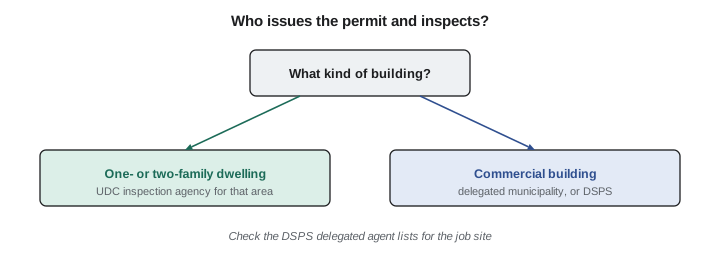
For Red Cedar, the practical result is a short list of offices. The City of Eau Claire handles both commercial and dwelling electrical permits inside the city. Some of the surrounding towns and villages use the county or a contracted agency for dwellings, and the commercial work in a few of them goes to the department. Beth keeps a one-page list of every municipality the company works in with the permit office, phone number and any local habits, and updates it when a place changes. That page is worth more than any amount of memory, because jurisdictions do change.
Getting the permit
A permit application identifies the property, the owner, the scope of work and the electrical contractor and responsible master. For commercial work, the department and many delegated agents use eSLA, the department's online system for permits and plan review, while some local offices use their own forms or portals. Larger commercial projects may need electrical plan review before the permit issues, depending on the size and type of work and the rules for that program. The application shows the contractor's credential number, and the permit office may check that the contractor and master are current.
The department's pages for the electrical contractor and the Registered Master Electrician repeat an important rule: work that requires a permit may not begin until the permit has been issued. That includes rough-in and service work. Starting early is not a paperwork problem. It can lead to orders to stop, fees, a requirement to expose concealed work and complaints against the contractor and master. Red Cedar's rule is simple: no permit number on the work order, no van leaves the shop.
| Step | Who acts | What to watch |
|---|---|---|
| Determine jurisdiction | Contractor | Check the delegated agent and UDC agency lists |
| Apply and submit plans if required | Contractor and designer | Credential numbers, scope and plan review |
| Permit issued | Permit office | No permitted work before issue |
| Rough-in inspection | Inspector | Before work is concealed |
| Service or other inspections | Inspector | As the program requires |
| Final inspection | Inspector | Before occupancy or energizing as required |
Inspections
The number and timing of inspections depend on the program and the job. A typical sequence includes an underground or slab inspection where conduit is buried, a rough-in inspection before walls and ceilings are closed, a service inspection where a utility needs approval before connecting, and a final inspection when the work is complete. The rule that matters most in the field is that work must not be concealed before the inspector has seen it. When concealment happens anyway, the inspector can require the work to be opened, as Tom did at the dental office.
The contractor requests each inspection by the method the permit office uses, usually online or by phone, and gives enough notice for the office's schedule. The inspector checks the work against the code edition that applies to the job, looks at the permit and plans, and may ask who the responsible master is. A correction notice lists what needs to change. The contractor makes the corrections and requests a reinspection, which may carry a fee. When all inspections are approved, the permit is closed.
# Tracking inspections on a permit (simplified study aid)
inspections = [
    ("underground", "approved"),
    ("rough-in", "corrections"),
    ("rough-in recheck", "approved"),
    ("service", "approved"),
    ("final", "pending"),
]
open_items = [name for name, status in inspections if status != "approved"]
for name, status in inspections:
    print(name.ljust(18), status)
print("open items:", ", ".join(open_items) if open_items else "none")
print("ready to close permit:", not open_items)underground approved rough-in corrections rough-in recheck approved service approved final pending open items: rough-in, final ready to close permit: False
The log is trivial in code, but the habit behind it is what keeps permits from lingering. A rough-in that needed corrections is not done until the recheck is approved. A final that is still pending means the permit is still open, and an open permit can follow a contractor for years, showing up when the owner sells the building or when the contractor applies for a permit elsewhere. Beth reviews Red Cedar's open permits every month.
Worked problem
Who has jurisdiction?
Red Cedar has three new jobs: a house in the City of Eau Claire, a machine shed on a farm in a town that has not taken commercial delegation, and a retail fit-out in a village that has. Where should Beth look and whom should she call for each?
Show solution
- The house is a one-family dwelling, so it falls under the UDC program; the city's inspection office handles it.
- The machine shed is not a dwelling; with no local delegation, the commercial electrical permit goes through the department.
- The retail fit-out is commercial in a delegated village, so the village's agent handles the permit and inspection.
- For each, confirm on the department's current lists, because delegation can change.
Answer: City for the house, the department for the shed, the village's delegated agent for the fit-out, each confirmed on the current lists.
The inspector and the master
An inspector's job is to confirm that the work meets the code; the master's job is to make sure it does in the first place. Good inspectors explain their findings, cite the section and answer questions. Good masters prepare for inspections: the permit posted, the plans on site, the work ready and visible, and someone present who knows the job. When the two disagree, the master asks for the section the inspector is relying on and, if the disagreement continues, can seek an interpretation from the department's code consultants. Arguing in front of the customer helps nobody.
Carla's notes from her years with Tom Kessler were practical. He wanted labels on panels before final, not after. He wanted the service grounding visible at rough-in. He did not want to find boxes buried behind drywall. None of those preferences was a new rule; each was a habit of checking what the code already requires. Learning an inspector's habits is part of learning a jurisdiction.
Fees, posting and closing out
Permit fees are set by the issuing office, whether that is the department or a local agent, and they usually depend on the size and type of work. A contractor builds permit fees into the estimate and should not be surprised by them. Many offices require the permit, or a card showing it, to be posted or available at the job site. At the end of the job, the final inspection closes the permit, and some programs issue a certificate or record that the owner keeps. A permit that never gets its final is not closed, however finished the work looks.
Owners sometimes ask a contractor to skip the permit to save money or time. The answer is no, for reasons that go beyond the rules. Unpermitted work can be ordered opened or removed, can complicate the sale of a building and can give an insurer a reason to dispute a claim after a fire. The contractor and the responsible master carry the risk as well, because pulling permits is part of their legal duty. Carla's line, borrowed from Gene, was that the permit is part of the job, not an extra.
Utilities and the service
Many service jobs involve the electric utility as well as the inspector. Utilities set their own requirements for meter locations, service entrance equipment and clearances, and they usually will not energize a new or upgraded service until the inspection authority has approved it. Some rural cooperatives in Red Cedar's area want to see a released inspection before they schedule a connection. A master who plans the service early with both the utility and the inspector avoids the common delay of a finished service that nobody will energize.
Red Cedar's crews also learned to read the permit card itself. It names the job address, the scope, the contractor and the responsible master, and any conditions the office attached, such as a required plan review or a utility release. When the work on site grows beyond the scope on the card, the permit needs to be revised before the extra work is done, not explained at the final inspection.
Permits and the exam
Exam questions on permits and inspection test the framework, not the habits of any particular office. Expect questions on who has jurisdiction for dwellings and commercial buildings, when work may begin, what happens when work is concealed before inspection, what credentials inspectors hold and the difference between a license and a permit. The answers live in the department's rules and in the administrative code chapters on buildings, and the binder should hold the sections that apply.
Common mistakes
MistakeStarting rough-in because the permit is approved in principle.
InsteadPermitted work may not begin until the permit is actually issued.
MistakeAssuming every place has a local electrical inspector.
InsteadCheck the delegated agent and UDC agency lists; the department may have jurisdiction.
MistakeClosing walls before the rough-in inspection.
InsteadWork must not be concealed before inspection; the inspector can require it to be opened.
MistakeTreating a state license as permission to skip a local permit.
InsteadA license is about who may do the work; a permit is about each job.
Summary and key terms
- The department may delegate commercial electrical permitting and inspection to local agents and lists them; elsewhere the department inspects.
- One- and two-family dwellings follow the Uniform Dwelling Code program through local inspection agencies.
- Permitted work may not begin until the permit is issued, and many commercial permits use the department's eSLA system.
- Inspections typically include underground, rough-in, service and final, with no concealment before inspection.
- Inspectors hold department credentials, and disagreements can go to the department's code consultants.
- Delegated agent
- A municipality, county or agency that has taken on commercial electrical permitting and inspection from the department.
- Uniform Dwelling Code
- Wisconsin's building code for one- and two-family dwellings, including electrical inspection.
- eSLA
- The department's online system for permits and plan review.
- Rough-in inspection
- The inspection of wiring before walls and ceilings are closed.
- Correction notice
- An inspector's list of items that must be fixed before approval.
Practice problems
Work each problem on paper first, then reveal the answer to check.
Who inspects commercial electrical work in a town without delegation?
Show answer
The department or its contracted inspectors.
Which code program covers electrical inspection of a new duplex?
Show answer
The Uniform Dwelling Code program.
May a crew start a service upgrade while the permit is pending?
Show answer
No. Permitted work may not begin until the permit is issued.
What must happen if a box is concealed before rough-in inspection?
Show answer
The inspector can require it to be opened for inspection.
Lesson quiz · 5 questions
Score 60% or more to complete this lesson.
Create a free account to save your progress, take quizzes and earn a certificate.