
MELU-324 · Lesson 11 of 12 · 19 min
Renewal and continuing education
▶ Video coming soon A video version of this lesson is on the way.
Every spring of a renewal year, Beth Olson printed a list of Red Cedar's credentials and taped it to the wall beside the coffee maker: the electrical contractor credential, Gene's master license, the journeymen, the registered electricians and the apprentices, each with its expiration date and the continuing education hours each person had on record. Names came off the list as people renewed. "It is embarrassing to put it on the wall," she told Carla, "and that's the point." Gene once let his own hours slip to the last month and spent two weekends in a hotel conference room in Wausau catching up. He never did it again.
This lesson covers the term of Wisconsin trade credentials, the continuing education requirement for the master electrician license, how hours are reported, what courses count, the renewal process in LicensE, what happens when renewal or continuing education is late, reinstatement, and the habits that keep a company's credentials current. The amounts and rules are summarized as of late 2026.
The four-year term
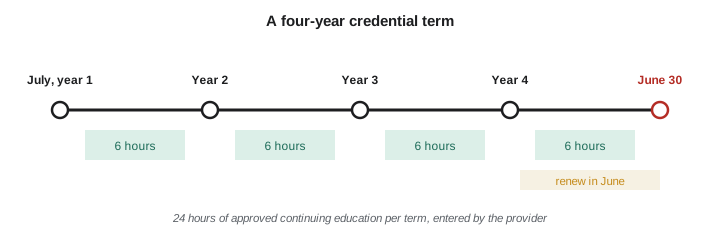
Wisconsin trade credentials, including the master electrician license and the electrical contractor credential, generally run on four-year terms that end on June 30 of the renewal year. A newly issued credential runs until the next June 30 in the cycle that applies to it, which is why a first-term credential fee is prorated. The department's page explains that renewal becomes available in LicensE about four weeks before the expiration date. The Registered Master Electrician is an exception: the department's page says that registration does not expire.
A credential that is not renewed by its expiration date expires, and the holder may not do the work the credential covers until it is renewed or reinstated. For a master who is responsible for a contractor, an expired license can stop the company's electrical work as well. That alone is reason enough to treat the June 30 date as fixed and to renew early in the window rather than on the last day.
The continuing education requirement
The department's master electrician page states that 24 hours of approved continuing education are required to renew. The hours must be completed during the credential term and come from courses the department has approved for the credential. SPS 305 sets the details, including which topics count and any limits on how hours may be earned, and it may require some hours on the code or on particular subjects. Approved courses come from trade associations, technical colleges, apprenticeship programs, manufacturers and private training companies, and are offered in classrooms and online.
Twenty-four hours over four years is about six hours a year, which is one Saturday class or a few evening sessions. Spread out, the requirement is easy. Saved for the last spring, it can mean the hotel conference room Gene remembers. Carla's plan was to take a code update course in her first year, because the 2023 code was new, and to add a few hours each year on topics Red Cedar worked on, such as energy storage, motor controls and grounding for agricultural buildings.
| Item | Master electrician, in summary |
|---|---|
| Term | Four years, ending June 30 |
| Continuing education | 24 hours of approved courses per term |
| Reporting | Approved providers enter completed hours with the department |
| Renewal window | Opens in LicensE about four weeks before expiration |
| Late hours | A late continuing education fee may apply |
| Long lapse | A license expired for more than four years follows the reinstatement path |
How hours are reported
Under the department's process, the approved course provider reports completed hours to the department, and they appear on the credential holder's record. The holder does not mail certificates in, but should still keep them, because providers occasionally report late or report the wrong credential number. A candidate who finishes a course in May of a renewal year should check the record before renewing and call the provider if the hours are missing. Courses that are not approved for the credential do not count, however useful they are, so check the approval before paying for a course.
# Tracking continuing education hours across a term (illustrative records)
REQUIRED = 24
courses = [
    ("2027-10", "2023 NEC changes, part 1", 8),
    ("2028-03", "Grounding and bonding for agricultural buildings", 4),
    ("2029-11", "Energy storage systems", 4),
    ("2030-04", "Motor controls and VFDs", 6),
]
total = 0
for when, title, hours in courses:
    total += hours
    print(when, title, "-", hours, "hours, running total", total)
short = REQUIRED - total
print("hours still needed:", short if short > 0 else 0)2027-10 2023 NEC changes, part 1 - 8 hours, running total 8 2028-03 Grounding and bonding for agricultural buildings - 4 hours, running total 12 2029-11 Energy storage systems - 4 hours, running total 16 2030-04 Motor controls and VFDs - 6 hours, running total 22 hours still needed: 2
The output shows a common situation: the holder is two hours short in the spring of the renewal year. Two hours is easy to make up with one approved online course in May. Twenty hours would not be. Keeping a running total like this, in a spreadsheet or on the wall, turns the requirement from a deadline into a routine.
Renewing in LicensE
Renewal is done online through LicensE once the window opens. The holder logs in, confirms personal and business information, answers the renewal questions, confirms the continuing education on record and pays the renewal fee set by rule. Published summaries put the master electrician renewal fee at a few hundred dollars per four-year term, but the amount on the LicensE screen is the one that applies. Like the initial application, renewal asks about criminal charges and convictions, discipline in other places and delinquency in state taxes, unemployment contributions or child support. A renewal can be held up by any of those answers, so renewing early leaves time to sort them out.
The electrical contractor credential renews on its own schedule with its own fee, and the contractor must still have a responsible master with a current license. Beth renews Red Cedar's contractor credential on the first day the window opens and confirms each master's renewal before June 30. She also checks that every employee's credential is current, because the contractor's duty to use credentialed workers does not pause for a renewal season.
Late renewal, late hours and reinstatement
The department's page notes a late continuing education fee for holders who complete their hours after the deadline. A holder who misses the renewal date may be able to renew late within a period set by rule, usually with a late fee and proof of the required hours. A license that has been expired for more than four years follows the reinstatement path the department lists as a separate route to the license, which may require additional steps such as an exam or proof of current competence. In every case, the holder may not work under an expired credential.
Worked problem
Planning a renewal
Carla's master license will be issued in March 2027 and, under the four-year cycle that applies to it, will expire on June 30, 2030. She wants to renew without a scramble. How should she plan?
Show solution
- Count the requirement: 24 hours of approved continuing education during the term.
- Schedule about six hours a year, starting with a code update course in 2027.
- Check the department's record each spring to confirm providers have reported the hours.
- Renew in LicensE as soon as the window opens in late May or early June 2030, and confirm the contractor credential and other masters as well.
Answer: Spread the 24 hours over the term, verify the record each spring and renew as soon as the window opens.
Choosing courses that help
Twenty-four hours is a requirement, but it is also an opportunity. A master who picks courses only by price and convenience meets the requirement and learns little. A master who picks courses for the work the company does, or wants to do, gets a return on the time. Code update courses after a new edition are the obvious choice. Courses on topics that are growing in Red Cedar's market, such as solar and energy storage, electric vehicle charging, motor controls on farms and arc flash safety, give the crews an edge on bids and inspections. Courses that also count for other credentials or certifications the company needs can do double duty, if the department approves them for the electrical credential.
Format matters too. Classroom courses at a technical college or a trade association bring the chance to ask questions and compare notes with other masters, which is how many contractors learn about local inspection habits. Online courses are easier to schedule and often cheaper. Many masters mix the two. Whatever the format, the course must be approved for the credential before it is taken; a course approved for plumbers or for a different electrical credential may not count. The department's approved course search shows each course's approval.
If a record looks wrong
Sometimes the hours on the department's record do not match the certificates in the holder's file. The provider may have reported under the wrong credential number, reported late, or not reported at all. The holder should contact the provider first, with the certificate in hand, and ask for a correction. If that fails, the department's credentialing staff can explain the next step. Waiting until the last week of June to discover the problem leaves no time to fix it, which is why Beth checks every record in April.
Carla also kept a one-line note for each course in her own records: the date, the provider, the course number, the hours and a sentence on what she learned. The note took a minute to write and turned out to be useful twice, once when a provider reported under the wrong number and once when a younger journeyman asked which course on energy storage was worth taking. A record that explains the hours is worth more than a pile of certificates.
Masters who hold more than one credential, such as a master license and an inspector certification, should check whether one course can count toward both and whether each credential has its own requirement and renewal date. The department's rules treat each credential separately, so a plan that works for one may leave the other short.
Keeping a company current
A company's credentials are only as current as its least organized employee. Red Cedar's office keeps one list with every person's credential type, number, expiration date and continuing education total, and checks it monthly. New hires are checked in the public lookup on their first day. Before each renewal season, Beth sends each person a note with their date and hours. The company pays for approved courses and gives paid time to attend them, which is cheaper than a crew lead who cannot work in July.
The same list helps with the supervision ratio. When a journeyman's license lapses, that person no longer counts as a licensed electrician on a site, and the ratio of registered electricians allowed drops. A company that does not notice can be out of compliance on every job that person leads.
Common mistakes
MistakeAssuming the requirement is six hours a year.
InsteadThe requirement is 24 hours per term; spreading it out is a plan, not a rule.
MistakeTaking any electrical course and expecting it to count.
InsteadOnly courses approved for the credential count.
MistakeWaiting until July 1 to renew.
InsteadRenewal opens about four weeks before June 30; after that date the credential has expired.
MistakeForgetting that a lapsed journeyman changes the supervision ratio.
InsteadA person with an expired license does not count as licensed on the site.
Summary and key terms
- Wisconsin trade credentials generally run four-year terms ending June 30; the Registered Master Electrician registration does not expire.
- The master electrician license requires 24 hours of approved continuing education per term.
- Approved providers report hours to the department, and holders should check the record before renewing.
- Renewal is done in LicensE once the window opens about four weeks before expiration, with the fee set by rule.
- Late hours carry a fee, and a license expired more than four years follows the reinstatement path.
- Credential term
- The four-year period a Wisconsin trade credential is valid, ending June 30.
- Continuing education
- Approved courses that a credential holder must complete to renew.
- Approved provider
- A course provider whose courses the department has approved and who reports hours.
- Renewal window
- The period before expiration when renewal is open in LicensE.
- Reinstatement
- The path back to a license that has expired for more than four years.
Practice problems
Work each problem on paper first, then reveal the answer to check.
How many hours of continuing education does a master need per term?
Show answer
24 hours of approved courses.
On what date do Wisconsin trade credential terms generally end?
Show answer
June 30 of the renewal year.
Who reports completed continuing education hours to the department?
Show answer
The approved course provider.
Does a Registered Master Electrician registration expire?
Show answer
No, according to the department's page.
Lesson quiz · 5 questions
Score 60% or more to complete this lesson.
Create a free account to save your progress, take quizzes and earn a certificate.