
MELU-324 · Lesson 7 of 12 · 19 min
Duties and responsibilities of the Master Electrician License holder
▶ Video coming soon A video version of this lesson is on the way.
On a Thursday in April, Gene took Carla to a school addition in Chippewa Falls where Red Cedar had nine people on site. He did not look at the conduit first. He looked at the sign-in sheet. "Two journeymen, one apprentice, six registered electricians," he said. "Is that legal?" Carla had to stop and think. She knew the code cold, but she had never been the person whose license stood behind every one of those nine people. That, Gene said, was what the master license really changes: not what you know about wiring, but what you answer for.
This lesson covers the master electrician's role under Wisconsin law: being responsible for electrical work at all times, the difference between general and direct supervision, the ratio of registered electricians to licensed electricians on a site, using only credentialed workers, keeping records, dealing with inspectors and customers, and the discipline that follows when a master's responsibility is not met. Questions on these topics come straight from the Statutes and SPS 305, so they belong in the binder.
Responsible at all times
Section 101.862 allows a person who is not a master electrician to do electrical wiring only if a master electrician is responsible for the work at all times. That sentence is the foundation of a master's role in Wisconsin. It means that for every job a contractor performs, a named master electrician or Registered Master Electrician answers for the work meeting the code and for the people doing it holding the right credentials. The master does not have to be on site every hour, but the master must have real control over how the work is planned, staffed and checked.
Responsibility is personal. A master who lends a license number to a company without directing the work, or who is named as responsible for more work than they can actually oversee, is exposed to discipline along with the company. The department's rules let it reprimand, suspend, limit or revoke a credential for misconduct, and lending a license or failing to supervise are classic grounds. Gene told Carla about a master in another part of the state who was named on permits for three companies at once and lost his license after a fire in a house none of them had inspected properly.
General and direct supervision
Wisconsin distinguishes two kinds of supervision. General supervision means the licensed person is responsible for the work and is available to direct it, but need not be physically present at every moment. Direct supervision means the licensed person is present at the work location and can see and direct the work. Journeymen work under the general supervision of a master. Registered electricians and apprentices work under the direct or general supervision of a licensed electrician as the rules specify for their credential and task. The department's frequently asked questions explain each case.
| Worker | Who supervises | Kind of supervision, in summary |
|---|---|---|
| Journeyman | A master or Registered Master Electrician | General |
| Apprentice | A licensed electrician | As set by the apprenticeship rules |
| Registered electrician | A licensed electrician | As set in SPS 305 for the task |
| Registered Master Electrician | No one | May supervise others |
The supervision ratio
The department limits the number of registered electricians who may work on a project site relative to the number of licensed electricians there. As the department's frequently asked questions describe the rule, the number of registered electricians on a site may not exceed two times the number of licensed masters and journeymen on the site, plus two. With one licensed electrician on a site, up to four registered electricians may work there. With two, up to six. The ratio applies to Registered Master Electricians as well, even though they need no supervision themselves.
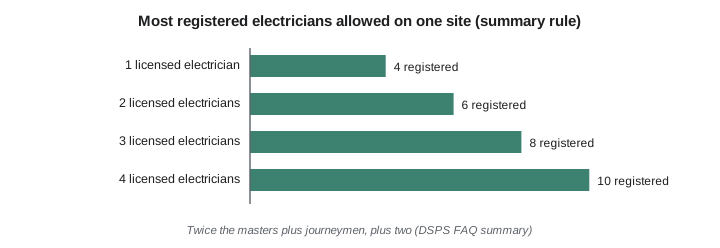
Back at the school addition, Carla did the arithmetic. Two journeymen are licensed electricians, so the site could have up to two times two plus two, or six, registered electricians. Six registered electricians were there, so the site was at the limit but within it. Apprentices in an approved program have their own supervision rules under the apprenticeship program, so Carla made a note to check in SPS 305 how an apprentice affects the count rather than guess. Carla wrote the rule on a card in her binder. If one journeyman had called in sick that morning, the site would have been over the limit.
# Checking the registered electrician ratio on a site (simplified study aid)
def max_registered(licensed):
    return 2 * licensed + 2
sites = [("Chippewa Falls school", 2, 6),
         ("Altoona dental clinic", 1, 5),
         ("Fall Creek farm shop", 3, 4)]
for name, licensed, registered in sites:
    limit = max_registered(licensed)
    ok = registered <= limit
    print(name, "- licensed:", licensed, "registered:", registered, "limit:", limit,
"OK" if ok else "OVER")Chippewa Falls school - licensed: 2 registered: 6 limit: 6 OK Altoona dental clinic - licensed: 1 registered: 5 limit: 4 OVER Fall Creek farm shop - licensed: 3 registered: 4 limit: 8 OK
The dental clinic in the output is over the limit: one licensed electrician allows four registered electricians, and five are there. The fix is to add a licensed electrician or move a registered electrician to another site. On the exam, a ratio question usually gives a crew and asks whether it complies or how many more registered electricians may be added. Write the formula on your binder card and use it every time rather than reasoning from memory.
Credentialed workers only
The department's pages for the electrical contractor and the Registered Master Electrician both say that electrical work must be done by individuals who hold the appropriate license or registration. A master responsible for a job should know that every person doing wiring has a current credential. Red Cedar's practice is to check every new hire in the department's public lookup on the first day and to keep a list of credential numbers and expiration dates in the office. Beth checks the list every month and reminds people of their renewals.
Unlicensed help is the most common way a master gets into trouble without meaning to. A customer's nephew who wants to help, a laborer who starts pulling wire because the crew is behind, a subcontractor whose people are not registered: each puts the master's license at risk. The answer in each case is the same. Either the person gets the right credential, or the person does not do electrical work.
Records, permits and inspections
A master who is responsible for a company's work needs records that show it. Permits, plans, inspection results, correction notices and their resolution, crew assignments and credential checks all belong in the job file. When an inspector or the department asks who did the work and who supervised it, the answer should come from the file, not from memory. Permits must be issued before permitted work begins, and the master should be the one who knows each job's permit status.
Worked problem
Answering for a job
An inspector finds that a registered electrician at a Red Cedar job wired a subpanel with no licensed electrician on site for two days, and the crew exceeded the ratio on one of those days. Carla is the master responsible. What should she do?
Show solution
- Confirm the facts from the job file: who was on site and what credentials they held each day.
- Correct the work if needed and request reinspection.
- Fix the staffing so the ratio and supervision rules are met for the rest of the job.
- Change the company's scheduling process so a licensed electrician is assigned before registered electricians are sent.
Answer: Correct the work and the staffing now, and fix the process that let it happen, because the responsibility is hers.
Discipline
The department can investigate complaints against credential holders and take discipline when it finds a violation. Common grounds include doing or allowing unlicensed work, exceeding supervision ratios, starting permitted work without a permit, lending a license, misrepresenting qualifications and repeated serious code violations. Discipline can range from a reprimand or a fine to limiting, suspending or revoking the credential, and it is public. A master who receives a complaint should respond on time, truthfully and with records, and consider speaking with a lawyer.
Discipline against a master can also affect the electrical contractor the master is responsible for. If a contractor loses its responsible master, it cannot continue electrical work until another master or Registered Master Electrician is in place. Lesson 8 covers that link from the contractor's side.
Working with customers and other trades
A master electrician's responsibility does not stop at the crew. Customers ask for changes in the middle of a job, general contractors push schedules, and other trades cover up work or cut into it. A master who is responsible for the electrical work needs a habit of putting changes in writing, telling the customer when a request would break the code or need a permit revision, and coordinating with other trades before concealment. The dental office box that Tom Kessler found behind drywall in Lesson 6 was a coordination failure as much as a code problem, and the master answers for both.
Customers also deserve plain answers about what the code requires and what is a choice. When a homeowner asks whether surge protection is needed on a service upgrade under the new code, the master should know the answer and explain it, not sell it as an option if it is a requirement or require it if it is not. Being honest about the line between required work and recommended work protects the customer and the master's reputation.
Planning for succession
Gene's situation is common. Many Wisconsin electrical contractors are built around one master, and when that person retires, moves or becomes ill, the company's right to do electrical work depends on another master or Registered Master Electrician stepping in. A master who is responsible for a contractor should plan for that day: train a successor, encourage journeymen toward the exam, and keep records good enough that someone else can take over. Carla's exam is the center of Red Cedar's plan, but Gene also asked a second journeyman to start the master route as a backup.
Gene's last piece of advice on duties was to write things down. A master who can show the crew assignments, the credential checks and the inspection results for a job rarely has trouble explaining it later; a master who relies on memory usually does.
Master duties on the exam
Expect questions on who may supervise whom, the ratio, what responsible at all times means, the difference between general and direct supervision, the Registered Master Electrician's position, and grounds for discipline. These come from SPS 305 and the Statutes, not the NEC, so an open-book answer is found in the binder. Tab the sections on supervision and the ratio, and keep the ratio formula on a punched note page.
Common mistakes
MistakeGuessing how apprentices affect the ratio.
InsteadThe ratio rule is about registered electricians; check SPS 305 and the apprenticeship rules for apprentices.
MistakeThinking a Registered Master Electrician is outside the ratio.
InsteadThe FAQ says the ratio still applies.
MistakeBelieving a master must be on site at all times.
InsteadThe master must be responsible at all times, which usually means general supervision.
MistakeLetting someone pull wire without checking their credential.
InsteadEvery person doing electrical wiring needs a current license or registration.
Summary and key terms
- A non-master may do electrical wiring only if a master electrician is responsible for the work at all times.
- Journeymen work under a master's general supervision; direct supervision means being present at the work.
- Registered electricians on a site may not exceed twice the number of licensed electricians plus two, as the department describes the rule.
- Only individuals with the appropriate license or registration may do electrical work.
- The department can reprimand, fine, limit, suspend or revoke a credential for violations such as lending a license or exceeding ratios.
- Responsible master
- The master electrician who answers for a contractor's electrical work at all times.
- General supervision
- Being responsible for the work and available to direct it without being present at every moment.
- Direct supervision
- Being present at the work location and able to see and direct the work.
- Supervision ratio
- The limit on registered electricians relative to licensed electricians on a site.
- Discipline
- Action by the department against a credential holder, from reprimand to revocation.
Practice problems
Work each problem on paper first, then reveal the answer to check.
Three licensed electricians are on a site. How many registered electricians may work there?
Show answer
Up to eight: two times three plus two.
Does a journeyman need a master on site at all times?
Show answer
No. A journeyman works under a master's general supervision.
Does the ratio apply to sites run by a Registered Master Electrician?
Show answer
Yes. The FAQ says the ratio still applies.
Name two common grounds for discipline of a master.
Show answer
Allowing unlicensed work and exceeding the supervision ratio; others include lending a license.
Lesson quiz · 5 questions
Score 60% or more to complete this lesson.
Create a free account to save your progress, take quizzes and earn a certificate.