
MELU-324 · Lesson 2 of 12 · 19 min
Eligibility for the Master Electrician License
▶ Video coming soon A video version of this lesson is on the way.
Carla's first job after the meeting with Gene was a dull one. She sat at the kitchen table with her old pay stubs, her journeyman card and a spreadsheet Beth Olson, Red Cedar's office manager, had started for her. "The department will want to see that you qualify before it lets you book anything," Beth said. "Better to know now which route you're using than to find out from a rejection letter." Carla had held her journeyman license since the spring of 2021 and had worked full time for Red Cedar the whole time. She was fairly sure she qualified, but fairly sure is not the standard the department applies.
This lesson covers who may take the Wisconsin master electrician exam, the three experience and education routes in the statute, how hours are counted and documented, the special case of the Registered Master Electrician, and the exemptions that decide whether a job needs a licensed electrician at all. The exemptions belong here because candidates are expected to know where the license requirement starts and stops, and because a surprising share of eligibility questions on the exam are really questions about scope.
The three routes in the statute
Section 101.868 sets the qualifications for a master electrician license. In summary, an applicant must pass the department's exam and meet one of three conditions. The first route is a bachelor's or master's degree in electrical engineering. The second is at least 12 months of experience doing electrical wiring while holding a journeyman electrician license. The third is at least 60 months of experience doing electrical wiring that adds up to at least 10,000 hours. The statute leaves room for the department to set the details by rule, including the qualifications for other master-level credentials such as the residential master electrician.
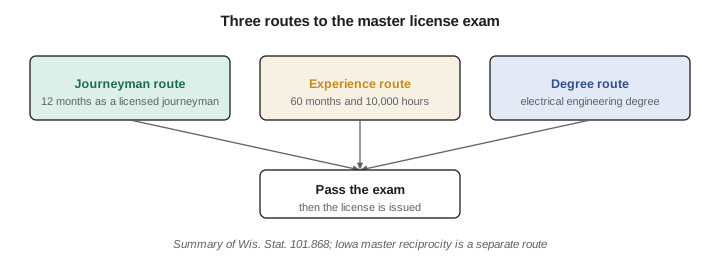
Most candidates use the journeyman route, as Carla will. It rewards the work a journeyman already does: a year of wiring under a journeyman license shows the department that the person has applied the code in the field at the level the master exam builds on. The experience route exists mainly for people who did years of wiring before statewide licensing, or who came from places where journeyman licensing did not exist. The degree route is the least common in practice. Engineers who take it often have strong theory and calculations but less field experience, and they tend to find the installation and administration questions harder than the calculations.
| Route | What the applicant shows | Typical candidate |
|---|---|---|
| Journeyman route | At least 12 months of wiring work while holding a journeyman license | A working journeyman |
| Experience route | At least 60 months and 10,000 hours of wiring work | A long-time electrician without the journeyman path |
| Degree route | A bachelor's or master's degree in electrical engineering | An engineer moving into contracting |
Counting and documenting hours
The department decides whether an applicant qualifies from what the application shows. For the journeyman route, the key facts are the date the journeyman license was issued and the months of wiring work since then. For the experience route, the applicant reports employers, dates and hours, and the department may ask for verification from employers. In both cases the work has to be electrical wiring of the kind the license covers. Time spent as an estimator, a salesperson or a warehouse manager usually does not count, even at an electrical company. Part-time work counts for the months it covers, but a route with an hours floor needs the hours to add up as well.
Beth's advice to Carla was practical. Keep a simple record of each employer, the start and end dates, the average hours per week and the kind of work, and keep copies of pay records that back it up. If an employer has closed or changed hands, write down who can confirm the work. The department's journeyman application uses a similar approach, counting a full year of work as 2,000 hours in its examples, and the habit of documenting carries over. Applicants who have kept such records rarely have trouble; applicants who reconstruct ten years from memory often do.
# Does a work history meet the experience route? (simplified study aid)
history = [  # (employer, months, average hours per week)
    ("Lakeside Electric", 24, 36),
    ("Chippewa Ag Services", 18, 28),
    ("Red Cedar Electric", 20, 40),
]
WEEKS_PER_MONTH = 52 / 12
months = sum(m for _, m, _ in history)
hours = sum(m * WEEKS_PER_MONTH * h for _, m, h in history)
print("months of wiring work:", months)
print("hours of wiring work:", round(hours))
print("meets 60 months:", months >= 60)
print("meets 10,000 hours:", hours >= 10000)
print("experience route met:", months >= 60 and hours >= 10000)months of wiring work: 62 hours of wiring work: 9395 meets 60 months: True meets 10,000 hours: False experience route met: False
The example history crosses 60 months but falls short of 10,000 hours, because two stretches averaged well under 40 hours a week. That is the trap in the experience route: both conditions apply. An applicant who comes up short on hours keeps working and applies when the total crosses the line, or uses the journeyman route if they hold that license. Carla's numbers were simpler. She had more than five years as a licensed journeyman, well past the 12 months the journeyman route needs.
Worked problem
Choosing a route
Dave holds a Wisconsin journeyman license issued 14 months ago and has worked full time as an electrician since then. Before that he wired houses for seven years in a state with no journeyman license. Which route should he use, and what will he need to show?
Show solution
- The journeyman route needs at least 12 months of wiring work while holding a journeyman license.
- Dave has 14 months as a licensed journeyman, all full time in wiring, so he meets it.
- He could also try the experience route with his earlier years, but that needs employer documentation for many more hours.
- The simpler choice is the journeyman route, documented with his license date and his current employer's confirmation of work.
Answer: Use the journeyman route; show the license issue date and 14 months of wiring work since then.
The Registered Master Electrician
When statewide licensing took effect, the department made room for older electricians who had worked for decades without a state license. Under the department's rules as described in its frequently asked questions, a person born before January 1, 1956 who had at least 15 years of experience in electrical wiring could obtain a Registered Master Electrician credential instead of taking the master exam. A Registered Master Electrician needs no supervision, may supervise others and may be responsible for an electrical contractor's work, but the supervision ratios still apply. The department's page notes that the registration does not expire.
Arnie Lindgren, born in 1952, holds one of these registrations and does service work for a few farm co-ops near Menomonie. He is a useful contrast for Carla. His credential came from age and experience under a one-time rule; hers will come from the exam. Neither is a lesser credential for the work it covers, but a new candidate cannot qualify for the registration now, so the exam is the only route for Carla's generation.
Where the license requirement stops
The license requirement in section 101.862 is broad, but it has edges. The exemptions in the statute and in the department's guidance include the following, in summary. An owner may do electrical wiring in a single-family home the owner occupies or will occupy, though the department's guidance says this does not cover a duplex or a new home that the owner is building to sell. Systems at 100 volts or less are outside the requirement. Replacing a switch, receptacle or similar device rated 20 amperes or less with a like device is exempt. Employees working on the premises of an existing industrial facility, volunteers for qualified nonprofits building new one- and two-family homes, and work on elevators, telecommunications and utility systems have their own treatment.
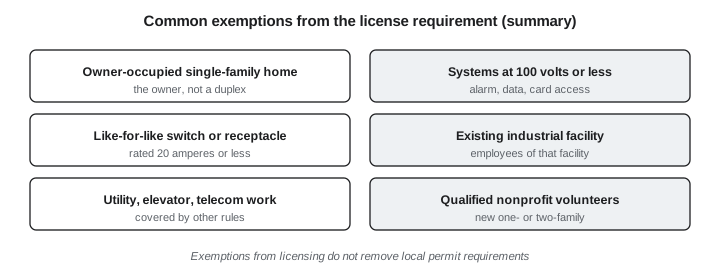
Each exemption is narrower than it first sounds. The owner exemption covers the owner personally, not a friend or a relative the owner pays. The low-voltage exemption covers systems that operate at 100 volts or less, not the 120-volt power supply that feeds the alarm panel. The device replacement exemption covers a like-for-like swap, not adding a new circuit or a new receptacle. And none of the exemptions removes a permit requirement where the local program or the state requires one. An owner rewiring a basement in a city that requires permits still needs the permit.
Residential and other master-level credentials
The statute lets the department set qualifications for other credential types by rule, and the department's credential list includes residential journeyman and residential master electrician credentials limited to dwelling work, as well as an industrial journeyman credential. Each has its own application, its own exam and its own scope. A residential master can be responsible for dwelling work but not for a dental office or a school addition. Red Cedar does both kinds of work, so a residential master would not be enough for Gene's succession plan. Carla needs the full master electrician license.
When the department reviews an application and finds the applicant does not qualify yet, it says why. The common reasons are missing documentation, hours that do not reach a floor, or work that does not count as electrical wiring. An applicant who is short can usually fix the gap and reapply, but the application fee is generally not refunded. That is the practical case for checking eligibility carefully before paying anything.
Carla's own file was short in the end: her journeyman license number and issue date, Red Cedar's confirmation of her full-time wiring work since then, and copies of a few pay records in case the department asked. Beth reviewed it before Carla submitted it and found one problem, a middle initial missing from the application that appeared on her license. It took thirty seconds to fix and might have taken two weeks to sort out after submission.
Reading eligibility questions on the exam
Exam questions on eligibility usually test one of three things: the numbers in each route, the fact that both the month and hour conditions apply in the experience route, and the scope of the exemptions. Read each question for the credential it names. A question about a journeyman's eligibility has different numbers from one about a master's. A question about a residential master electrician may point to a different rule from one about a master electrician. If a question describes a person and asks whether they need a license, look first for the exemption that might apply, then check whether the facts fit it exactly.
Common mistakes
MistakeCounting months but ignoring hours on the experience route.
InsteadThe experience route needs at least 60 months and at least 10,000 hours.
MistakeAssuming any job at an electrical company counts as experience.
InsteadOnly electrical wiring work counts; office, sales and warehouse time does not.
MistakeThinking a new candidate can still become a Registered Master Electrician.
InsteadThat registration was for people born before January 1, 1956 with 15 years' experience.
MistakeTreating the owner exemption as covering a duplex or a spec house.
InsteadThe department's guidance limits it to the owner's own occupied single-family home.
Summary and key terms
- Section 101.868 lets an applicant take the master exam through an electrical engineering degree, 12 months as a licensed journeyman, or 60 months and 10,000 hours of wiring.
- Both the month and hour conditions apply in the experience route.
- Only electrical wiring work counts, and good records of employers, dates and hours make approval easier.
- The Registered Master Electrician credential covered long-time electricians born before 1956 and carries master-level responsibility.
- The license requirement has specific exemptions, such as an owner's own occupied single-family home and systems at 100 volts or less.
- Journeyman route
- Qualifying for the master exam with at least 12 months of wiring while licensed as a journeyman.
- Experience route
- Qualifying with at least 60 months and 10,000 hours of wiring work.
- Degree route
- Qualifying with a bachelor's or master's degree in electrical engineering.
- Owner exemption
- The exemption for an owner wiring the owner's own occupied single-family home.
- Like-for-like replacement
- Replacing a switch or receptacle rated 20 amperes or less with a similar device, which is exempt.
Practice problems
Work each problem on paper first, then reveal the answer to check.
How many months as a licensed journeyman does the journeyman route need?
Show answer
At least 12 months of wiring work while licensed.
An applicant has 66 months but 9,400 hours of wiring. Does the experience route work?
Show answer
No. Both the 60-month and 10,000-hour conditions must be met.
May an owner wire a new duplex the owner will live in half of?
Show answer
Not under the owner exemption as the department describes it; it covers a single-family home.
Is installing a new 20-ampere circuit covered by the device replacement exemption?
Show answer
No. The exemption covers replacing a like device, not adding circuits.
Lesson quiz · 5 questions
Score 60% or more to complete this lesson.
Create a free account to save your progress, take quizzes and earn a certificate.