
MELU-324 · Lesson 1 of 12 · 20 min
How electrical licensing works in Wisconsin
▶ Video coming soon A video version of this lesson is on the way.
Gene Halvorsen started Red Cedar Electric, LLC out of his garage on the north side of Eau Claire in 1991, a few months after he passed the state master exam. Thirty-five years later the company has fourteen electricians and apprentices, six vans, a shop off Hastings Way and a steady mix of farm service upgrades in Chippewa and Dunn counties, dental and retail fit-outs downtown, school additions as a subcontractor, cabins on the lakes toward Spooner, and a growing list of heat pumps, solar tie-ins and electric vehicle chargers. One snowy Monday in January, Gene asked his lead journeyman, Carla Mendez, to stay after the morning meeting. "I'm sixty-three," he said. "The state needs to see a master electrician responsible for everything this company wires. When I step back, that has to be someone else. I'd like it to be you." He slid a printout of the master electrician page from the Department of Safety and Professional Services across the table, along with the list of materials allowed in the exam room.
Carla had started as an apprentice in 2016, passed the journeyman exam in 2021 and had been running crews ever since. She had worked through the master electrician core courses on the National Electrical Code, load calculations, grounding and bonding, motors and transformers, special occupancies, and business and law. This course takes that preparation and applies it to Wisconsin: who licenses electricians and electrical businesses, how the master exam works, which edition of the code is enforced and how the state changes it, how permits and inspections run through the state and its delegated agents, and the Wisconsin law on contracts, construction liens, workers' compensation, workplace safety and credential renewal that a master electrician is expected to know.
One department, three jobs
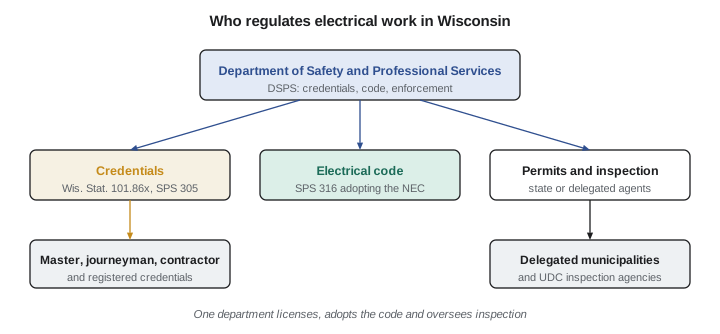
Wisconsin regulates electrical work through a single state agency, the Department of Safety and Professional Services, usually shortened to DSPS. Many states split this work among a licensing board, a fire marshal and local building departments. In Wisconsin, one department issues the credentials, writes the administrative rules, adopts the electrical code and oversees permits and inspection. The department's Division of Industry Services handles the trades side, including electrical plan review and inspection programs, while its credentialing staff process applications and renewals through the online system called LicensE.
The licensing law sits in the Statutes in a short run of sections that begins at 101.861. Section 101.862 says who needs a credential to do electrical work and lists the exceptions. Section 101.868 sets out the routes to the master electrician license. Other sections in the same group cover journeymen, apprentices, registered electricians, contractors and inspectors. The department fills in the details through its rules. Chapter SPS 305 covers credentials for the trades, including fees, terms, continuing education and supervision ratios. Chapter SPS 316 is the Wisconsin Electrical Code, which adopts the National Electrical Code with state changes.
The credential types
Wisconsin electrical credentials form a ladder. A person usually starts as a registered electrician or an indentured apprentice, working under the supervision of a licensed electrician. After the required hours of work, the person can take the journeyman exam and become a licensed journeyman electrician. A journeyman can then qualify for the master exam by one of several routes and become a licensed master electrician. Separate credentials cover residential-only work, industrial journeymen, beginning electricians, electrical inspectors and the electrical contractor business credential. The department's pages list each type with its own application form and fee.
| Credential | What it allows | Exam |
|---|---|---|
| Registered electrician | Work under the supervision of a licensed electrician | None |
| Apprentice | Work in an approved apprenticeship under supervision | None to start |
| Journeyman electrician | Do electrical wiring under the general supervision of a master | Yes |
| Master electrician | Be responsible for electrical work and supervise others | Yes, open book |
| Registered Master Electrician | Like a master, for long-time electricians who qualified under the older rule | None |
| Electrical contractor | Lets a business engage in electrical work with a master responsible | None, application only |
Two points in that table surprise electricians who move from other states. First, the license that lets a company contract for electrical work is a separate credential held by the business, the electrical contractor license, and it does not test anyone. The knowledge test sits with the master electrician. Second, Wisconsin has a credential called the Registered Master Electrician, created when statewide licensing took effect for people born before 1956 who had long experience in the trade. A Registered Master Electrician does not take the exam, does not need supervision and may be responsible for a contractor's work, so Carla will meet a few of them on jobs.
Who must hold a credential
Section 101.862 requires a business that installs, repairs or maintains electrical wiring to hold an electrical contractor license, and it requires the people doing the wiring to hold a license or registration. A person who is not a master electrician may do electrical wiring only if a master electrician is responsible for the work at all times. The statute and the department's guidance list exemptions, such as an owner working in the owner's own occupied single-family home, systems operating at 100 volts or less, replacing a switch or receptacle rated 20 amperes or less, and work on elevators, telecommunications and utility systems that other rules cover. Lesson 2 looks at the exemptions in more detail.
The department has enforced these requirements statewide since April 1, 2014. Before then, Wisconsin had a patchwork in which some cities licensed electricians and others did not. The statewide system replaced local electrician licenses. A person with a state license does not need a separate license from a city, although the city may still require a permit for the work. That difference between a license and a permit is worth saying out loud, because many disputes between contractors and inspectors start with someone treating them as the same thing.
Reciprocity and other paths in
Wisconsin's master electrician page lists four ways to get the license: pass the exam after qualifying, obtain it through reciprocity with Iowa for a master who passed Iowa's state exam, exchange another credential where the rules allow, or reinstate a license that expired more than four years ago. The department's frequently asked questions say the Iowa arrangement covers the journeyman and master licenses only. Electricians from other states generally take the Wisconsin exam after showing qualifying experience. Anyone relying on reciprocity should confirm the current terms with the department before taking work in Wisconsin.
The code and the inspector
The Wisconsin Electrical Code is chapter SPS 316. It adopts the National Electrical Code by reference and lists Wisconsin's additions, changes and omissions. In 2026 the department moved from a modified 2017 edition to a modified 2023 edition, effective September 1, 2026. Lesson 5 covers what changed and how the effective date works for plans and exams.
Inspection is shared between the state and local agents. The department inspects commercial electrical work in places that have not taken on the job, and it delegates commercial permitting, plan review and inspection to municipalities, counties and other agencies that ask for it and meet its standards. One- and two-family dwellings follow the Uniform Dwelling Code program, where local inspection agencies usually do the work. In Eau Claire, Red Cedar pulls most permits from the city, while a farm job out in the town of Union may go to a county or contracted agency. Lesson 6 explains how to tell which applies.
# Which Wisconsin credential fits each role? (simplified study aid)
roles = [
    ("Pull wire under supervision", "registered electrician"),
    ("Wire a service under a master's general supervision", "journeyman"),
    ("Be responsible for a company's electrical work", "master"),
    ("Let an LLC engage in electrical work", "electrical contractor"),
    ("Long-time electrician born before 1956", "Registered Master Electrician"),
]
exam = {"registered electrician": False, "journeyman": True, "master": True,
        "electrical contractor": False, "Registered Master Electrician": False}
for role, cred in roles:
    tag = "exam required" if exam[cred] else "no exam, application only"
    print(role)
print(" credential:", cred, "-", tag)Pull wire under supervision credential: registered electrician - no exam, application only Wire a service under a master's general supervision credential: journeyman - exam required Be responsible for a company's electrical work credential: master - exam required Let an LLC engage in electrical work credential: electrical contractor - no exam, application only Long-time electrician born before 1956 credential: Registered Master Electrician - no exam, application only
The output shows the structure the exam expects you to understand. The contractor license has no exam of its own, because the knowledge test sits with the master electrician who is responsible for the work. The contractor credential is about which business may engage in electrical work and who answers for it; the master license is about what that person knows. The Registered Master Electrician is the one responsible-person credential that came from experience and age rather than an exam.
Worked problem
Mapping a company to the credential rules
Two brothers in Green Bay form an LLC to do commercial electrical work. One holds a journeyman license and the other is a project manager with no credential. They plan to start taking jobs next month. What do they need?
Show solution
- A business that installs, repairs or maintains wiring needs an electrical contractor license from the department.
- Someone who is not a master may wire only if a master electrician is responsible for the work at all times.
- Neither brother is a master, so the LLC must employ a master or Registered Master Electrician, or the journeyman must qualify for and pass the master exam.
- The crew must hold licenses or registrations, and the LLC must pull permits wherever the job requires them.
Answer: The LLC needs an electrical contractor license and a master electrician or Registered Master Electrician responsible for its work before it takes electrical jobs.
Where the rules live
Wisconsin electrical contractors work under several layers of law, and the master exam expects candidates to know which layer answers which question. The Statutes in chapter 101 and the rules in SPS 305 set credentials, eligibility, renewal, supervision and discipline. SPS 316 sets installation rules. Other parts of the administrative code, including the commercial building code and the Uniform Dwelling Code, set the permit and inspection framework for buildings. Chapter 779 of the Statutes governs construction liens. Chapter 102 covers workers' compensation and chapter 108 covers unemployment insurance. Federal OSHA rules in 29 CFR Part 1926 cover safety on construction sites for private employers.
Those layers also tell you who to call. A question about whether your hours count goes to the department's credentialing staff. A question about whether a kitchen counter receptacle needs ground-fault protection goes to the inspector for the job, and a formal interpretation can come from the department's code consultants. A question about whether you can still file a lien claim goes to a construction lawyer. A question about premiums goes to your insurance agent. Knowing the right office saves days of phone tag and keeps you from relying on a friend's guess.
Gene put it more bluntly at the end of that first meeting. "The exam is open book," he told Carla, "so nobody expects you to memorize the code. They expect you to know which book to open." That idea runs through the whole course. Each lesson ends with the sources you would check, and the practice exam in Lesson 12 is built to test how quickly you can find an answer as much as whether you know it.
Common mistakes
MistakeAssuming a city license is still needed on top of a state license.
InsteadStatewide licensing replaced local electrician licenses; the city may still require a permit.
MistakeThinking the contractor license tests anyone.
InsteadThe electrical contractor credential is an application; the exam sits with the master.
MistakeBelieving an out-of-state license transfers automatically.
InsteadOnly listed reciprocity, such as Iowa for journeyman and master, avoids the Wisconsin exam.
MistakeTreating every small job as exempt.
InsteadThe exemptions are specific; most wiring needs a licensed person and a master responsible.
Summary and key terms
- The Department of Safety and Professional Services issues electrician credentials, writes the rules in SPS 305 and adopts the Wisconsin Electrical Code in SPS 316.
- The ladder runs from registered electrician or apprentice to journeyman to master, with residential, industrial and inspector credentials alongside.
- A business needs an electrical contractor license, and a master electrician or Registered Master Electrician must be responsible for its work.
- Statewide licensing took effect April 1, 2014 and replaced local electrician licenses, but local permits still apply.
- Inspection is done by the department or by delegated local agents, with dwellings under the Uniform Dwelling Code program.
- DSPS
- The Wisconsin Department of Safety and Professional Services, which credentials electricians and adopts the electrical code.
- Section 101.862
- The statute that says who needs an electrical credential and lists the exemptions.
- SPS 305
- The department's rules on credentials for the trades, including terms, fees and continuing education.
- SPS 316
- The Wisconsin Electrical Code, which adopts the NEC with state changes.
- Registered Master Electrician
- A credential for long-time electricians born before 1956 that carries master-level responsibility without an exam.
Practice problems
Work each problem on paper first, then reveal the answer to check.
Which agency issues the Wisconsin master electrician license?
Show answer
The Department of Safety and Professional Services.
Does a state-licensed journeyman need a separate Madison electrician license?
Show answer
No. Statewide licensing replaced local licenses, though Madison may still require a permit.
Which chapter of the administrative code is the electrical code?
Show answer
SPS 316.
Which state's masters may get a Wisconsin license by reciprocity?
Show answer
Iowa, for masters who passed Iowa's state exam, under the current terms.
Lesson quiz · 5 questions
Score 60% or more to complete this lesson.
Create a free account to save your progress, take quizzes and earn a certificate.