
MELU-324 · Lesson 8 of 12 · 19 min
Contractor licensing, insurance and bonding
▶ Video coming soon A video version of this lesson is on the way.
Beth Olson kept Red Cedar's credential file in a red binder on the shelf behind her desk: the company's electrical contractor license, the certificate of workers' compensation insurance, the general liability policy, the commercial auto policy, the bonding letter from the surety agent and a list of every employee's credential and expiration date. When Gene told her Carla would become the company's responsible master, Beth opened the binder and made a list. "The license is the easy part," she said. "The insurance is where people get hurt." Carla had never paid much attention to the red binder. Now it would be partly hers.
This lesson covers the electrical contractor credential, the link between a contractor and its responsible master, what happens when that master leaves, the attestations and conditions on the application, workers' compensation requirements in Wisconsin, unemployment insurance, the insurance a contractor needs in practice and the bonds that public and many private projects require. The rules are summarized as of late 2026.
The electrical contractor credential
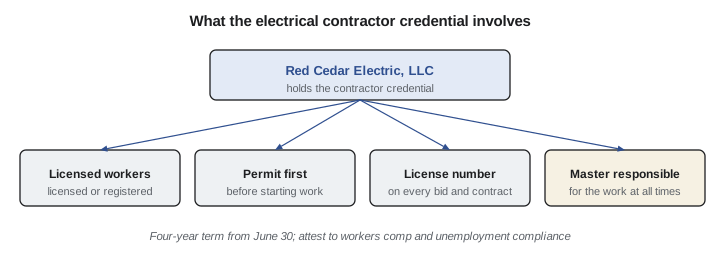
Section 101.862 requires a business that installs, repairs or maintains electrical wiring to hold an electrical contractor license, and the department's rule in SPS 305 sets out the credential. The application is made by the business, signed by an owner, partner or the chairperson or chief executive officer of a corporation, and it names the business entity and its contact information. The department's page states the conditions that come with the credential: electrical work must be done by individuals who hold the appropriate license or registration, work that requires a permit may not begin until the permit is issued, and the contractor's credential number must appear on all bids and contracts.
The contractor credential has no exam. What makes it work is the requirement that a master electrician or Registered Master Electrician be responsible for the electrical work, which comes from section 101.862 and is reflected in how the department and industry guides describe the credential. A contractor may be owned by a master, as Red Cedar is by Gene, or it may employ a master who is responsible for its work. Either way, the department and inspectors expect to be able to name that person for any job.
| Item | What the department's form and page describe |
|---|---|
| Who applies | The business, signed by an owner, partner or chief executive |
| Term | Four years, ending June 30, with a prorated first-term fee |
| Fees | An application fee and a credential fee, set by rule |
| Conditions | Credentialed workers, permits before work, credential number on bids and contracts |
| Attestations | Compliance with workers' compensation and unemployment insurance law |
| Denial | Delinquent state taxes, unemployment contributions or child support |
When the responsible master leaves
A contractor whose responsible master leaves, retires, dies or loses the license cannot keep doing electrical work as if nothing changed. It needs another master electrician or Registered Master Electrician responsible for its work, and it should update its information with the department and tell the permit offices it works with. Open permits that name the departing master may need to be transferred or updated under the local office's procedure. A company that runs on one master should plan for this before it happens, which is the whole point of Gene's succession plan.
Carla and Gene planned the change for the start of a quiet month. On the day her license issued, Beth would update the company's records with the department, send a letter to each permit office with open Red Cedar permits, and update the company's bid templates. Gene would stay on for a year as a second master, which gave the company coverage if anything went wrong.
Workers' compensation
Chapter 102 of the Wisconsin Statutes is the workers' compensation law, administered by the Department of Workforce Development. The department's employer pages say that a private employer must have workers' compensation insurance on the day it employs three or more full-time or part-time employees, and that an employer with one or more employees who pays 500 dollars or more in gross wages in any calendar quarter must have coverage by the 10th day of the first month of the next quarter. Most electrical contractors cross these thresholds quickly, and the electrical contractor application asks the applicant to attest to compliance.
An out-of-state employer whose employees work in Wisconsin needs coverage through an insurer licensed in Wisconsin, with Wisconsin named on the policy's information page as the department's guidance describes. Self-insurance is possible for large employers that meet the department's financial standards, but almost every electrical contractor buys a policy. Penalties for operating without required coverage can be substantial and can include orders to stop work; the department's pages describe the current amounts.
# Is workers' compensation coverage required? (simplified study aid from DWD's employer rules)
def coverage_required(employees, quarter_wages):
    if employees >= 3:
        return "yes, from the day the third employee is hired"
    if employees >= 1 and quarter_wages >= 500:
        return "yes, by the 10th of the first month of the next quarter"
    return "not yet under these two tests"
cases = [("Red Cedar Electric", 14, 210000),
         ("A one-person shop with a part-time helper", 1, 2400),
         ("A new owner-operator with no employees", 0, 0)]
for name, n, wages in cases:
print(name, "->", coverage_required(n, wages))Red Cedar Electric -> yes, from the day the third employee is hired A one-person shop with a part-time helper -> yes, by the 10th of the first month of the next quarter A new owner-operator with no employees -> not yet under these two tests
The output shows the two tests working together. A company with three or more employees needs coverage immediately. A company with one employee needs it after paying 500 dollars in a quarter, which a part-time helper reaches in a few weeks. An owner-operator with no employees may not need a policy for themselves under these tests, but general contractors and customers often ask for a certificate anyway, and some owners buy coverage to be eligible for that work.
Unemployment insurance
Chapter 108 of the Statutes is the unemployment insurance law, also administered by the Department of Workforce Development. Employers that meet its thresholds register, report wages and pay contributions. The electrical contractor application asks the applicant to attest to compliance with chapter 108 as well as chapter 102, and state law requires the department to deny a credential to an applicant who is delinquent in unemployment contributions. Beth files the quarterly reports for Red Cedar and keeps the confirmations in the red binder.
General liability and other insurance
The department's contractor application, as reviewed for this course, does not set a general liability insurance requirement for the credential. In practice, almost every electrical contractor carries it, because general contractors, building owners, school districts and many homeowners require a certificate of insurance before work starts, often with minimum limits and additional insured endorsements written into the contract. Completed operations coverage protects against claims that arise after a job is finished, which matters for electrical work. Commercial auto, tools and equipment, and an umbrella policy round out a typical program.
Bonds
A bond is a promise by a surety company to pay if the contractor fails to meet an obligation. Wisconsin public works contracts generally require payment and performance bonds from the prime contractor, and general contractors often require them from major subcontractors. A payment bond protects suppliers and subcontractors who are not paid; a performance bond protects the owner if the work is not completed. Some municipalities also require a license or permit bond. The contractor credential itself, as described on the department's form, does not require a bond. A contractor's ability to get bonded depends on its finances and track record, which is another reason to keep clean books.
Worked problem
Checking a contractor's file before a school bid
Red Cedar wants to bid the electrical work on a public school addition in Menomonie. The bid documents ask for the electrical contractor credential number, a certificate of general liability insurance with stated limits, proof of workers' compensation, and a performance and payment bond for the subcontract. What should Beth check?
Show solution
- Confirm the contractor credential is current and put its number on the bid.
- Confirm the responsible master's license is current and named in the company's records.
- Get certificates from the insurance agent showing the required limits and workers' compensation coverage.
- Ask the surety agent for the bond and confirm the company's bonding capacity covers the subcontract value.
Answer: Current credential number on the bid, a current responsible master, the required certificates and the bond from the surety.
Renewing and changing the contractor file
The contractor credential renews on the same four-year cycle as other trade credentials, through LicensE, with its own fee. The renewal repeats the attestations about workers' compensation and unemployment insurance and asks again about tax and child support delinquencies. A renewal can also be the moment the department notices that the company's information is out of date, such as an old address, a changed business name or a responsible master who has left. Changes like those should be reported when they happen, not saved for the renewal.
A change in the business entity itself, such as converting a sole proprietorship to an LLC or selling the company, usually means the new entity needs its own credential, because the credential belongs to the business that applied for it. Gene learned this in 2008 when he converted Red Cedar from a sole proprietorship to an LLC on the advice of his accountant. The new LLC applied for its own credential before the conversion took effect, so the company never had a gap. A buyer of an electrical company should check the same point before closing and plan for it in the purchase timeline.
Certificates of insurance in practice
Most of Beth's insurance work is not buying policies but answering requests for certificates. A general contractor bidding a school addition wants a certificate naming it as an additional insured with stated limits; a hospital wants a waiver of subrogation; a homeowner wants proof that a worker hurt in the basement is covered. Each request goes to the insurance agent, who issues the certificate if the policy supports it. Beth reads every contract's insurance section before the bid goes out, because promising coverage the policy does not have can leave the company exposed after a claim. When a contract asks for something unusual, she asks the agent before Red Cedar signs, not after.
Contractor rules on the exam
Expect questions on who needs the contractor credential, what conditions come with it, the link to the responsible master, the four-year term, workers' compensation thresholds and the difference between insurance and bonds. These are answered in SPS 305 and in the Statutes, and a few in the workers' compensation law. Tab the sections in the binder, and put a short note page on the workers' compensation tests if the permitted list allows it.
Common mistakes
MistakeThinking the contractor credential tests the business owner.
InsteadThe credential has no exam; it depends on a responsible master.
MistakeLeaving the credential number off a bid or contract.
InsteadThe department requires the number on all bids and contracts.
MistakeAssuming workers' compensation starts only at ten employees.
InsteadCoverage is required at three employees, or at one with 500 dollars in quarterly wages.
MistakeConfusing a payment bond with insurance.
InsteadA bond guarantees the contractor's obligations to others; insurance protects the contractor against losses.
Summary and key terms
- A business that does electrical wiring needs an electrical contractor credential, with a master or Registered Master Electrician responsible for its work.
- The credential requires credentialed workers, permits before work and the credential number on bids and contracts, and runs four years to June 30.
- Workers' compensation is required at three employees, or at one employee with 500 dollars of gross wages in a quarter.
- The application asks for attestations of workers' compensation and unemployment insurance compliance, and delinquencies lead to denial.
- General liability and bonds are usually required by contracts rather than by the credential itself.
- Electrical contractor
- The business credential that lets a company engage in electrical wiring in Wisconsin.
- Chapter 102
- The Wisconsin workers' compensation law.
- Chapter 108
- The Wisconsin unemployment insurance law.
- Payment bond
- A surety's promise to pay subcontractors and suppliers if the contractor does not.
- Completed operations coverage
- Liability insurance for claims that arise after a job is finished.
Practice problems
Work each problem on paper first, then reveal the answer to check.
Who signs the electrical contractor application?
Show answer
An owner, partner or the chairperson or chief executive of the business.
A company has two employees who earned 3,000 dollars this quarter. Is coverage required?
Show answer
Yes, by the 10th of the first month of the next quarter.
Must the contractor credential number appear on a bid?
Show answer
Yes, on all bids and contracts.
What protects an owner if a contractor fails to finish the work?
Show answer
A performance bond.
Lesson quiz · 5 questions
Score 60% or more to complete this lesson.
Create a free account to save your progress, take quizzes and earn a certificate.