
MELU-324 · Lesson 4 of 12 · 19 min
The exam format and the references allowed
▶ Video coming soon A video version of this lesson is on the way.
Gene's own code book sat on a shelf in his office, the spine split and the pages fat with handwritten notes. "That book got me through the exam in 1991," he said, "and it would get you thrown out of the room today." He was mostly joking, but he had a point. Wisconsin's trades exams are open book, which sounds like a gift, but the department controls exactly which books and how they may be marked. A candidate who shows up with the wrong edition, a loose page or a row of sticky tabs can lose a reference at the door and spend three hours looking for answers in a book they have never opened.
This lesson covers what the master electrician exam looks like, how it is scored, the department's permitted materials list, how to build a binder and tab a book within those rules, and how to pace yourself in an open-book exam. Carla spent more time on this lesson than she expected, and she later said it was the one that paid off most on exam day.
The shape of the exam
The Wisconsin master electrician exam is a written, open-book exam given at a department site or a Pearson VUE center. Questions are multiple choice and draw on the code as Wisconsin has adopted it, the department's rules for the trades, electrical theory and calculations, and the responsibilities of a master electrician. Many questions describe a field situation and ask what the code requires, where a rule is found, or what a calculation gives. Some test the Wisconsin rules in SPS 305 and SPS 316 directly, such as supervision, credential scope and the state's changes to the NEC.
The department states its passing standard on its exam materials, and published summaries of the trades exams report a passing score of 70 out of 100. The number of questions and the time allowed are set by the department and shown in the candidate's exam information and confirmation. Candidates should plan from the confirmation rather than from what a coworker remembers, because formats have changed over the years and may change again with the new code edition.
The permitted materials list
The department's permitted materials list for the master electrician exam allows a small set of references. In summary, as the list has read, a candidate may bring one three-ring binder holding the department's rules in SPS 305 and SPS 316, a copy of the National Electrical Code in the edition named on the list, and up to two bound reference books such as a pocket electrical reference or a published exam guide. The total is limited to four items. The list in use before the 2026 code change named the 2017 NEC, and the department said exam questions would reflect the new code from October 1, 2026, so a candidate must check which edition the current list names.
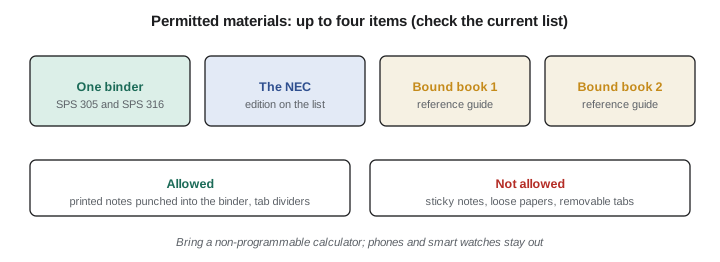
The list also sets rules for how the materials may be marked and assembled. Printed notes are allowed only if they are three-hole punched and placed in the binder. Paper tab dividers may be used in the binder. Bound books may carry tabs only if the tabs came with the book from the publisher or were permanently attached as the list allows; removable tabs, sticky notes, paper clips and loose papers are not allowed. Highlighting and handwritten notes in the margins are commonly permitted, but the current list is the authority on that point. Staff check materials at the door and remove anything that does not comply.
| Item | Allowed | Watch for |
|---|---|---|
| Binder | One three-ring binder with SPS 305 and SPS 316 | Printed notes must be punched and inside it |
| NEC | The edition named on the current list | The list changed with the 2026 code adoption |
| Bound references | Up to two published books | Only tabs the list permits |
| Calculator | Non-programmable | No phones, watches or stored formulas |
| Not allowed | Sticky notes, paper clips, loose pages | Removable tabs |
Building the binder
The binder is the one place a candidate can organize Wisconsin's own rules. Carla printed SPS 305 and SPS 316 from the Legislature's administrative code pages, punched them and put each chapter behind its own divider. Inside SPS 316 she put a divider at each part of the code the state changes, so she could flip from an NEC article to the Wisconsin change quickly. In SPS 305 she marked the sections on supervision ratios, continuing education, credential types and scope. Because printed notes are allowed only inside the binder, she added a short punched page of her own lookup notes: which article covers which topic, with page numbers. She kept it short, because a binder thick with notes is slower, not faster.
Tabbing and marking the code book
Most candidates spend more time in the NEC than anywhere else. Within the permitted rules, a well-marked book is the single biggest advantage in an open-book exam. Many candidates use publisher tab sets made for the edition they are using, attached as the list allows, with one tab per article that comes up often: definitions, branch circuits, feeders, services, overcurrent protection, grounding and bonding, wiring methods, conductors, boxes, motors, transformers, hazardous locations, health care, and the tables chapter. Highlighting the key phrase of a rule, not the whole paragraph, makes the rule easy to spot on a second look.
Practice with the exact book you will bring. A candidate who studies from a library copy and buys a new book the week before the exam loses the most valuable thing a marked book provides, which is the memory of where a rule sits on the page. Carla bought her exam copy in February and used nothing else.
Calculators
The calculator must be non-programmable. A basic scientific calculator with square roots and memory is fine for the calculations on the exam, which include voltage drop, load calculations, conduit fill, motor currents and transformer sizing. A calculator that can store programs or text is not permitted. Bring a spare battery or a second permitted calculator if the rules allow it, and practice with the calculator you will use so that keying in a three-phase formula is automatic.
# Pacing an open-book exam (illustrative numbers; use the counts on your confirmation)
questions = 70
minutes = 210
per_q = minutes / questions
print("minutes per question on average:", round(per_q, 1))
first_pass = questions * 0.6 * 1.5   # 6 in 10 answered quickly, about 1.5 min each
second = questions * 0.4 * 3.5       # the rest need lookups, about 3.5 min each
print("planned first pass minutes:", round(first_pass))
print("planned second pass minutes:", round(second))
print("minutes left for review:", round(minutes - first_pass - second))minutes per question on average: 3.0 planned first pass minutes: 63 planned second pass minutes: 98 minutes left for review: 49
The output shows why pacing matters more in an open-book exam than in a closed one. With the illustrative counts, a candidate who answers the quick questions first and saves the lookups for a second pass still has a margin for review. A candidate who stops to look up every question in order runs out of time with questions unread. The numbers on your confirmation will differ; the method does not.
Worked problem
Checking a binder against the list
Josh plans to bring a binder with SPS 305, SPS 316 and ten punched pages of notes, the NEC with publisher tabs, two pocket reference guides, and a printed table of motor currents held in the binder with a paper clip. Will everything pass the check?
Show solution
- Count the items: the binder, the NEC and two bound references make four, which is the limit.
- Punched notes inside the binder are allowed.
- Publisher tabs on the NEC are allowed if attached as the list permits.
- The paper clip and anything held only by it are not allowed and will be removed.
Answer: Everything passes except the clipped page; punch it and put it in the binder instead.
What the questions tend to cover
The department does not publish its question bank, and candidates should not trust anyone who claims to have it. Its exam information and the experience of past candidates point to a familiar spread of topics for a master exam. A large share of questions test the NEC: services, feeders and branch circuits, overcurrent protection, grounding and bonding, wiring methods and conductor sizing, equipment for general use, motors, transformers and special occupancies. A set of questions tests calculations: dwelling and commercial load calculations, voltage drop, conduit and box fill, motor and transformer currents and conductor ampacity with adjustment and correction. A smaller set tests the Wisconsin rules in SPS 305 and SPS 316, including supervision, credential scope, continuing education and the state's changes to the NEC.
Within each area, the questions favor practical decisions over trivia. A question is more likely to describe a restaurant kitchen and ask which receptacles need ground-fault protection than to ask for the number of a section. That is good news for a working journeyman, because the questions read like the problems they already solve on jobs. It also means the exam punishes candidates who know the national rule but forget to check the Wisconsin change, which is why Lesson 5 spends so long on reading the two books together.
Practicing under exam conditions
Carla's study plan included one timed practice set every Saturday morning for eight weeks, taken at the kitchen table with only the four permitted items, a pencil and the calculator she would bring. She set a timer, answered in two passes, and logged every miss with its cause. The first few sets were humbling. By the fifth she was finishing with time to spare. The point of practicing this way is not to learn new rules but to make the exam room feel ordinary: the same books, the same tabs, the same pace, the same habit of moving on from a hard question instead of fighting it.
Reading open-book questions
Open-book questions reward a few habits. Read the last sentence first to see what is being asked, then read the facts. Underline the words that decide which rule applies: dwelling or commercial, indoor or outdoor, new or existing, the voltage, the occupancy. Decide which article or Wisconsin section should answer the question before opening the book. If a question asks where a rule is found, the answer is often in a heading or an index entry rather than in the rule itself. And remember that the Wisconsin binder exists for a reason: questions about supervision, credentials and the state's changes to the NEC are answered there, not in the NEC.
Common mistakes
MistakeBringing a code edition that is not on the current permitted list.
InsteadCheck the list; the edition changed with the 2026 code adoption.
MistakeUsing sticky notes or removable flags to mark the code book.
InsteadOnly tabs the list permits; removable tabs and sticky notes are removed at the door.
MistakePacking a fifth reference because it might help.
InsteadThe list limits candidates to four items in total.
MistakeLooking up every question in order.
InsteadUse two passes: answer the quick ones first, then the lookups.
Summary and key terms
- The Wisconsin master exam is open book and multiple choice, drawing on the adopted NEC, SPS 305, SPS 316, theory, calculations and master responsibilities.
- Published summaries report a passing score of 70 out of 100; the question count and time are on your confirmation.
- The permitted list allows one binder with SPS 305 and SPS 316, the NEC edition named on the list and up to two bound references, four items in total.
- Printed notes must be punched into the binder, and only permitted tabs may be used; sticky notes, clips and loose papers are not allowed.
- A two-pass pacing plan and practice with the exact book you will bring are the keys to an open-book exam.
- Open book
- An exam in which permitted references may be used to find answers.
- Permitted materials list
- The department's list of references and items allowed in the trades exam room.
- Binder
- The single three-ring binder holding SPS 305, SPS 316 and any punched notes.
- Non-programmable calculator
- A calculator that cannot store programs or text, as required in the exam room.
- Two-pass method
- Answering quick questions first and returning to lookup questions on a second pass.
Practice problems
Work each problem on paper first, then reveal the answer to check.
How many items may a candidate bring under the permitted list?
Show answer
Four in total: the binder, the NEC and up to two bound references.
May a candidate bring a page of notes loose inside the NEC?
Show answer
No. Printed notes must be punched and placed in the binder.
What passing score do published summaries report?
Show answer
70 out of 100; confirm with the department.
Where would a question about supervision ratios be answered?
Show answer
In SPS 305, in the binder.
Lesson quiz · 5 questions
Score 60% or more to complete this lesson.
Create a free account to save your progress, take quizzes and earn a certificate.