
MELU-324 · Lesson 12 of 12 · 19 min
Practice exam review and test-day strategy
▶ Video coming soon A video version of this lesson is on the way.
Carla's first full practice set went badly. She sat at the kitchen table on a Saturday in January 2027 with her binder, her new code book, two bound references and her calculator, set a timer and worked through a practice exam a training company had written for the Wisconsin master. When the timer went off she had answered most of the questions and gotten too many wrong to pass. She was annoyed for about an hour. Then she did what Gene had told her to do: she went back through every miss and wrote down why she had missed it. The list surprised her. She had not missed many questions because she did not know the rule. She had missed them because she could not find the rule in time, because she had misread what the question asked, or because she answered from habit with a 2017 rule that had changed.
This lesson pulls the course together into an exam plan: how to use practice sets, how to keep a miss log and what it tells you, how to drill lookups, the two-pass method on exam day, managing time and nerves, a review of the high-yield Wisconsin topics, and what to do in the days before the exam and after it. Carla passed on her first attempt in April 2027. Most of what she did differently between January and April is in this lesson.
What practice sets are for
A practice set is a measurement, not a study session. Its job is to tell you where your points are going so you can spend your remaining study time where it pays. That means taking each set under conditions as close to the real exam as possible: the four permitted items, a pencil, the calculator you will bring, a timer set to the time on your confirmation and no phone. A set taken with a laptop open and a coffee break halfway through measures something else. Carla took one set every second Saturday and spent the Saturdays in between on the areas the last set exposed.
Practice sets have limits. They are written by training companies, not the department, and they vary in quality. Some are built for other states or older code editions. A set's score is a rough guide, not a prediction. What makes a set valuable is the review afterward, and that review is where most candidates cut corners.
The miss log
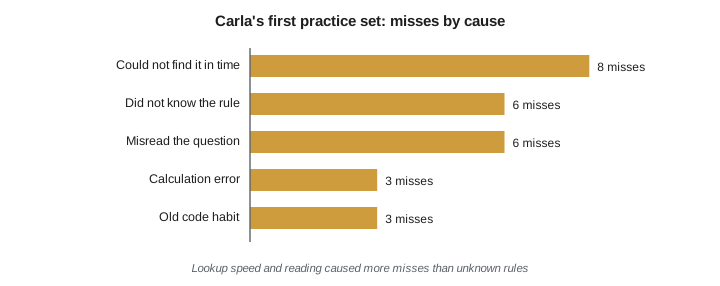
A miss log is a simple table with one row for each question missed or guessed: the topic, the source that answers it, the reason it was missed and what you will do about it. The reasons are the useful part. Carla used five: could not find it in time, did not know the rule, misread the question, calculation error and old code habit. After her first set, the log showed that lookup speed and reading together caused more misses than unknown rules. That changed her plan. Instead of reading more of the code, she spent the next two weeks drilling lookups and practicing a reading routine.
# Summarizing a miss log by cause (illustrative entries from one practice set)
misses = ["lookup", "rule", "misread", "lookup", "calc", "old code", "lookup", "misread",
          "rule", "lookup", "misread", "rule", "lookup", "old code", "misread", "calc",
          "lookup", "rule", "misread", "lookup", "rule", "old code", "misread", "calc",
          "rule", "lookup"]
counts = {}
for m in misses:
    counts[m] = counts.get(m, 0) + 1
for cause, n in sorted(counts.items(), key=lambda kv: -kv[1]):
    print(cause.ljust(9), "#" * n, n)
skill = counts["lookup"] + counts["misread"]
print("misses from lookup speed or reading:", skill, "of", len(misses))lookup ######## 8 rule ###### 6 misread ###### 6 calc ### 3 old code ### 3 misses from lookup speed or reading: 14 of 26
The output shows the same pattern as Carla's log: 14 of 26 misses came from lookup speed or reading, not from missing knowledge. For an open-book exam, that pattern is common and good news, because lookup speed and careful reading improve quickly with practice. Missing knowledge takes longer to fix. A candidate whose log shows the opposite pattern, with most misses from unknown rules, needs more study of the code itself before more practice sets.
Lookup drills
A lookup drill is a timed exercise in finding rules. Write twenty short prompts, such as the minimum size of a grounding electrode conductor for a given service, the receptacle requirements for a kitchen countertop, or the Wisconsin rule on the supervision ratio, and time how long it takes to find the answer for each in the permitted references. Repeat with new prompts until most take under a minute. Use the index as well as the tabs, because the index finds rules the tabs do not. Carla's average lookup time dropped from about three minutes to under one in two weeks, and her second practice set improved more than any amount of reading would have produced.
| Topic | Where to look | What to know |
|---|---|---|
| Eligibility routes | Statutes and SPS 305 | Degree, 12 months as a journeyman, or 60 months and 10,000 hours |
| Supervision ratio | SPS 305 and the DSPS FAQ | Registered electricians up to twice the licensed plus two |
| Code edition | SPS 316 and DSPS releases | 2023 NEC base from September 1, 2026 |
| Permits | Building program rules | No permitted work before the permit issues |
| Liens | Chapter 779 | 60-day owner notice, 30-day intent, six-month claim, two-year suit |
| Renewal | SPS 305 and DSPS page | 24 hours per four-year term ending June 30 |
Reading the question
Misreading costs points that knowledge cannot recover. A simple routine helps. Read the last sentence first to find what is being asked. Then read the facts and circle the words that decide which rule applies: the occupancy, the voltage, dwelling or not, indoor or outdoor, new or existing, the date if a code edition matters. Watch for words such as not, except, minimum, maximum and all of the following. Decide which reference should answer the question before opening any book. After choosing an answer, reread the question once to confirm the answer matches what was asked, not a related question.
Calculations
Calculation questions reward a consistent method. Write the formula, write the values with units, compute and check the result against common sense. A dwelling service that calculates to 2,000 amperes is wrong. Know which table the question expects you to use, and look for the adjustment and correction factors that change a conductor's ampacity. Practice with the calculator you will bring until the sequence of keys for a three-phase calculation is automatic. On her third practice set, Carla made no calculation errors at all, because she had started writing units on every line.
The two-pass method
On exam day, use two passes. On the first pass, answer every question you can answer quickly, either from knowledge or with a lookup you know will take under a minute, and mark the rest. On the second pass, return to the marked questions and work them with full lookups. If time runs short, answer every remaining question with your best guess rather than leaving it blank, unless the exam instructions say blanks and wrong answers are scored differently. The first pass banks the easy points and shows you how much time the hard ones can have.
Worked problem
Managing the clock
Josh is halfway through the time on his exam and has answered 45 questions, with 15 marked for the second pass and the rest still unread. He is stuck on a long load calculation. What should he do?
Show solution
- Mark the calculation and move on; one question is not worth the time of three.
- Finish the first pass on the unread questions, answering the quick ones.
- Return to the marked questions in order of how quickly he expects to solve them.
- Leave a few minutes at the end to make sure every question has an answer.
Answer: Move on, finish the first pass, then work the marked questions fastest first and answer everything before time ends.
The days before and the morning of
In the last week, stop learning new material and review: your miss log, your lookup notes and the high-yield table. Check the permitted materials list one more time and pack the four items, pencils, calculator, spare battery and photo ID the night before. Confirm the location, the arrival time and parking. Sleep and eat normally. Carla drove to the exam site in Eau Claire the Sunday before so that Monday morning held no surprises. On the morning itself, arrive about 30 minutes early, use the restroom before check-in, and spend the first minute in the seat breathing slowly and reading the instructions.
Nerves are normal and useful in small amounts. If a question rattles you, mark it and move on; a fresh question often restores confidence. If your mind goes blank, close your eyes for ten seconds, breathe and return to the reading routine. The exam is long enough that one bad stretch does not decide it.
A sample week of study
Carla's study weeks between January and April followed a simple pattern. Monday and Wednesday evenings were for one weak area from the miss log, about an hour each, reading the rules and working a few practice questions on that topic. Tuesday was a twenty-prompt lookup drill with a timer. Thursday was calculations: two load calculations, a voltage drop problem and a conduit fill problem, each with units written on every line. Friday was off. Saturday morning was a full timed practice set every second week, or a review of the last set's misses in the weeks between. Sunday was a short review of the binder and the high-yield table.
That schedule added up to about six hours a week, which fit around full-time work and a family. The structure mattered more than the hours. Each week attacked the causes the miss log showed, and each practice set measured whether the fix had worked. By the fourth practice set the misses from lookups and misreading had fallen to a handful, and the remaining misses were spread thinly across topics. That was the point at which Carla booked the exam.
One more habit helped in the last month. After each practice set, Carla wrote three questions she had missed on index cards with the answer and the section on the back, and reviewed the stack on her lunch breaks. By April the stack held about forty cards, almost all of them Wisconsin-specific rules and code changes from 2017 to 2023.
After the exam
Results generally arrive within about three weeks. If you pass, pay the credential fee, give the license number to your company and put the expiration date and continuing education plan on your calendar. If you do not pass, request the review of the failed exam if it will help, update your miss log with the areas the score report shows, and schedule the retake far enough out to fix them. Many good masters passed on a second attempt. Carla's pass came with a note from Gene taped to her binder: "Now the hard part starts."
Common mistakes
MistakeTreating practice set scores as predictions.
InsteadA practice set measures where points are lost; the review is what matters.
MistakeReading more code when the miss log shows lookup and reading problems.
InsteadDrill lookups and practice a reading routine when those are the causes.
MistakeFighting one hard question for ten minutes.
InsteadMark it and return on the second pass.
MistakePacking materials the morning of the exam.
InsteadPack the night before and check against the current permitted list.
Summary and key terms
- Take practice sets under exam conditions and treat them as measurements.
- Keep a miss log by cause; lookup speed and reading are often the biggest sources of lost points.
- Use timed lookup drills, a reading routine and a consistent calculation method.
- Use the two-pass method on exam day and answer every question before time ends.
- Review, pack and plan the logistics before exam day, and follow up on results either way.
- Practice set
- A timed set of exam-style questions used to measure readiness.
- Miss log
- A record of each missed question with its topic, source and cause.
- Lookup drill
- A timed exercise in finding rules in the permitted references.
- Reading routine
- A fixed way of reading each question to avoid misreading it.
- Two-pass method
- Answering quick questions first, then returning to marked questions.
Practice problems
Work each problem on paper first, then reveal the answer to check.
What is the main purpose of a practice set?
Show answer
To measure where points are being lost, so study time goes where it pays.
A miss log shows most misses from could not find it in time. What should the candidate do?
Show answer
Drill lookups with a timer and practice using the index and tabs.
What should a candidate do with a question that is taking too long?
Show answer
Mark it, move on and return on the second pass.
How early should a candidate arrive on exam day?
Show answer
About 30 minutes early, with photo ID and permitted materials.
Lesson quiz · 5 questions
Score 60% or more to complete this lesson.
Create a free account to save your progress, take quizzes and earn a certificate.