
MELU-324 · Lesson 5 of 12 · 18 min
The NEC as adopted in Wisconsin and state amendments
▶ Video coming soon A video version of this lesson is on the way.
In the summer of 2026 Red Cedar's estimators had a new question on every bid sheet: which code? The department had announced that Wisconsin would move from its modified 2017 National Electrical Code to a modified 2023 edition on September 1, 2026. A dental clinic in Altoona had its plans submitted in August; a farm shop near Fall Creek would not be submitted until October. Gene called a short meeting. "Two jobs, two code books," he said. "Somebody is going to wire one of them to the wrong edition if we're not careful." For Carla, the meeting doubled as exam preparation, because the department had also announced that trades exam questions would reflect the new code from October 1.
This lesson explains how Wisconsin adopts the NEC through SPS 316, what adoption by reference with changes means, how the effective date decides which edition applies to a project, the safety changes the department highlighted in 2026, how to read a Wisconsin change alongside the NEC, and where to get an interpretation. It cites code sections by number only. The NEC and the Wisconsin rules should be read in the official texts.
Adoption by reference
Wisconsin does not reprint the National Electrical Code. Chapter SPS 316 adopts it by reference, which means the state says, in effect, that the NEC in a named edition is the Wisconsin Electrical Code except where SPS 316 says otherwise. SPS 316 then lists the Wisconsin changes, which fall into three kinds: additions that add a requirement the NEC does not have, changes that replace or modify an NEC rule, and omissions that remove an NEC rule from use in Wisconsin. Each Wisconsin change points to the NEC section it affects, so a reader can work from either book to the other.
Because of this structure, a Wisconsin electrician needs both books on the job and in the exam room. The NEC answers most installation questions. SPS 316 answers whether Wisconsin has changed that answer. A rule that appears in the NEC but has been omitted in Wisconsin does not apply here, and a requirement that appears only in SPS 316 applies even though the NEC is silent. Exam questions on the Wisconsin code are often built on exactly this point: a candidate who reads only the NEC picks the national answer, and the Wisconsin answer is different.
The 2026 change of edition
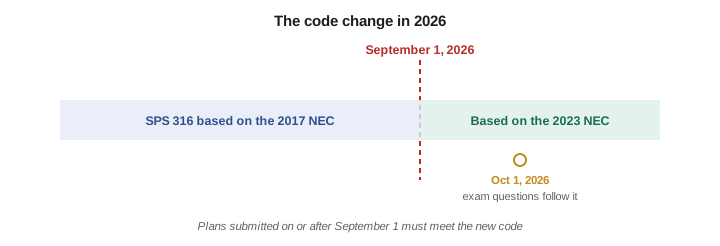
The department announced in mid-2026 that the updated SPS 316, adopting the 2023 NEC with Wisconsin's specific changes and omissions, would take effect on September 1, 2026, replacing the previous code based on the 2017 NEC. Its news release said that plans submitted on or after that date must meet the new code. A separate release said that from October 1, 2026, questions on the trades exams given by the department and Pearson VUE would reflect the code changes. Trade press coverage noted that Wisconsin had skipped the 2020 edition and moved directly to 2023.
Skipping an edition makes the jump larger. Several cycles of NEC changes arrived at once: new and expanded ground-fault and arc-fault requirements, changes to service and feeder rules, new provisions for energy storage, electric vehicle equipment and emergency disconnects, and rewritten articles throughout. Electricians who learned the 2017 edition should not assume a familiar rule kept its section number or its wording. Carla bought a new code book in the summer and studied from it alone, using an NEC changes summary from a training publisher to see what had moved.
Which edition applies to a job
The department's release ties the new code to the date plans are submitted. For work that requires plan review, plans submitted on or after September 1, 2026 must meet the new code. For work that does not require plan review, the date that controls is set by the rules and the local program, commonly tied to the permit application or the start of work. When in doubt, the inspector for the job is the person to ask, before the rough-in rather than after it. The dental clinic plans submitted in August stayed under the previous code; the farm shop submitted in October fell under the new one.
# Which Wisconsin code edition applies? (simplified study aid; check the rule for your job)
from datetime import date
CHANGE = date(2026, 9, 1)
def edition(submitted):
    return "SPS 316 based on the 2023 NEC" if submitted >= CHANGE else "SPS 316 based on the 2017 NEC"
jobs = [("Altoona dental clinic", date(2026, 8, 14)),
        ("Fall Creek farm shop", date(2026, 10, 6)),
        ("Lake Hallie retail fit-out", date(2026, 9, 1))]
for name, d in jobs:
    print(name, "submitted", d, "->", edition(d))
EXAM_CHANGE = date(2026, 10, 1)
print("exam questions follow the new code from", EXAM_CHANGE)Altoona dental clinic submitted 2026-08-14 -> SPS 316 based on the 2017 NEC Fall Creek farm shop submitted 2026-10-06 -> SPS 316 based on the 2023 NEC Lake Hallie retail fit-out submitted 2026-09-01 -> SPS 316 based on the 2023 NEC exam questions follow the new code from 2026-10-01
The output shows the edge case that confuses people: a job submitted on September 1 itself falls under the new code, because the rule says on or after. On the exam, a question that gives a date and asks which edition applies is testing exactly that boundary. Read the date in the question carefully and compare it to the effective date.
The changes the department highlighted
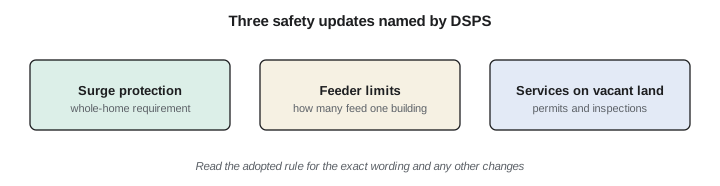
In announcing the new code, the department highlighted several safety updates. Among them were a requirement for whole-home surge protection, limits on the number of feeders that may supply a building, and permits and inspections for electrical services on vacant land. Each of these comes partly from the 2023 NEC and partly from how Wisconsin chose to adopt it, so the exact rule has to be read in both books. A candidate does not need to memorize the wording; the candidate needs to know that these topics changed and where to look.
The vacant-land change matters in a rural market like Red Cedar's. Farmers and cabin owners often want a service on a pole at the edge of a field or a lot before anything else is built. Under the new rule, such services need a permit and an inspection like any other. Red Cedar added a line to its estimating checklist for the permit, and Beth started asking customers early whether the parcel had a building on it yet.
| Kind of Wisconsin change | What it does | How to read it |
|---|---|---|
| Addition | Adds a requirement the NEC does not have | Apply it along with the NEC rule |
| Change | Replaces or modifies an NEC rule | Use the Wisconsin version instead |
| Omission | Removes an NEC rule from use in Wisconsin | The NEC rule does not apply here |
Interpretations and variances
When the code is unclear for a particular installation, the inspector for the job makes the first call. A contractor who disagrees can ask the department's code consultants for an interpretation. Where a project cannot meet a rule as written but can meet its intent another way, the administrative code provides for a petition for variance, which the department reviews and may grant with conditions. Variances take time and need a written explanation, so they are a planning tool, not a fix for a failed rough-in. Carla's notes for the exam listed the difference: an interpretation explains what the rule means; a variance permits a different way to meet its intent.
Worked problem
Reading a Wisconsin change
A question describes a new single-family home in Eau Claire wired after the 2026 change and asks whether surge protection is required for the service. A candidate finds the NEC section on surge protection in dwelling services. What else should the candidate check before answering?
Show solution
- Confirm which edition applies from the date given in the question.
- Read the NEC section in the 2023 edition for the general requirement.
- Look in SPS 316 for any Wisconsin addition, change or omission to that section.
- Answer from the combination: the NEC rule as modified, if at all, by Wisconsin.
Answer: Check SPS 316 for a Wisconsin change to the NEC section before answering; the Wisconsin version controls where it differs.
Other Wisconsin rules that touch electrical work
SPS 316 is not the only part of the administrative code an electrician meets. The Uniform Dwelling Code sets building rules for one- and two-family homes, including the electrical permit and inspection framework for those homes, and its own requirements on items such as smoke alarms that tie into the electrical work. The commercial building code sets rules for other buildings, including plan review thresholds. Other chapters cover elevators, fire protection systems and energy conservation. When a question or a job involves one of those systems, the electrical code may not be the only rule that applies, and the inspector may point to a different chapter.
The department's code pages list each chapter with its subject and current edition. Carla kept a short index in her binder of which chapter covered which kind of building and system, so that when an exam question described a two-family home she would think of the Uniform Dwelling Code as well as SPS 316. She did not try to learn those chapters in depth, because the master exam focuses on the electrical code and the credential rules, but knowing they exist kept her from picking a wrong answer that ignored them.
How code changes reach the field
Code changes do not arrive overnight on job sites. In the months before and after the effective date, contractors finish jobs under the old code while bidding new ones under the new code, inspectors carry both books, suppliers adjust stock, and training providers run update classes. Approved continuing education providers usually offer code update courses in the cycle after a change, and many masters build their next renewal hours around them. Red Cedar held three lunch sessions in the fall of 2026, each covering a handful of changes that mattered to the company's work, and Carla taught one of them as part of her own exam preparation.
Studying for the new code
Because the exam moved to the new code a month after the code itself, candidates who sat in late 2026 and 2027 studied from the 2023 edition and the new SPS 316. Practice questions written for the 2017 edition can still help with calculations and general structure, but their section numbers and some of their answers will be wrong. Carla checked every practice question against her new book and wrote the 2023 section number next to each one in her practice log. That habit turned old questions into useful ones and taught her where things had moved.
Common mistakes
MistakeReading only the NEC and assuming it is the whole Wisconsin code.
InsteadAlways check SPS 316 for additions, changes and omissions.
MistakeAssuming the job's edition depends on when wiring starts in every case.
InsteadThe department ties the new code to plans submitted on or after September 1, 2026; confirm the rule for each job.
MistakeUsing a practice set written for the 2017 edition without checking it.
InsteadCheck each question against the 2023 edition and the current SPS 316.
MistakeTreating a variance like an interpretation.
InsteadAn interpretation explains a rule; a variance permits a different way to meet its intent.
Summary and key terms
- SPS 316 adopts the NEC by reference and lists Wisconsin additions, changes and omissions.
- The code based on the 2023 NEC took effect September 1, 2026, replacing the code based on the 2017 NEC; plans submitted on or after that date must meet it.
- Trades exam questions follow the new code from October 1, 2026.
- The department highlighted whole-home surge protection, limits on feeders to a building and permits for services on vacant land.
- Interpretations come from the inspector and the department's code consultants; a variance is a petition to meet a rule's intent another way.
- Adoption by reference
- Making a published code part of state law by naming it, without reprinting it.
- Addition
- A Wisconsin requirement that adds to the NEC.
- Omission
- An NEC rule that Wisconsin removes from use.
- Petition for variance
- A request to the department to meet the intent of a rule in a different way.
- Code consultant
- A department staff member who answers code questions and gives interpretations.
Practice problems
Work each problem on paper first, then reveal the answer to check.
On what date did the code based on the 2023 NEC take effect?
Show answer
September 1, 2026.
Plans submitted August 31, 2026: which edition?
Show answer
The code based on the 2017 NEC.
From what date do trades exam questions reflect the new code?
Show answer
October 1, 2026.
If the NEC requires something that SPS 316 omits, does it apply in Wisconsin?
Show answer
No. An omitted NEC rule does not apply.
Lesson quiz · 5 questions
Score 60% or more to complete this lesson.
Create a free account to save your progress, take quizzes and earn a certificate.