
MELU-317 · Lesson 9 of 12 · 19 min
Contracts and mechanics' liens in Tennessee
▶ Video coming soon A video version of this lesson is on the way.
In the spring, Duck River finished the electrical work on a two-story office building in Spring Hill for Hardin Builders, a general contractor it had worked with for years. The subcontract was 186,000 dollars. Hardin paid the first three monthly draws on time, then started paying late, then stopped. By June, Duck River was owed 58,000 dollars, Hardin's office was not returning calls, and Hector Ruiz had heard from a supplier that Hardin was in trouble on two other jobs. Renee asked the question every contractor eventually asks: can we put a lien on the building?
The answer depended on dates Renee had not been tracking closely enough, and the lesson she took from the Hardin job became Duck River's lien calendar. This lesson covers the contract basics a Tennessee electrical contractor needs, the difference between prime and remote contractors under the lien statute, the notices and deadlines that preserve lien rights, the owner's tools for shortening those deadlines, and the special rules for residential work. Lien law is technical and the deadlines are strict, so treat this as a map and read the statute in Title 66, Chapter 11 of the Tennessee Code, or ask a construction lawyer, before relying on a deadline.
Contract basics
Most lien problems begin as contract problems. A written contract should identify the parties, the property, the scope of work and the drawings or specifications it is based on, the price or the method of pricing, the payment schedule and retainage, the procedure for change orders, the schedule and the warranty. It should also say what happens if the owner or general contractor does not pay: interest, the right to stop work after notice, and who pays the costs of collection.
Subcontracts deserve a careful read, because general contractors write them and the terms tend to favor the general contractor. Clauses to look for include pay-if-paid or pay-when-paid language tying Duck River's payment to the owner's payment of Hardin, broad indemnity clauses, waivers of lien rights in advance, and no-damages-for-delay clauses. Tennessee law limits some of these, but the details are a matter for the contract and the statute, and a construction lawyer can tell you which clauses are enforceable before you sign rather than after a dispute.
Change orders are where many electrical disputes start. A general contractor's superintendent asks for an extra circuit, a moved panel or a new fixture type, the crew does it, and the extra never makes it into writing. Duck River's rule is that every change gets a written change order, signed or at least confirmed by email, before the work is done, with the price or the method of pricing stated. That record also matters for liens, because a lien covers the value of the work actually furnished under the contract and its changes.
Prime and remote contractors
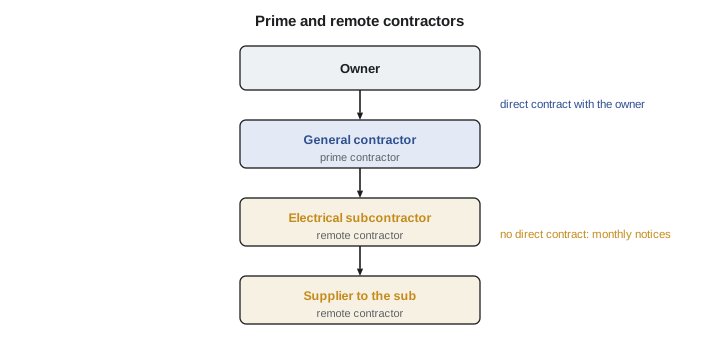
Tennessee's lien statute divides lienors into two groups. A prime contractor is one who contracts directly with the owner of the property. A remote contractor is one who does not, such as a subcontractor to the general contractor, a sub-subcontractor or a supplier to a subcontractor. The two groups have different notice requirements, and remote contractors have more steps to follow. On the Spring Hill building, Hardin Builders was the prime contractor and Duck River was a remote contractor.
Prime contractor rights
A prime contractor's lien arises from the contract with the owner, and generally attaches from the visible commencement of work on the property. To preserve its priority against later purchasers and lenders, a prime contractor generally records a notice of lien within ninety days after the work is completed or abandoned. A lien is then enforced by filing suit within the period the statute allows, generally one year from recording or completion, depending on the circumstances. When Duck River contracts directly with an owner, such as a farm owner or a church, it is a prime contractor and follows these rules.
Remote contractor notices
A remote contractor has to give notice along the way. Under the statute, a remote contractor who is not paid for work furnished in a month serves a notice of nonpayment on the owner and the prime contractor within ninety days after the last day of that month. The notice tells the owner that money is owed before the owner pays the prime contractor in full, which gives the owner a chance to protect itself. A remote contractor who skips the monthly notice can lose lien rights for the unpaid amounts it covered.
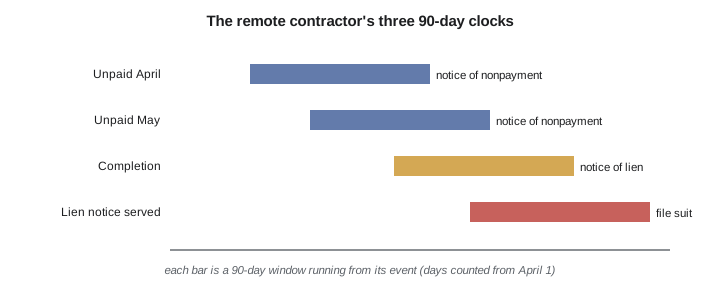
To preserve the lien itself, the remote contractor serves and records a notice of lien within ninety days after the completion or abandonment of the improvement, and then files suit to enforce it within ninety days after serving the notice of lien. Those three ninety-day periods, monthly nonpayment, notice of lien and suit, are the core of the remote contractor's calendar, and each one has to be met independently.
from datetime import date, timedelta
import calendar

def month_end(y, m):
    return date(y, m, calendar.monthrange(y, m)[1])

unpaid_months = [(2026, 4), (2026, 5)]   # months with unpaid work on the Hardin job
completion = date(2026, 6, 12)

for y, m in unpaid_months:
    end = month_end(y, m)
    print(f"Unpaid work in {calendar.month_name[m]}: notice of nonpayment by {end + timedelta(days=90)}")

lien_notice = completion + timedelta(days=90)
print("Serve and record the notice of lien by", lien_notice)
served = date(2026, 7, 20)               # the day Renee actually served it
print("If served on", served, "suit must be filed by", served + timedelta(days=90))Unpaid work in April: notice of nonpayment by 2026-07-29 Unpaid work in May: notice of nonpayment by 2026-08-29 Serve and record the notice of lien by 2026-09-10 If served on 2026-07-20 suit must be filed by 2026-10-18
Running the calendar showed Renee that Duck River was still inside every window when she asked the question in June. She served notices of nonpayment for April and May, served and recorded a notice of lien in July, and gave the lawyer the dates for a suit. Hardin's lender, faced with a recorded lien, paid Duck River from the remaining construction loan in August, before any suit was filed.
The owner's tools
The statute also gives owners tools to limit lien exposure. An owner can record a notice of completion when the improvement is finished. After that notice, a lienor who has not already served a notice of lien generally must do so within thirty days, or within a shorter period for residential work, rather than ninety. An owner can also serve a written demand on a lienor to file suit, and the lienor then generally must sue within sixty days or lose the lien. Owners use these tools when they want to close out a project or sell or refinance the property, so a contractor who receives either document must check the new deadline immediately.
| Event | Who acts | Period described in the statute |
|---|---|---|
| Unpaid work in a month | Remote contractor serves notice of nonpayment | Within 90 days after the last day of that month |
| Completion or abandonment | Remote contractor serves and records notice of lien | Within 90 days |
| Remote contractor serves notice of lien | Remote contractor files suit | Within 90 days after service |
| Owner records notice of completion | Lienors who have not given notice of lien | Within 30 days, or 10 days for residential |
| Owner serves demand to sue | Lienor files suit | Within 60 days |
| Prime contractor completes work | Prime records notice of lien for priority | Within 90 days |
Residential work
Residential projects have extra rules. For work on a residence, the statute generally limits lien rights for remote contractors, and the owner's protections are stronger, because a homeowner who has paid the prime contractor in full should not have to pay twice. A residential prime contractor has its own notice and contract requirements. For Duck River, which does panel upgrades and additions for homeowners as a prime contractor, the practical lesson is to use a clear written contract, collect progress payments as the work proceeds and never let a residential balance grow large, because the lien is a weaker tool on homes than on commercial projects.
As a subcontractor on residential subdivisions, Duck River's position is weaker still. A remote contractor on a home may have no lien at all, and its protection is the contract with the builder and the builder's credit. Hector checks a builder's payment history with suppliers before taking on residential subcontract work, and he limits the company's exposure to any one builder.
Public projects
Liens generally cannot be filed against public property, such as a school, a county building or a state facility. On public work, the protection for subcontractors and suppliers is the payment bond that the prime contractor furnishes, covered in lesson 8. Claims on a payment bond have their own notice and suit deadlines, set by the statute that governs that public owner and by the bond itself, and those deadlines can be shorter than lien deadlines. When Duck River works on a public job, Renee asks the general contractor for a copy of the payment bond at the start, not when a payment problem arises.
Prompt pay and retainage
Tennessee also has prompt pay rules that set times for payment and limit retainage on many construction contracts, and they generally require retained funds on certain contracts to be held in a separate account. These rules change the conversation with a slow-paying general contractor, because they can give the subcontractor a claim for interest. Their details depend on the type of project and the contract, so read the current statute with the contract in hand. Duck River's subcontracts now ask for retainage to be released within a set time after the electrical work is accepted, rather than at the end of the whole project.
Worked example: a missed month
Worked problem
What does a late notice cost?
On another job, Duck River was owed 9,000 dollars for March work and 14,000 dollars for April work. Renee served a notice of nonpayment for both months on August 15. Which amounts did the notice cover in time, if each notice is due within 90 days after the end of the month?
Show solution
- The end of March is March 31; ninety days later is June 29.
- The end of April is April 30; ninety days later is July 29.
- August 15 is after both deadlines.
- Neither month's notice was timely.
Answer: Both months were late, so Duck River may have lost lien rights for the 23,000 dollars, leaving the contract claim against the general contractor. The lesson is to serve notices every month, as soon as payment is late.
The example is the reason Duck River's lien calendar is a monthly routine. On the tenth of each month, Renee reviews every open job for unpaid amounts from earlier months and serves notices where needed. General contractors who pay on time never see them, and those who do not are reminded that Duck River knows the law.
Common mistakes
MistakeWaiting until the job is finished to think about lien rights.
InsteadRemote contractors need monthly notices of nonpayment along the way.
MistakeIgnoring an owner's notice of completion.
InsteadIt can shorten the time to serve a notice of lien to thirty days, or less for residential work.
MistakeFiling a lien against a public school.
InsteadPublic property is generally not lienable; use the payment bond.
MistakeRelying on verbal change orders.
InsteadPut every change in writing before doing the work.
Summary and key terms
- Prime contractors contract with the owner; remote contractors do not and have more notice steps.
- A remote contractor serves a notice of nonpayment within 90 days after the end of each unpaid month.
- A remote contractor serves and records a notice of lien within 90 days after completion and sues within 90 days after serving it.
- An owner's notice of completion shortens the time to give notice of lien, and a demand to sue requires suit within 60 days.
- Remote contractors have limited or no lien rights on residential work, and public projects rely on payment bonds instead of liens.
- Prime contractor
- A contractor who contracts directly with the owner.
- Remote contractor
- A subcontractor, sub-subcontractor or supplier without a direct contract with the owner.
- Nonpayment notice
- Also called a notice of nonpayment; a remote contractor's notice to the owner and prime contractor that it has not been paid for a month's work.
- Lien notice
- Also called a notice of lien; the document that preserves a lien, served and recorded within the statutory period.
- Completion notice
- Also called a notice of completion; an owner's recorded notice that the improvement is complete, which shortens lien deadlines.
Practice problems
Work each problem on paper first, then reveal the answer to check.
On the Spring Hill building, was Duck River a prime or remote contractor?
Show answer
A remote contractor, because it contracted with Hardin Builders, not the owner.
How long does a remote contractor have to serve a notice of nonpayment for a month's unpaid work?
Show answer
Within 90 days after the last day of that month.
What must a lienor do after receiving an owner's demand to sue?
Show answer
File suit within 60 days or lose the lien.
What replaces lien rights on a public project?
Show answer
The prime contractor's payment bond.
Lesson quiz · 5 questions
Score 60% or more to complete this lesson.
Create a free account to save your progress, take quizzes and earn a certificate.