
MELU-317 · Lesson 2 of 12 · 20 min
Eligibility for the Electrical Contractor License
▶ Video coming soon A video version of this lesson is on the way.
Alicia's first question was simple: am I allowed to apply? In many states the answer depends on a count of hours and years as a licensed journeyman. In Tennessee, the state contractor's license works differently. The license belongs to a business, and eligibility is spread across three things: the person who will qualify the business by passing the exams, the business's finances, and the business's insurance. Renee Coleman, Duck River's office manager, pulled the company's last financial statement and insurance certificates while Alicia read the board's application instructions, and the two of them went through the requirements line by line.
This lesson walks through those three parts, explains how the board sets a monetary limit, and covers the local master electrician licenses that some Tennessee cities require on top of the state license. It uses Duck River's numbers, which are invented for the course, to show how the calculations work.
Who can hold a license
A Tennessee contractor's license can be issued to a sole proprietor, a partnership, a limited liability company or a corporation. The application lists the owners, partners, members, officers and major stockholders, and the board's contractor affidavit has to be signed and notarized by the qualifying agent and by those principals. The affidavit asks about past complaints, criminal convictions and any bids or work performed without a required license. A yes answer does not automatically disqualify an applicant, but it can lead the board to call the applicant in for an interview at a regular board meeting before deciding.
The business also needs the ordinary registrations any Tennessee company needs: a filing with the Secretary of State for an LLC or corporation, a federal employer identification number if it has employees, and local business tax registration where it operates. Those are not part of the contractor application itself, but the board expects the business named on the application to exist in that form, and a mismatch between the legal name on the application and the name on the financial statement or insurance certificate is a common reason for delays.
The qualifying agent
Every classification on the license is backed by a qualifying agent, the individual who passes the exams for that classification. For the CE classification, the qualifying agent passes the Business and Law exam and the CE trade exam. The board's materials describe exam scores as generally valid for two years, so the application should follow the exams reasonably soon. The qualifying agent does not have to own the business, but has to be genuinely connected to it, because the agent's name and exam results are what the board relies on when it grants the classification.
Unlike a state master electrician license in many other states, the CE classification does not come with a published minimum number of journeyman years that the agent must hold. The board instead asks for evidence of experience and a letter of reference. The reference must come from a past client, a past employer or a code official who inspected the applicant's work, and it may not come from a family member. Alicia asked the Metro Codes inspector who had signed off on several of her commercial jobs, and a general contractor Duck River has worked for, to write letters describing the work she supervised.
The financial statement
The part of Tennessee eligibility that surprises most electricians is the money. The board sets a monetary limit for each license, and the limit comes from the business's financial statement. The board defines working capital as current assets minus current liabilities, and net worth as total assets minus total liabilities. The monetary limit is ten times the lesser of the two figures, and the applicant must also show the required experience. A business with 15,000 dollars of working capital and 15,000 dollars of net worth qualifies for a 150,000-dollar limit; a business with 50,000 dollars of working capital and 30,000 dollars of net worth is limited by the smaller figure and qualifies for 300,000 dollars.
The board publishes rules about the statement itself. It must be prepared by an independent licensed accounting firm, follow generally accepted accounting principles and be less than twelve months old. Under the board's current guidance, a reviewed statement is required for requested limits of 3,000,000 dollars or less, and an audited statement for limits above that. An unlimited license requires at least 300,000 dollars in both working capital and net worth, along with experience and an audited statement. Older versions of the application booklet used lower thresholds, so read the version current when you apply.
| Item | Definition or rule (board guidance) |
|---|---|
| Working capital | Current assets minus current liabilities |
| Net worth | Total assets minus total liabilities |
| Monetary limit | Ten times the lesser of working capital and net worth, plus required experience |
| Reviewed statement | Required for limits of 3,000,000 dollars or less |
| Audited statement | Required for limits above 3,000,000 dollars |
| Unlimited license | At least 300,000 dollars in both working capital and net worth, experience and an audited statement |
| Bid tolerance | Bids may exceed the limit by up to a tenth of the limit (not for the restricted residential license) |
Duck River's numbers
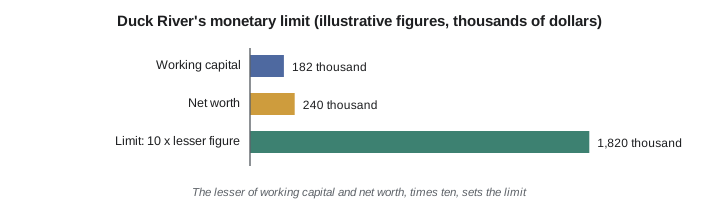
Duck River's most recent reviewed statement, prepared by its accounting firm in Columbia, shows current assets of 412,000 dollars and current liabilities of 230,000 dollars, for working capital of 182,000 dollars. Total assets are 651,000 dollars and total liabilities 411,000 dollars, for net worth of 240,000 dollars. The lesser figure is the working capital, so the limit is ten times 182,000 dollars, or 1,820,000 dollars. With the board's tolerance of one tenth, the company could bid a job of up to 2,002,000 dollars without asking for an increase.
def monetary_limit(cur_assets, cur_liab, tot_assets, tot_liab):
    working_capital = cur_assets - cur_liab
    net_worth = tot_assets - tot_liab
    lesser = min(working_capital, net_worth)
    return working_capital, net_worth, 10 * lesser

wc, nw, limit = monetary_limit(412_000, 230_000, 651_000, 411_000)
tolerance = limit // 10
print(f"Working capital: {wc:,} dollars")
print(f"Net worth:       {nw:,} dollars")
print(f"Monetary limit:  {limit:,} dollars")
print(f"Largest bid with tolerance: {limit + tolerance:,} dollars")

# What working capital would the Memphis warehouse need on its own?
warehouse = 1_240_000
print(f"Working capital and net worth needed for {warehouse:,}: {warehouse // 10:,} each")Working capital: 182,000 dollars Net worth: 240,000 dollars Monetary limit: 1,820,000 dollars Largest bid with tolerance: 2,002,000 dollars Working capital and net worth needed for 1,240,000: 124,000 each
The Memphis warehouse at 1,240,000 dollars fits easily. If Duck River later wants to bid hospital work above 2,000,000 dollars, it would need either a stronger balance sheet or another way to support a higher limit, and Renee has already marked that question for a conversation with the accountant.
Bonds and guaranties
When the financial statement falls short of the limit the business wants, the board allows other support. Its guidance describes a guaranty from a person or company with enough financial strength, which expires at renewal and lasts no more than two years, and a bond on the board's form, set at 500,000 dollars, or 1,000,000 dollars for an unlimited limit. The board's current guidance also says that starting July 1, 2026, a surety bond of at least half of the requested limit may be used in place of the financial statement. Each option has its own paperwork and cost, and a surety will look hard at the same balance sheet the board would have read.
Insurance and workers' compensation
The board will not issue a license until it has proof of general liability insurance and workers' compensation coverage. The required liability coverage rises with the monetary limit, so a company asking for a higher limit needs a larger policy. Workers' compensation is required unless the applicant has a valid exemption, and Tennessee's rules for construction businesses are strict: construction employers with one or more employees must carry coverage. Lesson 8 covers the insurance tiers, exemptions and bonding in detail.
Duck River already carries both, so for this application the company only needs current certificates that name the business exactly as it appears on the application. Renee asks the agent to issue them directly to the board, which avoids copies that the board might question.
Classifications beyond CE
The board's classification outline lists several electrical specialties alongside CE. High-voltage work, sound, intercom, fire detection and alarm systems, telephone lines, cabling and electric meter installation each have their own classification, and some of them do not require a trade exam. A business that only installs low-voltage cabling might hold one of those narrower classifications. A full-service electrical contractor holds CE, which covers residential, commercial and industrial wiring, and may add specialties as its work expands.
| Classification (board outline) | Scope | Trade exam |
|---|---|---|
| CE | Electrical: residential, commercial and industrial wiring | Yes |
| CE high-voltage specialty | High-voltage work | Check the outline |
| CE alarm and signaling specialty | Sound, intercom, fire detection or alarm systems | Check the outline |
| CE telephone and cabling specialties | Telephone lines and cabling | No trade exam listed |
| CE meter specialty | Electric meter installation | Check the outline |
Alicia's checklist
By the end of the evening Alicia and Renee had a list. Alicia would book the Business and Law exam and the CE trade exam. Renee would get updated insurance certificates and confirm the accountant's statement was less than twelve months old on the date the application would reach the board. Alicia would collect two reference letters. Carl would sign the affidavit as an owner, and Alicia would sign as the new qualifying agent. Because the company already holds a license, they would file to change the qualifying agent rather than apply for a brand-new license, and Renee called the board's office to confirm which form that takes.
They also noted two local tasks. Alicia would apply to sit Metro Nashville's master electrician exam if Metro still required it of the company's supervising electrician, and Renee would check the Memphis and Shelby County registration requirements before the warehouse bid was due. Those local steps run on their own schedules and should not wait until the state license work is finished.
Worked example: the limit after a bad year
Worked problem
A shrinking balance sheet
Suppose a slow year leaves Duck River with current assets of 300,000 dollars, current liabilities of 260,000 dollars, total assets of 540,000 dollars and total liabilities of 390,000 dollars. What monetary limit would a new statement support, and could the company still bid the 1,240,000-dollar Memphis warehouse?
Show solution
- Working capital is 300,000 minus 260,000, or 40,000 dollars.
- Net worth is 540,000 minus 390,000, or 150,000 dollars.
- The lesser figure is working capital at 40,000 dollars.
- Ten times 40,000 dollars is a limit of 400,000 dollars; the bid tolerance of one tenth adds 40,000 dollars.
Answer: The limit would be 400,000 dollars, too low for the warehouse. The company would need to rebuild working capital, request a higher limit with a bond or guaranty, or use the surety bond route available from July 1, 2026.
The example shows why the board looks at working capital and not only at net worth. A company can own trucks, equipment and a building and still have little cash and receivables left after paying its short-term bills. Working capital is the money that carries a contractor through the gap between buying material and getting paid, and the limit tracks it closely. Renee watches the ratio through the year, not only when the statement is due, because a large job with slow payments can drain working capital in a few months.
Two habits help. First, avoid surprising the balance sheet right before the statement date with large equipment purchases paid from cash, which shift money from current to fixed assets. Second, collect retainage and old receivables before year end where the contracts allow it. Neither habit changes what the company is worth, but both keep the figure the board uses closer to the company's real strength.
Common mistakes
MistakeAssuming the CE classification has a fixed number of journeyman years like a master license.
InsteadThe board relies on exams, experience evidence and references; local master licenses may set their own year requirements.
MistakeUsing net worth to set the limit when working capital is lower.
InsteadThe limit is ten times the lesser of working capital and net worth.
MistakeSubmitting a financial statement more than twelve months old.
InsteadThe board requires a statement less than twelve months old, prepared by an independent licensed accounting firm.
MistakeAsking a relative for a reference letter.
InsteadReferences must come from a past client, employer or inspecting code official, not a family member.
Summary and key terms
- A Tennessee contractor's license is issued to a business, qualified by an individual who passes the exams for each classification.
- The monetary limit is ten times the lesser of working capital and net worth, and the applicant must show experience.
- Reviewed statements cover limits up to 3,000,000 dollars and audited statements cover higher limits under current guidance; an unlimited license needs 300,000 dollars in both figures.
- Bonds or guaranties can support a limit the statement cannot, and from July 1, 2026 a surety bond of at least half the limit may replace the statement.
- Proof of general liability insurance and workers' compensation coverage is required before the license issues.
- Working capital
- Current assets minus current liabilities.
- Net worth
- Total assets minus total liabilities.
- Reviewed statement
- A financial statement on which an accounting firm performs limited review procedures.
- Audited statement
- A financial statement examined by an independent accounting firm under auditing standards.
- Contractor affidavit
- The notarized statement signed by the qualifying agent and principals about complaints, convictions and unlicensed work.
Practice problems
Work each problem on paper first, then reveal the answer to check.
A company has working capital of 60,000 dollars and net worth of 90,000 dollars. What monetary limit does the formula give?
Show answer
600,000 dollars, ten times the lesser figure.
With that limit, what is the largest bid allowed with the one-tenth tolerance?
Show answer
660,000 dollars.
Who may write a reference letter for the application?
Show answer
A past client, past employer or a code official who inspected the work, but not a family member.
What does an unlimited license require financially?
Show answer
At least 300,000 dollars in both working capital and net worth, with an audited statement.
Lesson quiz · 5 questions
Score 60% or more to complete this lesson.
Create a free account to save your progress, take quizzes and earn a certificate.