
MELU-317 · Lesson 10 of 12 · 19 min
Workplace safety law and OSHA for electrical contractors
▶ Video coming soon A video version of this lesson is on the way.
Jaylen Price had been with Duck River for eight months when he reached into a lighting panel at a school renovation to pull a conductor he was sure was dead. The circuit had been switched off at the panel, but a second feed from an old emergency transfer arrangement nobody had drawn on the plans was still live. He got a shock through his hand, let go and sat down hard on the floor. He was lucky: a sore arm and a scare. The next morning, Alicia stopped every crew for an hour to talk about lockout, testing before touching and what the company is required to do when someone is hurt.
This lesson covers the safety law that governs that conversation. Tennessee runs its own occupational safety and health program, known as TOSHA, under a plan approved by federal OSHA. The lesson explains who TOSHA covers, which standards apply to electrical work, the employer's duties to report, record and train, what happens during an inspection, and how NFPA 70E fits with the law. The CE exam's reference list includes OSHA's construction standards and NFPA 70E, so this material appears on the test as well as on the job.
TOSHA and federal OSHA
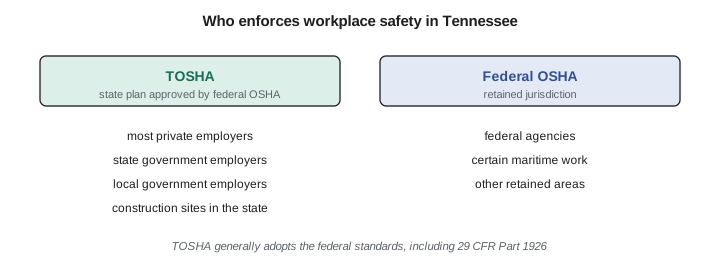
The federal Occupational Safety and Health Act lets states run their own programs if they are at least as effective as the federal one. Tennessee does so through the Tennessee Occupational Safety and Health Administration, part of the Department of Labor and Workforce Development. TOSHA enforces safety and health rules for most private employers in the state and also covers state and local government employers, which federal OSHA does not. A few workplaces, such as federal agencies and certain maritime operations, stay under federal jurisdiction.
TOSHA generally adopts the federal standards, including the construction standards in 29 CFR Part 1926 and the general industry standards in Part 1910, and it can add state rules. For an electrical contractor, the practical effect is that the federal standards apply on Tennessee jobs, enforced by state inspectors, with any state additions on top. When the CE exam asks about Part 1926, it is asking about the same rules TOSHA enforces.
The general duty and the specific standards
Every employer has a general duty to provide a workplace free from recognized hazards likely to cause death or serious harm, and a duty to comply with the specific standards that apply. On construction sites, the electrical standards in Subpart K of Part 1926 are central. They cover the design and installation of temporary wiring, ground-fault protection for receptacles used by employees, the condition of cords and tools, working near energized parts, and lockout and tagging of circuits.
One requirement every electrical crew knows is ground-fault protection on construction sites. The construction standards require the employer to protect employees using temporary receptacles either with ground-fault circuit interrupters or with an assured equipment grounding conductor program that inspects and tests cords and tools on a schedule. Most contractors use GFCI protection because it is simpler to document. Duck River's job boxes carry portable GFCI units, and the crews test them before use.
Other parts of Part 1926 matter just as much. Fall protection rules apply when workers are on ladders, scissor lifts and roofs. Excavation rules apply to trenches for underground feeders. Rules for cranes and other equipment working near overhead lines set minimum clearances. Personal protective equipment rules require the employer to assess hazards and provide equipment that fits the hazard.
| Topic | Where it appears | Typical electrical contractor issue |
|---|---|---|
| Electrical safety on construction sites | 29 CFR Part 1926, Subpart K | Temporary wiring, GFCI or assured grounding, lockout and tagging |
| Fall protection | Part 1926, Subpart M | Work on roofs, platforms and open edges |
| Ladders and stairways | Part 1926, Subpart X | Nonconductive ladders and proper setup |
| Excavations | Part 1926, Subpart P | Trenches for underground feeders and services |
| Workplace electrical safety practices | NFPA 70E | Energized work permits, arc flash boundaries and PPE |
Reporting injuries and deaths
Employers must report serious events to TOSHA quickly. A work-related fatality must be reported within eight hours of the employer learning of it. A work-related inpatient hospitalization, an amputation or the loss of an eye must be reported within twenty-four hours. Reports can be made by phone to TOSHA or through the channels it publishes. The clock starts when the employer learns of the event, so a supervisor who hears about a hospitalization late on a Friday must report it by Saturday, not on Monday.
Jaylen's shock did not require a report, because he was not hospitalized. If he had been admitted overnight, Duck River would have had twenty-four hours to call. Alicia keeps the TOSHA reporting number on the emergency card in every truck, next to the address of the nearest hospital for each job.
from datetime import datetime, timedelta

def report_deadline(event, learned_at):
    hours = 8 if event == "fatality" else 24
    return learned_at + timedelta(hours=hours)

learned = datetime(2026, 10, 9, 17, 30)   # Friday at 5:30 in the afternoon
days = ["Monday", "Tuesday", "Wednesday", "Thursday", "Friday", "Saturday", "Sunday"]
for event in ["fatality", "inpatient hospitalization", "amputation"]:
    d = report_deadline(event, learned)
print(f"{event}: report to TOSHA by {days[d.weekday()]} at {d.hour:02d}:{d.minute:02d}")fatality: report to TOSHA by Saturday at 01:30 inpatient hospitalization: report to TOSHA by Saturday at 17:30 amputation: report to TOSHA by Saturday at 17:30
Records
Employers with more than ten employees at any time during the year generally keep injury and illness records on the OSHA forms: the log of work-related injuries and illnesses, the annual summary and the incident reports. The annual summary is posted in the workplace from February through April each year. Some employers must also submit the data electronically. Duck River has fourteen employees, so Renee keeps the log, posts the summary on the shop bulletin board and keeps the records for the required five years. Smaller contractors are partly exempt from routine recordkeeping but still must report fatalities and serious injuries.
Training and the competent person
Many standards require training and a competent or qualified person. A qualified person, in the electrical standards, is one trained to recognize and avoid the electrical hazards of the work being done. A competent person, in excavation, scaffolding and other standards, is one who can identify hazards and has authority to correct them. Tennessee does not require every construction worker to hold a particular safety card, but owners and general contractors often require OSHA outreach training, and the standards themselves require training on specific hazards before a worker is exposed.
Duck River's training program has three layers. Every new hire gets a safety orientation before going to a job. Each crew holds a short toolbox talk weekly on a topic tied to the work in front of it. And apprentices and journeymen take NFPA 70E training on a regular cycle, with documentation kept in each employee's file.
NFPA 70E and lockout
NFPA 70E is a consensus standard, not a law, but TOSHA and federal OSHA use it as evidence of what employers should do to protect workers from electrical hazards, and many owners require it by contract. Its basic rule is that energized work is allowed only when de-energizing creates a greater hazard or is infeasible, and that before working on equipment the worker establishes an electrically safe work condition: identify the sources, disconnect them, apply locks and tags, test for absence of voltage with a properly rated tester and ground where needed.
The near miss with Jaylen came from skipping one step: testing for absence of voltage at the point of work. Turning off a breaker is not an electrically safe work condition. Alicia's crews now test before touching, every time, and they assume unmarked feeds exist in old buildings until the testing proves otherwise.
Inspections and citations
TOSHA inspections are triggered by fatalities and serious injuries, by complaints, by referrals and by programmed inspections of high-hazard industries, which include construction. The inspector holds an opening conference, walks the site, interviews workers and reviews records, then holds a closing conference. Citations can follow, classified by seriousness, with penalties and deadlines for correcting the hazard. An employer can contest a citation within the period stated on it, or request an informal conference to discuss it. On a multi-employer construction site, the employer who created the hazard, the employer who controls the site and the employer whose workers are exposed can each be cited.
Earl Pruitt, the deputy electrical inspector, is not a TOSHA inspector, and the two programs are separate. An electrical inspection checks the installation against the electrical code. A TOSHA inspection checks the workplace and the employer's practices. A job can pass one and fail the other.
Worked example: the multi-employer site
Worked problem
Whose citation?
On a Nashville job, the general contractor's laborers remove a guardrail to bring in material and do not replace it. A Duck River apprentice works near the open edge the next morning. A TOSHA inspector arrives. Who may be cited?
Show solution
- The general contractor created the hazard by removing the guardrail.
- The general contractor also controls the site.
- Duck River's employee was exposed, and Duck River had a duty to protect its worker.
- Each employer's citation depends on what it knew and what it could reasonably do.
Answer: Both the general contractor and Duck River may be cited. Duck River's defense is stronger if its foreman reported the hazard and kept the apprentice away from the edge until it was fixed.
The example is why Alicia teaches her foremen to treat hazards on a shared site as their problem too. Reporting a hazard to the general contractor in writing, and keeping Duck River's workers away from it, protects both the workers and the company.
Building the company safety program
Compliance with individual standards is easier inside a written safety program that ties them together. A practical program for an electrical contractor names who is responsible for safety, lists the hazards the company's work typically involves, sets procedures for lockout, energized work, fall protection, excavation and personal protective equipment, describes how employees are trained and how training is documented, and explains how incidents and near misses are reported and investigated. It should be short enough that foremen actually use it.
Duck River's program fits in a binder in each truck. After Jaylen's shock, Alicia added a page on unknown feeds in older buildings, with a requirement to test at the point of work and to treat any conductor not verified as dead as live. She reviewed the near miss with every crew, not to blame Jaylen but to show how a reasonable assumption nearly hurt someone. Near-miss reports are encouraged because each one is a free lesson.
Owners and general contractors increasingly ask about a subcontractor's safety record before awarding work, often through prequalification forms that ask for injury rates, the experience modification rate from the workers' compensation insurer and copies of the written program. A strong program therefore helps win work as well as protecting people.
Workers' compensation and safety meet in the experience modification rate. Insurers compare a company's past claims with those expected for its size and type of work, and a company with fewer and smaller claims than expected earns a rate below one, which lowers its premium. A serious injury can raise the rate for several years. For a small contractor, that difference in premium can equal the profit on several jobs, so the safety program pays for itself in insurance costs alone, before counting the human cost of an injury.
Alicia reviews the company's rate with the insurance agent each year and shares the trend with the foremen, so that the crews can see how their daily habits show up in the company's costs and in its ability to win work from owners who screen subcontractors by safety record.
Common mistakes
MistakeWaiting until Monday to report a weekend hospitalization.
InsteadInpatient hospitalizations must be reported within twenty-four hours of learning of them.
MistakeTreating a switched-off breaker as safe.
InsteadTest for absence of voltage at the point of work before touching.
MistakeAssuming the electrical inspector enforces worker safety.
InsteadElectrical inspections and TOSHA inspections are separate programs.
MistakeAssuming only the employer that created a hazard can be cited.
InsteadOn multi-employer sites, the exposing, creating and controlling employers can all be cited.
Summary and key terms
- Tennessee runs its own OSHA-approved program, TOSHA, covering most private employers and state and local government.
- TOSHA generally adopts the federal standards, including the construction standards in 29 CFR Part 1926.
- A work-related death must be reported within eight hours; inpatient hospitalizations, amputations and eye losses within twenty-four hours.
- Construction sites require GFCI protection or an assured equipment grounding conductor program for temporary receptacles.
- NFPA 70E sets the practice for establishing an electrically safe work condition and is widely used as the measure of safe electrical work.
- TOSHA
- The Tennessee Occupational Safety and Health Administration.
- State plan
- A state program approved by federal OSHA as at least as effective as the federal program.
- Qualified person
- A worker trained to recognize and avoid the electrical hazards of the work.
- Electrically safe work condition
- Equipment disconnected, locked out, tested for absence of voltage and grounded as needed.
- Multi-employer site
- A worksite where several employers can share responsibility for a hazard.
Practice problems
Work each problem on paper first, then reveal the answer to check.
Within how many hours must a work-related fatality be reported?
Show answer
Eight hours.
Which part of the federal regulations contains the construction safety standards?
Show answer
29 CFR Part 1926.
What are the two options for protecting temporary receptacles on construction sites?
Show answer
GFCI protection or an assured equipment grounding conductor program.
Does the deputy electrical inspector enforce TOSHA rules?
Show answer
No. They are separate programs.
Lesson quiz · 5 questions
Score 60% or more to complete this lesson.
Create a free account to save your progress, take quizzes and earn a certificate.