
MELU-317 · Lesson 7 of 12 · 19 min
Duties and responsibilities of the Electrical Contractor License holder
▶ Video coming soon A video version of this lesson is on the way.
On the day the board updated Duck River's license, Carl took Alicia to lunch at the diner across from the courthouse in Millers Bend. He did not talk about the exams. He talked about the phone call he got in 2009, when a homeowner's lawyer called to say a Duck River crew had left a panel cover off in a basement where a child played, and about the letter from the board in 2014 asking him to explain an advertisement a new salesman had placed without the license number. "Passing the test makes you the qualifying agent," he said. "Those calls are what the job actually is."
This lesson covers what the license holder and its qualifying agent are responsible for once the license issues: supervising the work, keeping the license in order, how the company presents itself in bids, contracts and advertising, what happens when the qualifying agent leaves, and the conduct that leads to discipline. The Tennessee statute and the board's rules are the authority; this lesson summarizes them in general terms and points out where to read the exact text.
Two holders, one license
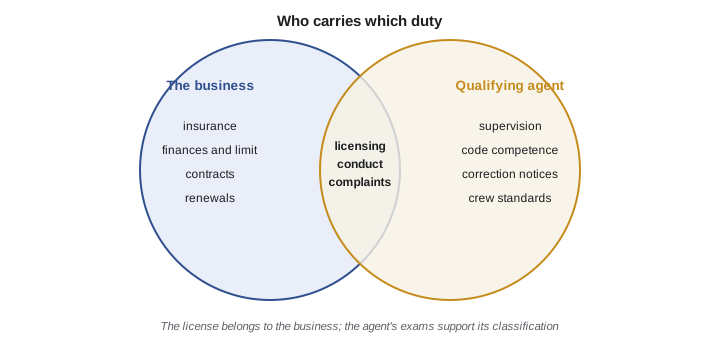
A Tennessee contractor's license belongs to the business, not to the person who passed the exams. The license names the business, its classifications and its monetary limit, and it names the qualifying agent whose exams support each classification. The business is responsible for its contracts, its insurance, its finances and its conduct. The qualifying agent is responsible for the technical competence behind the classification, and the board treats the agent as a person who stands behind the company's work in that classification.
That split has practical effects. If the business closes, the qualifying agent can qualify another business later, because the exams belong to the person. If the qualifying agent leaves, the business keeps its license only if it names a replacement in the way the rules require. And if the business does something that leads to discipline, the board can look at both the business and the agent, depending on who was responsible.
Supervising the work
The qualifying agent's central duty is to see that work in the classification is done competently and to code. The board's rules expect the qualifying agent to be genuinely connected with the business, as an owner, officer or employee, rather than a name rented for the license. Lending a license or qualifying a business you do not actually work for is one of the board's most serious concerns, because it lets an unqualified company bid as if it were qualified.
In practice, supervision means Alicia reviews the scope and code issues of each job before it is priced, makes sure each crew has a competent lead, visits job sites, reviews correction notices and makes sure they are fixed, and steps in on the work that carries the most risk: services, large feeders, hazardous locations and anything energized. She cannot personally inspect every box, but she sets the standards the crews follow and she knows when a job is going wrong.
Supervision also covers the electricians themselves. Inside cities that license electricians locally, the company must use properly licensed workers and register them where required. On state-inspected jobs, the state's credentials apply. A qualifying agent who lets unlicensed workers do work that requires a local license can put both the company's local registration and its state license at risk.
Keeping the license in order
The business must keep its license current, renew it on time, keep its insurance in force and keep the board informed of changes. Changes the board expects to hear about include a change of business name or address, a change in ownership or business structure, and a change of qualifying agent. Some changes, such as a new corporation formed to take over the business, may require a new license rather than an update, because the license belongs to a particular legal entity. Renee keeps a list of these events taped inside the license folder and calls the board before any change in the company's structure.
The monetary limit is also a continuing duty. The business may not bid or contract for a single job above its limit, allowing for the tolerance described in lesson 2. If Duck River wants to bid a larger job, it must request a higher limit first, with updated financial support. Splitting a large job into smaller contracts to stay under a limit, or under the 25,000-dollar threshold for needing a license, is treated as evasion.
| Event | What the business does | Why it matters |
|---|---|---|
| Qualifying agent leaves | Notify the board and name a qualified replacement within the time the rules allow | Without a qualifying agent the classification cannot be supported |
| Business moves | Update the address with the board | Board notices and renewal reminders go to the address on file |
| New corporation or LLC takes over | Ask the board whether a new license is needed | The license belongs to a specific legal entity |
| Job larger than the limit | Request a higher limit before bidding | Bidding above the limit is a violation |
| Insurance lapses | Restore coverage and provide proof | Insurance is a condition of the license |
Bids, contracts and advertising
Tennessee requires contractors to identify their licenses in the places where customers and public owners rely on them. The statute generally requires the license number and related information on bids for public work, and on bids where electrical work is a listed subcontract, the prime contractor's bid typically names the electrical subcontractor and its license information. Advertising by a licensed contractor is expected to show the license number, and the board treats advertising for contracting work without a license as a violation in its own right. Read the current statute and rules for the exact details, because they set out exactly which documents need which information.
On the Memphis warehouse, the general contractor asked Duck River for its license number, classification, expiration date and monetary limit before listing it on the bid to the owner. Renee sends that information on a standard letterhead form so that every general contractor gets the same accurate details. Her form also includes the company's local registration numbers for the cities where it works.
Contracts are the qualifying agent's concern too. A clear written contract with scope, price, payment terms, change order procedure and warranty prevents most disputes, and Tennessee lien law, covered in lesson 9, rewards contractors who keep good written records. Alicia reviews the scope language on every proposal to be sure it describes what the crew will actually install and to what code.
# A pre-bid check Renee runs before any proposal goes out.
license = {"limit": 1_820_000, "classification": "CE", "expires": "2027-06-30",
           "gl_in_force": True}

def prebid(job_value, classification_needed, tolerance=0.10):
    problems = []
    if classification_needed != license["classification"]:
        problems.append("classification not held")
    if job_value > license["limit"] * (1 + tolerance):
        problems.append("over monetary limit")
    if not license["gl_in_force"]:
        problems.append("liability insurance lapsed")
    return problems or ["ok to bid"]

print("Warehouse:", prebid(1_240_000, "CE"))
print("Hospital wing:", prebid(2_300_000, "CE"))
print("HVAC package:", prebid(300_000, "CMC"))Warehouse: ['ok to bid'] Hospital wing: ['over monetary limit'] HVAC package: ['classification not held']
The script catches the two most common licensing mistakes at the bid stage: bidding outside the classification and bidding over the limit. Renee added it after a salesman nearly submitted a mechanical package that Duck River was not licensed to perform.
When the qualifying agent leaves
Carl's retirement is a planned change, which is the easiest kind. The company named Alicia before Carl stepped back, so the license was never without an agent. An unplanned departure, such as a death, a sudden resignation or a qualifying agent who goes to a competitor, is harder. The rules require the business to notify the board and to replace the agent within a set period, and during that period the business should be careful about new bids in the affected classification. A company with only one person who has passed the trade exam is exposed to this risk, which is why some contractors encourage a second employee to pass the exams too.
A qualifying agent who leaves should also notify the board, so the board's records show that the agent no longer stands behind the old company's work. This protects the agent from complaints about work done after they left, and it is a simple letter or form.
Conduct that leads to discipline
The board can investigate complaints, hold hearings, impose civil penalties and suspend or revoke licenses. Conduct that commonly leads to discipline includes contracting above the monetary limit or outside the classification, lending a license, abandoning a job, failing to pay subcontractors or suppliers in a way that harms the owner, misrepresentation in the application or in advertising, and failing to obtain required permits. Contracting without a license at all is a criminal offense under Tennessee law and can also bar recovery in court for the unlicensed work beyond actual documented expenses.
Most complaints start with a customer. A homeowner who feels a job was abandoned or done badly calls the board, the board asks the contractor for a response, and the contractor's records decide how the complaint goes. A prompt, professional response with the contract, the permit, the inspection records and a plan to fix any real problem usually resolves it. Ignoring the board's letter almost never does.
Worked example: an unlicensed subcontractor
Worked problem
Who carries the risk?
A general contractor offers Duck River a 40,000-dollar electrical subcontract on a restaurant, then mentions that it has also hired an unlicensed friend to do 30,000 dollars of electrical work on a second building at the same site. What should Alicia consider?
Show solution
- Electrical subcontracts of 25,000 dollars or more require a contractor's license with the right classification.
- The friend's 30,000-dollar subcontract therefore requires a license the friend does not have.
- Duck River's own subcontract is licensed and within its limit, but working next to unlicensed electrical work invites disputes about whose work caused problems.
- Alicia should document Duck River's scope clearly and may decline if the arrangement puts the company's license at risk.
Answer: Duck River can bid its own subcontract, but it should keep its scope and records separate and should not supervise, pull permits for or lend its license to the unlicensed work.
The example reflects a real pressure. General contractors under schedule stress sometimes ask a licensed subcontractor to pull the permit for work someone else is doing. That request is a request to lend the license, and the answer has to be no.
Records a qualifying agent keeps
Good records are how a qualifying agent shows supervision after the fact. For each job, Duck River's file holds the contract and change orders, the permit, every inspection result and correction notice with the date it was fixed, the names of the crew leads, and any safety incidents. For the company as a whole, Renee keeps the license certificates, insurance certificates, renewal confirmations, local registrations and every letter to or from the board. When a complaint arrives, those files let the company answer in a day instead of a month.
Alicia also keeps a short supervision log: the jobs she visited each week, what she checked and any instructions she gave. It takes ten minutes on a Friday afternoon. If the board ever asks how she supervises work across three jurisdictions, the log answers the question with dates rather than general assurances, and it has already helped her spot a crew that needed more attention before an inspector did.
Common mistakes
MistakeThinking the license belongs to the person who passed the exams.
InsteadThe license belongs to the business; the qualifying agent's exams support its classifications.
MistakePulling permits for work another company performs.
InsteadThat is lending the license and can lead to discipline.
MistakeTreating a structure change as a paperwork detail.
InsteadA new legal entity may need a new license; call the board first.
MistakeIgnoring a complaint letter from the board.
InsteadRespond promptly with the contract, permit and inspection records.
Summary and key terms
- The license belongs to the business; the qualifying agent stands behind the technical competence of each classification.
- The qualifying agent must be genuinely connected with the business and must actually supervise the work.
- The business keeps the license current, stays within its classification and monetary limit, and reports changes to the board.
- Bids, advertising and public work documents generally must identify the license as the statute and rules require.
- When the qualifying agent leaves, the business must notify the board and replace the agent within the time the rules allow.
- License holder
- The business named on the contractor's license.
- Qualifying agent
- The person whose exams support a classification on the license.
- Lending a license
- Allowing another person or company to contract or pull permits under your license.
- Classification
- The type of work the license covers, such as CE for electrical.
- Evasion
- Splitting or disguising contracts to avoid licensing requirements or the monetary limit.
Practice problems
Work each problem on paper first, then reveal the answer to check.
Who owns a Tennessee contractor's license, the business or the qualifying agent?
Show answer
The business.
What should a business do before bidding a job above its monetary limit?
Show answer
Request a higher limit from the board with updated financial support.
Is pulling a permit for another company's work allowed?
Show answer
No. It amounts to lending the license.
What should a departing qualifying agent do?
Show answer
Notify the board that they no longer qualify the business.
Lesson quiz · 5 questions
Score 60% or more to complete this lesson.
Create a free account to save your progress, take quizzes and earn a certificate.