
MELU-317 · Lesson 3 of 12 · 19 min
Applying, approval and booking the exam
▶ Video coming soon A video version of this lesson is on the way.
Carl remembered his own license application as a stack of paper mailed to Nashville and a long wait for an answer. Alicia's will look different. The board now takes most applications online, the testing vendor handles exam registration on its own website, and the order of steps matters more than it used to, because exam scores, financial statements and insurance certificates each have their own expiration clocks. If the steps are done in the wrong order, one of those clocks runs out while the others are still being gathered, and the application stalls.
This lesson follows Alicia through the process: learning the rules, booking and passing the exams, assembling the application, the board's review and the possibility of an interview, and the separate steps for a Limited Licensed Electrician and for a local license. The fees and vendors quoted are those published in 2026; always confirm them on the board's website and in the current candidate bulletin before you pay.
Step one: read the law
The board's own instructions begin with a step that most applicants skip: read the contractor licensing law and the board's rules. The Business and Law exam tests some of that material directly, and the board warns that not knowing the rules can lead to violations that affect the license later. Alicia downloaded the statute and rules from the board's website and spent two evenings reading them with a highlighter, marking the sections on monetary limits, qualifying agents, advertising, and what counts as contracting without a license.
Step two: book the exams
Exams are booked directly with the state's testing vendor, not through the board. For many years that vendor was PSI. The board's current guidance says that starting July 1, 2026, a company called Prov administers the contractor exams, with PSI continuing through September 2026 during the transition. A candidate in late 2026 should check the board's exam page to see which vendor is taking registrations for the exam they need, and should read that vendor's current candidate bulletin, because the two vendors' rules on scheduling, identification and reference books may differ.
PSI's Tennessee bulletin revised in April 2026 lists the Business and Law Management exam and the CE trade exam at 57 dollars each. A candidate can book the two exams for the same day or for separate days. Alicia booked the Business and Law exam first, on a Saturday in February, and the CE exam three weeks later, so that she could focus on one reference set at a time. She brought two forms of identification as the bulletin required, and arrived early enough to have her books inspected before her seat time.
| Exam | Who takes it | Fee in PSI's 2026 bulletin | Notes |
|---|---|---|---|
| Business and Law Management | Every qualifying agent | 57 dollars | Open book, NASCLA Tennessee edition |
| CE Electrical trade exam | Qualifying agent for the CE classification | 57 dollars | Open book, code and safety references listed in the bulletin |
| LLE exam | Individuals applying for a Limited Licensed Electrician license | Check the current bulletin | Booked through the state's testing vendor |
Step three: pass and keep the scores
Scores are reported by the testing vendor, and the board's materials describe exam results as generally valid for two years. That window is the first clock. If Alicia passes in February and March 2026, she has until early 2028 to use the scores, which is plenty of time if the rest of the application is ready. A candidate who passes and then waits a long time to gather financial paperwork can find the scores stale and have to retest.
A candidate who fails can retake the exam, paying the fee again. Neither the board nor PSI's bulletin sets a lifetime limit, but each attempt costs money and time, and a pattern of failures in the same content area is a signal to change the study approach rather than simply rebook. Lesson 12 covers study plans and test-day routines.
Step four: assemble the application
With passing scores in hand, Alicia and Renee assembled the application. For a business that already holds a license and is changing its qualifying agent, the board has a specific process, and Renee confirmed it by phone. For a new license, the application package includes the application form, the 250-dollar nonrefundable application fee, the financial statement or approved alternative, a letter of reference, proof of general liability insurance, proof of workers' compensation coverage or an exemption, the notarized contractor affidavit and the exam score reports. Applications can be filed online through the state's licensing portal, with documents uploaded and fees paid by card.
The second and third clocks are the financial statement and the insurance. The statement must be less than twelve months old when the board reviews it, and the insurance certificates must be in force. Renee schedules the accountant's annual review for the spring, so that a statement dated December 31 is still fresh through the following year, and she calendars the insurance renewal date next to the license renewal date so neither surprises her.
from datetime import date, timedelta

passed_bl = date(2026, 2, 14)    # Business and Law
passed_ce = date(2026, 3, 7)     # CE trade exam
statement = date(2025, 12, 31)   # financial statement date
gl_expires = date(2026, 11, 1)   # liability policy end

def plus_years(d, n):
    return d.replace(year=d.year + n)

score_deadline = min(plus_years(passed_bl, 2), plus_years(passed_ce, 2))
statement_stale = plus_years(statement, 1)
print("Use the exam scores by:", score_deadline)
print("Statement must reach the board before:", statement_stale)
print("Liability policy in force until:", gl_expires)
target = date(2026, 4, 10)
ok = target < statement_stale and target < gl_expires and target < score_deadline
print("Filing on", target, "keeps every clock running:", ok)Use the exam scores by: 2028-02-14 Statement must reach the board before: 2026-12-31 Liability policy in force until: 2026-11-01 Filing on 2026-04-10 keeps every clock running: True
The script shows the planning logic. The earliest of the three deadlines controls the filing date. In Duck River's case, filing in April 2026 keeps every document current, with room to spare if the board asks for something more.
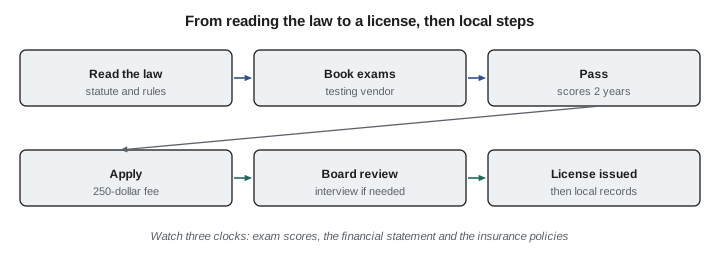
Step five: board review and interviews
Board staff review the application for completeness. Most clean applications are approved without the applicant ever meeting the board. If something is incomplete or not in order, or if the affidavit discloses complaints, convictions or past unlicensed work, the applicant can be asked to appear for an interview at a regularly scheduled board meeting. The board describes these interviews as informal, typically up to thirty minutes, and warns that the wait at a meeting can exceed an hour. An applicant who is called in should bring copies of everything filed, a clear explanation of any disclosed issue, and patience.
Alicia's application had nothing that would trigger an interview, but Hector Ruiz, Duck River's estimator, remembered a competitor who had bid a 30,000-dollar subcontract years ago before getting licensed and had to explain it to the board when he finally applied. The lesson he took from it was simple: answer the affidavit questions truthfully, because the board can learn the answer from other records, and an honest explanation goes much better than a discovered omission.
Step six: after the license issues
Once the board updates the license to show Alicia as the qualifying agent for CE, Duck River's license certificate and the online license record show the change. The company still has to update any local registrations that list the qualifying agent or supervising electrician. Metro Nashville and the Memphis and Shelby County codes office each keep their own records, and a local registration that still names Carl after he retires could cause a permit to be refused.
The LLE process
The Limited Licensed Electrician has a shorter path. The board's LLE page lists the steps as reviewing the law, passing the LLE exam through the testing vendor, applying online with the scanned score report and a photo identification, and paying the two-year license fee of 50 dollars. The board asks applicants to allow five to seven business days for processing and to verify the license through the state's license search before starting work. Duck River does not need LLEs because it holds CE, but its newest apprentice, Jaylen Price, asked about it for side work, and Alicia explained that an LLE would not let him work inside Nashville, where Metro's own rules apply.
Local licenses
Local licensing runs on its own schedule. Metro Nashville's 2022 electrical exam application, for example, listed its license classes, required approval before the exam, used Prov as its exam vendor, set a passing grade of 70 and required a thirty-day wait before reapplying after a failure. Other cities use other vendors or their own tests. Start local applications early, because a local board's approval step can take weeks and the local exam may be offered only at certain times.
Worked example: a clock that runs out
Worked problem
Scores against the calendar
Jaylen's cousin, Marcus, passed the Business and Law exam on March 3, 2025 and the CE exam on October 20, 2025, but his company's financial statement is dated June 30, 2024 and the accountant cannot finish a new one until August 2026. If exam scores are treated as valid for two years and statements must be less than twelve months old, what is the latest safe filing date and what must change first?
Show solution
- The earlier exam score, from March 3, 2025, is usable until about March 3, 2027.
- The June 30, 2024 statement went stale on June 30, 2025, so it cannot be used now.
- The new statement will be dated in August 2026 and stays fresh until August 2027.
- The controlling deadline after the new statement is the March 2027 score date.
Answer: Marcus should file as soon as the new statement is ready in August 2026, well before March 2027, so that a request for more information does not push the review past the score date.
Marcus's case is common. Candidates often study and pass first, because the exams feel like the hard part, and only then discover that the financial paperwork takes months. Planning backward from the earliest clock avoids that trap: ask the accountant when a statement can be ready, then book the exams so the scores land shortly before it.
Common reasons applications stall
The board's staff return incomplete applications rather than approving them partly. The most frequent problems are easy to avoid. A reference letter from a relative is not accepted. An affidavit left unsigned or not notarized cannot be processed. Insurance certificates that name the wrong entity, for instance the owner personally rather than the company, do not prove coverage for the applicant. A business name on the application that does not match the name registered with the Secretary of State causes questions. And a financial statement prepared by the owner rather than by an independent accountant does not meet the requirement for most limits.
Renee built a one-page checklist of these items and checks each document against it before uploading. She also saves the confirmation page from the online portal and a copy of every uploaded file in the company's license folder, so that if the board asks about a document months later, she can see exactly what was sent.
Common mistakes
MistakeBooking exams through the board's office.
InsteadExams are booked directly with the state's testing vendor, which in 2026 is moving from PSI to Prov.
MistakeWaiting so long after passing that the scores go stale.
InsteadThe board treats exam scores as generally valid for two years; file well inside that window.
MistakeFiling with a financial statement that will be more than a year old when reviewed.
InsteadTime the accountant's review so the statement stays current through the filing and review.
MistakeForgetting local registrations after a qualifying agent change.
InsteadUpdate each city or county record that lists the agent or supervising electrician.
Summary and key terms
- Read the licensing law and rules first; the board warns that ignorance of them can lead to violations.
- Book the Business and Law and CE exams directly with the testing vendor; Prov took over from PSI starting July 1, 2026, with PSI continuing through September.
- Exam scores are generally valid for two years, financial statements must be less than twelve months old, and insurance must be in force.
- Applications go to the board with a 250-dollar fee and supporting documents; some applicants are interviewed at a board meeting.
- LLE applicants pass the LLE exam, apply online and pay a 50-dollar two-year fee; local licenses follow their own process.
- Candidate information bulletin
- The testing vendor's document describing exams, references, fees and test-day rules.
- Score validity
- The period during which a passing exam score can be used for an application.
- Board interview
- An informal meeting with the board, typically up to thirty minutes, for applications with open questions.
- Change of qualifying agent
- The process for naming a new qualifying agent on an existing license.
- License search
- The state's online lookup for verifying licenses.
Practice problems
Work each problem on paper first, then reveal the answer to check.
Who takes registrations for Tennessee contractor exams in late 2026?
Show answer
The state's testing vendor: Prov from July 1, 2026, with PSI continuing through September during the transition; check the board's exam page.
What is the nonrefundable application fee for a new contractor's license?
Show answer
250 dollars.
How long does the board describe exam scores as generally valid?
Show answer
Two years.
What fee comes with an LLE application?
Show answer
A two-year license fee of 50 dollars.
Lesson quiz · 5 questions
Score 60% or more to complete this lesson.
Create a free account to save your progress, take quizzes and earn a certificate.