
MELU-317 · Lesson 11 of 12 · 19 min
Renewal and continuing education
▶ Video coming soon A video version of this lesson is on the way.
Carl's license history included one bad month. In 2011, during a busy summer, the renewal notice went to an old post office box, nobody in the office noticed the date and Duck River's license expired. The company found out when a general contractor's office manager ran a license search before signing a subcontract. Renewal took a few days and a late fee, but Duck River lost the subcontract, and Carl never forgot the feeling of explaining to a customer that his license had lapsed. Since then, renewal has been on the office calendar in three places.
This lesson covers keeping a license alive once it exists: the two-year renewal of the contractor's license, what the renewal requires, what happens if it lapses, renewal of the Limited Licensed Electrician license, local license renewals and continuing education. The fees and periods below come from the board's published materials, some of them older, and the board updates fees by rule, so check the current amounts on the board's website at each renewal.
The two-year renewal
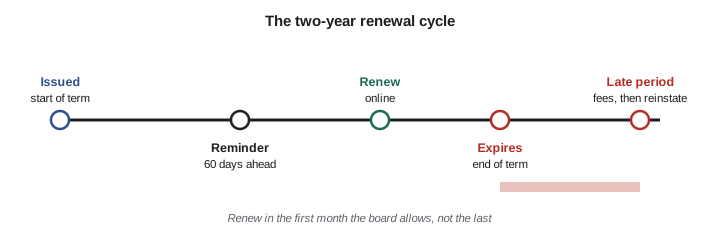
A Tennessee contractor's license is issued for two years and renewed before its expiration date. The board sends a renewal notice to the address on file, which is one reason to keep that address current, but the license holder is responsible for renewing whether or not the notice arrives. Renewal can be done online through the state's licensing portal. The board's older licensing booklet listed a renewal fee of 200 dollars for two years; confirm the current fee before paying.
Renewal is not only a fee. The license holder confirms its information, provides current proof of general liability and workers' compensation coverage or exemption, and answers questions about complaints, judgments and other events since the last renewal. If the business wants to keep a monetary limit that depends on financial information, the board may ask for current financial support. Changes such as a new qualifying agent or a new address should be reported when they happen, not saved for renewal.
If the license lapses
A license that is not renewed by its expiration date expires, and the business may not contract in the expired classification until it is renewed or reinstated. The board's older booklet described a late fee of 20 dollars a month after expiration, renewal rights for twelve months, and reinstatement with a 250-dollar fee after that; the current rules may differ, so confirm before relying on these numbers. A license that stays expired past the renewal period may require a new application and possibly new exams.
Contracting while the license is expired is treated like contracting without a license. Bids submitted during the lapse can be challenged, and a general contractor or owner who checks the license search will see the expired status. For a qualifying agent, a lapse also raises questions about how carefully the business is managed, which is not the impression anyone wants to give the board.
| Event | Contractor's license, from the board's older booklet | LLE license, from the board's LLE page |
|---|---|---|
| Renewal period | Every two years | Every two years |
| Renewal fee | 200 dollars | 50 dollars |
| Grace period | Late fees after expiration | No grace period |
| Late renewal window | Renewal rights for twelve months, with a monthly late fee | Renewal rights within 90 days |
| Reinstatement | 250 dollars after the renewal window | 80 dollars, a 50-dollar fee plus a 30-dollar penalty |
Renewing the LLE
The Limited Licensed Electrician license also runs for two years, with a 50-dollar fee. The board's LLE page states that there is no grace period, that renewal rights last for ninety days after expiration and that a license renewed within that window is reinstated for 80 dollars, the 50-dollar fee plus a 30-dollar penalty. After the ninety days, the holder must reapply. An LLE who works on an expired license is doing electrical work without the required license, so LLE holders should renew before expiration rather than counting on the reinstatement window.
from datetime import date, timedelta

def lle_status(expires, today):
    if today <= expires:
        return "active: renew for 50 dollars before expiration"
    if today <= expires + timedelta(days=90):
        return "expired: reinstate for 80 dollars within the 90-day window"
    return "renewal rights lost: reapply"

expires = date(2026, 9, 30)
for day in [date(2026, 9, 1), date(2026, 11, 15), date(2027, 1, 10)]:
print(day, "->", lle_status(expires, day))2026-09-01 -> active: renew for 50 dollars before expiration 2026-11-15 -> expired: reinstate for 80 dollars within the 90-day window 2027-01-10 -> renewal rights lost: reapply
Continuing education
Many states require licensed electricians and contractors to complete continuing education hours to renew. Tennessee's state contractor's license has generally been renewed without a continuing education requirement for the qualifying agent, and the board's renewal materials focus on fees, insurance and the business's information. Rules change, however, and the board can adopt education requirements by rule or the legislature can add them, so check the current renewal instructions rather than relying on that general statement.
Local programs are a different matter. Some Tennessee cities that license electricians locally require continuing education to renew local licenses, often tied to the code cycle, and they set their own hours, approved providers and reporting methods. If you hold a local license, read the local board's renewal requirements well before your renewal date, because a course offered only a few times a year can be hard to find at the last minute.
Even without a requirement, continuing education is a qualifying agent's responsibility in practice. The code changes every three years nationally, local adoptions change on their own schedules, safety practices evolve, and lien and contract law shift with new legislation and court decisions. Alicia plans a code update class for herself and the foremen whenever a city where Duck River works adopts a new edition, and an NFPA 70E refresher for the crews on a regular cycle. Those classes cost far less than one failed inspection or one injury.
Local renewals
Local licenses and registrations follow their own calendars. The Memphis and Shelby County codes office's contractor registration is annual. Metro Nashville's local licenses have their own renewal periods and requirements. Business licenses from cities and counties renew on yet other schedules. Renee's renewal calendar lists every credential with its expiration date, the office that issues it, the fee last paid and the documents needed, and the reminders go out sixty days ahead so there is time to gather insurance certificates and complete any required classes.
A useful check is to run the state's license search and each city's license lookup on Duck River's own name every quarter. It takes five minutes and shows exactly what customers see. If a record is wrong, such as an old qualifying agent still listed or an expired insurance certificate on file, the quarterly check catches it before a customer does.
Worked example: a lapse discovered late
Worked problem
Renewing after the date
A competitor's license expired on June 30. Its office manager discovers the lapse on September 12 while preparing a bid. Using the older booklet's terms of a 20-dollar monthly late fee and twelve months of renewal rights, what should the company do?
Show solution
- September 12 is within twelve months of June 30, so renewal rights remain.
- The license has been expired for part of July, August and September, so late fees apply for those months under the older terms.
- The company should stop bidding in the classification until the license is renewed.
- It should renew immediately, confirm the current fees with the board and check that any bids made during the lapse are handled properly.
Answer: The company can renew with late fees and should not contract until the renewal is processed. It should also review any bids or contracts made while the license was expired.
The cheapest fix is the one Carl adopted after 2011: put the expiration date on the calendar in several places and renew in the first month the board allows, not the last.
Keeping the qualifying agent current
Renewal also gives the business a moment to check its qualifying agent arrangements. Is the qualifying agent still active in the business? Is there a second person who has passed the trade exam or could, in case the agent leaves? Are local licenses in the agent's name current? Duck River uses the renewal month each cycle for that review, and Alicia uses it to decide which classes she and the foremen need in the next two years.
A renewal calendar that works
A renewal calendar is only useful if it is complete and someone owns it. Duck River's calendar lists the state contractor's license, each local license and registration, each business license, the corporate annual report with the Secretary of State, each insurance policy, the surety's annual review, every employee's local license if the company relies on it and the training cycles for NFPA 70E. For each, it shows the expiration date, the issuing office, the renewal method, the fee last paid, the documents needed and the person responsible. Reminders go to two people so that one absence does not cause a lapse.
Renee reviews the calendar on the first business day of each month. Items due in the next sixty days get a folder on her desk with the forms and documents gathered in advance. When a renewal is filed, she saves the confirmation and updates the next expiration date the same day, rather than waiting for the new certificate to arrive.
The calendar also catches dependencies. A local registration may require a current state license and current insurance certificates, so if the insurance renews in May and the local registration in June, the new certificates must be issued before the registration can be filed. Mapping those dependencies once saves a scramble every year.
Changes between renewals
Some changes cannot wait for the next renewal. A new qualifying agent, a new business address, a change in ownership or legal structure, a lapse in insurance and a request for a higher monetary limit all need attention when they happen. Treating renewal as the only time to update the board leads to records that are wrong for most of the two-year term. Alicia and Renee agreed that any change on the list triggers a call to the board within a week, followed by whatever form the board requires.
The same rule applies to local records. If an electrician whose local license Duck River relies on leaves the company, the local office may need to know, and permits that depended on that person's license may need to be reassigned. A short checklist used whenever someone joins or leaves the company keeps those records accurate.
What the renewal does not change
Renewal keeps the existing license, classification and monetary limit in force; it does not add anything. A business that wants a new classification, such as adding a mechanical classification to its CE license, applies for it separately, and the new classification needs a qualifying agent who has passed that trade exam. A business that wants a higher monetary limit requests it with financial support. Renee keeps these requests separate from the renewal itself, so that a question about a new classification or limit does not delay the renewal of the license the company already depends on.
Renewal also does not cure past problems. If the business contracted above its limit or without a required local registration during the term, renewing on time does not erase that conduct, and the renewal questions about complaints and judgments are there so the board can see it. Honest answers on the renewal, like honest answers on the original affidavit, are the only safe approach.
Common mistakes
MistakeRelying on the board's renewal notice to arrive.
InsteadThe license holder must renew whether or not the notice arrives; calendar the date.
MistakeAssuming an LLE has a grace period.
InsteadThe board's LLE page states there is no grace period; reinstatement is possible within 90 days.
MistakeAssuming no state CE requirement means no local requirement.
InsteadLocal licensing programs may require continuing education for local license renewal.
MistakeContracting while the license is expired.
InsteadStop bidding and contracting in the classification until the renewal is processed.
Summary and key terms
- The contractor's license renews every two years; the board's older booklet listed a 200-dollar renewal fee.
- The older booklet described monthly late fees, twelve months of renewal rights and a 250-dollar reinstatement; confirm current terms.
- The LLE renews every two years for 50 dollars, with no grace period and reinstatement for 80 dollars within 90 days.
- The state contractor's license has generally been renewed without a continuing education requirement; local licenses may require it.
- Keep a renewal calendar for every state and local credential and check the license lookups quarterly.
- Renewal
- Extending a license for another period before it expires.
- Reinstatement
- Restoring an expired license within the period the rules allow, usually with a penalty.
- Grace period
- A period after expiration during which a license remains valid; the LLE has none.
- Continuing education
- Courses required to renew some licenses.
- Renewal rights
- The period after expiration during which a license can still be renewed rather than reapplied for.
Practice problems
Work each problem on paper first, then reveal the answer to check.
How often does a Tennessee contractor's license renew?
Show answer
Every two years.
What does the board's LLE page say about a grace period?
Show answer
There is no grace period.
What does it cost to reinstate an LLE within 90 days of expiration?
Show answer
80 dollars, the 50-dollar fee plus a 30-dollar penalty.
Where might a Tennessee electrician face a continuing education requirement?
Show answer
In a local licensing program that requires it for local license renewal.
Lesson quiz · 5 questions
Score 60% or more to complete this lesson.
Create a free account to save your progress, take quizzes and earn a certificate.