
MELU-317 · Lesson 12 of 12 · 27 min
Practice exam review and test-day strategy
▶ Video coming soon A video version of this lesson is on the way.
Eight weeks before her Business and Law exam, Alicia took her first full practice test under timed conditions at the kitchen table, with the NASCLA guide tabbed and a timer on the counter. She scored 64. Two weeks later, after changing how she studied, she scored 78, and on test day she passed comfortably. The difference was not more hours. It was looking at what her wrong answers had in common and fixing that, instead of simply reading the books again.
This final lesson brings the course together. It describes how to build a study plan from the bulletin, how to use practice exams to find weak areas, how to review wrong answers, a set of worked review questions across the course, and a routine for test day. The course exam that follows uses the same mix of question types you have seen in the lesson quizzes.
Building the plan from the bulletin
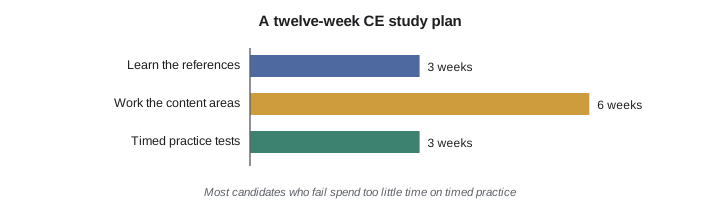
Start with the candidate bulletin for your exam date, because it tells you the number of questions, the time, the passing score, the content areas and the references. Divide the weeks you have into three phases. In the first phase, tab and learn your way around each reference. In the second, work through the content areas, weighting your time by the number of questions in each area and by how weak you are in it. In the third, take full timed practice tests and review them carefully. Most candidates who fail spend too much time in the second phase and too little in the third.
Alicia gave herself twelve weeks for the CE exam: three for the references, six for the content areas and three for timed practice. She scheduled study sessions on four weekday evenings and one weekend morning, and she kept a log of what she studied and how long. When the log showed she had spent twice as long on grounding as on motors, she rebalanced, because the bulletin weighted the two areas similarly.
Using practice tests
A practice test is useful only if it is taken under conditions like the real one: timed, with only the allowed references, without stopping to look things up outside those books. Afterwards, the score is the least important result. What matters is the pattern in the wrong answers. Sort each missed question into one of four groups: did not know the rule, could not find it in time, found the wrong rule, or misread the question. Each group has a different fix.
If you did not know the rule, study the topic. If you could not find it, improve your tabs and practice the index. If you found the wrong rule, slow down and check the conditions in the question against the scope of the section you found. If you misread the question, practice reading for the words that change the answer. Alicia's first practice test showed that most of her misses were in the second and fourth groups, which is why changing her study method raised her score so quickly.
# Sorting missed practice questions to decide what to fix.
missed = ["find", "misread", "find", "rule", "find", "misread", "wrong rule",
          "find", "misread", "rule", "find", "misread", "find"]
fixes = {
    "rule": "study the topic",
    "find": "improve tabs and index practice",
    "wrong rule": "check the question's conditions against the section scope",
    "misread": "practice reading for the words that change the answer",
}
counts = {k: missed.count(k) for k in fixes}
for cause, n in sorted(counts.items(), key=lambda kv: -kv[1]):
    print(f"{cause:10} {n:2}  -> {fixes[cause]}")
print("Score:", 50 - len(missed), "of 50")find 6 -> improve tabs and index practice misread 4 -> practice reading for the words that change the answer rule 2 -> study the topic wrong rule 1 -> check the question's conditions against the section scope Score: 37 of 50
The output shows Alicia's first practice test: thirteen misses on a fifty-question test, more than half of them from not finding the answer in time or misreading the question. Neither problem would have been fixed by reading the guide again.
Review questions across the course
The following worked questions draw on the whole course. Try each before reading the steps.
Worked problem
Licensing threshold
A business plans to bid an electrical subcontract worth 24,500 dollars and another, on a different building for the same owner, worth 18,000 dollars. Does it need a contractor's license?
Show solution
- The threshold for a contractor's license is 25,000 dollars or more for a project.
- Each subcontract is below that, and they are separate buildings with separate scopes.
- If the two were really one project split to stay under the threshold, the split would be evasion.
Answer: Not if they are genuinely separate projects, but the business must not split one project to avoid the threshold. For work under 25,000 dollars on state-inspected jobs, an LLE or CE license is needed for the electrical work itself.
Worked problem
Monetary limit
A company's working capital is 90,000 dollars and its net worth is 140,000 dollars. What monetary limit does its financial statement support?
Show solution
- The limit is ten times the lesser of working capital and net worth.
- The lesser figure is 90,000 dollars.
- Ten times 90,000 dollars is 900,000 dollars.
Answer: 900,000 dollars, before any tolerance the board allows on bids.
Worked problem
Inspection authority
A job is in a small town that appears on the State Fire Marshal's current list of authorized municipal programs. Who issues the permit?
Show solution
- Authorized programs issue permits and inspect inside their jurisdictions.
- The State Fire Marshal's Office does not inspect there except on state property.
Answer: The town's codes office issues the permit and inspects, using the code edition the town has adopted.
Worked problem
Liens
Duck River, a subcontractor, was not paid for work in July. By what date must it serve a notice of nonpayment?
Show solution
- The last day of July is July 31.
- The statute allows ninety days after the last day of the month.
- Ninety days after July 31 is October 29.
Answer: By October 29, counting as the statute directs; confirm the counting rule before relying on the exact date.
Worked problem
Safety reporting
An employee is admitted to a hospital overnight after a fall at 4 in the afternoon on a Wednesday, and the employer learns of it at 6 that evening. When is the report due?
Show solution
- Inpatient hospitalizations are reported within twenty-four hours.
- The clock starts when the employer learns of the event.
Answer: By 6 in the evening on Thursday.
Test-day routine
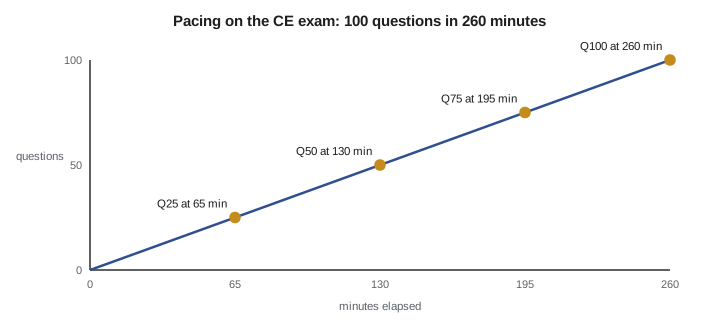
A routine keeps nerves from making decisions. The night before, pack the approved references, two forms of identification as the bulletin requires, the admission or confirmation details and an approved calculator, and check the route and parking. On the day, arrive early enough for check-in and the book inspection. Once seated, take a minute to write the pacing checkpoints on the scratch material the center provides, if the rules allow it.
During the exam, make a first pass answering every question you can do quickly and flagging the slow ones. Never leave a question blank, because there is generally no penalty for a wrong answer. On the second pass, work the flagged questions in order of how quickly you think you can solve them. In the last ten minutes, make sure every question has an answer. Change an answer only when you find a specific reason, such as a rule you misread the first time, not because of a vague feeling.
After the exam
Score reports are usually given at the test center or shortly after. A candidate who passes keeps the report and files the application within the score validity window described in lesson 3. A candidate who does not pass gets a report showing performance by content area, which is the best study guide for the next attempt. Rebook only after reviewing that report and adjusting the plan; rebooking for the next available date without changing anything tends to produce the same result.
Whatever the outcome, the exams are a step, not the finish. The qualifying agent's real work, as lesson 7 described, starts when the license issues: supervising the work, keeping the license in order and staying current with the code and the law. Alicia framed her passing score report and hung it next to the license in the office. Then she went back to the job board, because three permits were waiting.
Checklist before you book
Before booking either exam, confirm the vendor and its current bulletin, confirm the reference editions and buy them, plan the twelve weeks, schedule two or three full practice tests, and coordinate the exam dates with the financial statement and insurance dates so that the clocks from lesson 3 line up. If you are also seeking a local license, find out whether the local exam uses the same references and whether it can be scheduled near the state exams while the material is fresh.
A final practical point concerns the business side. While the qualifying agent studies, someone else has to run the crews and answer the phones. Carl took over two of Alicia's jobs for the twelve weeks, and Hector covered estimating for her. A business that plans for that load gives its candidate a fair chance to pass on the first attempt, which is cheaper for everyone.
Practicing the Business and Law questions
The Business and Law exam rewards a slightly different kind of practice. Many of its questions are short scenarios about payroll, taxes, contracts, liens, licensing or project management, and the answer usually turns on one or two words in the scenario. Practice by reading each question once for the situation and once for the specific ask, then finding the chapter in the NASCLA guide that covers it. For calculation questions, such as payroll withholding, depreciation, markup or financial ratios, work the guide's own examples until the steps are automatic, because the exam uses the same methods.
Alicia found the Tennessee chapters especially worth extra time. Questions about the licensing threshold, monetary limits, the prime and remote contractor lien rules and the board's disciplinary powers come straight from Tennessee law, and they are easier points than many general business questions if the candidate knows where those chapters are. She made a one-page index of the Tennessee topics in her study notebook, not in the book, and practiced finding each one in under a minute.
Group study can help too. Two of Duck River's foremen were preparing for local exams at the same time, and the three of them met on Saturday mornings to quiz each other. Explaining a lien deadline or a pacing plan out loud is a fast way to find out whether you actually understand it.
Finally, take care of the basics in the last week. Stop learning new material two or three days before the exam and spend that time on light review of your tabs and your notes on common mistakes. Sleep normally, eat before the exam and bring water if the center allows it. Candidates who cram until midnight before an open-book exam often lose more to fatigue than they gain from the extra hours, because the exam rewards careful reading and quick navigation more than last-minute memorizing.
Alicia's last evening before the CE exam was a short walk through her tabs, a review of her list of words that change the answer and an early night. She drove to the test center with the books in a bag, the identification in her pocket and the pacing checkpoints in her head.
Common mistakes
MistakeReading the references again after a poor practice score.
InsteadSort the missed questions by cause and fix the cause.
MistakeTaking practice tests without time limits or with extra books.
InsteadPractice under exam conditions so the score means something.
MistakeLeaving questions blank.
InsteadAnswer every question; there is generally no penalty for guessing.
MistakeRebooking immediately after a failed attempt without changing the plan.
InsteadUse the score report's content area results to adjust the plan first.
Summary and key terms
- Build the study plan from the current bulletin's content areas, references and format.
- Spend real time on timed practice tests and review the pattern of missed questions.
- Sort misses into not knowing the rule, not finding it, finding the wrong rule and misreading the question.
- On test day, make a fast first pass, flag slow questions, answer every question and change answers only for a specific reason.
- After passing, file within the score validity window; after failing, use the content area report to adjust the plan.
- Study log
- A record of topics studied and time spent, used to rebalance a plan.
- Timed practice test
- A full practice exam taken under real time limits with only the allowed references.
- Flagging
- Marking a question to return to after the first pass.
- Content area report
- A score report showing performance by exam topic.
- First pass
- The initial run through the exam answering the quick questions.
Practice problems
Work each problem on paper first, then reveal the answer to check.
What are the three phases of the study plan in this lesson?
Show answer
Learning the references, working the content areas and timed practice.
Name the four causes for sorting missed questions.
Show answer
Did not know the rule, could not find it, found the wrong rule, misread the question.
Should a candidate leave a hard question blank?
Show answer
No. Answer every question; there is generally no penalty for guessing.
What should a candidate do with a failing score report?
Show answer
Use its content area results to adjust the study plan before rebooking.
Lesson quiz · 5 questions
Score 60% or more to complete this lesson.
Create a free account to save your progress, take quizzes and earn a certificate.